
3.06.2026
NASA Invites Media to See Roman Space Telescope Arrive at Kennedy
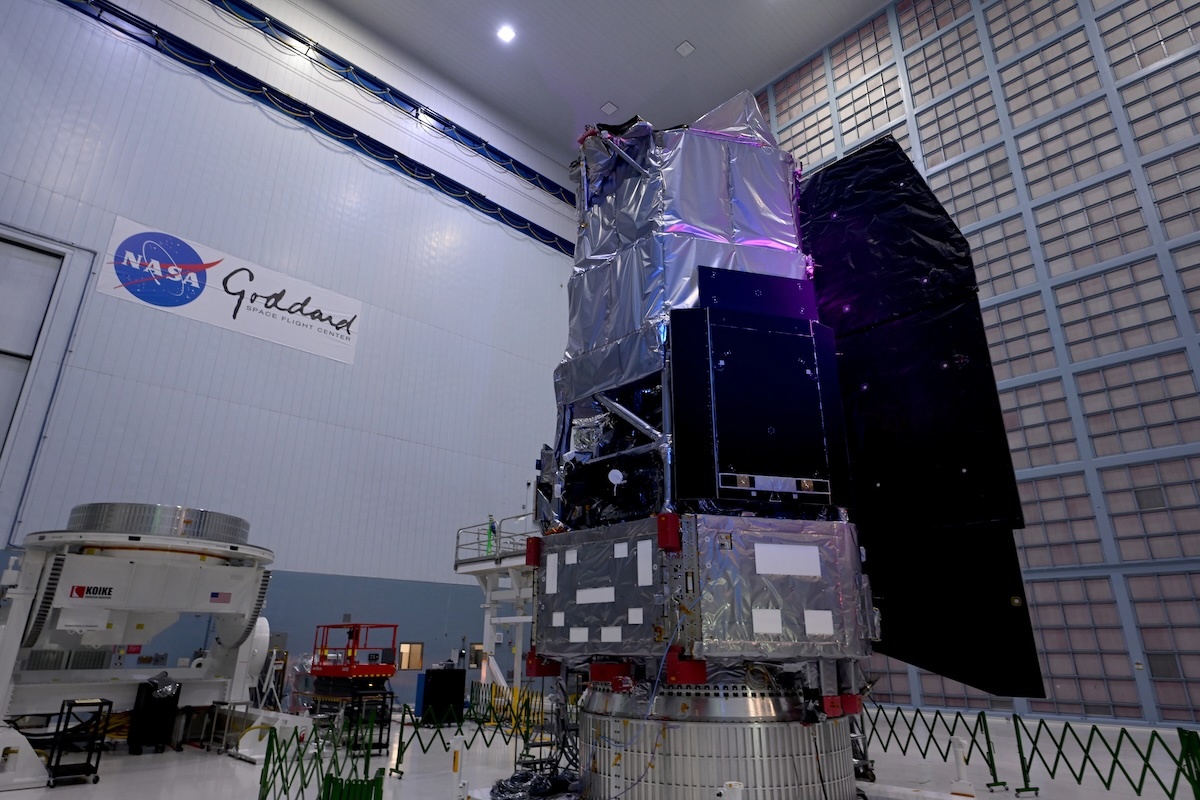
Registration is open for media to cover the arrival of NASA’s Nancy Grace Roman Space Telescope at the agency’s Kennedy Space Center in Florida in the coming weeks.
The observatory will arrive aboard NASA’s Pegasus barge from NASA’s Goddard Space Flight Center in Greenbelt, Maryland, where teams completed its construction, assembly, and testing. Credentialed media will be able to witness the arrival and unloading of the space telescope in its transport container at NASA Kennedy’s turn basin. From there, technicians will move the telescope to the center’s Payload Hazardous Servicing Facility for launch processing.
NASA subject matter experts will be available on site to answer questions about the arrival.
Media interested in participating must apply for credentials at:
To receive credentials, media must apply by 11:59 p.m. EDT on Thursday, June 4. This opportunity is open to U.S. citizens only.
Once approved, credentialed media will receive a confirmation email. Additional information, including the specific date of arrival activities, will follow. NASA’s media accreditation policy is available online. For questions about accreditation, please email ksc-media-accreditat@mail.nasa.gov. For other questions, please contact Kennedy’s newsroom at: 321-867-2468.
Named after NASA’s first chief astronomer, the Nancy Grace Roman Space Telescope will have a deep, panoramic view of the cosmos, generating never-before-seen pictures that will revolutionize our understanding of the universe. The observatory will usher in a new era of cosmic surveys, unveiling troves of celestial objects, and shedding light on some of the universe’s most profound mysteries, including phenomena we can’t see. Roman also will showcase a test of the most advanced technology ever flown in space to directly image planets around nearby stars, a key step in NASA’s search for life on other worlds.
The Roman telescope is managed at NASA Goddard with participation by NASA’s Jet Propulsion Laboratory in Southern California; Caltech/IPAC in Pasadena, California; the Space Telescope Science Institute in Baltimore; and a science team of scientists from various research institutions. The primary industrial partners are BAE Systems Inc., L3Harris Technologies, and Teledyne Scientific & Imaging. Contributions to Roman also are made by ESA (European Space Agency), JAXA (Japan Aerospace Exploration Agency), the French space agency CNES (Centre National d’Études Spatiales), and the Max Planck Institute for Astronomy in Germany.
The agency’s Launch Services Program, based at NASA Kennedy, manages the launch service for the Roman Space Telescope, which will lift off as soon as early September on a SpaceX Falcon Heavy rocket from Launch Complex 39A.
Quelle: NASA
----
Update: 23.06.2026
.
Nancy Grace Roman Space Telescope
The Nancy Grace Roman Space Telescope blog is NASA's hub for the mission's launch updates, where all are invited for behind-the-scenes looks on Roman's road to launch and beyond. This flagship mission’s vast, deep surveys will help astronomers explore dark matter, dark energy, exoplanets, and almost anything from our own solar system to galaxies at the edge of the observable universe. Follow along to join in on the excitement!
NASA’s Next Generation Telescope Arrives in Florida Ahead of Launch
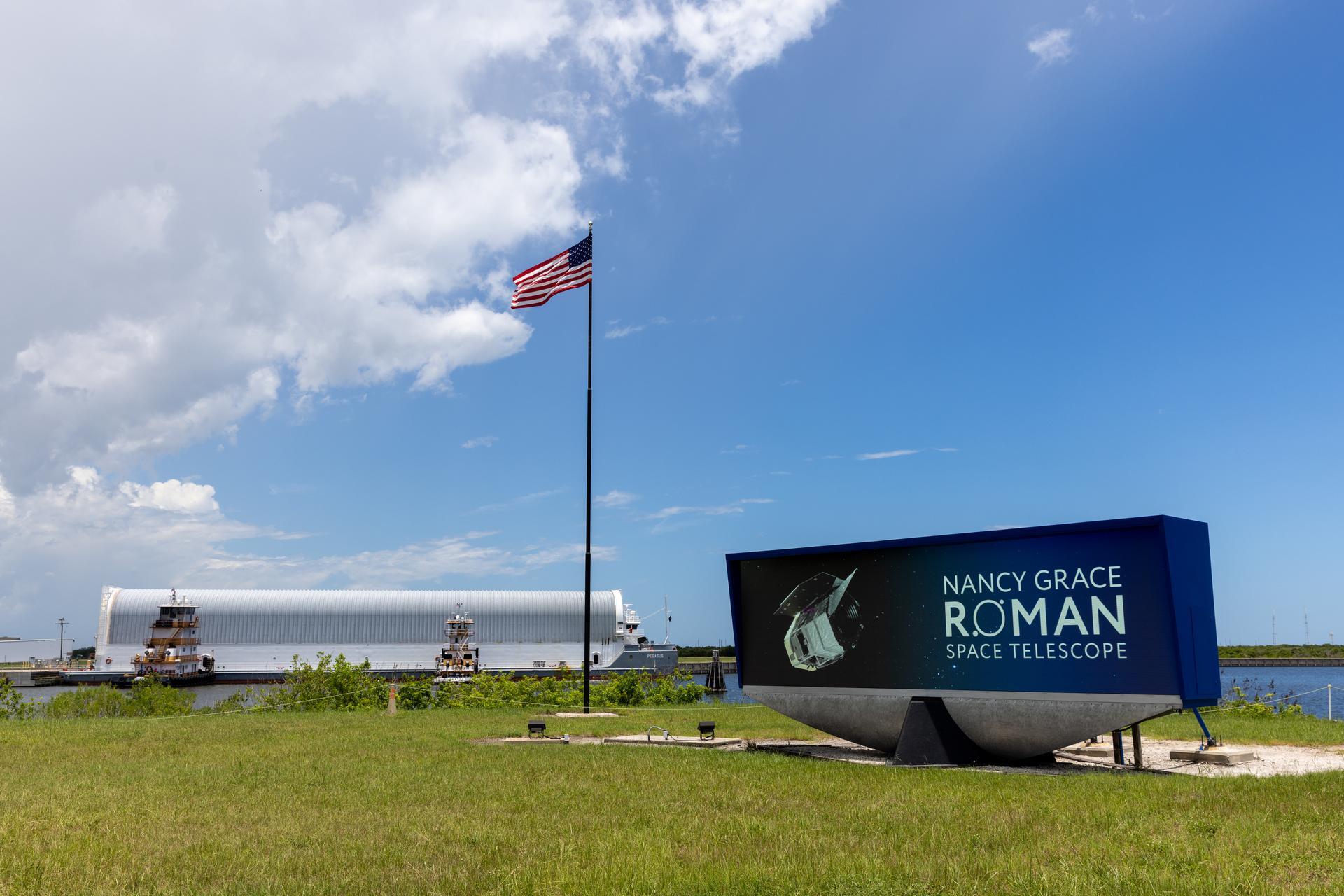
NASA’s Nancy Grace Roman Space Telescope arrived June 21, at the agency’s Kennedy Space Center in Florida, marking the start of final prelaunch preparations before liftoff later this summer.
After teams completed integration and testing on the observatory at NASA’s Goddard Space Flight Center in Greenbelt, Maryland, they loaded Roman into a protective and environmentally controlled transportation container and drove it to the port of Baltimore. There, the agency’s Pegasus barge safely transported the nearly 18,000-pound (8,200-kilogram) spacecraft down the coast of the Atlantic Ocean to its new home in Florida at the Payload Hazardous Servicing Facility, which recently completed upgrades to prepare for Roman’s arrival.
Technicians met the telescope at NASA Kennedy’s turn basin wharf and offloaded the trailer carrying the observatory from the barge where they connected it to a truck that transported Roman to the servicing facility.
When the spacecraft arrives at the facility, technicians will complete initial cleaning outside the building before moving the shipping container into the facility’s air lock. Once in the air lock, they will perform additional cleaning to reduce any remaining contaminants from the trip. The facility’s air filtration system also will scrub the air until the team can safely open the inner door. Once inside, technicians will unbox the spacecraft, raise it to a vertical position in the air lock, and move it into the clean room.
On Monday, June 22, technicians plan to remove the cover from the transport container and move Roman into the high bay. Later technicians will use large cranes to move Roman to its work platform, called the Pantheon. During the observatory’s time at the processing facility, technicians will perform several tasks, including testing the six solar panels and inspecting Roman’s insulation and thermal blankets to ensure the observatory is fully protected and flight ready. Specially trained team members will load about 290 gallons of hydrazine fuel into the spacecraft’s tanks.
NASA is targeting launch no earlier than Sunday, Aug. 30, on a SpaceX Falcon Heavy rocket from Launch Complex 39A at Kennedy. This puts Roman eight months ahead of schedule.
After launch, Roman will travel to the second Sun-Earth Lagrange point, or L2. There, it will make observations that give astronomers the chance to study an incredible number of new objects. Roman’s wide field of view and rapid survey capabilities will reveal billions of galaxies, hundreds of thousands of new exoplanets, hundreds of blackholes, and will provide vast volumes of daily data for astronomers to study.
The observatory also will map how common different kinds of planets are in our galaxy and help answer big questions about the universe, like what’s causing its rapid expansion and what distant worlds and cosmic objects look like in infrared light. In addition to its main instrument, which features a 300-megapixel camera, Roman will demonstrate technology designed to block starlight to directly image exoplanets and planet-forming disks.
Alongside Roman, the Pegasus barge also carried a weather cover for the Artemis III SLS (Space Launch System) core stage. The cover will protect the stage thermal systems while it sits at Launch Pad 39B in its short stack configuration. Because schedules aligned, the barge was able to transport NASA’s next flagship astrophysics mission together with the Artemis hardware, maximizing resources to support missions across the agency during the Golden Age of innovation and exploration.
Quelle: NASA
----
Update: 8.07.2026
.
Telescope Milestone: NASA’s Roman Moves Vertical Ahead of Processing
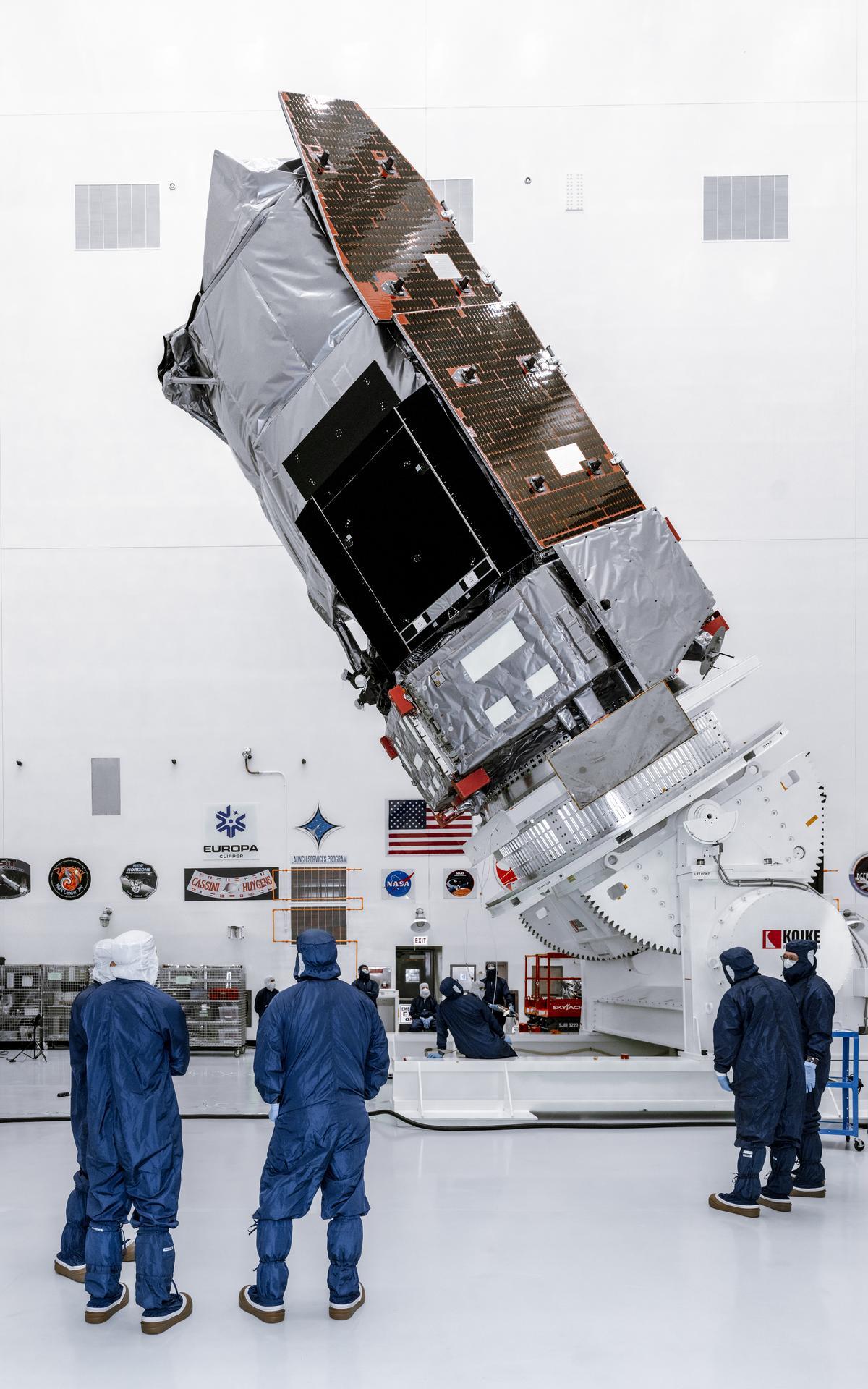
NASA’s Nancy Grace Roman Space Telescope has completed important prelaunch milestones as it prepares to launch nine months ahead of schedule. Engineers at the agency’s Kennedy Space Center in Florida raised Roman from horizontal to vertical, signaling preparations are moving forward for upcoming inspections, functional testing, and integration work.
Technicians transferred the observatory to NASA Kennedy inside its specialized, climate-controlled shipping container. Following Roman’s arrival, the team moved the telescope to the Payload Hazardous Servicing Facility for inspection after its trip from NASA’s Goddard Space Flight Center in Greenbelt, Maryland.
Engineers completed additional cleaning to remove any trace contaminants from the facility’s airlock before crews unboxed and raised Roman vertically in the high bay.
Named for NASA’s first chief astronomer and “mother of the Hubble Space Telescope,” the Roman Space Telescope will offer a field of view at least 100 times larger than Hubble’s, resulting in deep, sweeping explorations of the cosmos.
NASA and SpaceX are targeting launch no earlier than Sunday, Aug. 30, on a SpaceX Falcon Heavy rocket from Launch Complex 39A at Kennedy.
Quelle: NASA
----
Update: 11.07.2026
.
NASA’s Roman Launch Preparations Proceed
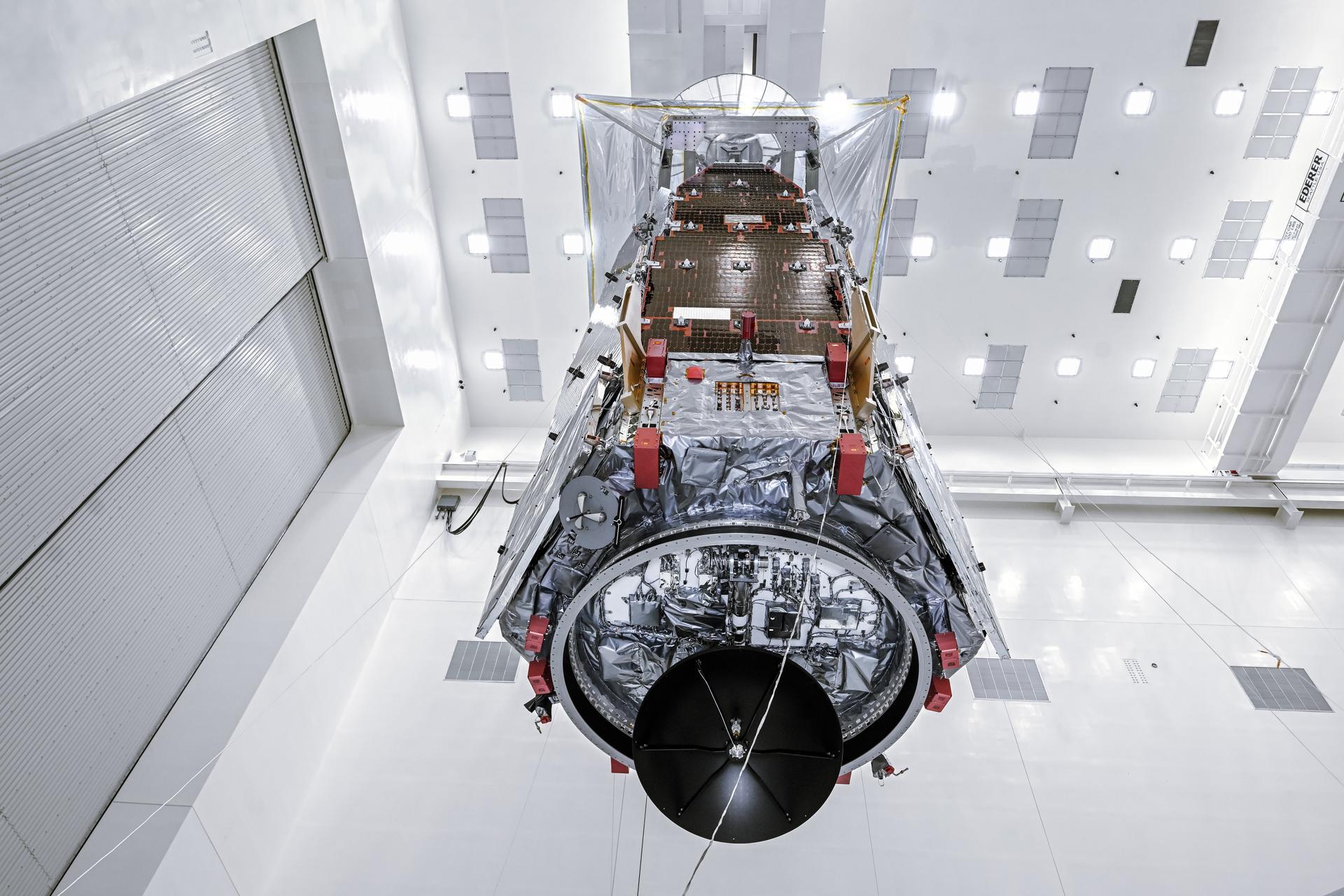
With less than two months until the launch of NASA’s Nancy Grace Roman Space Telescope, engineers at NASA’s Kennedy Space Center in Florida are preparing the observatory for its trip to space.
Inside the Payload Hazardous Servicing Facility, technicians used large cranes to carefully lift Roman and place it onto a specialized work platform, known as the Pantheon. This step transitions the observatory from its shipping configuration to the operational configuration necessary to begin integration and test activities that will prepare it for encapsulation and launch. Engineers then powered up the observatory to perform system checkouts, ensuring the telescope is operating correctly following its arrival at Kennedy.
Throughout the coming weeks, technicians plan to test Roman’s six solar array panels, inspect the space telescope’s insulation and thermal blankets, and test the spacecraft’s propellant tanks. Once those tests are complete, they will load approximately 290 gallons of hydrazine fuel into the observatory before encapsulating it inside a SpaceX payload fairing, one of the final steps before launch.
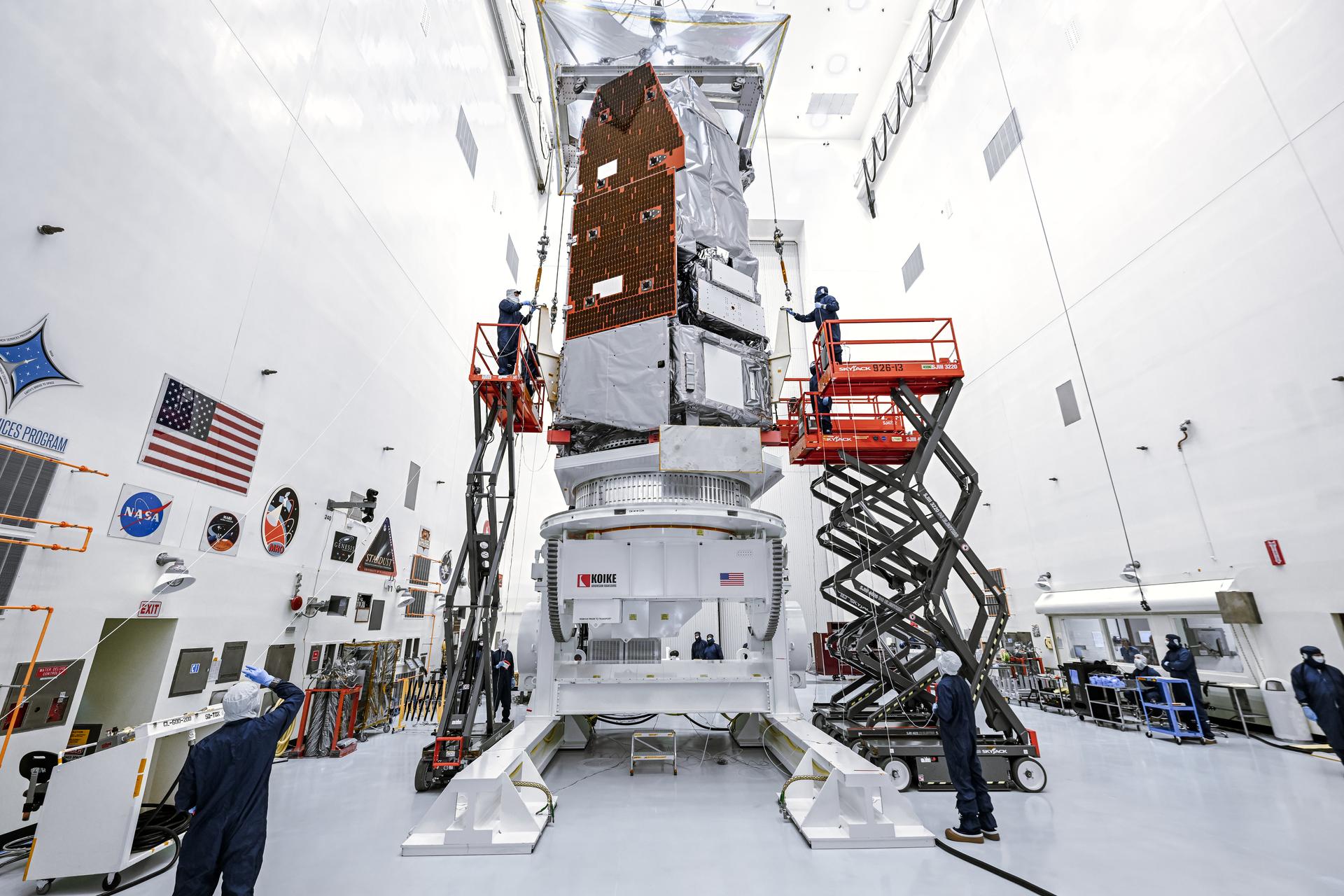
NASA is targeting no earlier than Sunday, Aug. 30, for the space observatory’s launch on a SpaceX Falcon Heavy rocket from Launch Complex 39A at Kennedy. The liftoff will occur about nine months ahead of schedule.
Roman will travel to the Sun-Earth Lagrange point 2, or L2, about one million miles from Earth, where the Sun’s and Earth’s gravity balance out. Orbiting at L2 will give the telescope a stable, unobstructed view of the universe and keep it far enough away so that Earth won’t block much of its view. From this vantage point, Roman will help answer questions about dark matter, dark energy, and exoplanets.
Roman’s wide field of view and rapid survey capabilities will map billions of galaxies, discover new exoplanets, study black holes, and provide vast volumes of daily data for astronomers to analyze. The observatory will sample such a large volume of the cosmos that the mission will offer practically limitless opportunities for astronomers to conduct a broad range of additional science.
Quelle: NASA
----
Update: 14.07.2026
.
NASA’s Roman telescope into prelaunch servicing following arrival in Florida
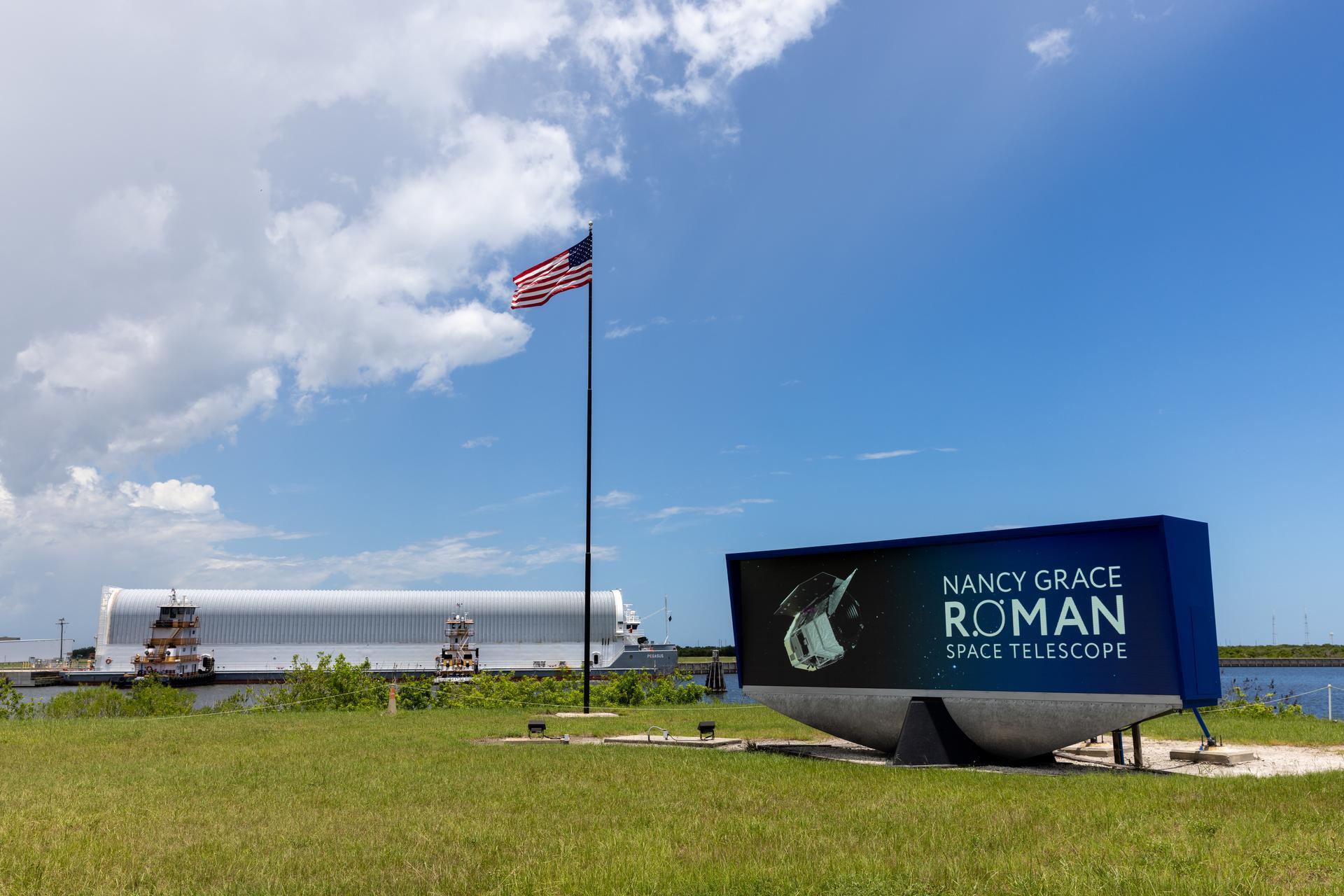
NASA’s Nancy Grace Roman Space Telescope arrives in Florida on June 21. (Credit: NASA/Amber Jean Notvest)
NASA’s next space telescope, the Nancy Grace Roman Space Telescope, arrived at Kennedy Space Center in late June ahead of its scheduled launch on Aug. 30 atop a SpaceX Falcon Heavy from Launch Complex 39A. Since its arrival at the Cape, the telescope has achieved several launch-processing milestones, including being moved to the Payload Hazardous Servicing Facility and flipped vertical.
Throughout the next weeks, Roman will undergo solar panel deployment tests, insulation and thermal tests, and more to validate the telescope’s systems. Following launch, the spacecraft will travel to the Sun-Earth Lagrange Point 2 (L2), where it will conduct wide-field surveys in near-infrared and visible wavelengths.
Constructed and operated by NASA’s Goddard Space Flight Center in Greenbelt, Maryland, Roman’s inner and outer segments were joined in November 2025, marking the telescope’s completion. After final testing, checkouts, and packaging were completed, the telescope was ready to be transported to the Kennedy Space Center (KSC) for final launch preparations and launch.
Riding in a protective, environmentally controlled transportation container aboard NASA’s Pegasus barge, Roman traveled from Maryland to Florida, arriving at KSC’s turn basin on June 21. The 8,200 kg telescope moved to the Payload Hazardous Servicing Facility (PHSF), which had received upgrades in anticipation of Roman’s arrival.
To reduce the risk that contaminants from the telescope’s trip to Florida would affect future telescope operations, technicians completed an initial cleaning outside the PHSF, followed by another cleaning within an airlock inside the facility. Furthermore, the PHSF’s air filtration system scrubbed the air around the telescope, allowing technicians to safely open the transport container’s inner door and expose the telescope to the PHSF’s environment for the first time.
Days after its arrival at KSC, PHSF technicians removed the container’s cover and moved Roman to the facility’s high bay. In the high bay, teams rotated Roman from its horizontal transport position to the vertical position. The following day, large cranes lifted the telescope onto a work platform named the “Pantheon.” Placing the telescope on the Pantheon gives technicians access to critical telescope components that need to be tested and validated ahead of launch.
With less than two months left until its targeted launch date, Roman has just a few prelaunch milestones to complete before it’s ready for launch. Technicians are expected to test the telescope’s six solar array panels, inspect and test its insulation systems and thermal blankets, and test its propellant tanks in the coming weeks. Once those tests are complete, technicians will fuel Roman, filling its propellant tanks with approximately 290 gallons of hydrazine. This fuel will enable the spacecraft to perform trajectory-correction burns en route to L2, orbital-correction burns at L2, and most importantly, maneuvers for observations.
After Roman’s systems have been validated and its propellant tanks filled, the telescope will be encapsulated in a fairing and transported to Launch Complex 39A (LC-39A) for integration with its Falcon Heavy rocket at SpaceX’s Horizontal Integration Facility (HIF).
Roman is scheduled to launch on Sunday, Aug. 30, at a yet-to-be-determined time from LC-39A — around nine months earlier than initially expected. The two Falcon Heavy side boosters will perform return-to-launch-site landings, with one landing at Landing Zone 40 (LZ-40) and the other at Landing Zone 2 (LZ-2), both located on the grounds of the Cape Canaveral Space Force Station. It is currently unknown whether or not SpaceX will attempt to recover the center core.
Once at L2, Roman will undergo a multi-month commissioning phase to ensure the telescope, its subsystems, and its instruments are functioning properly following launch. Using two instruments — the Wide-Field Instrument (WFI) and the Coronagraph Instrument (CGI) — Roman will conduct three main wide-field surveys and search for exoplanets. The telescope’s capabilities will allow scientists to map billions of galaxies and collect data that will be analyzed for decades to come.
Quelle: NSF
----
Update: 19.07.2026
.
Telescope Milestone: Teams Check Out NASA Roman Solar Panels
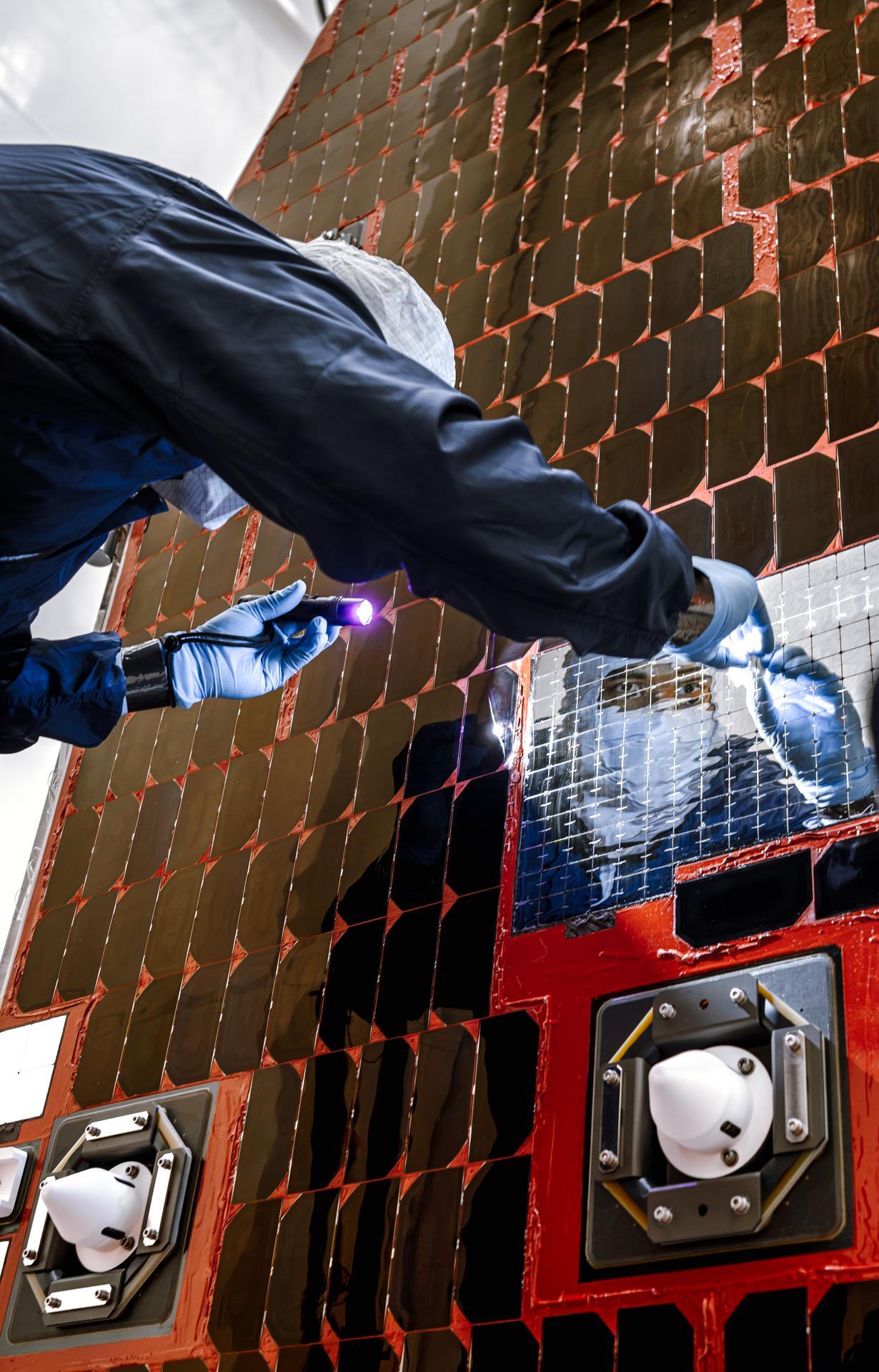
The solar panels that will help power NASA’s Nancy Grace Roman Telescope completed prelaunch cleaning and inspections July 8 at the Payload Hazardous Servicing Facility at NASA’s Kennedy Space Center in Florida.
Engineers and technicians are following necessary procedures to protect Roman from tiny debris, dust, or other material so that it operates optimally in space about one million miles away from Earth, or four times the distance to the Moon.
Collectively called the Solar Array Sun Shield, each of the six panels is about 7 by 10 feet (2.1 by 3 meters), designed, built, and installed at NASA’s Goddard Space Flight Center in Greenbelt, Maryland.
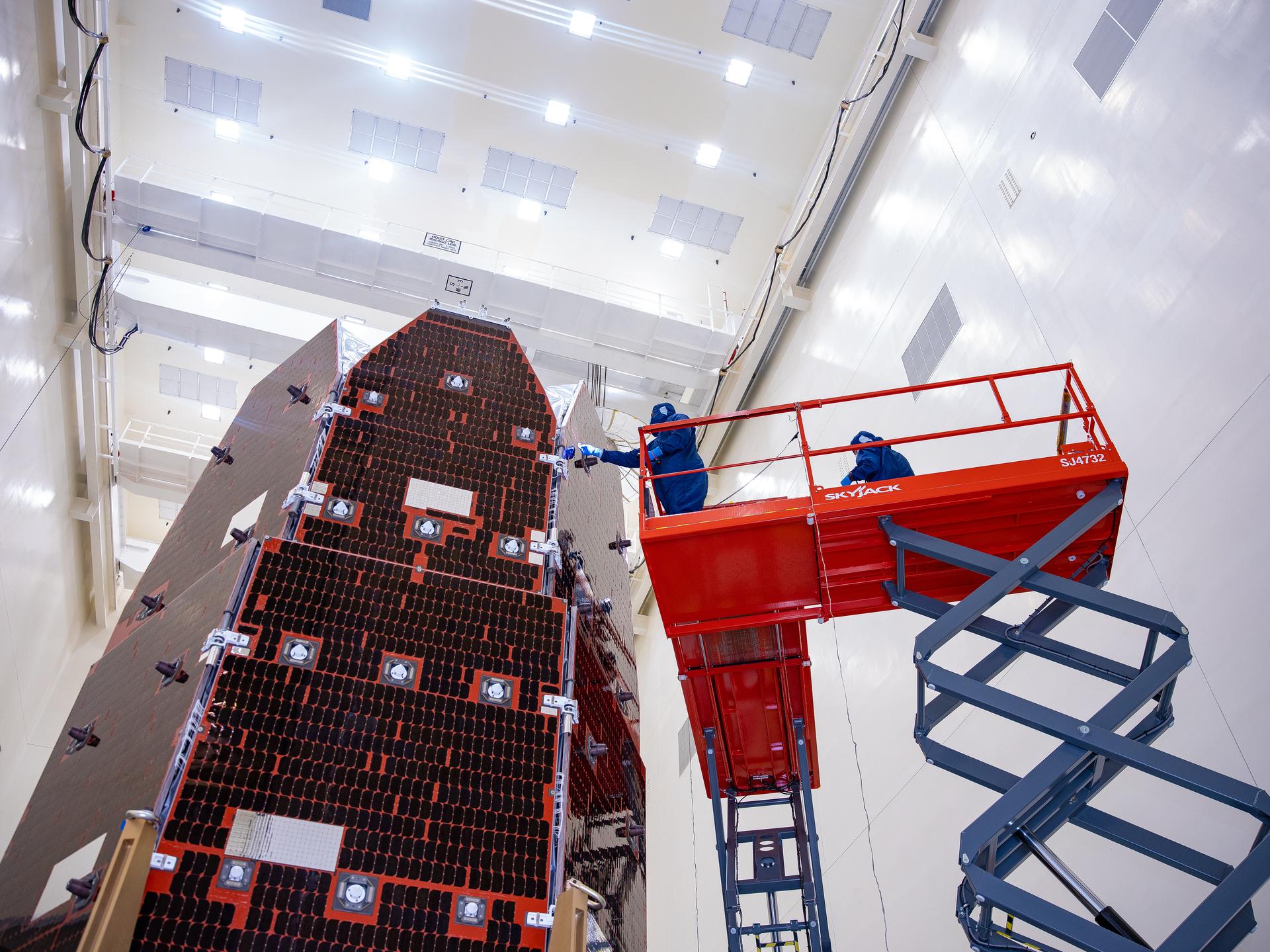
Roman will orbit at the second Sun-Earth Lagrange point (L2), the same orbit as NASA’s James Webb Space Telescope. The solar array panels will extend to continuously face the Sun during rotation, providing 4,100 watts to power the telescope as it gathers important data about planets outside our solar system and other fundamental mysteries about how the universe works. The observatory is designed to survey objects in our outer solar system, study exploding stars, and understand growing black holes and galaxies. Once processed, Roman’s data will be made publicly available so research teams can analyze it simultaneously.
NASA and SpaceX are targeting launch no earlier than Sunday, Aug. 30, on a SpaceX Falcon Heavy rocket from Launch Complex 39A at Kennedy.
Quelle: NASA
----
Update: 23.07.2026
.
NASA to Host Media Briefing on Roman Telescope, Launching Next Month
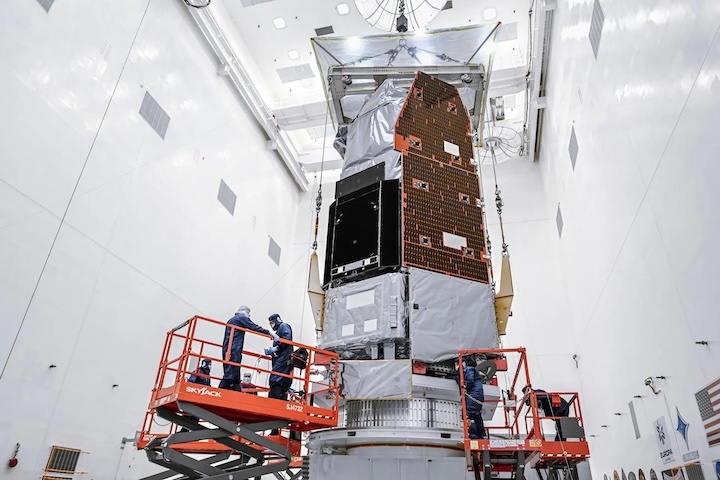
Media are invited to join NASA for a virtual news conference at 2 p.m. EDT, Wednesday, July 29, to preview the Nancy Grace Roman Space Telescope mission, scheduled to launch from the agency’s Kennedy Space Center in Florida on Sunday, Aug. 30.
NASA will stream this event live through a variety of platforms. Learn where to watch online: https://www.nasa.gov/live.
Participants in the briefing, who will provide an overview of the mission and its status, include:
- Shawn Domagal-Goldman, director, Astrophysics Division, NASA Headquarters in Washington
- Jackie Townsend, Roman telescope project manager, NASA’s Goddard Space Flight Center in Greenbelt, Maryland
- Julie McEnery, Roman telescope senior project scientist, NASA Goddard
- Jeremy Perkins, Roman telescope integration and test scientist, NASA Goddard
Media interested in participating by phone must RSVP no later than two hours prior to the start of the briefing to Rob Garner at rob.garner@nasa.gov. A copy of NASA’s media accreditation policy is online.
Named after NASA’s first chief astronomer, the Nancy Grace Roman Space Telescope will have a deep, panoramic view of the cosmos, generating never-before-seen pictures that will revolutionize our understanding of the universe. The observatory will usher in a new era of cosmic surveys, unveiling troves of celestial objects and shedding light on some of the universe’s most profound mysteries, including phenomena we can’t see. Roman also will showcase cutting-edge technology, including a test of the most advanced technology ever flown in space to directly image planets around nearby stars, a key step in NASA’s search for life on other worlds.
The Roman telescope is managed at NASA Goddard with participation by the agency’s Jet Propulsion Laboratory in Southern California; Caltech/IPAC in Pasadena, California; the Space Telescope Science Institute in Baltimore; and a team of scientists from various research institutions. The primary industrial partners are BAE Systems Inc., L3Harris Technologies, and Teledyne Scientific & Imaging. Contributions to Roman also are made by ESA (European Space Agency), JAXA (Japan Aerospace Exploration Agency), the French space agency CNES (Centre National d’Études Spatiales), and the Max Planck Institute for Astronomy in Germany.
Quelle: NASA
----
Update: 29.07.2026
.
NASA Fuels Roman Space Telescope for Late August Launch
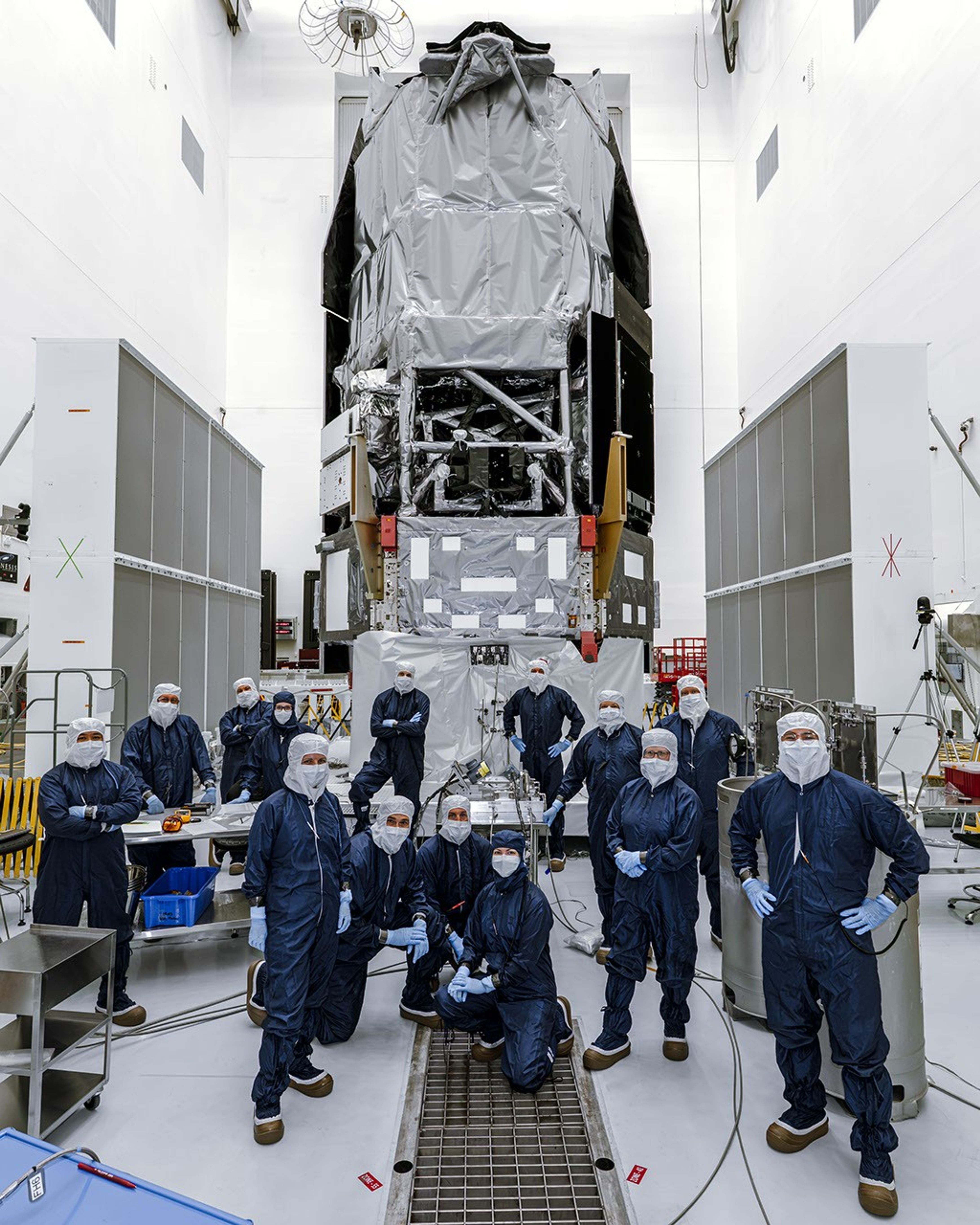
Technicians completed fueling NASA’s Nancy Grace Roman Space Telescope, bringing it an important step closer to launch. On July 25, the team completed operations that carefully loaded 290 gallons of hydrazine fuel into the observatory at the Payload Hazardous Servicing Facility at NASA’s Kennedy Space Center in Florida.
After launch and separation from the rocket, Roman will use this onboard propellant to perform maneuvers as it travels to Sun-Earth Lagrange point 2, or L2, located about one million miles from Earth. There, about four times the distance to the Moon, it will have an ideal home for astronomy.
Roman will use its propellant to power two types of thrusters that help it stay in its planned orbit around L2 and ensure the solar array panels face the Sun, which is the observatory’s main source of power throughout the mission. Roman has a five-year primary mission, and potentially enough fuel to support an additional five years for an extended mission. The Roman team recently cleaned and checked out the six solar array panels to prepare them for launch.
Researchers are eager to study thousands of exoplanets Roman will discover, to learn how closely they resemble Earth. They also will use Roman to study the mystery of dark energy and why it’s causing the universe to expand faster over time.
Now that fueling is complete, technicians soon will attach Roman to a device that secures to the rocket’s top stage. After that, Roman will be encapsulated within the rocket’s protective shell, known as a payload fairing. The payload fairing protects the spacecraft from aerodynamic forces and heat during ascent.
Launching nine months ahead of schedule, NASA and SpaceX are targeting liftoff for no earlier than 7:26 a.m. EDT Sunday, Aug. 30, aboard a SpaceX Falcon Heavy from Launch Complex 39A at Kennedy.
To learn more about Roman, visit:
