
25.07.2026
Simulations conducted by researchers at ETH Zurich suggest a strong likelihood that Venus’s rift valleys are still geologically active rather than being mere relics of a bygone era, as had been previously believed. This finding reshapes our understanding of Earth’s sister planet and will influence future missions to Venus.
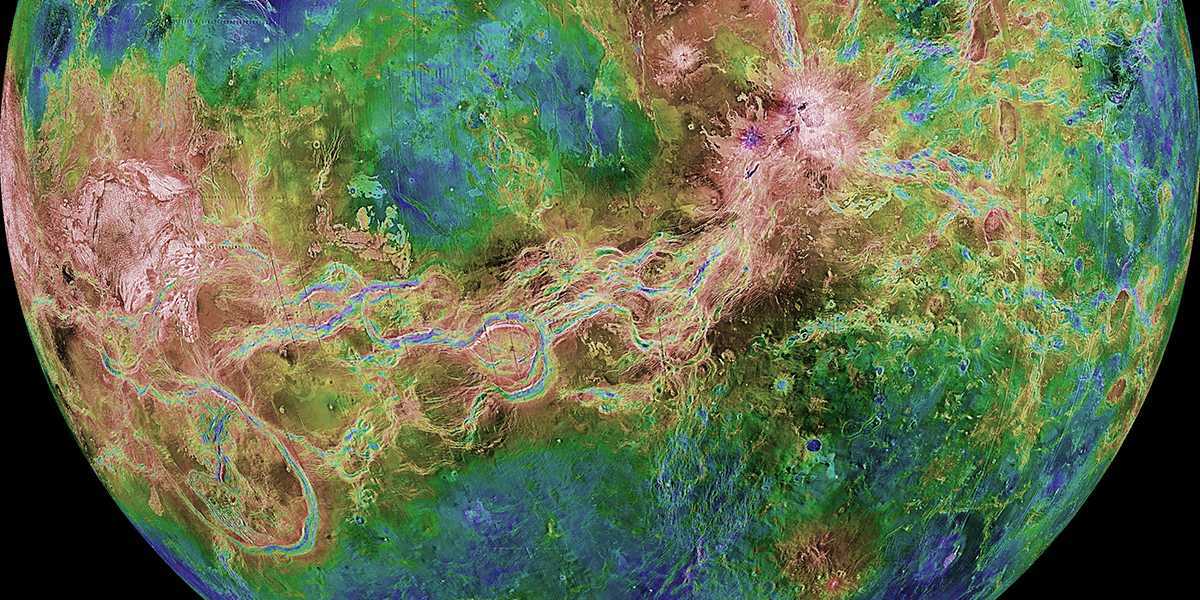
There are huge rift valleys on Venus. They suggest that the planet is still geologically active. (Image: NASA/JPL/USGS
Venus is an inhospitable place, with temperatures soaring to several hundred degrees Celsius and no oceans like those on Earth. Planetary scientists long believed Venus was geologically dormant. However, recent research indicates that Venus remains geologically “alive” and even hosts active volcanoes.
Rift valleys, which indicate tectonic activity, can be vast and resemble those on Earth, such as the African Rift Valley. On Venus, they can span up to 10,000 kilometres.
The timing of these rifts’ formation is uncertain. Geoscientists believe they originated more than 100 million years ago and are therefore remnants of the past.
Simulations indicate tectonic activity
ETH researchers, led by Taras Gerya, Professor of Geodynamics at the Department of Earth and Planetary Sciences, have used a new computer model to demonstrate that some rift valleys may have formed relatively recently. The planetary scientists also addressed the long-standing question of whether Venus is geologically active. This study has been published in Nature Geoscience. Lead author Xi Yang conducted the research as part of his Master’s studies under Gerya’s supervision.
Add ETH Zurich as a preferred Google source
With only one click, you can select which sources you want to see prioritized in your Google search. This allows you to quickly see what's truly relevant to you. Select ETH Zurich as a preferred source on Google now.
Yang and his team used a new computer model to simulate high-resolution, 3D rifts for the first time. This allowed them to accurately replicate these rift structures in simulations and provide better explanations of their formation. Earlier models had relied on simplified material assumptions and been mostly two-dimensional.
The models indicate that broad ridges, known as rift flanks, form along the edges of rift valleys when the rifts are geologically young and either still actively moving or have only recently stopped moving. The simulations also suggest that these rifts widen more rapidly than had been previously believed, at a rate of 3 to 10 centimetres per year.
Yang and his colleagues also show that the rift flanks tend to flatten rapidly after movement ceases; the older the rift system, the less steep and narrow its flanks. Unlike Earth, where erosion gradually wears down features, Venus’s flanks subside due to crustal relaxation.
Wide and high rift flanks are not only produced by the computer model but can also be seen in images of the Venusian surface from the Magellan probe during its 1990’s mission.

Based on their simulations and observational data, the researchers conclude that Venus remains an active planet with a more dynamic interior than had been previously believed. “The results help us to better assess the tectonic activity on Venus,” says Gerya.
The results of the ETH researchers’ model could help pinpoint active regions worthy of detailed investigation for these missions. Additionally, the study enhances our understanding of how rocky planets form. Importantly, the researchers aim to uncover clues that could improve the detection of rocky exoplanets.
Growing interest in our neighbouring planet
Interest in Venus is increasing as NASA and ESA prepare multiple missions to explore Earth’s neighbouring planet.
ETH geophysics professors Paul Tackley and Taras Gerya, along with their collaborators, are participating in ESA’s EnVision mission. They are developing instruments for the Venus orbiter to analyse the planet’s surface. The mission, scheduled for launch in the early 2030s, will explore the planet more thoroughly, from its core to its upper atmosphere.
Quelle: Eidgenössische Technische Hochschule Zürich