
20.07.2026
The lines etched into Voyager’s Golden Record cover point towards 14 pulsars whose spinning clocks reveal both where the Sun is and roughly when the spacecraft left — directions designed to work without relying on a single human language
The starburst etched into the lower-left corner of Voyager’s Golden Record cover is neither decoration nor a picture of an explosion.
The starburst etched into the lower-left corner of Voyager’s Golden Record cover is neither decoration nor a picture of an explosion. Fourteen of its rays extend from the Solar System towards pulsars, the rapidly rotating remains of collapsed stars. Beside each ray, a binary number records the pulsar’s rotation period in the early 1970s.
The directions, approximate distances and periods were intended to identify the Sun among the stars and provide a rough date for the message. The scheme does not require a recipient to understand English, Mandarin, Arabic or any of the other human languages heard on the disc. It begins with hydrogen, binary arithmetic and astronomical objects that another technically capable civilisation might also observe.
Calling it a universal address goes too far. The diagram is a tightly constructed set of clues, and every clue still has to be interpreted.
The map was designed for Pioneer first
Astronomer Frank Drake devised the pulsar map for the plaque carried by Pioneer 10, launched in March 1972. Carl Sagan, Linda Salzman Sagan and Drake described the design in a 1972 Science article titled “A Message from Earth”. Pioneer 11 carried a matching plaque the following year.
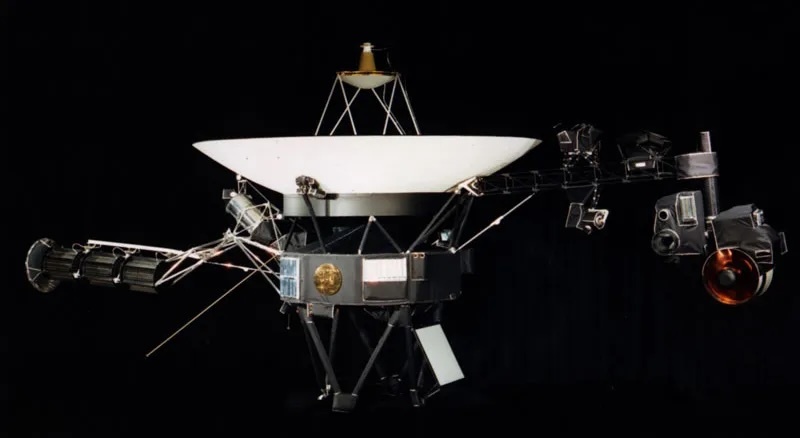
The Pioneer plaques had to communicate where their spacecraft came from, along with a compact description of their builders. When NASA prepared Voyagers 1 and 2 for launch in 1977, the Golden Record team reused the galactic map on the protective cover surrounding each record.
The record itself is a 30.5-centimetre gold-plated copper disc containing music, natural sounds, spoken greetings and 115 analogue-encoded images. The aluminium cover also carries diagrams explaining how to play the disc and rebuild its pictures from electrical signals.
Its engravings consequently form a chain. A finder would need to recognise the physical time standard, interpret binary values, understand the playback diagrams and then decode the contents. The pulsar map provides the location and epoch within that larger instruction set.
Pulsars work like identifiable stellar clocks
A pulsar is a neutron star, the compact core left when a massive star collapses. It spins and carries an intense magnetic field. Radiation escapes in beams near the magnetic poles, and an observer detects a pulse whenever one beam sweeps across the line of sight.
The lighthouse comparison is useful, provided one difference is kept in mind. A maritime lighthouse is deliberately coded. A pulsar’s flash pattern arises from its rotation, and the period can range from milliseconds to seconds. Its position and timing together give it a recognisable astronomical identity.
Drake selected 14 pulsars rather than the minimum needed for triangulation. The surplus was deliberate. A distant finder might be unable to see some objects because pulsar beams are directional, a source has become too faint or the spacecraft has been recovered from an unfavourable part of the Galaxy. Several successful matches could still identify the intended origin.
The centre of the starburst represents the Sun. Each of the 14 period-bearing rays supplies a direction, with its approximate length representing relative distance. Marks near the outer ends encode how far the pulsars lie above or below the galactic plane. Those vertical coordinates help lift a flat engraving into a three-dimensional reconstruction.
There is also a fifteenth ray. It has no pulsar period and points towards the centre of the Milky Way, indicating the Sun’s relative distance from that reference point and establishing the galactic plane used to orient the rest of the map.
Hydrogen defines the unit behind every number
A binary value has little use if the unit is unknown. Seconds, hours and years are human conventions. Even the length of a day depends on the rotation of one planet.
The Golden Record cover defines a time interval from neutral atomic hydrogen, the most abundant element in the Universe. At the lower right, two circles depict the atom in its two lowest-energy configurations. A connecting line and the binary digit one point to the hyperfine, or spin-flip, transition responsible for the familiar 21-centimetre radio line.
The transition’s associated period is about 0.70 billionths of a second. The long binary inscriptions beside the pulsar rays express each rotation period as a multiple of that interval. The 3.6-second time required for one record revolution and the timing used to reconstruct its pictures are defined from the same reference.
NASA’s explanation of the cover describes the hydrogen transition as the fundamental time scale for both the engraving and the decoded images. A recipient who solved the hydrogen clue would gain the unit needed for the remaining numerical instructions.
This is the limited sense in which the design avoids reliance on a single human language. The underlying transition should be the same everywhere. The drawing and the choice of binary notation remain a symbolic system devised by people, and there is no guarantee that another intelligence would assign the same meaning to them.
The pulsars provide a rough launch date
Pulsars are exceptionally stable clocks over human observing intervals, but they do not keep one period forever. They radiate energy and gradually rotate more slowly. Their pulse periods therefore lengthen with age.
The values on Voyager’s cover are snapshots of the selected pulsars when the map was designed. If a finder identified several sources, measured their later periods and understood their rates of slowdown, it could calculate backwards to the era when the encoded pattern matched the sky.
That procedure would not return a perfect launch timestamp. Pulsars can undergo glitches, sudden small changes in rotation. They move through the Galaxy, their beams evolve and timing measurements made in the early years of pulsar astronomy were less precise than modern values. One object on the original map was written with more binary digits than its measured period justified.
The timestamp is consequently redundant as well as approximate. Fourteen clocks offer cross-checks, while the cover carries an entirely separate dating device.
A two-centimetre patch was electroplated with a very small quantity of ultra-pure uranium-238. The isotope decays into daughter products with a half-life of about 4.51 billion years. Measuring the proportions of parent and daughter material could provide another estimate of how long the cover had been travelling.
The map reaches the Solar System, not Earth’s surface
Matching the pulsars would locate the central point at the Sun. It would not identify a country, planet or even an orbit. The decoded record supplies the more local information, including diagrams of the Solar System and images of Earth.
The map also demands considerable capability from its hypothetical reader. The finder has to recognise a manufactured artefact, understand the hydrogen transition, infer the use of binary numbers, detect some of the same pulsars and reconstruct their older positions and periods. A civilisation able to intercept a silent spacecraft between stars may meet those requirements, but the conclusion is built into the premise.
The address has a limited lifetime. Pulsars move and slow, some cease to be detectable, and the Sun orbits the Galactic centre. The 14-object redundancy extends the useful interval, yet no static map can describe an evolving Galaxy indefinitely.
Nor are the Voyagers on delivery routes. They are not aimed at known inhabited systems and carry no beacon announcing the records. After their radio transmitters eventually fall silent, each will be a small dark object moving through interstellar space. The probability of recovery is vanishingly low.
A language-independent message still contains assumptions
The Golden Record famously includes greetings in 55 human languages. Its cover takes a different approach. Rather than choose one language as the key to all the others, it tries to establish common ground through reproducible physics.
That does not make the engraving culture-free. Circles, connecting lines, flat projections, binary marks and the idea of a map are representational choices. Even the assumption that a finder will approach the object as a puzzle reflects something about its makers.
The design remains unusually economical. A single group of lines identifies a neighbourhood through position, a moment through changing rotation periods and a reference frame through the Galactic centre. The hydrogen diagram supplies the unit, and radioactive decay offers an independent check.
The pulsar map does not literally say “the Sun is here” in a script shared across the Universe. It poses a scientific problem whose solution points home: find these clocks, compare their old periods with the sky, and locate the origin from which all fourteen directions were measured.
Quelle: SD