
9.10.2024
Nasa spacecraft Psyche receives laser signal from 290 million miles away
Breakthrough could transform our exploration of the solar system, space agency says
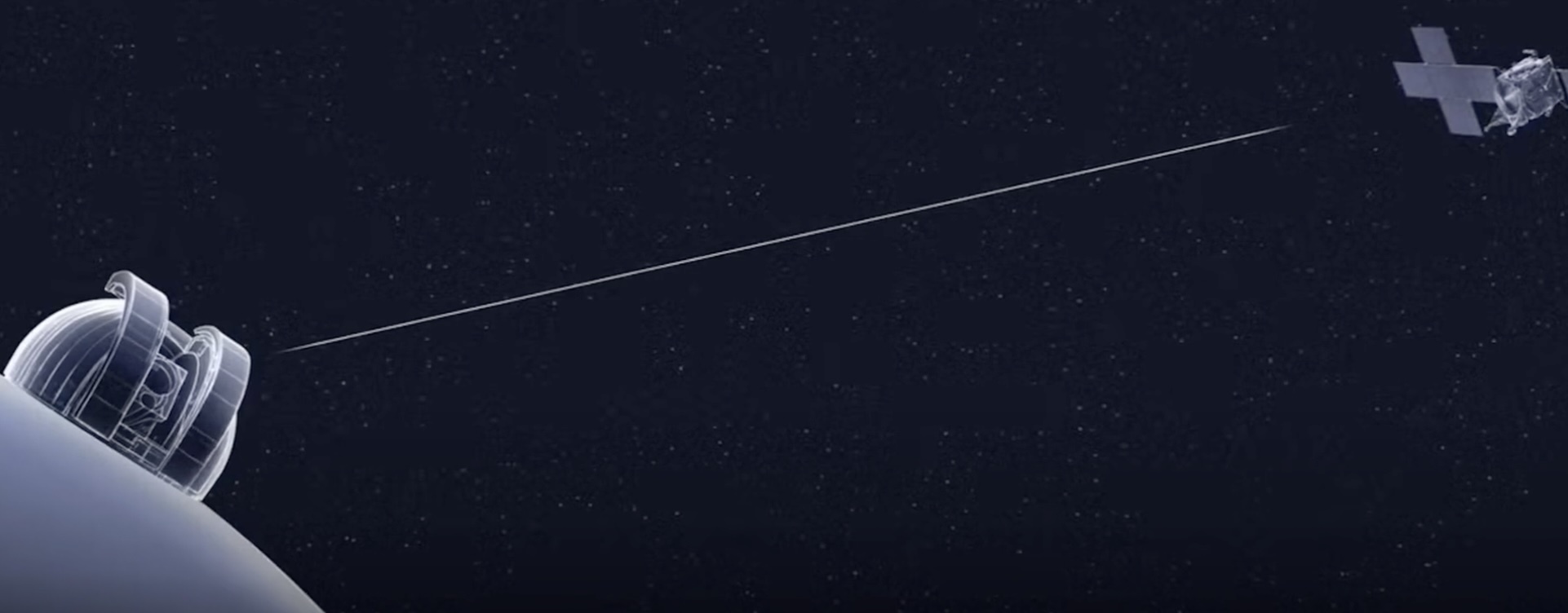
Nasa spacecraft receives laser signal from 290 million miles away
Nasa has successfully sent a laser signal about 290 million miles, smashing previous records and potentially transforming our exploration of the solar system.
The milestone was reached by Nasa’s Deep Space Optical Communications technology demonstration, which is exploring whether it is possible to use lasers to send messages deep into space. Lasers can send data at rates up to 100 times that of the radio frequencies used today, allowing for more complex and high-definition data, but they also require much greater precision to work.
It was sent to the Psyche spacecraft, which launched in October 2023. Its main mission is to study an asteroid with the same name, but it is also carrying the Nasa experiment to test laser communication through space.
The distance – which equates to about 460 million kilometres – is roughly the same as that between the Earth and Mars when they are their most distant.
Nasa hopes that the laser technology can help empower future crewed missions to Mars, among other exploration of our solar system, and so the successful test marks a major breakthrough.
“The milestone is significant. Laser communication requires a very high level of precision, and before we launched with Psyche, we didn’t know how much performance degradation we would see at our farthest distances,” said Meera Srinivasan, the project’s operations lead at NASA’s Jet Propulsion Laboratory, in a statement.
“Now the techniques we use to track and point have been verified, confirming that optical communications can be a robust and transformative way to explore the solar system.”
Nasa administrator Bill Nelson sent his congratulations to the team involved, on Twitter/X. “This extraordinary achievement will transform the way we explore the solar system,” he wrote.
Late last year, Nasa announced that it had successfully completed one such transmission from 10 million miles away. In the time since, it has broken through a whole set of records as Psyche continues to travel further from Earth.
That also included the first ultra high-definition video beamed from space. That happened late last year – when Psyche sent pictures of a cat named Taters.
As the distance from Earth increases, the speed of the connection is reduced. When it was 33 miles away, the spacecraft could receive data at its maximum rate of 267 megabits per second – but when the latest record was broken, in summer, it was hitting maximums of only 8.3 megabits per second.
Quelle: INDEPENDENT
----
Update: 2.05.2025
.
NASA’s Psyche spacecraft hits a speed bump on the way to a metal asteroid
“This kind of thing happens, and that’s why we build redundancy into our missions."
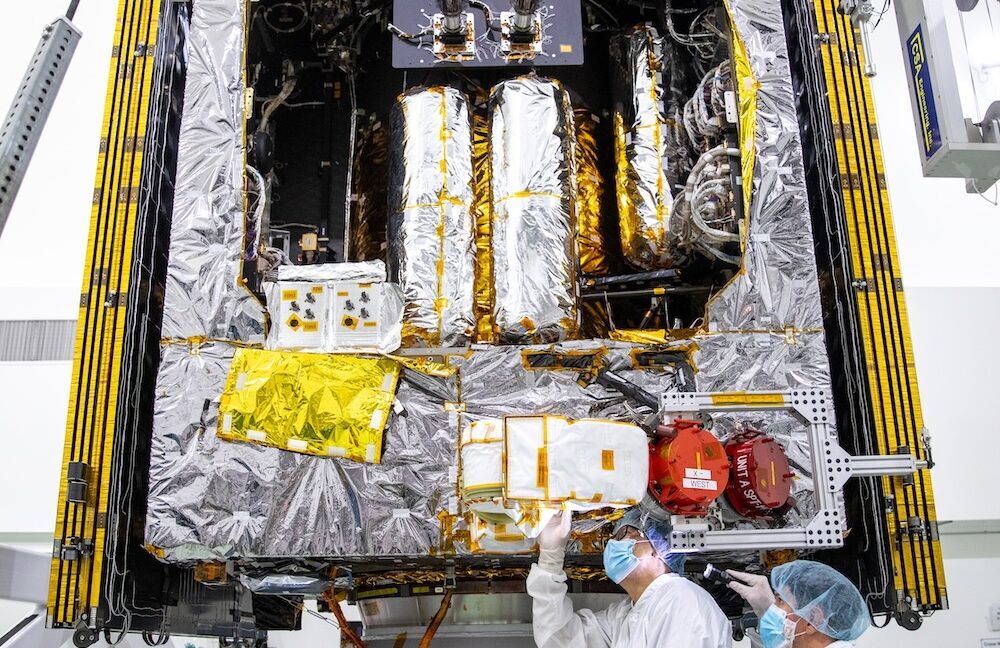
Engineers and technicians work on deploying and stowing stationary plasma thrusters on NASA's Psyche spacecraft before its launch in 2023. Two plasma engines are visible here mounted to a dual-axis positioning mechanism, which vectors their thrust in space. Some of Psyche's xenon fuel tanks are visible inside the main body of the spacecraft. Credit: NASA
NASA's Psyche spacecraft, located nearly 150 million miles from Earth on the way to an unexplored metal asteroid, has stopped firing its engines after detecting a problem in its propulsion system.
NASA published an update Tuesday revealing that the robotic spacecraft shut off its plasma thrusters earlier this month. The news wasn't widely shared until Wednesday, when NASA science chief Nicky Fox posted it on X.
"Engineers with NASA’s Psyche mission are working to determine what caused a recent decrease in fuel pressure in the spacecraft’s propulsion system," the agency said. The spacecraft detected the drop in pressure April 1 inside the line that feeds xenon fuel to the spacecraft's four plasma thrusters.
Sensors aboard the Psyche probe detected a pressure reduction in the xenon fuel line from about 36 pounds per square inch to about 26 psi. "As designed, the orbiter powered off the thrusters in response to the decrease," NASA said.
The Psyche spacecraft uses solar electric propulsion, a highly efficient means of maneuvering through space that relies on solar-generated electricity and more than a ton of xenon gas stored in seven 22-gallon (82-liter) tanks. Inside each of the mission's four thrusters, an electromagnetic field ionizes the xenon gas before expelling the ions to produce thrust.
These things happen
Louise Prockter, director of NASA's planetary science division, said engineers at the Jet Propulsion Laboratory in California are looking into the problem.
So far, there's no effect on the Psyche spacecraft's trajectory. Psyche's plasma thrusters can remain unpowered until at least mid-June before the spacecraft would begin to drift off course, according to NASA. Mission managers decided to keep Psyche's engines turned off until they better understand the pressure decrease. If engineers trace the problem to the fuel line itself, NASA has the option of switching to a backup fuel line to resume thrusting.
"This kind of thing happens, and that’s why we build redundancy into our missions," Prockter said at a meeting of Mars scientists Wednesday. "We don't have any concerns at the moment about it, but we’re obviously keeping tabs on it.”
Each electric thruster on Psyche generates just 250 milli-newtons of thrust, roughly equivalent to the weight of three quarters. But they can operate for months at a time, and over the course of a multi-year cruise, these thrusters provide a more efficient means of propulsion than conventional rockets.
The plasma thrusters are reshaping the Psyche spacecraft's path toward its destination, a metal-rich asteroid also named Psyche. The spacecraft's four electric engines, known as Hall effect thrusters, were supplied by a Russian company named Fakel. Most of the other components in Psyche's propulsion system—controllers, xenon fuel tanks, propellant lines, and valves—come from other companies or the spacecraft's primary manufacturer, Maxar Space Systems, in California.
The Psyche mission is heading first for Mars, where the spacecraft will use the planet's gravity next year to slingshot itself into the asteroid belt, setting up for arrival and orbit insertion around the asteroid Psyche in August 2029.
Psyche launched in October 2023 aboard a SpaceX Falcon Heavy rocket on the opening leg of a six-year sojourn through the Solar System. The mission's total cost adds up to more than $1.4 billion, including development of the spacecraft and its instruments, the launch, operations, and an experimental laser communications package hitching a ride to deep space with Psyche.
Psyche, the asteroid, is the size of Massachusetts and circles the Sun in between the orbits of Mars and Jupiter. No spacecraft has visited Psyche before. Of the approximately 1 million asteroids discovered so far, scientists say only nine have a metal-rich signature like Psyche. The team of scientists who put together the Psyche mission have little idea of what to expect when the spacecraft gets there in 2029.
Metallic asteroids like Psyche are a mystery. Most of Psyche's properties are unknown other than estimates of its density and composition. Predictions about the look of Psyche's craters, cliffs, and color have inspired artists to create a cacophony of illustrations, often showing sharp spikes and grooves alien to rocky worlds.
In a little more than five years, assuming NASA gets past Psyche's propulsion problem, scientists will supplant speculation with solid data.
Quelle: arsTechnica
----
Update: 30.05.2025
.
NASA’s Psyche Mission Looking Into Propulsion System
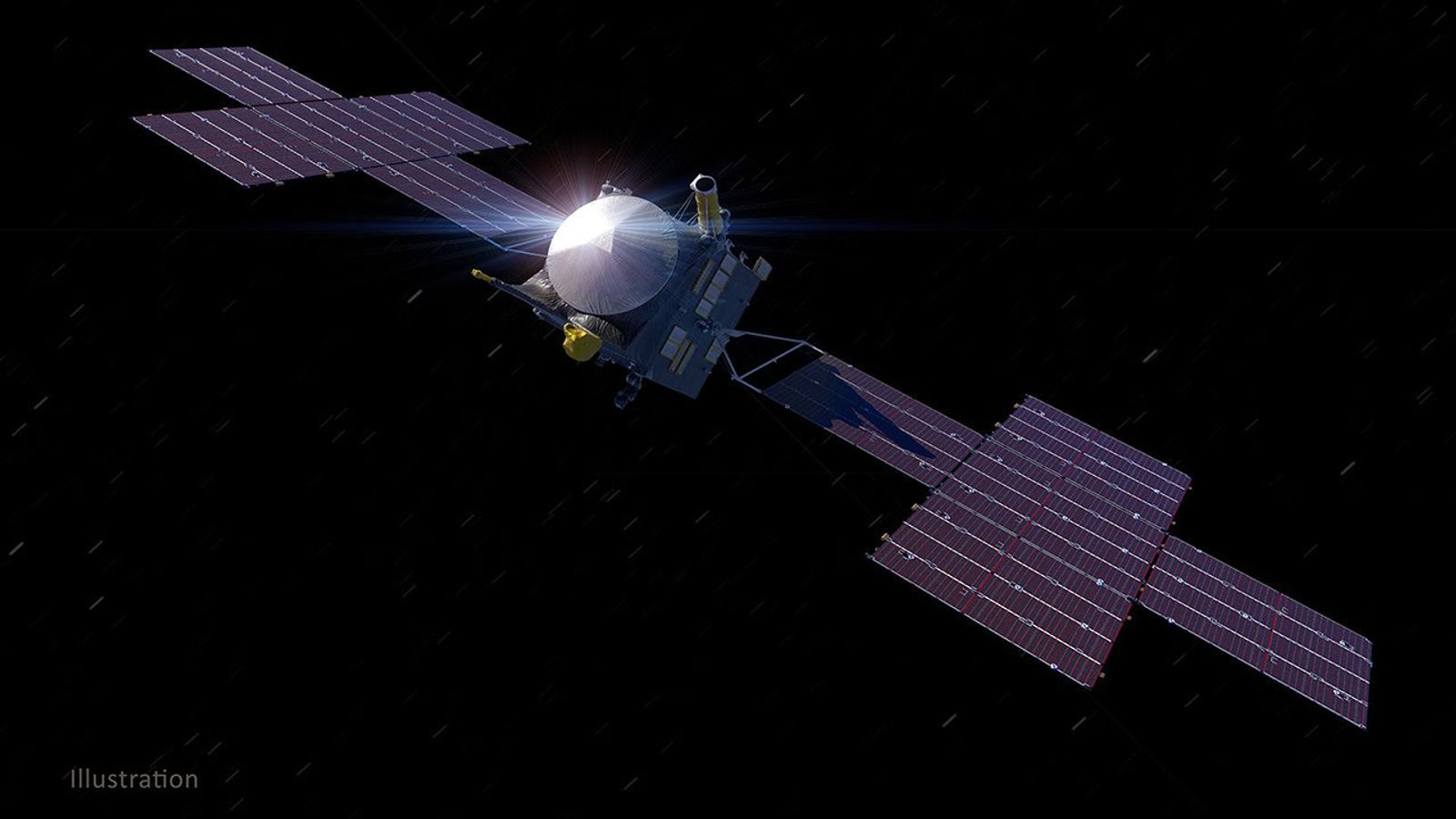
Engineers with NASA’s Psyche mission are working to determine what caused a recent decrease in fuel pressure in the spacecraft’s propulsion system. The spacecraft relies on solar electric propulsion, a system that uses energy to generate power for four electric thrusters. The thrusters then propel the spacecraft by expelling charged atoms, or ions, of the neutral gas xenon.
Psyche began firing its thrusters in May 2024. On April 1, the spacecraft detected a pressure drop in the line that feeds the xenon gas to the thrusters, going from 36 pounds per square inch (psi) to about 26 psi. As designed, the orbiter powered off the thrusters in response to the decrease.
The mission team has chosen to defer thrusting while engineers work to understand the pressure decrease. The mission design supports a pause in thrusting until at least mid-June before the spacecraft would see an effect on its trajectory. The electric propulsion system has two identical fuel lines, and the team may decide to switch to the backup fuel line to resume thrusting.
Psyche launched from NASA’s Kennedy Space Center in Florida on Oct. 13, 2023, and is now about 148 million miles (238 million kilometers) from Earth. In spring 2026, the spacecraft’s trajectory will bring it back toward Mars so that it can use the planet’s gravity to slingshot toward the main asteroid belt between Mars and Jupiter. The probe will begin orbiting the asteroid Psyche in 2029.
Quelle: NASA
----
Update: 22.06.2025
.
NASA’s Psyche Spacecraft Resumes Full-Time Propulsion
NASA’s Psyche spacecraft resumed full thruster operations on June 16, and the propulsion system is performing as expected after mission engineers switched to a backup propellant line. They will operate the thrusters for the equivalent of three months between now and November to keep the orbiter’s trajectory to the metal-rich asteroid Psyche on track.
Operation of all four electric thrusters had been paused since early April while the mission team investigated an unexpected drop in pressure in the primary xenon propellant line. Through comprehensive testing and analysis, the team narrowed down the potential causes to a valve that may have malfunctioned in the primary line. The switch to the identical backup propellant line in late May restored full functionality to the propulsion system.
“The mission team’s dedication and systematic approach to this investigation exemplifies the best of NASA engineering,” said Bob Mase, Psyche project manager at NASA’s Jet Propulsion Laboratory in Southern California. “Their thorough diagnosis and recovery, using the backup system, demonstrates the value of robust spacecraft design and exceptional teamwork.”
Psyche is propelled by xenon gas, which is ionized by the thrusters to create a gentle push on the spacecraft that builds throughout its journey. The three months’ worth of thrusting will keep the spacecraft on track for its long-planned flyby of Mars in May 2026. The spacecraft will use the planet’s gravity as a slingshot to help it on its way to the asteroid Psyche.
Psyche remains set for an on-time arrival in August 2029 at its target asteroid, located in the main asteroid belt between Mars and Jupiter. The spacecraft launched from NASA’s Kennedy Space Center in Florida in October 2023.
Quelle: NASA
----
Update: 20.08.2025
.
NASA’s Psyche Captures Images of Earth, Moon
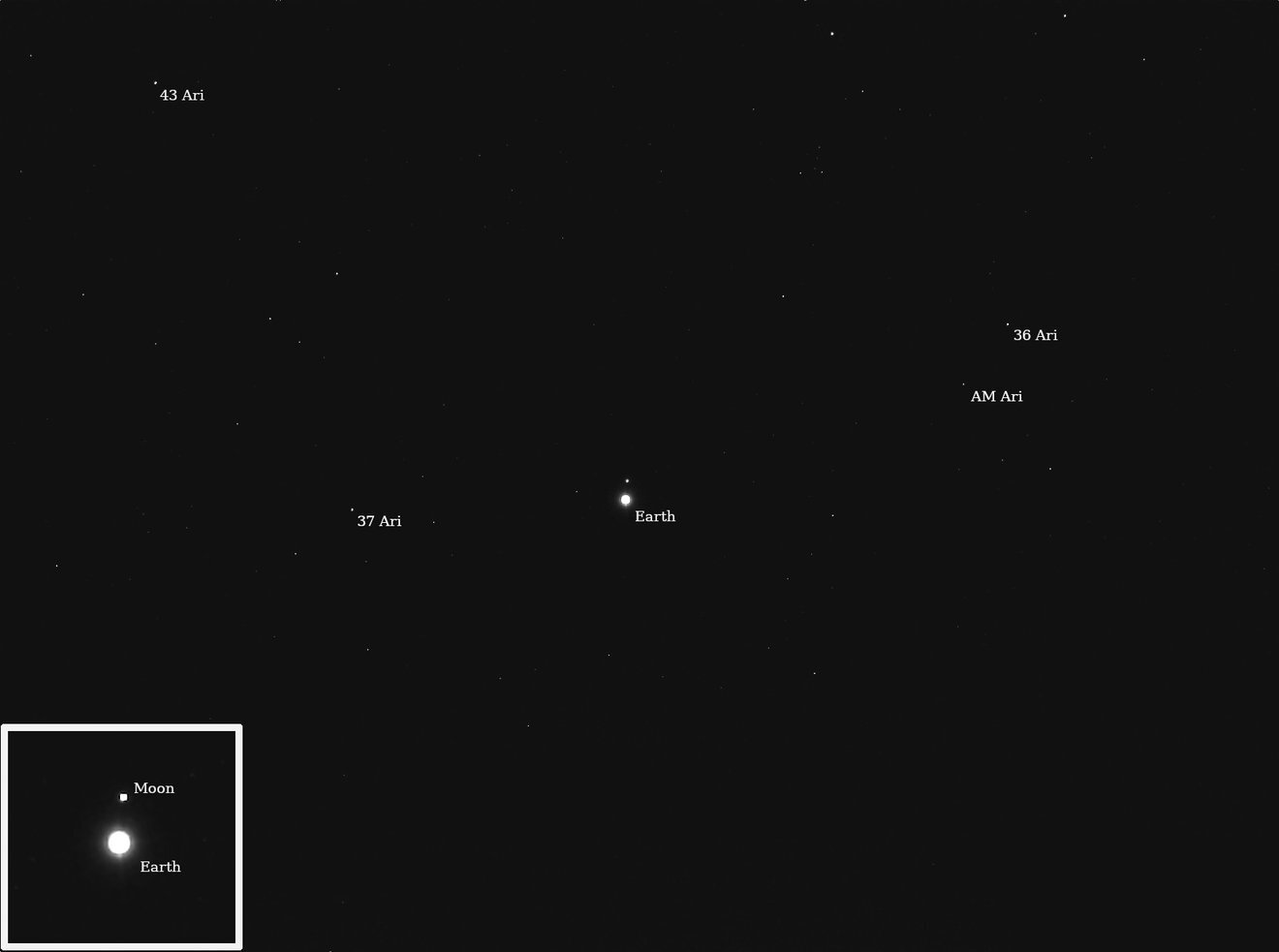
NASA’s Psyche captured images of Earth and our Moon from about 180 million miles (290 kilometers) away in July 2025, as it calibrated its imager instrument. When choosing targets for the imager testing, scientists look for bodies that shine with reflected sunlight, just as the asteroid Psyche does. Credit: NASA/JPL-Caltech/ASU
Headed for a metal-rich asteroid of the same name, the Psyche spacecraft successfully calibrated its cameras by looking homeward.
On schedule for its 2029 arrival at the asteroid Psyche, NASA’s Psyche spacecraft recently looked back toward home and captured images of Earth and our Moon from about 180 million miles (290 million kilometers) away. The images were obtained during one of the mission team’s periodic checkouts of the spacecraft’s science instruments.
On July 20 and July 23, the spacecraft’s twin cameras captured multiple long-exposure (up to 10-second) pictures of the two bodies, which appear as dots sparkling with reflected sunlight amid a starfield in the constellation Aries.
The Psyche multispectral imager instrument comprises a pair of identical cameras equipped with filters and telescopic lenses to photograph the asteroid Psyche’s surface in different wavelengths of light. The color and shape of a planetary body’s spectrum can reveal details about what it’s made of. The Moon and the giant asteroid Vesta, for example, have similar kinds of “bumps and wiggles” in their spectra that scientists could potentially also detect at Psyche. Members of the mission’s science team are interested in Psyche because it will help them better understand the formation of rocky planets with metallic cores, including Earth.
When choosing targets for the imager testing and calibration, scientists look for bodies that shine with reflected sunlight, just as the asteroid Psyche does. They also look at objects that have a spectrum they’re familiar with, so they can compare previous telescopic or spacecraft data from those objects with what Psyche’s instruments observe. Earlier this year, Psyche turned its lenses toward Jupiter and Mars for calibration — each has a spectrum more reddish than the bluer tones of Earth. That checkout also proved a success.
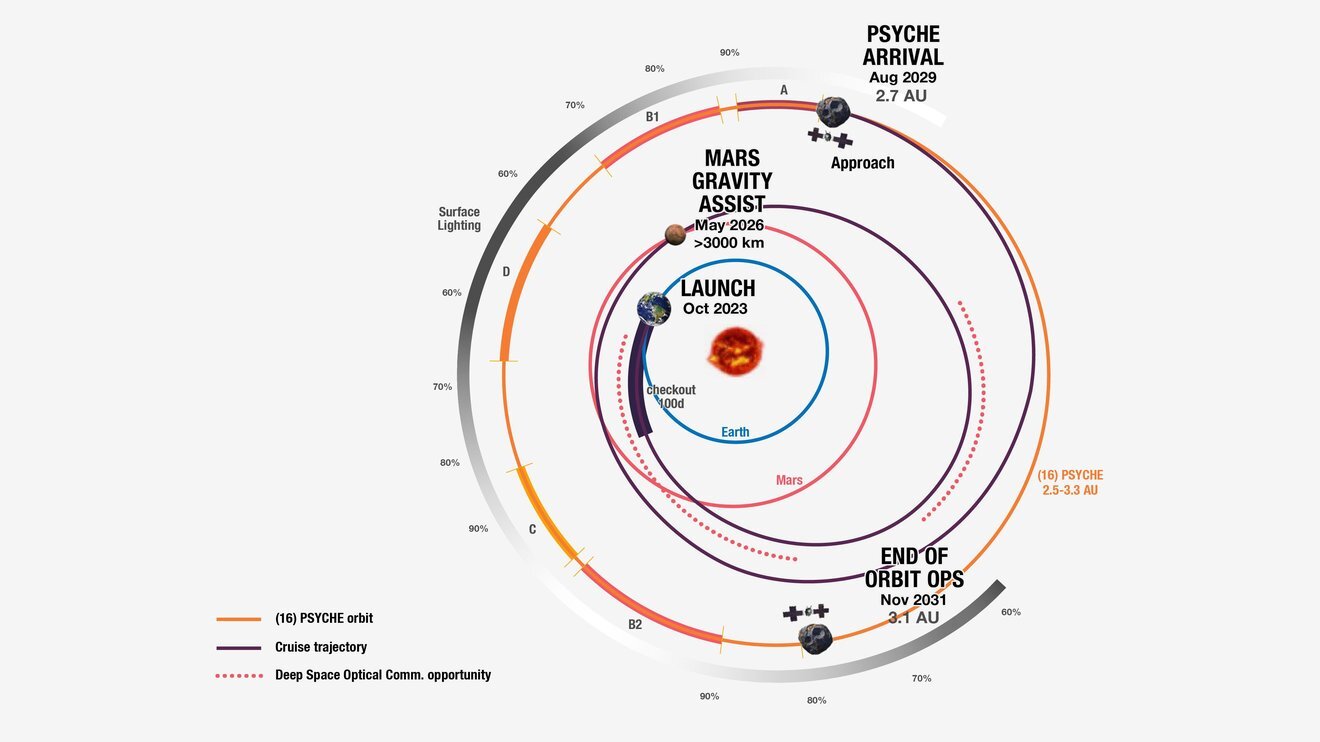
The Psyche spacecraft is taking a spiral path around the solar system in order to get a boost from a Mars gravity assist in 2026. It will arrive at the asteroid Psyche in 2029.
Credit: NASA/JPL-Caltech
To determine whether the imager’s performance is changing, scientists also compare data from the different tests. That way, when the spacecraft slips into orbit around Psyche, scientists can be sure that the instrument behaves as expected.
“After this, we may look at Saturn or Vesta to help us continue to test the imagers,” said Jim Bell, the Psyche imager instrument lead at Arizona State University in Tempe. “We’re sort of collecting solar system ‘trading cards’ from these different bodies and running them through our calibration pipeline to make sure we’re getting the right answers.”
trong and Sturdy
The imager wasn’t the only instrument that got a successful checkout in late July: The mission team also put the spacecraft’s magnetometer and the gamma-ray and neutron spectrometer through a gamut of tests — something they do every six months.
“We are up and running, and everything is working well,” said Bob Mase, the mission’s project manager at NASA’s Jet Propulsion Laboratory in Southern California. “We’re on target to fly by Mars in May 2026, and we are accomplishing all of our planned activities for cruise.”
That flyby is the spacecraft’s next big milestone, when it will use the Red Planet’s gravity as a slingshot to help the spacecraft get to the asteroid Psyche. That will mark Psyche’s first of two planned loops around the solar system and 1 billion miles (1.6 billion kilometers) since launching from NASA’s Kennedy Space Center in October 2023.
More About Psyche
The Psyche mission is led by ASU. Lindy Elkins-Tanton of the University of California, Berkeley is the principal investigator. A division of Caltech in Pasadena, JPL is responsible for the mission’s overall management, system engineering, integration and test, and mission operations. Maxar Technologies in Palo Alto, California, provided the high-power solar electric propulsion spacecraft chassis. ASU leads the operations of the imager instrument, working in collaboration with Malin Space Science Systems in San Diego on the design, fabrication, and testing of the cameras.
Psyche is the 14th mission selected as part of NASA’s Discovery Program, managed by the agency’s Marshall Space Flight Center in Huntsville, Alabama. NASA’s Launch Services Program, based at Kennedy, managed the launch service.
Quelle: NASA
----
Update: 25.09.2025
.
Psyche asteroid probe uses lasers to phone home from 218 million miles away
Final tests of NASA's laser beam communication technology suggests we'll soon have a new way to keep in touch with astronauts and spacecraft venturing into deep space.
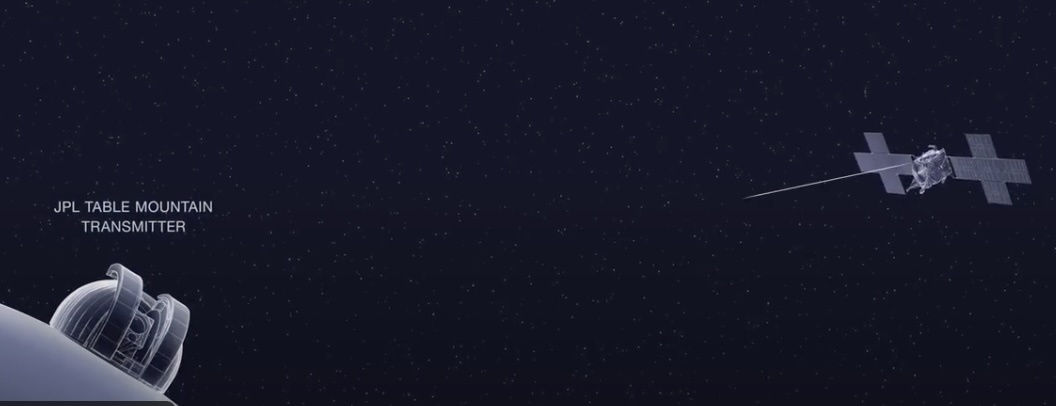
The Optical Communications Telescope Laboratory at JPL's Table Mountain Facility in Wrightwood, California, sends a laser beacon to NASA's Psyche spacecraft using its Deep Space Optical Communications flight laser transceiver, shown here in infrared. (Image credit: NASA/JPL-Caltech)
Final tests of NASA's laser beam communication technology offer a promising new way to keep in touch with astronauts and spacecraft venturing into deep space, including future missions to Mars.
NASA's Deep Space Optical Communications (DSOC) experiment, a technology demonstration carried aboard the Psyche mission, has completed its 65th and final test, successfully exchanging laser signals across 218 million miles (351 million kilometers), surpassing all technical goals after two years of operations, according to a statement from the space agency.
"NASA is setting America on the path to Mars, and advancing laser communications technologies brings us one step closer to streaming high-definition video and delivering valuable data from the Martian surface faster than ever before," Sean Duffy, acting NASA Administrator, said in the statement. "Technology unlocks discovery, and we are committed to testing and proving the capabilities needed to enable the Golden Age of exploration."
During its run, DSOC achieved 65 successful passes between Earth and Psyche as the spacecraft journeyed toward its asteroid target. The system encodes data into pulses of laser light, transforming digital information into streams of photons that can travel millions of miles — a significant shift from the radio frequencies used by NASA's Deep Space Network for decades.
A high-powered uplink laser at NASA's Table Mountain Facility in California helps Psyche's transceiver lock onto the signal and aim its own laser back at ground-based telescopes, where sensitive detectors capture the faint light. Advanced decoding systems then reconstruct the original data, allowing information sent from distances comparable to Mars to be received with remarkable accuracy. Across those tests, DSOC downlinked a remarkable 13.6 terabits of data — far more than anticipated, according to the statement.
DSOC hit a major milestone on Dec. 11, 2023, just two months after launch, when it streamed an ultra-high-definition video from 19 million miles (30.6 million kilometers) away at 267 megabits per second — faster than many home internet connections. Nearly a year later, on Dec. 3, 2024, it set a new benchmark by transmitting data from 307 million miles (494 million kilometers), farther than the average distance between Earth and Mars.
The constant motion of Earth and Psyche required extreme precision in aiming the laser beams at ground-based receivers — a challenge made even more difficult by poor weather and wildfires in Southern California. To help overcome these obstacles, an experimental hybrid radio-optical antenna at the Goldstone Deep Space Communications Complex tested new ways to capture the signals, providing a glimpse of future systems that could combine both technologies for greater flexibility and resilience as missions venture deeper into the solar system.
"As space exploration continues to evolve, so do our data transfer needs," Kevin Coggins, deputy associate administrator for NASA's SCaN (Space Communications and Navigation) program, said in the statement. "Future space missions will require astronauts to send high-resolution images and instrument data from the moon and Mars back to Earth. Bolstering our capabilities of traditional radio frequency communications with the power and benefits of optical communications will allow NASA to meet these new requirements."
Quelle: SC
----
Update: 10.05.2026
.
NASA’s Psyche Mission Captures Mars During Gravity Assist Approach

Description
This colorized image of Mars was captured by NASA’s Psyche mission on May 3, 2026, about 3 million miles (4.8 million kilometers) from the planet. The spacecraft is approaching the planet for a gravity assist on May 15 that will give it a boost in speed and adjust its trajectory toward asteroid Psyche for eventual arrival in 2029.
The spacecraft is approaching Mars from a high-phase angle, meaning that the planet appears only as a thin crescent, like our own crescent Moon seen around its new Moon phase. From this viewing geometry, the Sun is out of frame and “above” both Mars and Psyche.
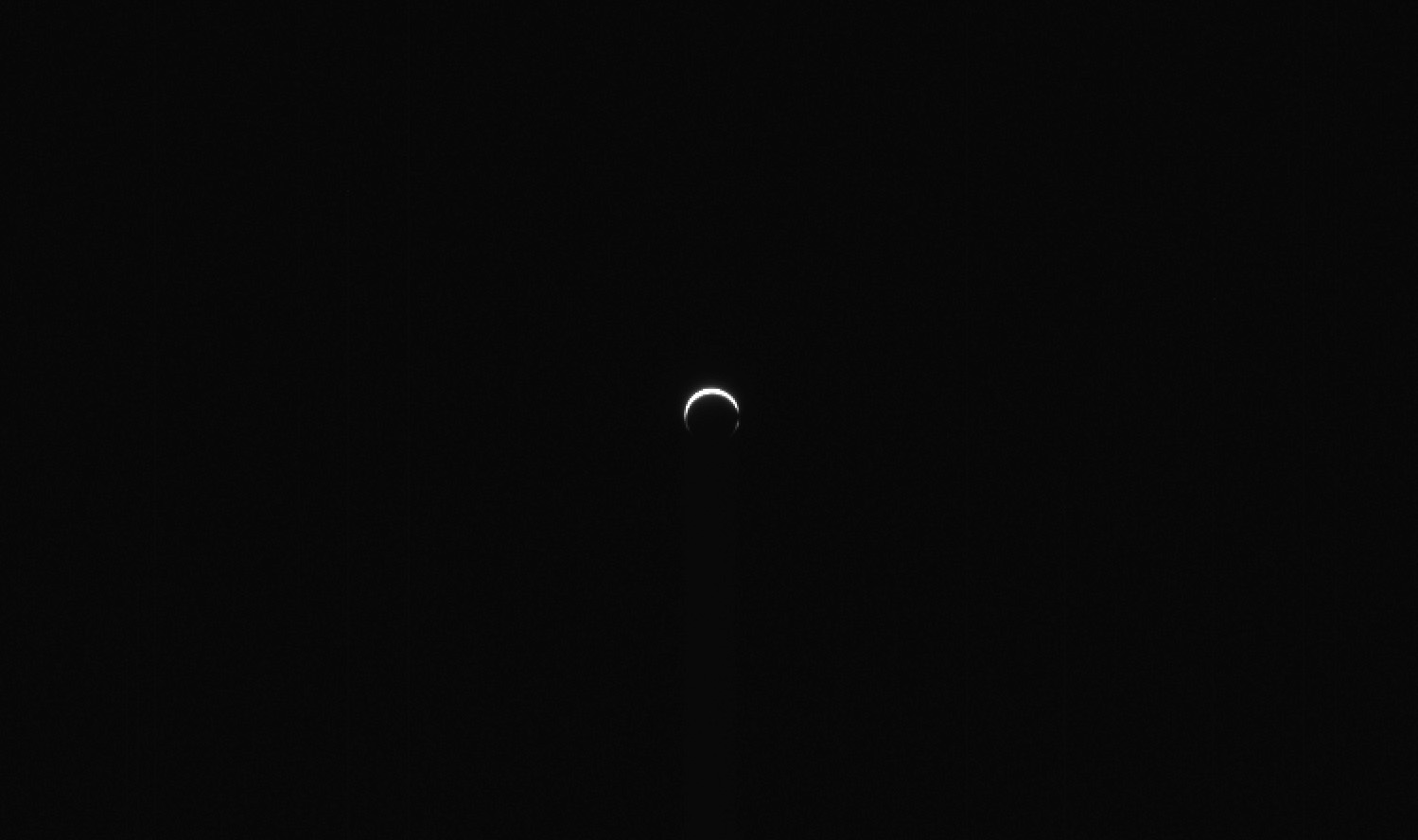
Figure A
Figure A is a zoomed-out view from the imager. No stars are visible in the background since they are much dimmer than the sunlight being reflected by Mars.
The observation was acquired by the multispectral imager instrument’s panchromatic or broadband filter, with an exposure time of just 2 milliseconds. Even with this very short exposure time, the crescent is extremely bright and parts of the image are oversaturated. The light seen here is sunlight reflected off the surface of Mars and also scattered by dust particles in its atmosphere. Because the quantity of dust in the atmosphere can vary rapidly over time, the anticipated brightness of the crescent was hard to predict before this early image was acquired.
The dustiness of Mars leads to sunlight being scattered by its atmosphere, making the crescent appear to extend farther around the planet than if it had no atmosphere (as with our Moon).Of note, on the right side of the extended crescent, there appears to be a gap, which coincides with the planet’s icy north polar cap. The cap is currently in winter and mission specialists hypothesize that seasonal clouds and hazes may be forming in that region, possibly blocking the atmospheric dust’s ability to scatter sunlight like it does elsewhere around the planet.
The Psyche mission’s imager team will be acquiring, processing, and interpreting similar images in the lead-up to the close approach on May 15. The images are primarily designed to calibrate the cameras and to characterize their performance in flight as a practice run for the approach to asteroid Psyche in 2029.
Quelle: NASA
----
Update: 21.05.2026
.
NASA’s Psyche Mission Aces Mars Flyby, Targets Metal-Rich Asteroid
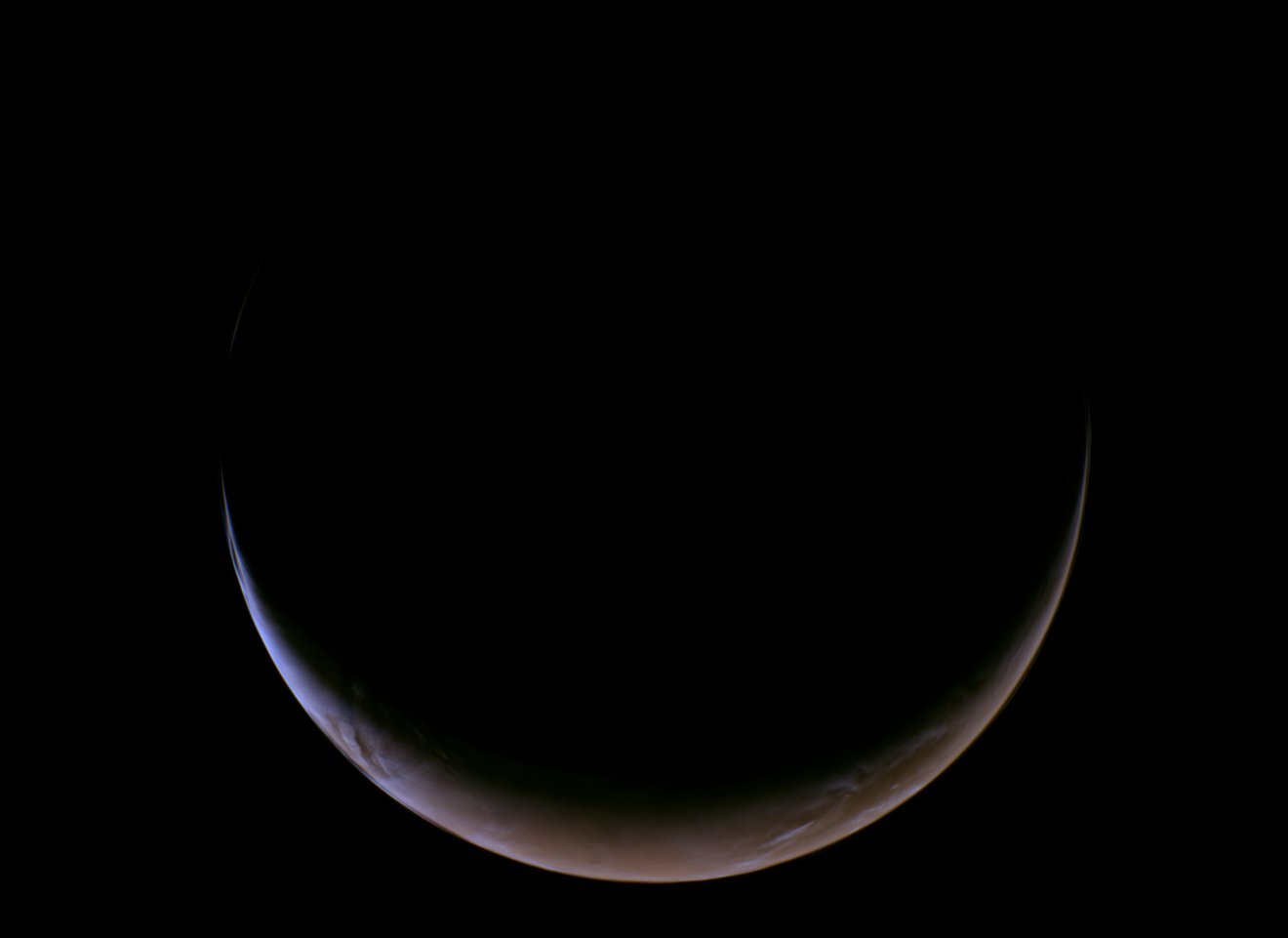
This view of a crescent Mars was captured on May 15, 2026, at about 5:03 a.m. PDT by NASA’s Psyche mission as it approached the planet for a gravity assist. The image has been processed into a natural-color view using red, green, and blue data from the multispectral imager instrument.
Credit: NASA/JPL-Caltech/ASU
The successful flyby of Mars on May 15 provided the mission team with a valuable practice run ahead of the spacecraft’s arrival at the mysterious asteroid Psyche in 2029.
NASA’s Psyche spacecraft completed its close approach of Mars on May 15, coming within 2,864 miles (4,609 kilometers) of the planet’s surface. This flyby used a gravity assist from Mars to provide a critical boost in speed and to adjust the spacecraft’s orbital planel without using any onboard propellant, sending it on its way toward the metal-rich asteroid Psyche.
The spacecraft is now headed directly toward the asteroid, located in the main asteroid belt between Mars and Jupiter. After the Mars flyby, the flight team analyzed radio signals between the spacecraft and NASA’s Deep Space Network (DSN), the agency’s global system for communicating with interplanetary spacecraft, to confirm that Psyche was on the correct trajectory.
“Although we were confident in our calculations and flight plan, monitoring the DSN’s Doppler signal in real time during the flyby was still exciting,” said Don Han, Psyche’s navigation lead at NASA’s Jet Propulsion Laboratory in Southern California. “We’ve confirmed that Mars gave the spacecraft a 1,000 mile‑per‑hour boost and shifted its orbital plane by about 1 degree relative to the Sun. We are now on course for arrival at the asteroid Psyche in summer 2029.”
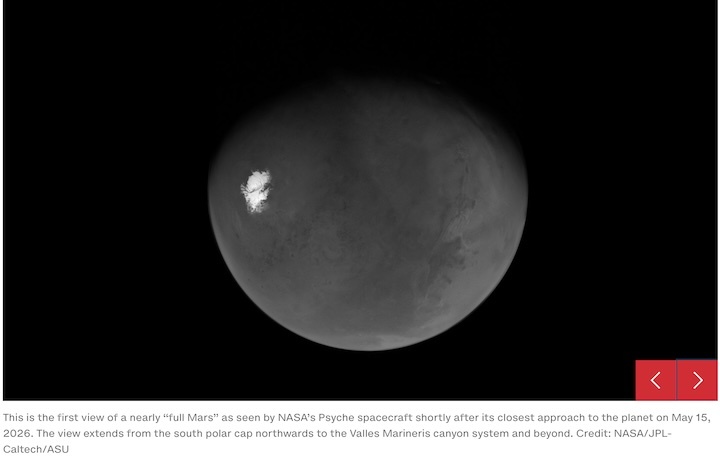
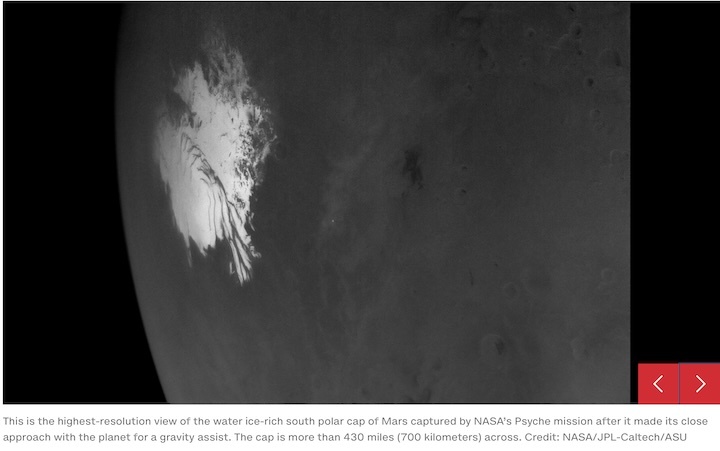
Unique Martian view
In the days running up to and during close approach, all of Psyche’s instruments were powered up for calibration efforts, including its imagers, magnetometers, and gamma-ray and neutron spectrometer. The planetary encounter provided the mission a valuable practice run for when it reaches the asteroid Psyche; as a bonus, it captured Mars images from a rare perspective.
Because Psyche approached Mars from a high phase angle, the planet appeared as a thin crescent in the days running up to the close approach, lit by sunlight reflecting off its surface. In observations from the spacecraft’s multispectral imager, the crescent appeared brighter and extended farther around the planet’s disk than anticipated because of the strong scattering of sunlight through the planet’s dusty atmosphere. As Psyche passed from Mars’ nighttime skies to daytime, it took a rapid series of pictures of the surface around the time of closest approach.
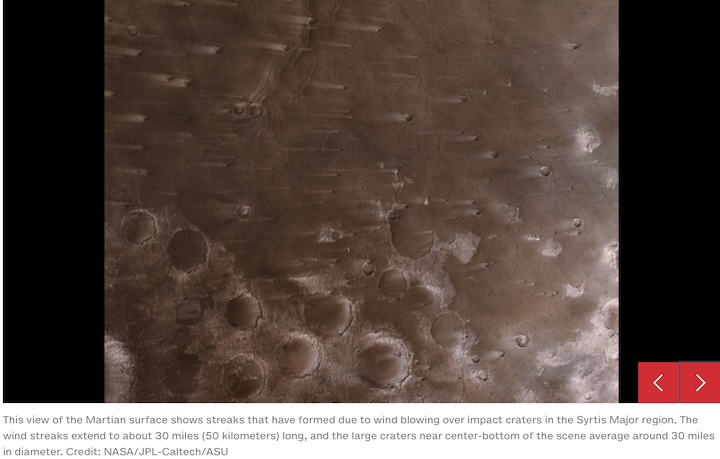
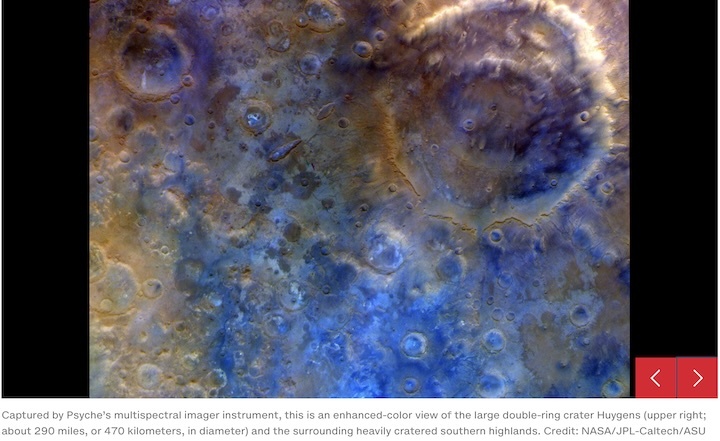
“We’ve captured thousands of images of the approach to Mars and of the planet’s surface and atmosphere at close approach. This dataset provides unique and important opportunities for us to calibrate and characterize the performance of the cameras, as well as test the early versions of our image processing tools being developed for use at the asteroid Psyche,” said Jim Bell, the Psyche imager instrument lead at Arizona State University (ASU) in Tempe. “As the spacecraft continues its journey after the flyby, we’ll continue calibration imaging of Mars for the rest of the month as it recedes into the distance.”
Bell also leads the Mastcam-Z imaging investigation on NASA’s Perseverance Mars rover mission team, which was among several missions that provided complementary surface and atmospheric imaging as well as navigation data during the flyby to help with calibration efforts. Other missions involved include NASA’s Mars Reconnaissance Orbiter, 2001 Mars Odyssey orbiter, and Curiosity rover, along with ESA’s (European Space Agency’s) Mars Express and ExoMars Trace Gas Orbiter.
In addition to the imager, early calibration measurements made by Psyche’s magnetometers may have detected Mars’ bow shock as the spacecraft passed the planet. The gamma-ray and neutron spectrometer team was also quickly gathering data to calibrate the instrument by comparing their measurements with the large pool of existing Mars data.
Onward to asteroid Psyche
With Mars in the rearview mirror, the spacecraft will soon resume using its solar-electric propulsion system to make a beeline to the main asteroid belt. When it arrives in August 2029, it will insert itself into orbit around the asteroid Psyche, which is thought to be the partial core of a planetesimal, a building block of an early planet. Through a series of circular orbits that go lower and then higher in altitude around Psyche, which is about 173 miles (280 kilometers) across at its widest point, the spacecraft will map the asteroid and gather science data.
If the asteroid proves to be the metallic core of an ancient planetesimal, it could offer a one-of-a-kind window into the interior of rocky planets like Earth.
“We’ve been anticipating the Mars flyby for years, but now it’s complete. We can thank the Red Planet for giving our spacecraft a critical gravitational slingshot farther into the solar system,” said Lindy Elkins-Tanton, principal investigator for Psyche at the University of California, Berkeley. “Onward to the asteroid Psyche!”
More about Psyche
The Psyche mission is led by ASU. A division of Caltech in Pasadena, JPL is responsible for the mission’s overall management, system engineering, integration and test, and mission operations. Intuitive Machines in Palo Alto, California, provided the high-power solar electric propulsion spacecraft chassis. The operations of the imager instrument are led by ASU, collaborating with Malin Space Science Systems in San Diego on the design, fabrication, and testing of the cameras.
Psyche is the 14th mission selected as part of NASA’s Discovery Program, managed by the agency’s Marshall Space Flight Center in Huntsville, Alabama. NASA’s Launch Services Program, based at NASA’s Kennedy Space Center in Florida, managed the launch service.
Quelle: NASA
----
Update: 24.07.2026
.
New timelapse video shows NASA's Psyche spacecraft zooming by Mars
"We didn't anticipate big discoveries, given how extensively the planet has been studied, but we did complement Mars science with the data we collected through Psyche's unique perspective."
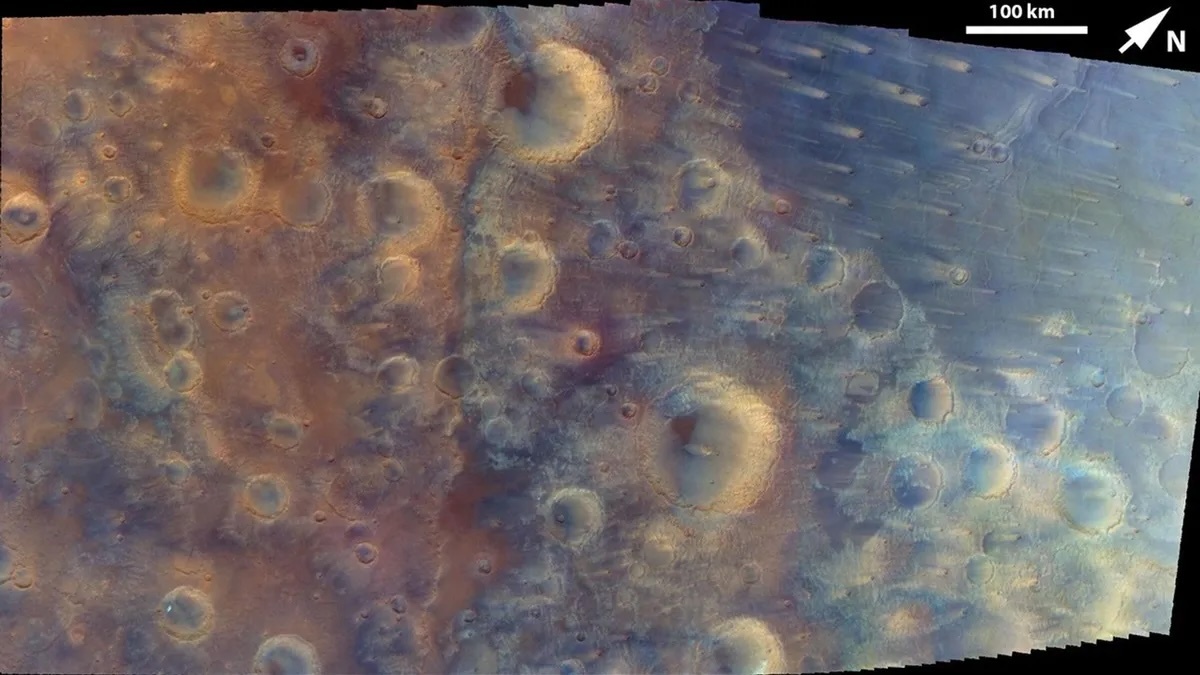
Captured by the multispectral imager instrument on NASA’s Psyche mission, this is an enhanced-color mosaic created from four individual images acquired on May 15, 2026, during the spacecraft’s flyby of Mars. (Image credit: NASA/JPL-Caltech/ASU)
Swelling from a razor-thin crescent into a cratered world before fading back into the darkness, Mars gave NASA's Psyche spacecraft both a spectacular view — and a 1,000-mph boost toward its namesake asteroid.
A new time-lapse video released by NASA, stitched from images taken throughout May, captures the probe's month-long encounter with Mars. On May 15, Psyche swooped within 2,864 miles (4,609 kilometers) of the surface, using the planet's gravity to boost its speed and adjust its trajectory toward asteroid Psyche, a metal-rich world in the main asteroid belt between Mars and Jupiter that the spacecraft is scheduled to reach in 2029.
"This gravity assist was years in the making, and the navigation team nailed it — Psyche flew by Mars on exactly the trajectory we needed to set us on a path to rendezvous with the asteroid in the summer of 2029," Bob Mase, Psyche's project manager at NASA's Jet Propulsion Laboratory in California, said in a statement.
Approaching from a steep or what scientists call a "high phase" angle relative to the sun, Psyche initially caught Mars as a slender crescent with just 4 percent of its disk illuminated and its thin atmosphere glowing in scattered sunlight, Hannah Zigo, a Psyche team member at the Arizona State University, said in a NASA video accompanying the statement.
As the spacecraft closed in, the video follows Mars steadily expanding to reveal numerous craters puncturing its surface, the ancient double-ringed Huygens crater and the south polar ice cap before receding in the spacecraft's rearview.
The flyby served a dual purpose. By aiming Psyche's suite of instruments at a well-studied world, engineers say they calibrated and validated the spacecraft's scientific payload ahead of its 2029 destination.
"We didn't anticipate big discoveries, given how extensively the planet has been studied," Lindy Elkins-Tanton, principal investigator for the Psyche mission at the University of California, Berkeley, said in the statement, "but we did complement Mars science with the data we collected through Psyche's unique perspective."
All three of the spacecraft's science instruments performed as expected, according to NASA. Its gamma-ray and neutron spectrometer, designed to determine the asteroid's elemental makeup, detected the predicted surge of escaping neutrons during closest approach, confirming its operational readiness.
The mission's magnetometer, which will search for evidence that asteroid Psyche is the metallic core of an early planetesimal, recorded its first magnetic signature from a planetary body since its launch in 2023, detecting the bow shock where the solar wind meets Mars' magnetic environment.
Psyche's twin multispectral cameras also passed their calibration tests, capturing the frames for the time-lapse while spotting Mars' tiny moons, Phobos and Deimos, from a distance, the NASA statement read.
Spotting the moons served as "a practice for the satellite search that we'll use at the asteroid Psyche to look for any moonlets there," Jim Bell, a planetary scientist at Arizona State University who leads the multispectral imager instrument team, said in the statement.
With Mars in its rearview and its instruments fully vetted, Psyche remains locked on course for its summer 2029 rendezvous with the metal asteroid.
"The spacecraft is in great shape, and we're on schedule to resume sustained thrusting with the solar-electric propulsion system later this fall," Mase said.
Quelle: SC