
20.10.2026
BANDWAGON-5 MISSION
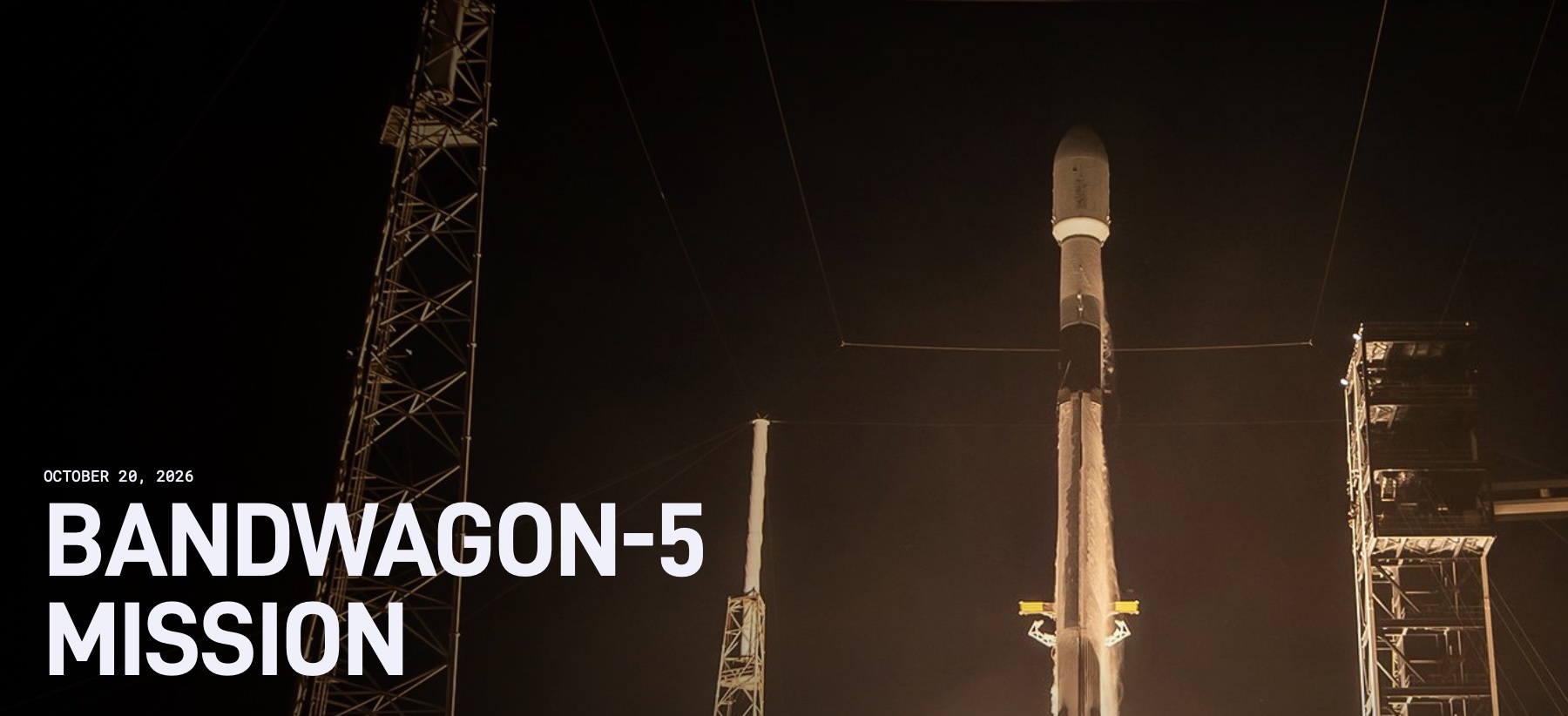
On Tuesday, October 20 at 7:04 a.m. ET, Falcon 9 launched the Bandwagon-5 mission to orbit from Space Launch Complex 40 (SLC-40) at Cape Canaveral Space Force Station in Florida. On board this mission were 32 payloads including cubesats, microsats, and reentry vehicles
This was the 19th flight of the first stage booster supporting this mission, which previously launched Crew-9, RRT-1, Firefly Blue Ghost Mission 1, Fram2, SXM-10, MTG-S1, EchoStar XXV, SXM-11, and now 10 Starlink missions. Following stage separation, the first stage landed on the A Shortfall of Gravitas droneship, which was stationed in the Atlantic Ocean.
Quelle: SpaceX
+++
Falcon 9 launches Bandwagon-5 rideshare mission from Florida
Following on from the successful Transporter 18 mission at the beginning of the month, SpaceX’s Falcon 9 vehicle launched an additional 32 rideshare payloads for the Bandwagon-5 mission on Tuesday, Oct. 20, delayed by a day due to unfavorable recovery weather.
Falcon 9 lifted off from Space Launch Complex 40 (SLC-40) at the Cape Canaveral Space Force Station in Florida. A one-hour launch window opens at 6:30 AM EDT (10:30 UTC), with the vehicle following a southeasterly trajectory to low-Earth orbit.
SpaceX’s Transporter and Bandwagon rideshare missions allow small satellite companies and government and educational institutions to launch payloads of up to 50 kg for $350,000, significantly cheaper than a full Falcon 9 launch. This offers a more affordable and straightforward route to space for many companies. Alongside the rideshare payloads, SpaceX is launching the second of its Starfall capsules, which is mounted atop the satellite stack.
SpaceX’s autonomous droneship A Shortfall of Gravitas recovered the first-stage booster, B1085, downrange in the Atlantic Ocean. B1085 was on its 19th flight, previously supporting the Crew-9, RRT-1, Firefly Blue Ghost Mission 1, Fram2, SXM-10, MTG-S1, EchoStar XXV, SXM-11 and 10 Starlink missions.
Payload deployment began at T+57:18 minutes, with the final Starfall payload scheduled for deployment at T+02:48:28 hours.
SpaceX’s Starfall payload
SpaceX is manifesting its second Starfall capsule for the Bandwagon 5 mission. Starfall Demo, a technology demonstration, launched on June 23 on Falcon 9. The disk-shaped reentry vehicle can remain in space indefinitely and can reenter and be recovered by SpaceX at any time.

Rendering of a Starfall capsule reentering Earth’s atmosphere. (Credit: SpaceX)
The capsule measures 3.1 m in diameter and 0.75 m in height, has a mass of 2,100 kg, and can carry up to 1,000 kg of payload. SpaceX will use the vehicle for point-to-point cargo delivery and for transporting goods manufactured in microgravity.
Starfall has a top plate with maneuvering thrusters; these cold-gas nitrogen thrusters orient the capsule correctly during reentry. The vehicle has a jettisonable heat shield and uses a parachute-assisted splashdown. All elements of the vehicle are recovered by SpaceX recovery vessels, with these initial tests planned to land in the Pacific Ocean around 1,300 km off the coast of the United States or Mexico.
Although Starfall is currently launched aboard Falcon 9, SpaceX will ultimately launch the capsules aboard its super-heavy-lift Starship, with multiple capsules likely to launch aboard the vehicle at one time.
Exolaunch’s payloads
Exolaunch, a launch services and mission management provider, is manifesting 22 customer satellites on Bandwagon-5. The company has provided payloads for every SpaceX rideshare mission to date and has manifested 890 payloads across different launch vehicles, including Rocket Lab’s Electron and Arianespace’s Ariane 6.
One such payload is Impulse Space’s LEO Express 4, an orbital transfer vehicle (OTV) or “space tug.” The highly maneuverable spacecraft is designed to host and deploy payloads within high-energy orbits using its Saiph thrusters. In addition to hosting payloads, the spacecraft can also perform rendezvous and proximity operations (RPO) and space domain awareness (SDA). Three previous spacecraft flew aboard Falcon 9 Transporter missions in 2023 and 2025.
Another set of payloads manifested by Exolaunch includes the Pulsar-01, Pulsar-02, Pulsar-03, and Pulsar-04 by Xona Space Systems. These payloads will form a larger constellation expected to have approximately 250 satellites. The constellation will provide a commercial positioning, navigation, and timing (PNT) system as an alternative to the government-owned Global Positioning System (GPS). Alongside this, these satellites will orbit closer to Earth than traditional GPS satellites, allowing the company to offer a signal at least 100x stronger. This will allow the signal to punch through interference.
Other rideshare payloads
Multiple synthetic aperture radar (SAR) satellites are being manifested on the mission. These include four SAR Earth observation satellites from ICEYE, two high-resolution SAR satellites from Capella Space, and two commercial SAR payloads from Umbra Space. SAR satellites use remote sensing to produce high-resolution imagery in any weather conditions, at any time of day. In addition to supporting military applications, SAR can also measure and observe Earth’s surface features in extreme detail.

Render of Winnebago during reentry. (Credit: Varda Space Industries)
Other payloads on Bandwagon-5 include Planet Labs’ Pelican-12, a very high-resolution optical imager that is set to join the larger Pelican constellation. Another payload is Starburst-1, an ESPA-class bus developed by Portal Space Systems, capable of delivering rapid retasking, RPO, and orbital changes. Starburst shares core systems and manufacturing with Supernova, a solar-thermal spacecraft engineered for maneuverability across orbits, from low-Earth orbit to cislunar space.
Varda Space Industries, a space research company, is manifesting its Winnebago 7 (W-7) capsule on Bandwagon-5. The autonomous free-flying platform was built to return pharmaceutical materials from orbit, with the capsule capable of reaching up to Mach 25 during reentry.
W-7 will contain a new cancer medicine called PROTAC, with Varda testing whether microgravity can overcome the drug’s poor solubility. In microgravity, molecules crystallize differently than on Earth, and the hope is that these crystal structures may improve the medicine’s properties, including its solubility.
Quelle: NSF