
7.11.2026
Blue Origin targeting early January for 1st New Glenn launch since explosion
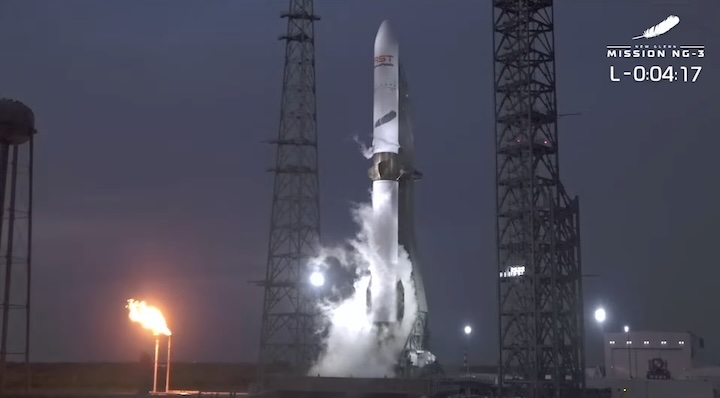
Blue Origin is now targeting the first or second week of January to return to flight since the May 28 New Glenn rocket static-fire explosion inflicted extensive damages across Launch Complex 36 at Cape Canaveral Space Force Station.
CEO Dave Limp made the on-stage announcement during a presentation Thursday, Nov. 5, at the UP.Summit technology conventionat NASA's Kennedy Space Center. More than 1,000 people have worked around the clock rebuilding Blue Origin's launch complex since the huge fiery blast.
"If we can do that, it will be the civil engineering project of all civil engineering projects," Limp told the expo crowd.
"I was just out there this morning. And we're making huge progress," he said.
In recent months, Limp and Blue Origin founder Jeff Bezos said they hoped the next New Glenn launch could occur by year's end. But in his UP.Summit remarks, Limp cited the weather as not working in their favor: Areas of Florida's Space Coast remain reeling from this week's record-shattering rainfall deluge and widespread flooding.
The National Weather Service station at Melbourne Orlando International Airport reported up to 10½ inches of rain fell on portions of NASA's Kennedy Space Center between Sunday, Nov. 1, and Tuesday, Nov. 3.
Blue Origin last launched a New Glenn on April 19 from Cape Canaveral Space Force Station. This marked the heavy-lift rocket's third mission. The first-stage booster stuck a second straight landing atop the drone ship Jacklyn hundreds of miles downrange in the Atlantic Ocean — but the upper stage failed to properly deploy AST SpaceMobile’s BlueBird 7 satellite into low-Earth orbit.
Investigators said the May New Glenn explosion on the pad was triggered by an oxygen-valve issue on one of the rocket's BE-4 engines.
Looking ahead to January, Limp said the next New Glenn first-stage booster is ready for launch, and the upper stage should undergo a hot-fire test in a week or two at NASA's Stennis Space Center in Mississippi. Fully stacked, a heavy-lift New Glenn measures more than 320 feet tall.
He said demand for launches is outstripping capacity, citing communications mega-constellations and data centers in space.
"It has never been higher demand for launch — ever. I think if we had 50 rockets to fly in the next six months, we'd probably fill them all," Limp said.
Blue Origin reveals third rocket stage, new engine
Limp also showed off artist's renderings of GS3, a third rocket stage for New Glenn that is designed for "high-energy" missions like science and exploration missions to the moon and deep space.
"The way that we've kept the vehicle light is by using composites as much as we possibly can. So the performance of this is nothing short of amazing. It can do 15 metric tons direct to (geosynchronous orbit) and 20 metric tons to TLI, to translunar injection," Limp said.
"The world has never seen a rocket that can put that amount of mass to these more-exotic orbits. And we're really excited," he said.
Blue Origin announced a governmental customer is scheduled to launch a three-stage New Glenn in 2028 to the region of space between Earth and the moon.
Limp also revealed the company's new Northstar booster engine, which is fueled by liquid oxygen and liquefied natural gas. He said the engine is more than 65% 3D-printed, and it can be assembled in less than a day.
Blue Origin officials said Northstar reduces mass by 30% and the parts count by 50% over today's BE-4 engine, while increasing power from 640,000 to 715,000 pounds of thrust.
"We're going to want to be able to fly thousands of times a year. And so, these storied places like Cape Canaveral here, they're going to feel like airports in the not-so-distant future," Limp said.
"So we have to scale the whole company to that kind of ambition," he said.
Quelle: Florida Today