
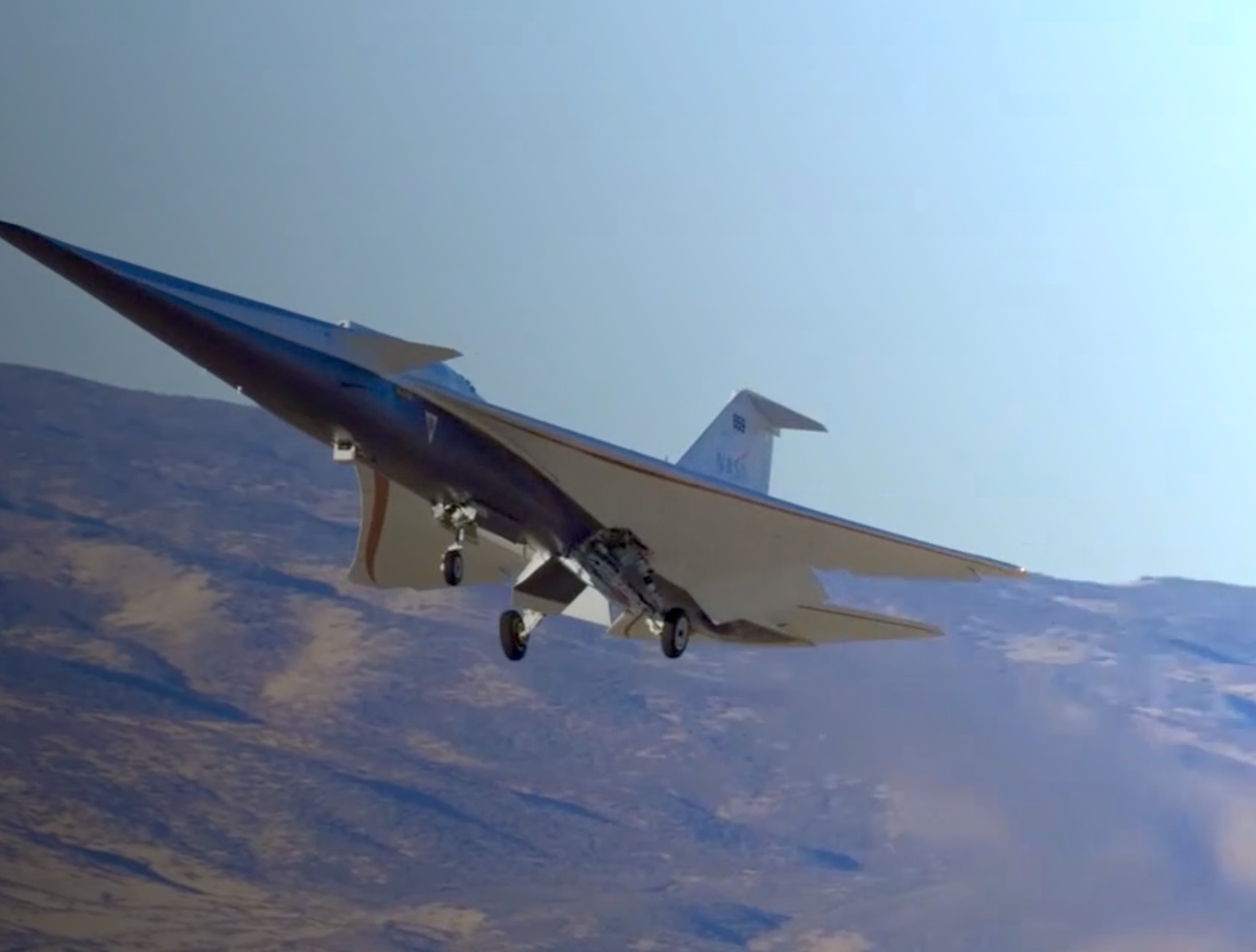
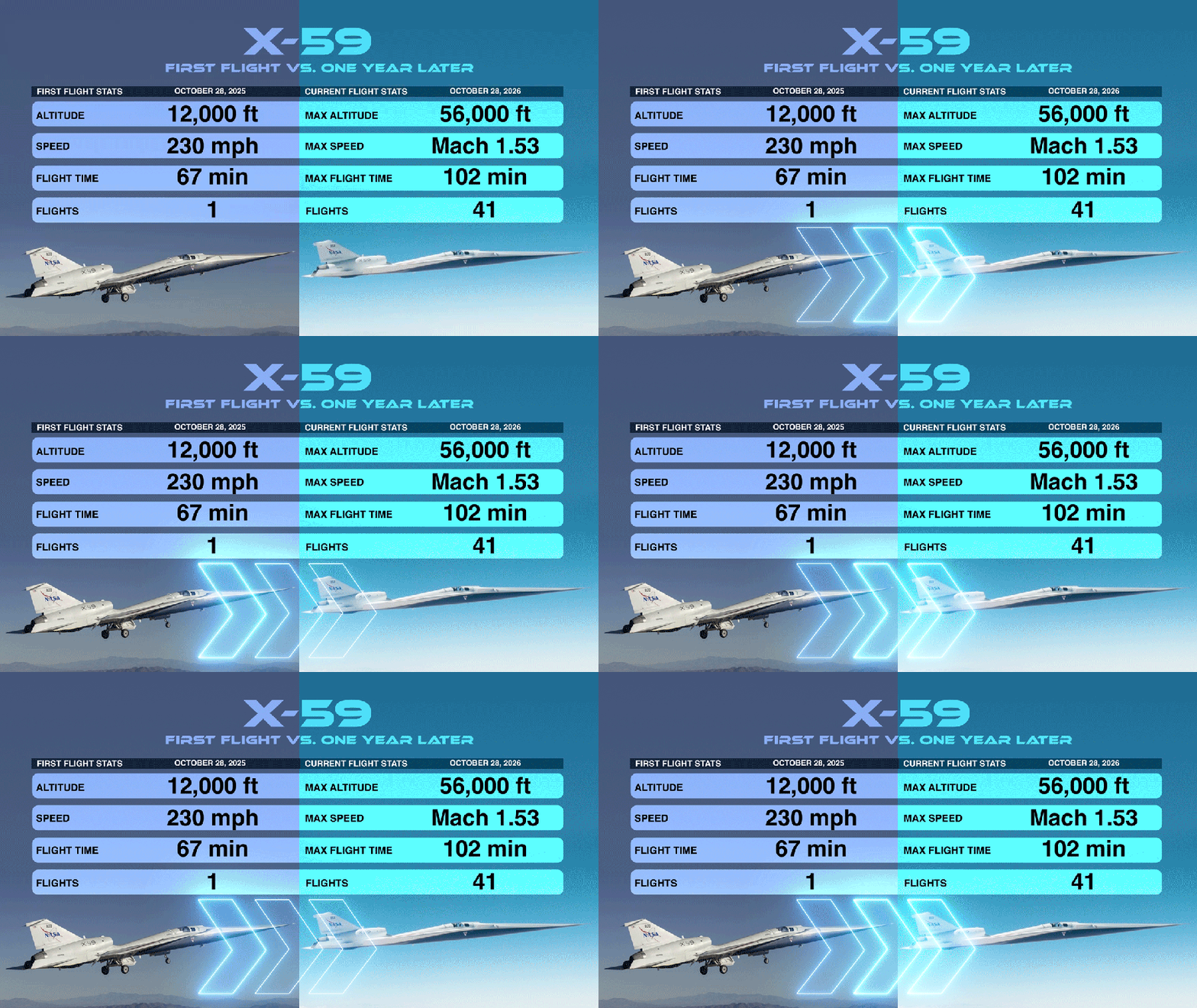
One year ago, NASA’s Quesst mission made history with the first flight of the X-59 quiet supersonic research aircraft. Since then, the X-59 has completed 40 additional flights, marking a year of steady progress for the program. While its first flight on Oct. 28, 2025, focused on low, slow flights to conduct systems checks, the X-59 has since reached a maximum altitude of more than 56,000 feet and speeds up to Mach 1.53. The X-59 has spent […]
+++
NASA’s Mike Lippert Takes Controls of X-59 for First Time
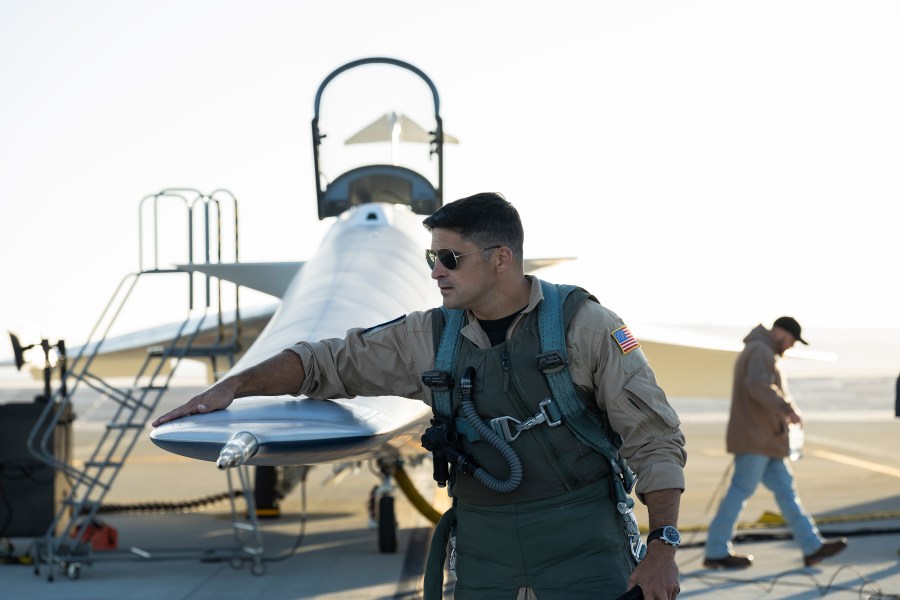
NASA test pilot Mike Lippert put months of simulator training and ground preparation into practice, completing his first flight in the agency’s X-59 quiet supersonic research aircraft.
Lippert took off Oct. 21 from NASA’s Armstrong Flight Research Center in Edwards, California, and landed one hour later. During the flight, he reached a maximum speed of Mach 1.4 and an altitude of 55,000 feet.
Although the X-59 has flown numerous times, the flight marked Lippert’s first opportunity to fly an X-plane during his more than 21 years of flying high-performance aircraft, including 11 years as a test pilot.
“After completing our high-altitude test points, there was a brief period where we descended and decelerated, where I was able to look outside and recognize that I was flying supersonic in an X-plane over the high deserts of the Mojave,” Lippert said. “It was a special moment for sure.”
The flight came after scheduled maintenance and a review of the X-59’s systems following the aircraft’s busiest week of testing to date. In September, the aircraft completed six flights in three days.
During its return to flight Lippert performed various maneuvers to assess the aircraft’s handling while the team evaluated its systems.
Lippert spent months preparing for the milestone. In August, he completed his first engine run, gaining experience with the cockpit and working alongside the mission control team. He also logged extensive simulator time and trained alongside fellow NASA test pilots Nils Larson and Jim “Clue” Less. The preparation ensured Lippert could make a smooth transition from the simulator to piloting the X-59.
“This flight was very special to me,” Lippert said. “For as long as I can remember, I’ve dreamt of doing exactly what I got to do today, testing a truly unique aircraft and working with the exceptional people on this test team.”
+++
Diving into Maintenance with NASA’s X-59
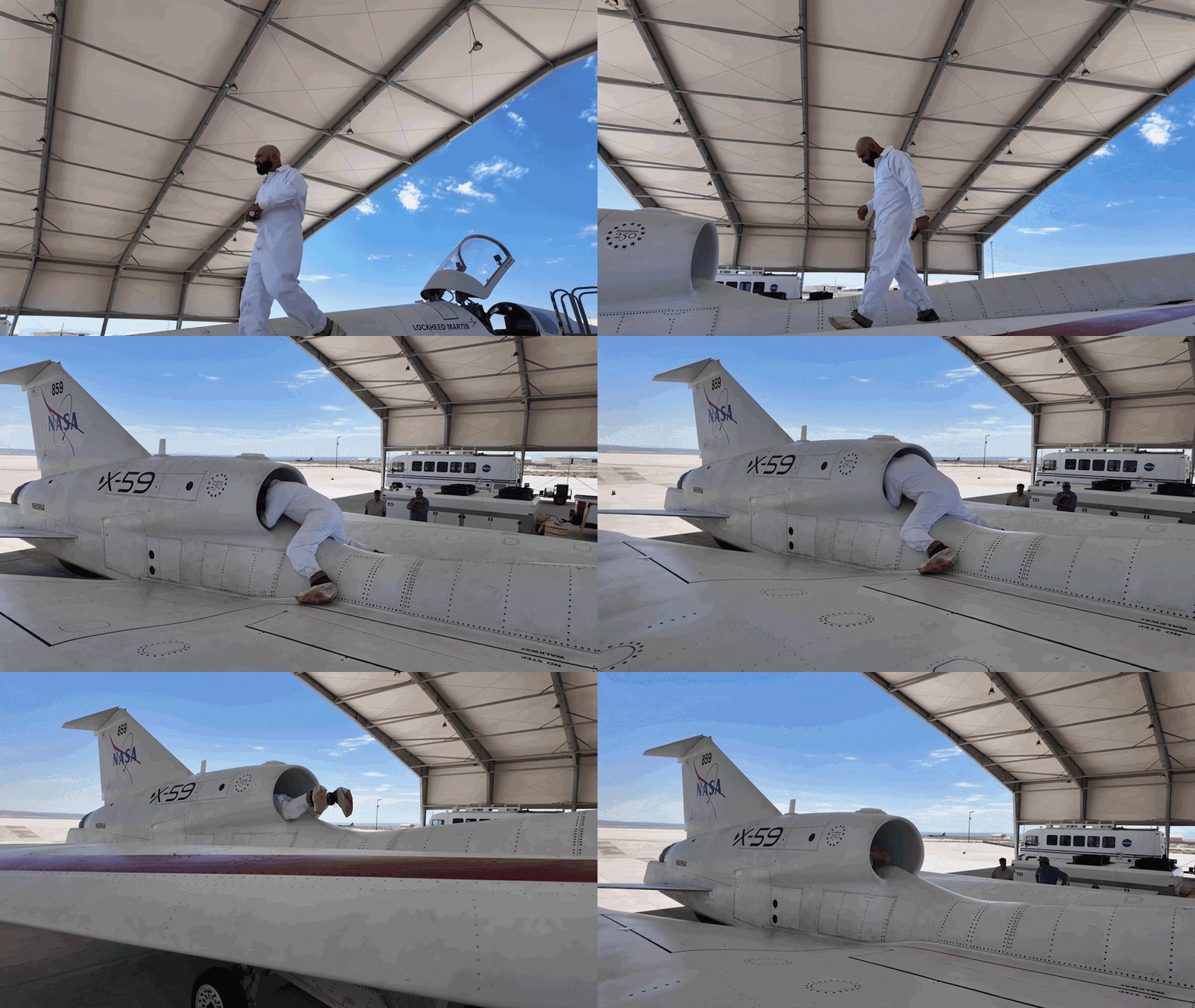
In the California desert, as NASA’s quiet supersonic X-59 paused between its 11th and 12th flights, mechanic Jonathan Reynaga climbed a ladder to the top of the aircraft. Reynaga strode down the plane’s wing until he reached the distinctive air inlet that leads to its engine and stuck his head in.
And then he dove in headfirst, completely disappearing.
The moment, caught on video in the spring of 2026, might seem bizarre to those unfamiliar with aircraft maintenance. But “duct diving” is just part of a regular day at NASA’s Armstrong Flight Research Center in Edwards, California.
“It’s a pretty normal procedure for aircraft maintenance,” said Paul Dees, NASA X-59 deputy propulsion lead. “What they’re trying to do is check for any potential damage, any potential foreign objects or debris that could affect engine performance.”
The X-59’s inlet slopes down toward its single engine, so Reynaga, a general flight mechanic with X-59 contractor Lockheed Martin Skunk Works, had his head lower than his feet as he went in. In a space not much wider than his shoulders, he used a flashlight to inspect the engine’s fan blades and other components. Reynaga had to move carefully around special sensors that the research team uses to gather data on engine performance.
He remained in the inlet for few minutes before wriggling out backwards, with another member of the crew keeping an eye on him throughout the process. The X-59 team makes sure its technicians stay safe and avoid overheating.
“It’s not a temperature-cool job,” Dees said. The X-59 stays in the shade for maintenance, but desert temperatures regularly rise to over 100 degrees Fahrenheit, and the aircraft is still cooling down post-flight as technicians work on it.
The checkup was brief, but vital. Although the X-59 undergoes in-depth maintenance on a regular schedule, a duct dive paired with a visual examination of the aircraft’s exhaust after every flight is a good way to quickly assess the health of its engine.
Technicians duct dive on NASA’s research jets across its centers. At Armstrong, that includes the aircraft that accompany the X-59 on test flights: an F-15 with deep, rectangular inlets that a person can crawl in fairly comfortably, and an F/A-18 with round, tight, curving inlet spaces that make for a less pleasant experience.
The X-59’s inlet has few advantages over the F/A-18, according to Juan Salazar, crew chief for the agency’s Low Boom Flight Demonstrator project. It’s similar to the F/A-18’s inlet in diameter but shallower, making for an easier dive.
Regardless of the aircraft, a human mechanic is still the best way to get the job done.
“Maybe one day there will be something that will replace this inspection, but right now, the best way to do it is to send a person in,” said Salazar.
The X-59 has a top-mounted engine, a key design element. The top mount helps the X-59 separate the shock waves that build up on its surfaces during supersonic flight. For traditional supersonic planes, the shock waves trailing the aircraft would pile up on each other as they traveled to the ground, ultimately leaving two that would be heard as a sonic boom. The X-59 prevents those waves from merging, for a quiet sonic thump.
The top mount also means the X-59’s engine doesn’t pull in the kinds of debris that can get sucked up by more conventional, lower-mounted engines during takeoffs and landings, Salazar said.
All of which means that after 38 flights, the X-59’s duct dives have found nothing but a damage-free engine. “And that’s how we like it,” Dees said.
Quelle: NASA