
26.03.2026
NASA's '1st nuclear powered interplanetary spacecraft' will send Skyfall helicopters to Mars in 2028
Skyfall will fly on Space Reactor-1 Freedom, which will demonstrate "advanced nuclear electric propulsion in deep space."
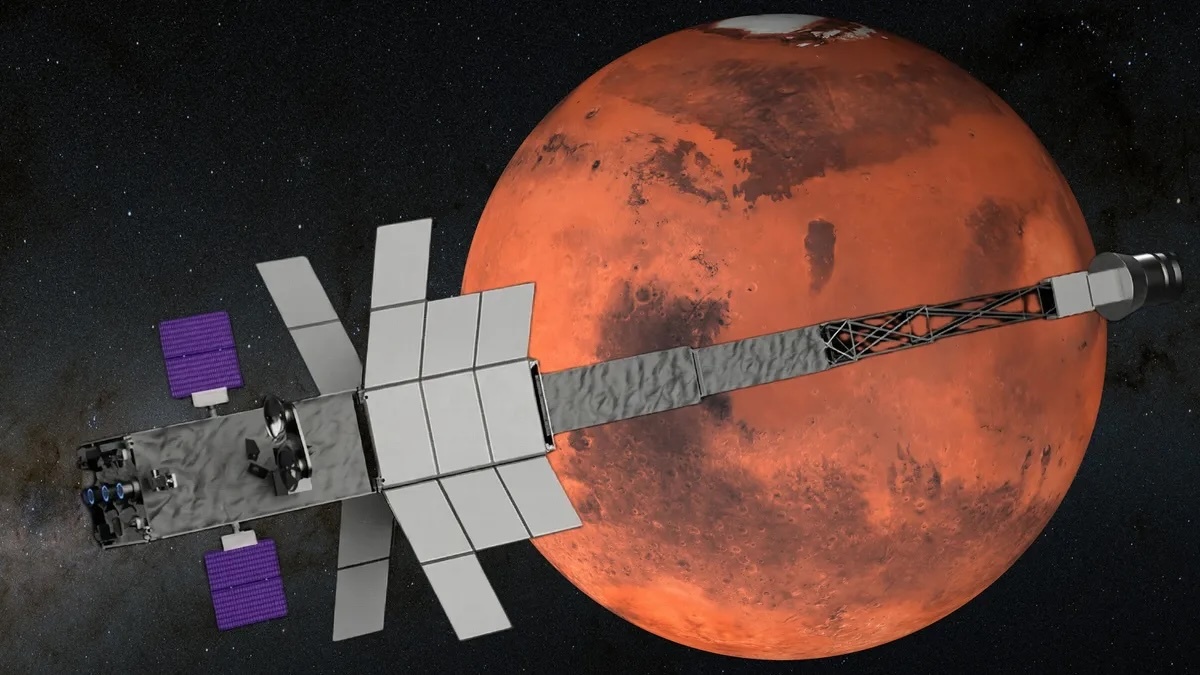
Illustration of NASA's SR-1 Freedom spaceship in front of an illustration of Mars.(Image credit: NEMES LASZLO/SCIENCE PHOTO LIBRARY/Getty Images/NASA)
Skyfall is happening, and it will get to Mars in a totally new way.
Last summer, NASA's Jet Propulsion Laboratory and the Virginia company AeroVironment unveiled their Skyfall mission concept, which would send a fleet of tiny helicopters to explore the skies of Mars.
Today (March 24), NASA announced that it will develop Skyfall for a 2028 launch, and that the mission will journey to the Red Planet on a spacecraft that uses nuclear electric propulsion (NEP) — what NASA is referring to as "the first nuclear powered interplanetary spacecraft."
NEP systems operate like nuclear power plants here on Earth, relying on an onboard fission reactor. NEP is a fundamentally different technology than radioisotope thermoelectric generators (RTGs), which have powered the instruments of NASA deep-space probes like Voyager for decades. RTGs use the heat of radioactive decay to generate electricity; they are not involved in propulsion.
"Requiring operating temperatures less than nuclear thermal propulsion, the thermal energy produced by the reactor generates electricity, which is then used to power highly efficient electric thrusters," NASA officials wrote in a descriptionof the agency's NEP efforts.
NASA views NEP tech — which can operate at all distances from the sun — as key to its future exploration efforts, from robotic missions to the outer solar system to the operation of a moon base via its Artemis program.
So the centerpiece of the Skyfall mission may not be its fleet of Mars helicopters but rather their interplanetary ride — a spacecraft called Space Reactor-1 (SR-1) Freedom.
"SR-1 Freedom will establish flight-heritage nuclear hardware, set regulatory and launch precedent, and activate the industrial base for future fission power systems across propulsion, surface and long‑duration missions," NASA officials said today in a statement announcing the mission.
"NASA and its U.S. Department of Energy partner will unlock the capabilities required for sustained exploration beyond the moon and eventual journeys to Mars and the outer solar system," they added.
That statement features a wealth of other exploration news and updates. For example, NASA also announced today that it's pausing its long-planned Gatewaymoon-orbiting space station to focus on building a base on the lunar surface — and some of Gateway's hardware will go into the construction of that outpost.
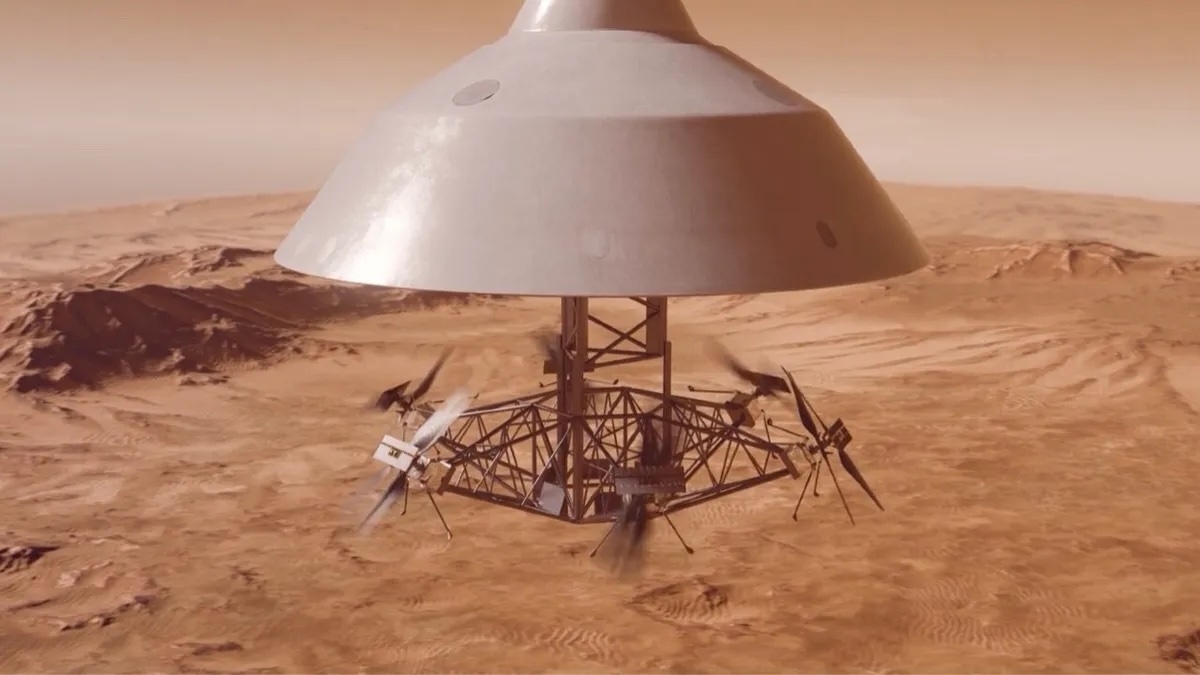
An illustration of the "Skyfall" helicopter concept that could deploy six scouts to Mars. (Image credit: AeroVironment)
That statement doesn't reveal many details about the planned Skyfall mission, but NASA revealed some during a webcast presentation today.
For example, Skyfall will feature three little helicopters, which will be similar to Ingenuity, the NASA rotorcraft that landed on the Red Planet with the Perseverance rover in February 2021. Ingenuity became the first helicopter ever to operate on a world beyond Earth, making a whopping 72 flights between April 2021 and January 2024.
Whereas Ingenuity was a technology demonstrator, however, the Skyfall fleet will have concrete tasks. Chief among them is scout: If all goes to plan, the little choppers will help NASA assess the potential of their target area (wherever that happens to be) to support human exploration.
The Skyfall helicopters will carry cameras and ground-penetrating radar to scout a future landing site, to understand the slopes and hazards for human-scale landers," Steve Sinacore, the program executive for NASA's Space Reactors Office, said during the briefing.
"They will also map and characterize the subsurface water ice to find out where the water ice deposits are, along with the size, depth and other important characteristics," he added.
If goes according to plan, the mission will launch in December 2028 and arrive at Mars about a year later. And that might not be the end of the line for SR-1 Freedom; NASA may decide to keep flying the spacecraft out into the solar system after it deploys the Skyfall choppers, according to Sinacore. The mission architecture, like much of NASA's exploration portfolio, is not yet finalized.
Quelle: SC
----
Update: 10.07.2026
.
NASA begins funding hardware for 'Skyfall' Mars helicopter mission
NASA is hoping to launch the mission to Mars in 2028.
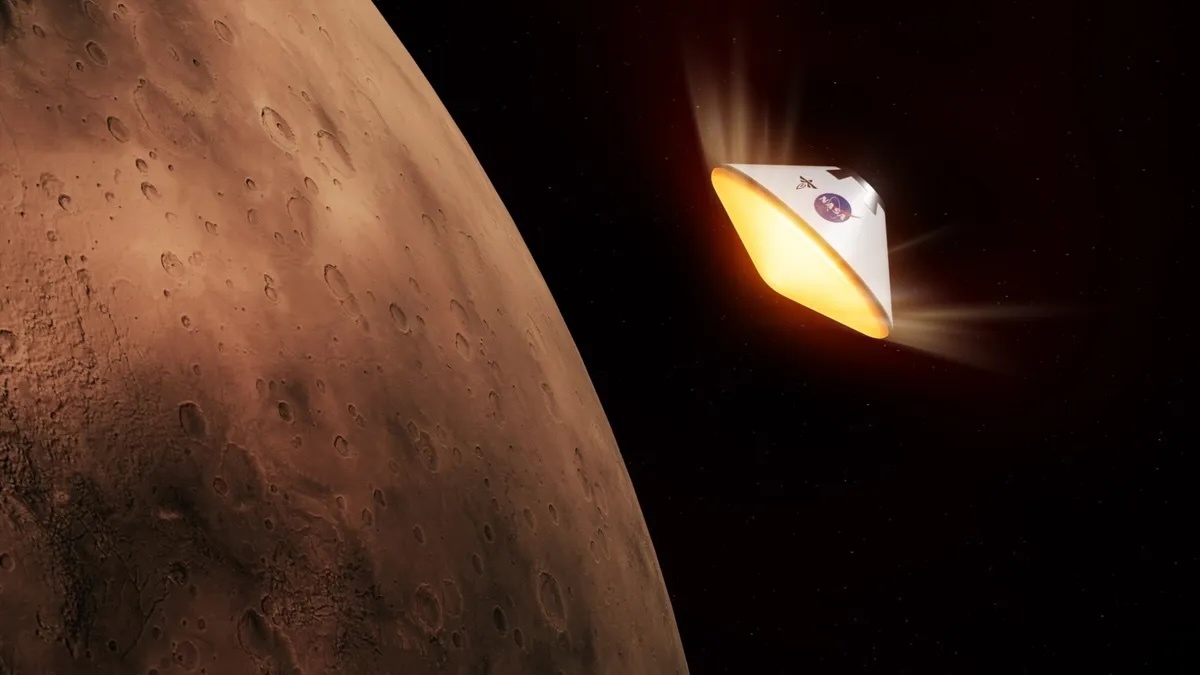
Rendering of aeroshell for NASA SkyFall mission to Mars (Image credit: Firefly Aerospace)
NASA's nuclear-powered mission to Mars is taking shape with the selection of Firefly Aerospace to design and manufacture the protective aeroshell that will shield the Skyfall spacecraft's descent stage during its plummet through the Martian atmosphere.
Skyfall, slated to be NASA's first-ever nuclear powered interplanetary probe, is scheduled to launch in 2028 with three helicopters similar to the Ingenuity drone that landed on the Red Planet with the Perseverance rover. The mission is being managed by NASA's Jet Propulsion Laboratory (JPL), in California, which just awarded Firefly a $13 million subcontract for the spacecraft component.
It will be the company's first project to be developed in its expanded Texas facility, Gloworks, and will lean on engineering expertise gained from its Blue Ghost lunar lander and Firefly's Alpha and Eclipse rockets, according to a company statement.
"We've proved our ability to execute off-Earth missions at a fraction of the cost and timeline through our successful Blue Ghost lunar mission," said Ray Allensworth, Firefly's vice president of spacecraft. "Now we’re applying these lessons learned and utilizing our proven technologies to continue accelerating and lowering costs for future missions to the moon, Mars, and beyond."
Blue Ghost launched in January 2025, and successfully touched down on the moon about two months later, as only the second commercial lander to ever soft land on the lunar surface. For its Mars contract, though, Firefly will be aiming higher.
Firefly's aeroshell design will include the Skyfall capsule's heatshield and its backshell, providing the thermal protection it needs from the Martian atmosphere and the aerodynamic characteristics to guide it safely and accurately out of its exit from the vacuum of space. Unlike Blue Ghost, however, Firefly won't need to worry about an actual landing.
Instead of delivering its helicopter trio to Mars' surface, Skyfall will release them mid-descent, where they will take to immediate flight through the Martian sky to begin their resource mapping mission. NASAis calling it the "SkyFall Maneuver."
The mission aims to demonstrate the applicability of the helicopters' onboard prospecting instruments. NASA plans to use that data to scout for water ice on Mars' surface to study potential landing sites for crewed missions in the future.
Once Firefly completes aeroshell development at Gloworks, work will move to the company's Rocket Ranch in Briggs, Texas, where it will begin manufacturing and testing before being transported to JPL for spacecraft integration.
Quelle: SC
----
Update: 8.08.2026
.
NASA Tests Featherweight Radar Antenna for SkyFall Mars Helicopters
When the trio of NASA’s SkyFall helicopters takes to the Martian skies, one of their tasks will be to hunt for frozen water — a critical resource for future astronauts — using ground-penetrating radar. For that radar to work, each rotorcraft will carry a flexible, fabric-based antenna that will need to extend below the aircraft without interfering with landings, or breaking upon impact. It is a specialized design for the mission, and it recently cleared a round of testing at the agency’s Jet Propulsion Laboratory in Southern California.
Although orbiting spacecraft can map the thick Martian ice deposits tens of yards below the surface, they’re effectively blind to the top several yards of regolith, or broken rock and dust. This shallow zone is what will matter most for future astronauts, who will need to easily reach and process ice for water, oxygen, and fuel.
“The only way to detect shallow subsurface ice remotely is to fly close to the ground,” said Adrian Tang, SkyFall’s ground-penetrating radar lead instrument scientist at JPL. “By flying low and slow, a SkyFall helicopter could capture radar images that resolve the fine layering where dry soil gives way to ice, detecting its presence and mapping its extent.”
Composed for Mars
To peer beneath the Martian surface, SkyFall’s ground-penetrating radar will use an ultra-wide frequency range — from 500 to 2,500 megahertz — corresponding to wavelengths of about 24 to 5 inches (60 to 12 centimeters). The longest wavelengths can penetrate several yards below the surface. The shorter wavelengths provide finer detail about the uppermost layers and surface texture.
This is where the unique antenna design comes in. A traditional antenna operating in that part of the electromagnetic spectrum would need to be 19 inches (48.3 centimeters) long and have a clear view of the ground, but the minimum clearance between Mars’ surface and the base of the helicopter’s fuselage is only about 6 inches (15.2 centimeters). The team needed an antenna that wouldn’t interfere with or be damaged by landing.
After an extensive search for the right antenna, the SkyFall team zeroed in on the Vivaldi because it can transmit and receive signals across a large, continuous range of radio frequencies, and because its flat, lightweight profile can be easily cut into flexible, metalized fabrics. The curvilinear antenna was named by its inventor, Peter Gibson, who felt its sweeping lines resembled a violin, an instrument associated with composer Antonio Vivaldi.
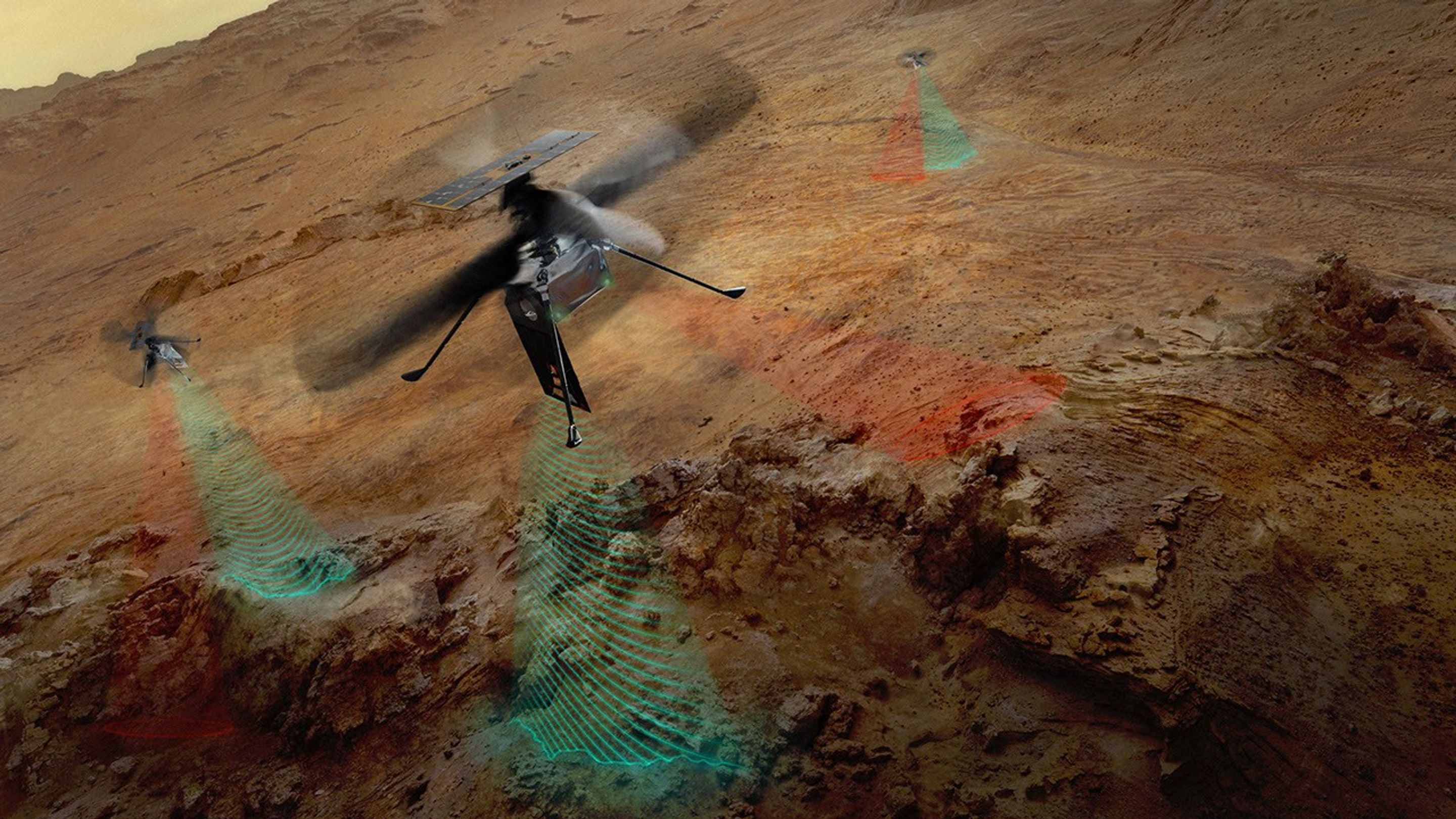
While the standard Vivaldi footprint was efficient and robust, it was still too large to work with SkyFall’s ground clearance. Fortunately, SkyFall’s ground-penetrating radar can be further miniaturized because it is designed specifically for shallow surveying (under 16 feet, or 5 meters) in the dry Martian regolith, which blocks radio waves far less than Earth’s soil. The team developed techniques to reduce the antenna’s size even more without sacrificing sensitivity.
“Although we managed to shrink the antenna quite a bit, it is about 1½ times longer than the helicopter’s legs,” said Christine Gebara, SkyFall ground-penetrating radar mechanical lead at JPL. “That means during landing, the Vivaldi has to bend out of the way — and if it lands on a rock, it bends even further. But when the helicopter takes off again, the antenna must spring back into place for data collection. Because SkyFall is expected to make dozens of flights exploring Mars, we needed an antenna that could repeatedly handle those pressures without losing its shape in flight.”
To ensure their downsized Vivaldi could withstand flight operations, the team sheathed it in a polyester and then layers of Vectran — the same flexible, superstrong material used for the landing airbags containing NASA’s Spirit and Opportunity Mars rovers. To help the antenna maintain shape while airborne, engineers added flexible fiberglass tape springs and a lightweight magnesium mounting structure. The entire setup weighs about 5 ounces (150 grams), slightly more than two violin bows.
Testing Vivaldi
Testing space hardware concepts with paper designs and mathematical models can get a mission only so far. The team needed to prove their antenna prototype could survive a full mission’s worth of intense temperature swings and space radiation.
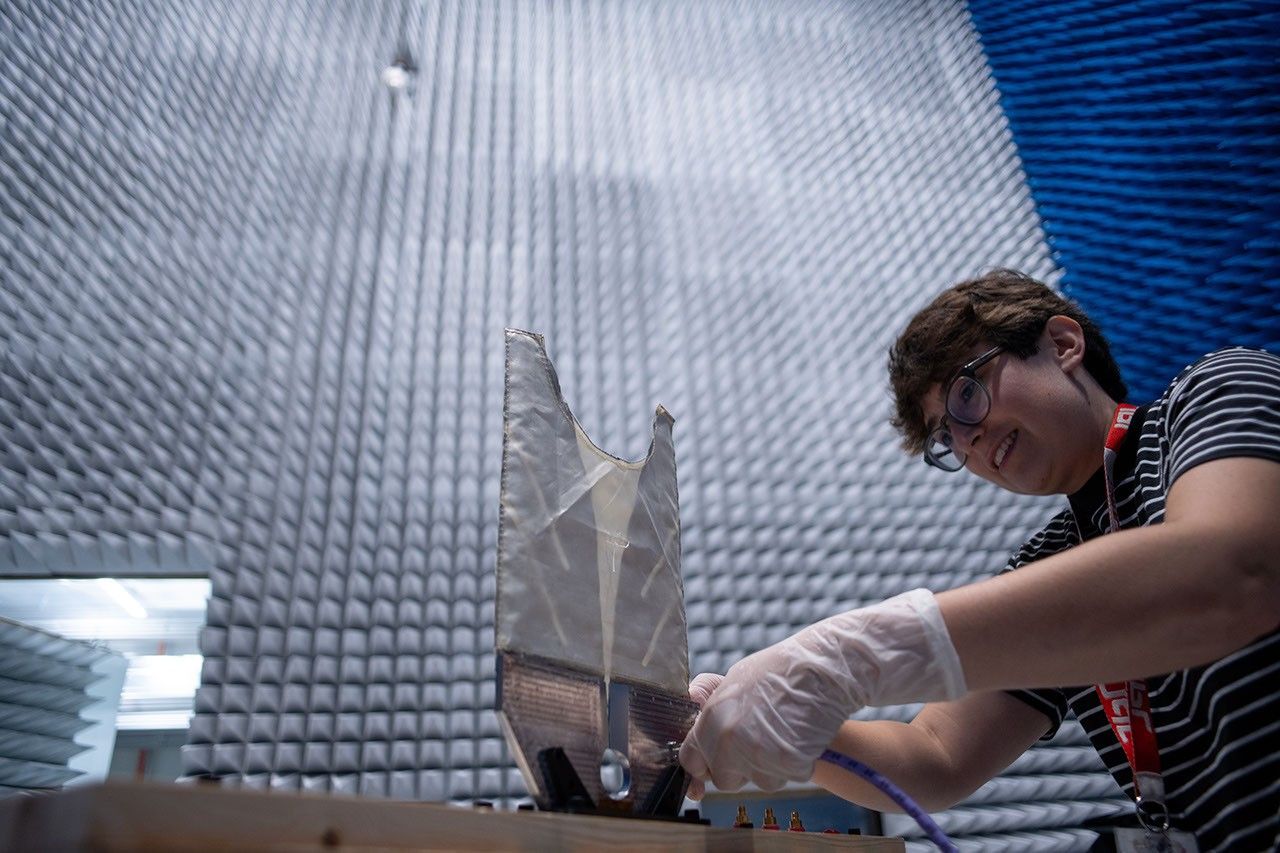
Working in JPL’s Environmental Test Laboratory, engineers bent the antenna to simulate one possible orientation after a SkyFall flight at Mars. Then they ran it through dramatic thermal shifts to simulate the Martian day-night cycle, during which temperatures can swing by as much as 170 degrees Fahrenheit (94 degrees Celsius). Next, they repeatedly flexed the antenna as if it had gone through dozens of landings. Along the way, they paused six times to carry the hardware to an electromagnetic test chamber to verify that its ability to beam and receive radar signals hadn’t diminished.
During radiofrequency testing, the team inverted the antenna so that the bottom pointed up — a setup that stresses the structure more than Mars’ one-third gravity ever would — and tested signal performance. By the end of the test campaign, the antenna had withstood 200 Mars landings, more than double what would be required for a successful prime mission, with no loss of performance.
“This test checked every box it was supposed to and answered our biggest technical questions,” said Tang. “While we still have work ahead of us before the antenna is fully flight-qualified, this was a major milestone, and the hardware performed exactly as expected.”
With the antenna’s first big test campaign behind it, the ground-penetrating radar team is building an engineering model that will endure vibration testing, deployment in a simulated Martian environment, signal testing, and outdoor trials at JPL’s Mars Yard.
Equipped with four instruments each, the three SkyFall aircraft follow in the footsteps of NASA’s Ingenuity Mars Helicopter, which flew 72 times over nearly three years, proving that powered, controlled flight is possible in the rarefied Martian atmosphere. It also demonstrated how an aerial perspective can generate valuable data by helping NASA’s Perseverance Mars rover team plan time-saving routes and choose locations for science-gathering.
SkyFall is expected to launch aboard NASA’s Space Reactor-1 Freedom in late 2028.
Quelle: NASA