
6.11.2026
Asteroids that come too close to the Sun don’t last long. Now astronomers think they might know why.
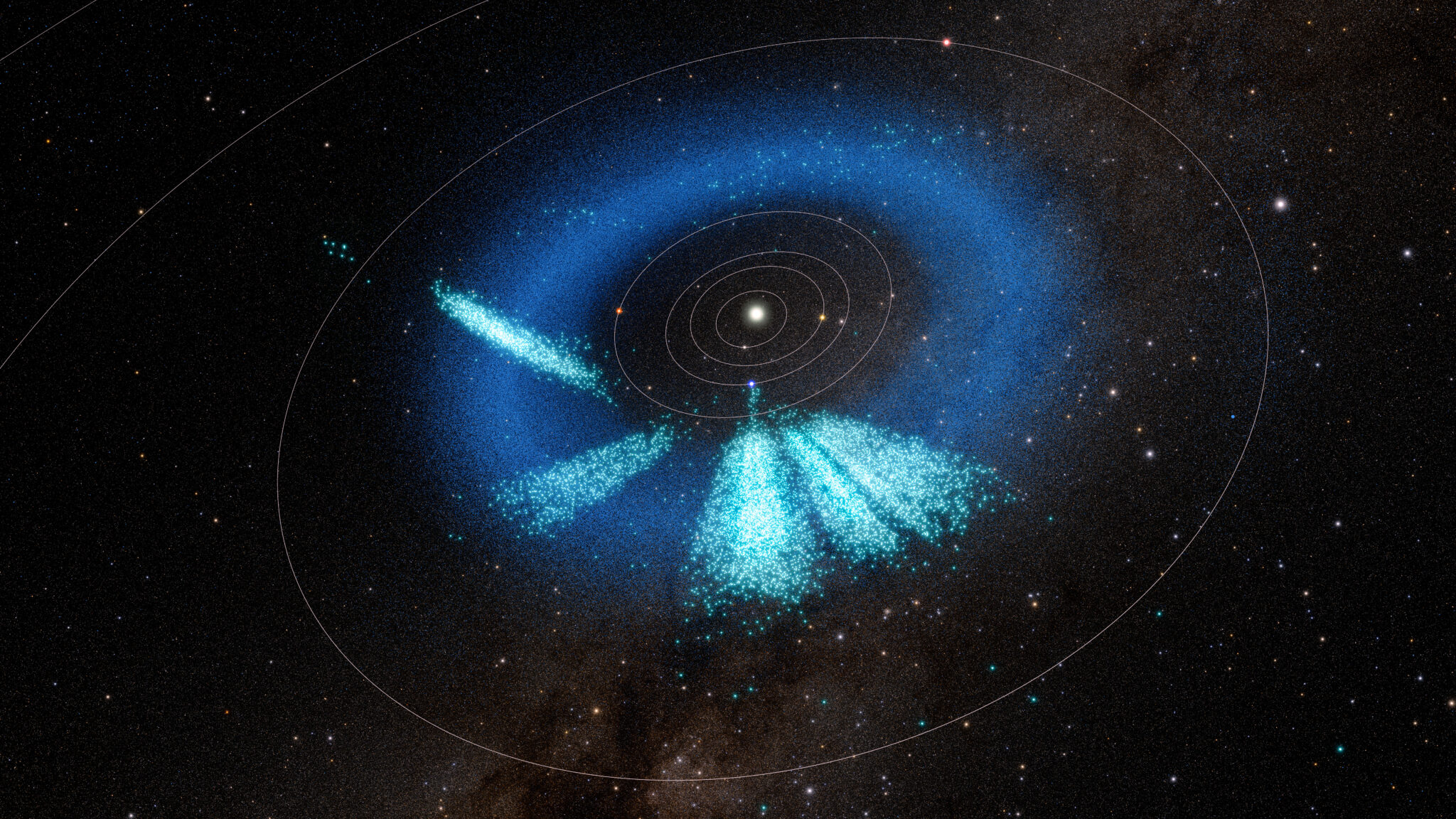
Coming too close to the Sun isn’t good for an asteroid. Sunlight removes bits and pieces off the body’s surface, until nothing is left but a stream of particles — one we might see on Earth as a meteor shower
That is the solution to the case of missing near-Sun asteroids, as presented by Mikael Granvik, (Luleå University of Technology, Sweden, and University of Helsinki, Finland). Granvik reported results of laboratory experiments on material that simulates asteroid surfaces at last week's meeting of the American Astronomical Society’s Division of Planetary Sciences in Spokane, Washington.
Granvik opened the case in 2016. He and his colleagues had calculated the evolution of orbits for near-Earth asteroids. They found that some would develop trajectories that would approach the Sun, coming closer than Mercury, the innermost planet at 0.4 astronomical unit (au) from the Sun. But few asteroids have been found with such orbits, with observed asteroids numbers several times lower than expected.
“[The difference] stuck out like a sore thumb,” Granvik tells Sky & Telescope.
Apparently, most asteroids don’t survive coming closer than around 0.2 au to the Sun. But the Sun’s heat can’t vaporize asteroids at those distances, so some other mechanism had to be involved. Did repeated heating and cooling of their surfaces as they rotated crack them up? Were they spun up so fast they couldn't hold together anymore? Or were they being bombarded by the remnants of comets, more fragile objects that had themselves disintegrated near the Sun?
Whatever is happening, it’s grinding down bodies that are already quite small, less than 100 meters (300 feet) across. It’s not clear how small they end up getting. Different researchers have made various estimates as to the fragments’ final size scale, from meters to centimeters or even smaller. “Based on our lab experiments, I would put my money on the millimeter scale,” Granvik says.
A key clue came from the well-known asteroid 3200 Phaethon, the source of the Geminid meteor shower in December. It’s a large body, with a diameter of 5.8 kilometers (3.6 miles), and its orbit stays just outside the apparently lethal zone. But Phaethon nevertheless show signs of distress: It develops a comet-like tail when it comes closest to the Sun, providing the source particles for the Geminid meteor stream. (The rocky comet is the destination of Japan’s DESTINY+ mission in 2030, in which Granvik is involved.
To find out what process is breaking down near-Sun asteroids, Granvik and his collaborators built an experiment called the Space and High-Irradiance Near-Sun Simulator, or SHINES. The vacuum-chamber experiment replicates the intense radiation near the Sun. Within that hot and bright chamber, the team placed a piece of material manufactured to resemble a common type of meteorite, called carbonaceous chondrites. These types of asteroids are the most depleted near the Sun. Using a lamp like those used in movie theaters, SHINES concentrates the bright solar spectrum on a small surface.
In January, Granvik reported in Icarus that, once the irradiated surface became hot enough, millimeter-size pieces of the sample were "explosively" ejected. Eventually, as heat penetrated further in, the whole sample disintegrated.
“It's more challenging than you would think to actually find the mechanism that's causing it,” Granvik notes, “but in all the experiments we see a significant outgassing of the volatile elements, such as water, sulfur, and so forth.”
Quelle: Sky&Telescope