
26.10.2026
NAS releases independent report recommending four sites astronauts could visit
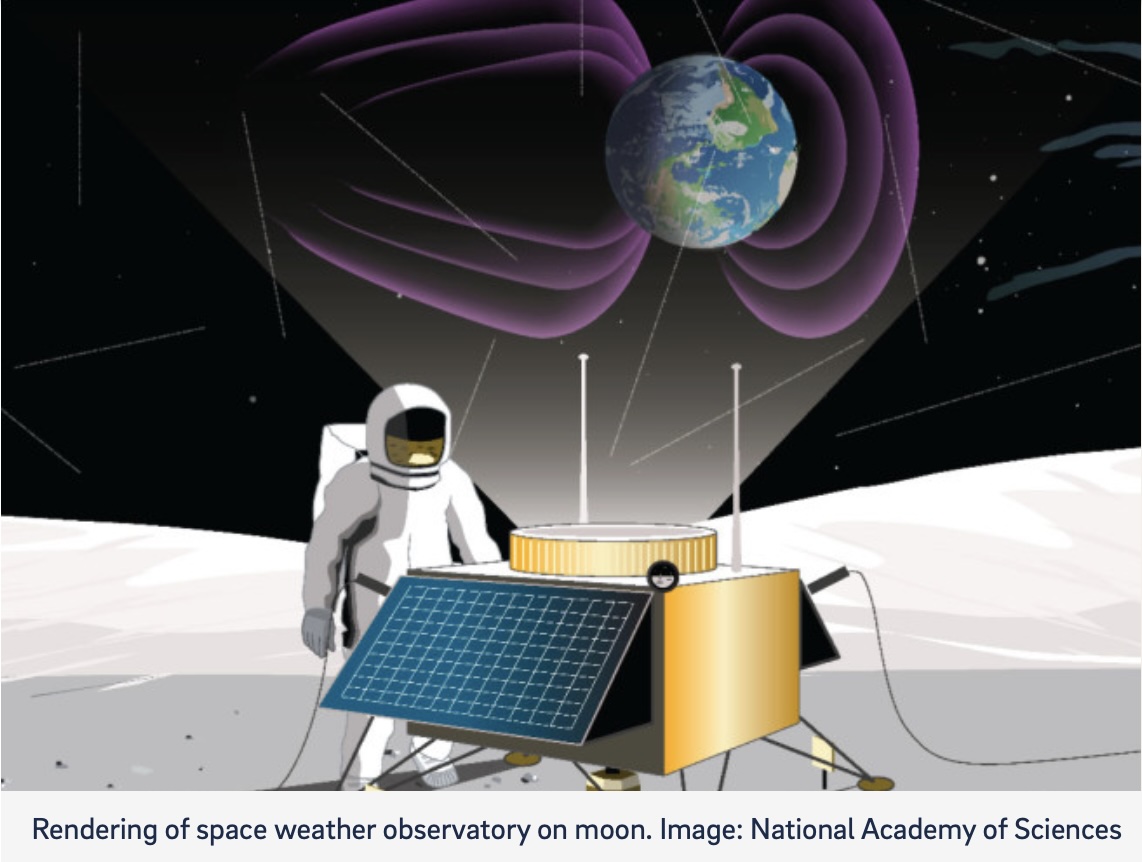
The National Academy of Sciences issued Oct. 21 an independent report commissioned by NASA recommending four potential crewed lunar missions and outlining their scientific value.
The report recommending where this should be done, authored by a committee co-chaired by James Day, a geologist at UC San Diego’s Scripps Institution of Oceanography, argues that NASA should explore beyond the moon’s south pole and pursue a global exploration strategy to investigate different parts of the moon to answer a wide range of scientific questions.
While the south pole has long been of interest to NASA because its shadowed craters contain vast deposits of water ice needed for life support systems, there are other locations with resources that could aid future missions and provide opportunities for scientific research.
The recommended mission locations include the far side of the moon, where astronauts could take advantage of the location’s natural protection from radio interference to study the early universe. At the lunar limb (the outer edge of the moon's visible disc as seen from Earth) astronauts would investigate the moon’s formation and collect valuable geological samples.
“Both these sites are within massive craters, one more ancient and less well preserved than the other,” Day said. “These are excellent sites for astronomy experiments, and for obtaining some of the best geological samples for understanding how the moon formed.”
At the site of an Apollo landing on the near side, researchers could study how the location has changed over time in space.
“This will be like doing space archaeology,” said Day. “By going back in time this will help us in the future to understand how to live, work and survive safely in space.” Finally, at the volcanic plateau on the near side, astronauts would study volcanic rocks and consider how they might ‘live off the land’ on the Moon,” according to Day.
It’s been nearly 54 years since humans last set foot on the moon during Apollo 17. Artemis II recently completed a crewed lunar flyby and now NASA has its sights set on landing astronauts on the lunar surface, both for research purposes and to establish a base of operations for future space exploration.
“This report makes a compelling scientific case for sending human explorers to a range of lunar sites, not only the south pole, to answer fundamental questions about the moon’s origin and the history of our solar system,” said Scripps Director Meenakshi Wadhwa, herself a space scientist.
Several locations were considered by Day and his colleagues, but not all of them made the cut. For example, a mission to the moon’s lava tubes was deemed too unsafe.
“We need to learn how to operate safely in space to ensure there’s reward and minimum risk,” said Day.
To make these decisions, scientists and experts had to consider the moon’s geology and environmental conditions, how human physiology and biology might be affected in deep space, and how NASA can effectively use missions to the moon to gather data on everything from astronomy to the maintenance of life far from earth.
“NASA would like to send human explorers to the moon, and then, one day, to Mars. That means we need to understand how humans can operate effectively in deep space,” said Day.
Finding ways to sustain life on the moon and other celestial bodies is critical to the future of space travel. It’s also something that Day and his colleagues at UC San Diego have spent years working on. Setting up shop on the moon is going to require ample resources, but according to Day, some of these resources, such as metals like platinum and palladium, can actually be sourced from the lunar surface.
“The moon still bears the scars of colossal impacts that struck its surface. It’s within the melted rocks from those impacts that we suggest precious metal enrichment may have occurred, perhaps even at the levels seen in the world’s greatest resource of these metals; the Bushveld Complex of South Africa.”
Day believes, however, that any resource extraction from the moon needs to be done with the utmost care.
“I do not want to see the moon being exploited unnecessarily – any use of lunar resources should be done responsibly and with respect, primarily for science and exploration, and to keep it for future generations,” he said. “The moon is a pristine environment; we need to learn how to keep things that way.”
The report’s authors argue that the moon still has a lot to teach humanity and that these proposed missions could bring society not one, but many steps closer to learning everything there is to know about our closest celestial neighbor and the history of our solar system.
“The moon has been a companion to Earth for four-and-a-half-billion years! It’s fundamentally affected everything that we experience, from the tides, to the length of the day,” said Day. “But we still don’t know what made the moon or if its presence explains why our Earth is habitable, whereas a planet like Venus is not.”
Daniel Dumbacher of Purdue University co-chaired the committee.
Quelle: University of California