
17.07.2026
How NASA’s Artemis III Lander Test Will Pave Way for Moon Landings

Before Artemis astronauts land on the Moon’s surface in 2028, NASA will conduct the Artemis III demonstration mission in 2027, allowing teams on Earth and in orbit to practice rendezvous and docking operations between commercial human landing systems and the Orion spacecraft. Data from that mission, along with future uncrewed demonstration missions at the Moon, will support astronaut safety and mission success for crewed lunar landings.
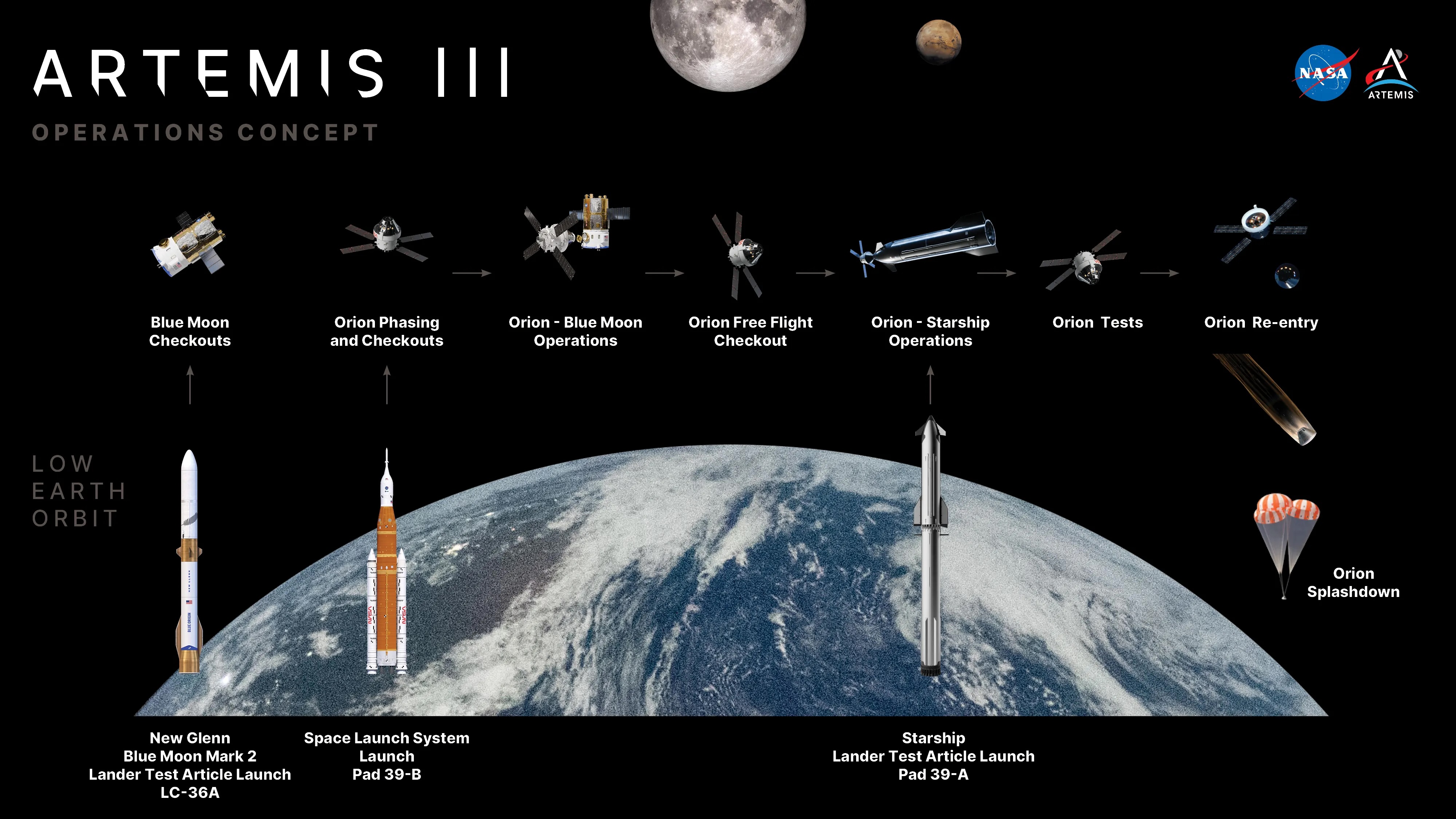
NASA is working with two American companies to develop the human landing systems that will safely transport astronauts from lunar orbit to the Moon’s surface and back for future Artemis missions. For Artemis III, both SpaceX and Blue Origin will fly test versions, or test articles, of the crewed landers that will be used for future Moon landings. The lander test articles will launch by commercial rockets, while the Artemis III crew will launch to low Earth orbit in Orion atop the agency’s SLS (Space Launch System) rocket.
Stage setting for crewed flights
NASA and the human landing system providers have been working closely together to plan and determine capabilities for the Artemis III mission. With missions fast approaching, both SpaceX and Blue Origin are optimizing hardware availability and capability. SpaceX plans to use the company’s latest version of Starship and basis of the future Starship HLS, called Version 3, while Blue Origin will test their planned HLS crew cabin, allowing each company to apply lessons learned prior to uncrewed and crewed missions on the Moon.
“Each human landing system provider has taken a different approach to the Artemis III mission,” said Steve Creech, program manager, Human Landing System Program, NASA’s Marshall Space Flight Center in Huntsville, Alabama. “Ultimately, SpaceX and Blue Origin have put forward a list of aggressive objectives and goals intended to complement upcoming uncrewed demonstration missions at the Moon so that we can gain both understanding and confidence in the spacecraft and launch vehicles prior to a crewed landing. The lander prototype designs will inform future development efforts and will continue to mature over the next year.”
For the Artemis III mission, the Blue Moon test lander will be based on Blue Origin’s current architecture for its Mark 2 crew lander, incorporating all the major avionics and flight software and control systems to ensure flight operations from this demonstration mission can directly translate to crewed lunar flights. Up to two crew members, donning orange Orion crew survival system suits, will open the hatch to enter the Blue Origin test lander. The production hardware must incorporate many of the same systems and subsystems, including an Environmental Control and Life Support System (ECLSS), a crew cabin, and avionics.
The Blue Origin lander also will fly with an instrumented lunar surface spacesuit mass simulator. Like the suited “Moonikin” manikin that flew aboard Orion during the uncrewed Artemis I test flight, the low-fidelity spacesuit mass simulator will provide real-time feedback about the environment within the Blue Moon crew cabin.
SpaceX’s Starship lander test article will use a Starship Version 3, currently in production and testing, with an added docking system installed on the nose of the 171-foot (52-m) spacecraft, enabling NASA and SpaceX to evaluate how the entire integrated stack of Orion and the Starship test lander interact. NASA and SpaceX are identifying controllability and communications tests for the Artemis III mission. Astronauts will not enter the Starship test lander during Artemis III.
Launch cadence
NASA, SpaceX, and Blue Origin will launch three of the world’s most powerful rockets within a short timeframe of one another, exercising ground processing, launch crews, and facilities as well as control centers, networking, and data exchange at key sites across the country during two separate, back-to-back rendezvous and docking maneuvers between Orion and the lander test articles, before a safe splashdown of the Artemis III crew in Orion.
“Artemis III will be a highly choreographed dance with a demanding launch sequence across multiple launch pads and equally demanding mission operations for our ground and flight crews, making it one of the most complex and ambitious missions NASA has ever undertaken,” said Jeremy Parsons, Artemis program manager. “The demonstration mission will set the stage before our next giant leap. NASA’s expertise in systems engineering and integration, as well as launch and mission operations in low Earth orbit, will bring the mission together.”
For future crewed missions to the Moon, NASA and one of the commercial lander partners will execute a “dual launch campaign,” prepositioning the lander in orbit to await a crewed Orion, launched on SLS. Launching the three rockets in succession of one another for Artemis III offers a unique opportunity to practice launch processing and operations.
Blue Origin’s lander test article is planned to launch first and will be able to loiter in space for up to 30 days, allowing for checkouts in orbit prior to the launch of SLS and Orion from Launch Complex 39B at NASA’s Kennedy Space Center in Florida. The Blue Origin test article will launch at a set trajectory to meet a designated “parking” orbit for these systems checks.
Artemis III will be a highly choreographed dance with a demanding launch sequence across multiple launch pads and equally demanding mission operations for our ground and flight crews, making it one of the most complex and ambitious missions NASA has ever undertaken.

JEREMY PARSONS
Artemis program manager
Following the completion of Blue Origin’s rendezvous and docking operations testing and the Artemis III crewed launch on SLS, SpaceX will launch its Starship lander test article to rendezvous with Orion and its crew for its phase of on-orbit testing.
Throughout the Artemis III mission, Orion will fly in a circular orbit. All three rockets will have more launch opportunities than are available for a lunar mission and will be able to reach the designated mission altitude in a single launch.
Docking operations
During docking and undocking operations, Orion and the Artemis III crew will use the lander test articles as the targets, while Orion will operate as the chaser spacecraft. This is the same configuration planned for future crew landing mission to the Moon.
NASA will ensure both test landers are mission ready and crew safe prior to Artemis III. These verifications will be based on functional and performance requirements for the test lander designs and hazard controls for hardware and software, ensuring the Artemis III astronauts inside Orion are safe throughout both docking phases of the mission.
SpaceX and Blue Origin have already tested their docking capabilities for their respective landers on the ground. SpaceX’s docking capability was qualified in 2023; Blue Origin conducted development ground testing on its pressurized docking system earlier this year.
A key difference between the docking capabilities of both lander test articles will be the location of docking. Orion will dock along the side of the Blue Moon test lander, adjacent to the crew cabin. Later, Orion will dock nose-to-nose with the giant SpaceX test lander.
Software testing between spacecrafts will help demonstrate that the commercial human landing system prototypes and Orion can meet at a precise time and location in space. When Orion docks with the Blue Moon test lander, the Orion spacecraft’s software will control the docked spacecraft. Meanwhile, the SpaceX test article will control the docked spacecraft for the second portion of the mission. During the docking phases, teams with NASA and the commercial partners will be able to test hardware and software interoperability, as well as dynamics of how the integrated lander-Orion spacecraft moves in space.
Through the Artemis program, NASA will send astronauts to explore the Moon for scientific discovery, economic benefits, and to build the foundation for the first crewed missions to Mars – for the benefit of all.
Quelle: NASA
----
Update: 18.07.2026
.
NASA Taps SpaceX’s Starlink to Deliver Artemis III Imagery from Orion
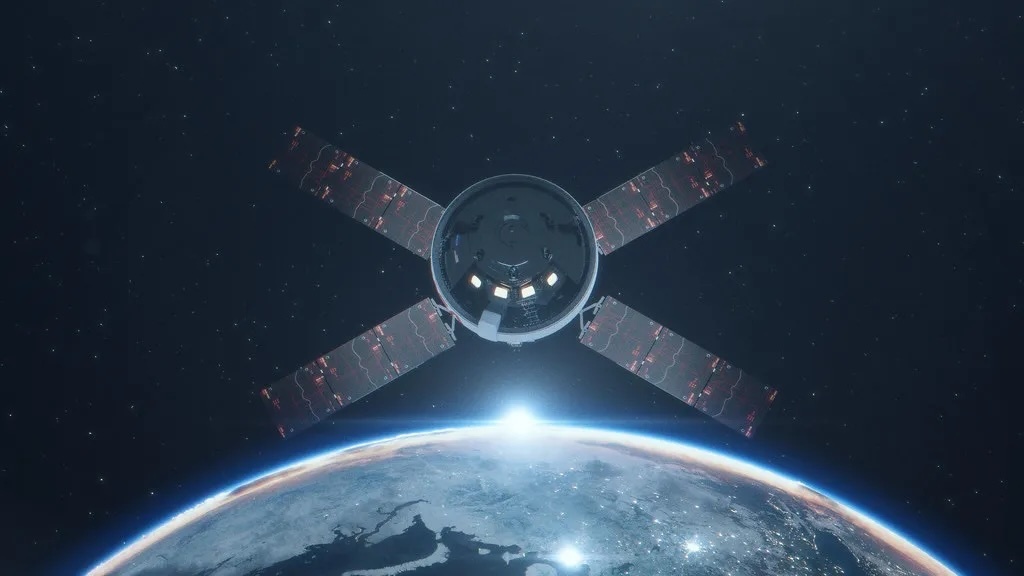
An artist’s concept of the Orion spacecraft orbiting Earth.
NASA has selected SpaceX to deliver laser communications capabilities for next year’s Artemis III mission, enabling the agency to provide a front row seat for viewers from the Orion spacecraft as four astronauts test rendezvous and docking capabilities between Orion and test versions of commercial human landing systems needed to return astronauts to the Moon in 2028.
To supplement Orion’s existing communications system, NASA will install two of SpaceX’s Starlink mini laser terminals – the same laser crosslink technology that SpaceX developed for its Starlink constellation – on the exterior of the spacecraft to downlink 4K imagery and video to the Mission Control Center at NASA’s Johnson Space Center in Houston.
Laser, or optical, communications systems use invisible infrared light to transmit more data in a single downlink than traditional radio frequency systems.
NASA previously demonstrated an optical communications system during the Artemis II mission, successfully transmitting high-definition video, flight procedures, photos, engineering and science data, and voice communications from Orion to Earth over laser signals when the spacecraft had line of sight with ground terminals.
SpaceX first demonstrated laser communications capabilities for NASA as part of a funded Space Act Agreement to develop and demonstrate commercial relay systems during the Fram2 human spaceflight mission in 2025. The Starlink mini lasers that will be added to Orion are based on the more than 25,000 lasers currently operating on-orbit to interconnect the Starlink constellation. The company has utilized the Starlink satellite network for video and telemetry on its Starship flight tests, providing real-time data across all phases of flight.
Facilitated through a partnership with the SCaN (Space Communications and Navigation) Division’s Communications Services Project, the Artemis III laser communications demonstration builds upon the agency’s existing agreement with SpaceX, advancing NASA’s broader strategy to commercialize satellite relay services for missions operating near-Earth.
Quelle: NASA
----
Update: 23.08.2026
.
Isaacman says Artemis III could launch from Kennedy Space Center in June 2027

NASA Administrator Jared Isaacman said Friday that the agency’s Artemis III mission could launch from Kennedy Space Center as early as June 2027 — a fast-approaching target.
The Greater Palm Bay Chamber of Commerce 8th Space Coast Symposium hosted Aug. 21 at the Radison Conference Center in Cape Canaveral brought together space industry leaders to discuss the latest economic scene on Florida’s Space Coast. Much discussion focused on the workforce in Brevard County and the continued growth of the space industry.
Congressman Mike Haridopolos, a Republican who represents Brevard, moderated the conversation with Isaacman, saying he could give the NASA leader “honorary citizenship” in Brevard County. As NASA’s Artemis return to the moon program ramps up, Isaacman is said to be spending more time on the Space Coast.
Isaacman acknowledged the deep history of the rightfully named "Space Coast", noting the public beaches of Brevard have long been gathering spots to watch rockets launch into space.
“The sight of rockets crossing Cocoa Beach has certainly sparked inspiration for more than a few engineers and astronauts,” Isaacman said.
And it was just back on April 1 that Artemis II inspired the world as four astronauts took off from Kennedy Space Center on a mission around the moon, the first in more than 50 years. On Friday, Aug. 28, President Trump will award the Congressional Space Medal of Honor to the crew.
“Now Reid, Victor, Christina, and Jeremy reminded the world when America commits to big, bold endeavors, that there is nothing we cannot achieve,” said Isaacman, referencing the Artemis II crew.
Isaacman went on to say the Artemis III SLS (Space Launch System)rocket will roll out to Kennedy Space Center Pad 39B for wet dress test before the end of the year, stating a liftoff is planned for as early as June 2027.
While the SLS rocket is currently being stacked inside the Vehicle Assembly Building at KSC, little is known about a major component of the mission: the status of the landers.
The mission is designed as a test of Orion's capability to dock in space with the lunar landers. It calls for three major rockets to lift off, SLS carrying Orion, Blue Origin's New Glenn and SpaceX's Starship. The plan: Have both a SpaceX Starship and Blue Origin Mark 2 lunar lander dock with the Orion spacecraft, which will be carrying four astronauts, in low Earth orbit.
While Blue Origin is still rebuilding its Launch Complex 36 after its New Glenn rocket exploded during a test in May, SpaceX’s Starship has not yet gone orbital during test flights out of Texas.
NASA’s long-term goal is to set up a moon base, which would be a massive endeavor between NASA and private industry.
Artemis III was originally set to be the awaited moon landing. However, in an attempt to launch SLS on an annual basis, and test the landers closer to home before the actual moon landing, the return to the moon was delayed to Artemis IV.
And with the recent White House National Space Transportation Policystating launch ranges should be able to support upwards of 1000 launches and reentries per year by 2030, Isaacman said it's time to get ready for many more rocket launches in the future. Most of these would come from private companies, such as SpaceX, Blue Origin, United Launch Alliance, Relativity, and Stoke.
“You thought every other day was a lot. I think things are only going to get bigger out here on the Space Coast," he said.
Quelle: Florida Today
----
Update: 29.08.2026
.
NASA Starts Artemis III Engine Install; Boosters, Crew Training Advance
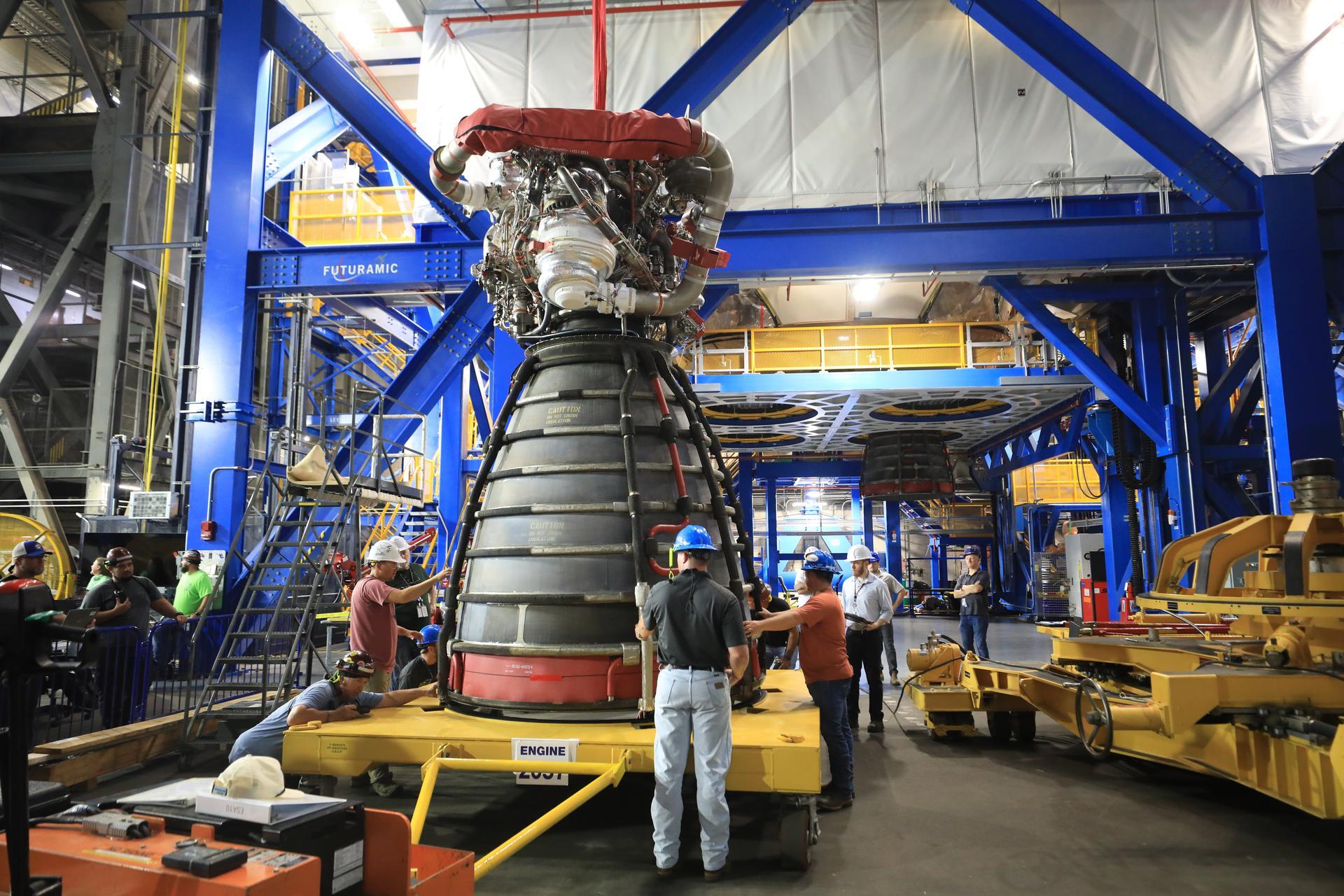
Technicians at NASA’s Kennedy Space Center in Florida began the installation of the four RS-25 engines in the core stage of the agency’s SLS (Space Launch System) rocket that will launch the Artemis III crew next year.
The milestone on Aug. 24 marks the next phase of core stage integration following the mating of the engine section to the top four-fifths of the stage earlier this summer. Inside High Bay 2 at the spaceport’s Vehicle Assembly Building (VAB), teams will continue installing the remaining engines, as well as the propulsion and electrical systems throughout the stage.
Weighing in at approximately 7,700 pounds, each engine produces nearly 500,000 pounds of thrust. All four engines are located at the base of the SLS and are integrated inside the engine section. Built to withstand the extreme conditions during launch, this section protects the engines from severe temperatures. During ascent, the engines fire continuously for more than eight minutes, consuming propellant from the core stage’s two massive propellant tanks at a rate of approximately 1,500 gallons per second.
Each RS-25 engine carries a unique serial number that traces its detailed flight history. The four engines assigned to Artemis III, including E2054, E2057, E2048, and E2052, previously powered multiple shuttle missions. Engine 2048 helped power NASA astronaut Randy Bresnik’s previous mission on space shuttle Atlantis during the STS-129 mission. The engine also powered Space Shuttle Discovery on STS-95 in 1998, which was the mission that returned 77-year-old space pioneer U.S. Sen. John Glenn to orbit, making him the oldest person to fly in space at the time.
Technicians also continue to integrate the twin solid rocket booster motor segments atop the mobile launcher inside the VAB. Teams began stacking the segments in early July and are now more than halfway complete after streamlining processes and procedures learned from previous Artemis launches.
Progress on the Orion spacecraft continues after the recent integration of the crew and service modules. Technicians recently installed the umbilical connector, which bridges the electrical, data, and fluid systems between the two modules, and installed its electrical connectors and fluid lines. Teams powered on the spacecraft for the first time since joining the two components to ensure electrical connectivity through the umbilical mechanism and that the communications of the subsystems between the crew and service module work as planned.
Crew training underway
After being assigned to the Artemis III mission on June 9, NASA astronauts Bresnik, Andre Douglas, Frank Rubio, and ESA (European Space Agency) astronaut Luca Parmitano began an intensive training flow that covers Orion systems and operations, science objectives, leadership and team‑building exercises, as well as joint training with commercial human landing system providers.
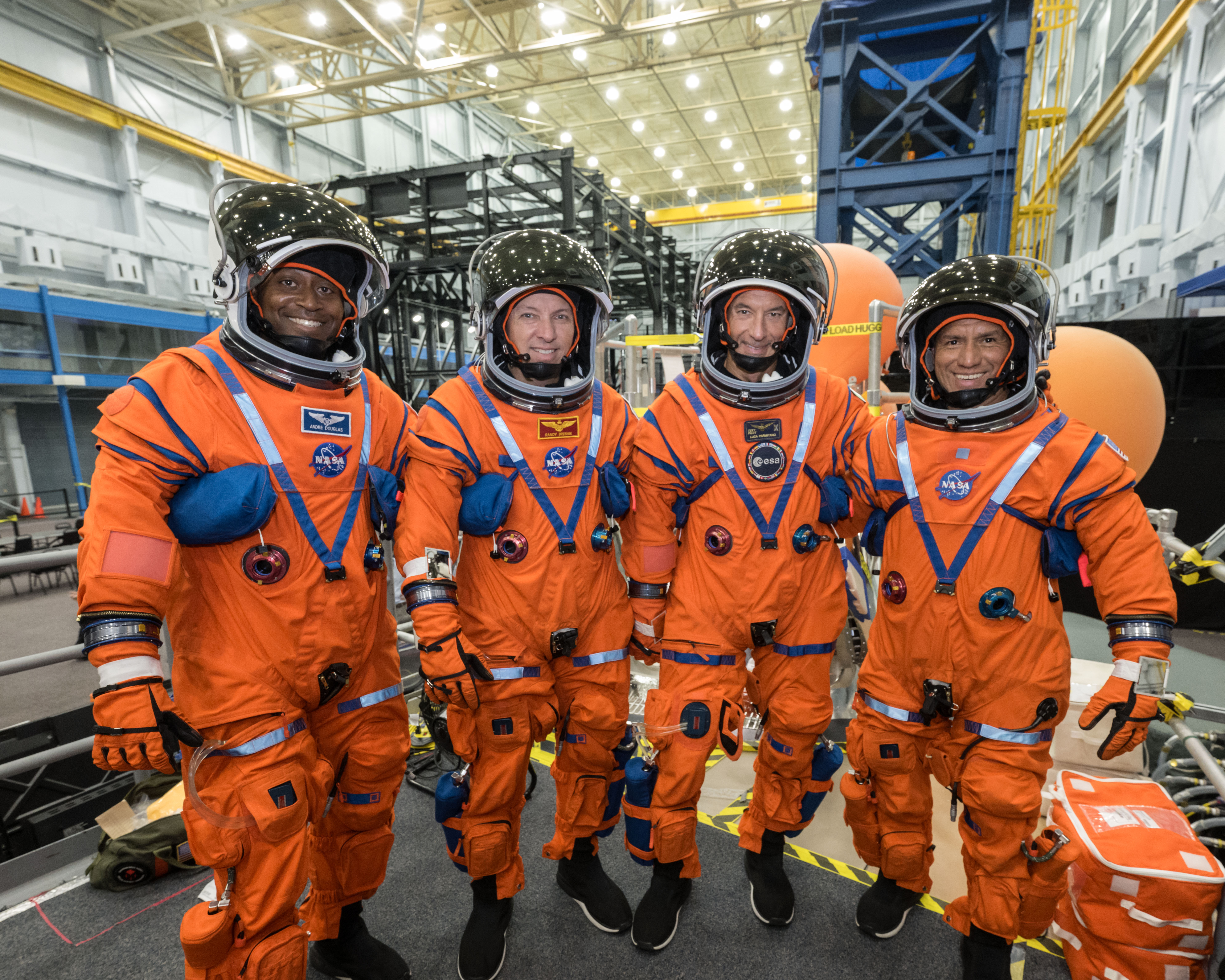
The crew’s training is organized around major phases of the mission, including ascent, orbit and rendezvous operations, entry, and both pre‑ and post‑landing readiness.
Crew members are working in the Orion mockup at NASA’s Johnson Space Center in Houston, practicing daily spacecraft operations, such as mealtime routines, using equipment like the food warmer and potable water dispenser. They also are refining their camera skills to capture and share imagery from their mission in low Earth orbit.
The crew recently completed an introductory water survival class focused on hardware used during off‑nominal landings, along with a post‑landing emergency exiting course that introduced splashdown procedures and initial post‑landing conditions.
This week in NASA’s Neutral Buoyancy Lab, they donned their spacesuits and practiced exiting Orion in an upright configuration. The practice allowed the crew to demonstrate the proper use of their Orion Crew Survival System suits, survival hardware, life raft, and more.
The Artemis III crew also began integrated simulations with the flight control team, including the first simulation with the four crew members together. In these sessions, crew members and controllers rehearse mission timelines and respond to a variety of situations they could face in space, strengthening coordination, decision‑making, and procedures.
Quelle: NASA
----
Update: 9.09.2026
.
Artemis III SLS stacking advances as Orion results confirm trajectory fix
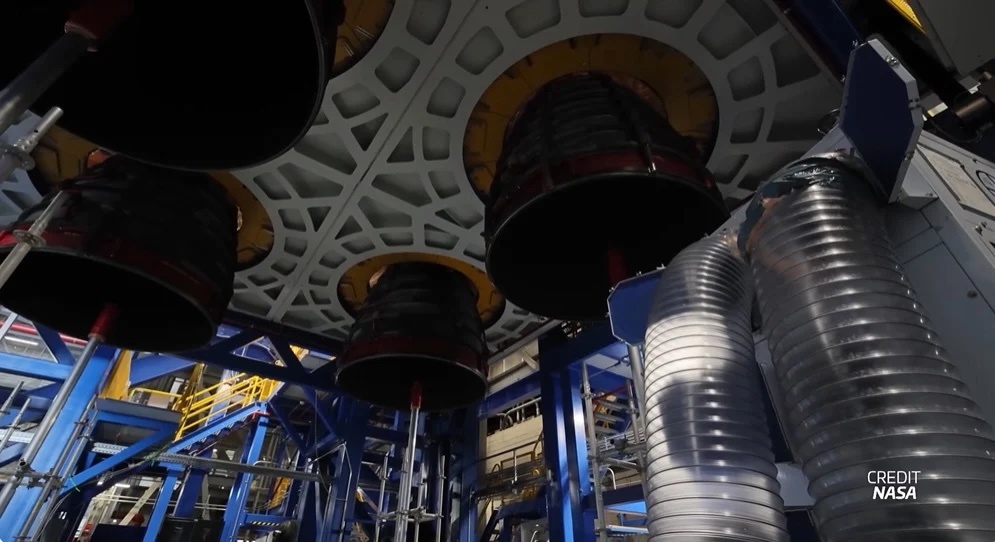
Teams at NASA’s Kennedy Space Center have pushed Artemis III Space Launch System hardware another step forward, stacking the next pair of solid rocket booster segments inside the Vehicle Assembly Building while Core Stage-3 engine work and early Artemis IV processing also continue.
The progress comes as NASA’s Aerospace Safety Advisory Panel (ASAP) reviewed post-flight analysis of Orion’s Artemis II heat shield, confirming that a modified reentry profile sharply reduced the Avcoat char-loss seen after Artemis I.
Four of five booster segments now stacked
NASA completed mating of the center segments on the twin five-segment SLS solid rocket boosters for Artemis III. Teams have since begun stacking the forward center segments on top of those, leaving only the forward assemblies to complete each booster stack.
Photographs from the base of Mobile Launcher 1 looking up the boosters also show the Tail Service Mast Umbilicals missing their quick-disconnect plates.
Officials had previously indicated that leaks found on those interfaces during Artemis II processing could prompt a design change for a firmer seal.
The missing plates may reflect that work, or they may simply be part of the post-Artemis II refurbishment of the launcher.
Either way, the configuration is likely to become clearer as Artemis III stacking continues.
Inside the VAB, teams have also completed installation of all four RS-25 engines on Core Stage-3.

That milestone opens the remaining outfitting work needed before the stage can be transferred onto Mobile Launcher 1 between the two boosters.
Artemis IV hardware arrives as well
While most of Core Stage-4 remains in production at the Michoud Assembly Facility in New Orleans, its engine section has been in processing at Kennedy for years. This past week, NASA’s Pegasus barge delivered the last major piece still needed for that section: the boattail.
The boattail attaches to the engine-section barrel and provides aerodynamic support for the RS-25 engines in flight. Its arrival keeps Artemis IV hardware moving in parallel with Artemis III stacking. NASA is targeting a 2028 lunar landing on Artemis IV, a schedule that will require continued hardware flow of this kind.
Artemis II heat shield: fewer than 10 percent of Artemis I’s char-loss sites
Artemis II lifted off April 1, becoming the first crewed Artemis flight and the first human mission around the Moon since 1972. It flew with the same class of Avcoat heat shield already installed when post-flight inspection of Artemis I revealed unexpected char loss. The issue was not a large void or obvious gap. It was permeability. During reentry, Avcoat heats, gasifies, and ablates. Heat also soaks deeper into the material, so lower layers continue generating gas while the outer layers are still in the same process. If those outer layers are too permeable, gas from below cannot escape. Pressure builds and can blow out the upper layers, a process known as spallation, or char loss.
Artemis I used a skip reentry: Orion dipped into the atmosphere, shed a large amount of speed, then used lift to skip back out before the final descent and Pacific splashdown.
That profile created two problems for the heat shield. The longer exposure gave more time for gas to build in deeper layers. The skip also interrupted gasification at the outer surface while residual heat kept the inner layers generating gas that could no longer vent.
NASA chose not to remanufacture the already-installed Artemis II heat shield, which would have delayed the mission. Instead, it flew a non-skip, steeper reentry. That path imposed higher heat loads but kept heat from soaking as deep, and it shortened the time available for pressure to build.
Recovery images made the difference visible immediately. After nearly five months of analysis, NASA presented the results to the Aerospace Safety Advisory Panel.
Panel member Paul Hill, a former NASA flight director and MOD Director, said Artemis I’s heat shield had more than 100 spallation sites. In contrast, Artemis II had only nine, a reduction of more than 90 percent from changing the entry profile alone.
The trade is operational. Skipping the skip shortens the distance from entry interface to splashdown and reduces the area NASA can target, cutting mission-planning flexibility.
To restore skip-entry capability, NASA has changed Avcoat manufacturing so that the material is more permeable and can vent gases rather than trap them.
That process change will fly first on Artemis III next year and will be used on subsequent Orion heat shields.
The VAB work now underway is the next test of whether that hardware cadence can keep Artemis III and IV on their intended paths.
Featured Image: NASA.
NASA’s Artemis III Mission to Test Future Moon Lander Operations
efore astronauts return to the lunar surface, NASA will first conduct one of the most ambitious and complex test missions in the agency’s history.
Launching in 2027, Artemis III will send NASA astronauts Randy Bresnik, Frank Rubio, Andre Douglas, and ESA (European Space Agency) astronaut Luca Parmitano aboard the Orion spacecraft into low Earth orbit to perform a series of demonstrations with test versions, or test articles, of human landing systems being developed by industry partners Blue Origin and SpaceX. During the planned 14-day mission, crews and flight controllers will practice the rendezvous, docking, habitation, and operational procedures that will be essential when Artemis astronauts begin landing near the Moon’s South Pole in 2028. The mission is designed to reduce risk, validate hardware, and gain operational experience before NASA attempts a crewed lunar landing.
“Every piece of this mission in Earth orbit is designed to reduce risk before we put astronauts back on the Moon,” said Jeremy Parsons, NASA’s Artemis program manager. “We’re launching three spacecraft on three different rockets and testing how they operate together — something NASA has never attempted. Every lesson we learn here gets us closer to landing on the Moon in 2028.”
First stop: Blue Origin’s lunar lander test article
Earlier Artemis missions used only NASA’s SLS (Space Launch System) rocket and Orion spacecraft. Artemis III will involve three separate spacecraft launched on three different heavy-lift rockets within a relatively short period of time.
The mission begins with Blue Origin launching a test version of its Blue Moon Mark 2 lander into a circular low Earth orbit approximately 273 miles (237 nautical miles) above Earth. The spacecraft can remain on orbit for up to 30 days providing schedule flexibility. Artemis III is designed as a tightly choreographed campaign, with NASA planning to launch Orion on top of SLS from the agency’s Kennedy Space Center in Florida only days after the Blue Moon test article launch and confirmation the vehicle is healthy and ready for joint operations.
Following launch, Orion will initially enter an elliptical Earth orbit of 18 x 1122 miles (16 x 975 nautical miles). It will use its service module to perform a series of maneuvers to transition to a circular orbit at about 345 miles (300 nautical miles) for thermal stabilization before then gradually setting up its rendezvous with the waiting Blue Moon lander test article. Because each spacecraft operates in slightly different orbital regimes optimized for its mission requirements, Artemis III requires a carefully choreographed sequence of orbital maneuvers and rendezvous operations throughout the flight.
During the first two days of flight, the crew will check out Orion’s systems, prepare for proximity operations, and gradually position themselves for the mission’s first major objective: rendezvous and docking with the Blue Moon test vehicle.
The operation represents NASA’s first opportunity to evaluate how Orion and a commercial lunar lander work together in space. Engineers will assess how software aboard both spacecraft, guidance systems, communications systems, and operational procedures perform in real-world conditions, while flight controllers gain experience coordinating activities across multiple teams and organizations.
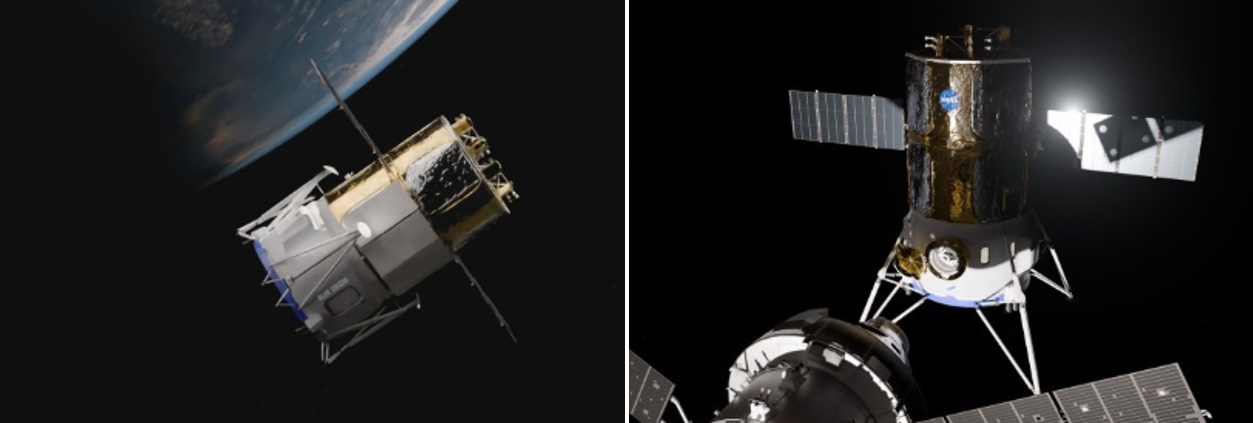
Once docked, astronauts will spend approximately two days conducting evaluations aboard the Blue Moon test article. Crew members will open the hatch and enter the spacecraft, allowing them to assess the cabin environment, controls, and life-support systems firsthand. Teams will verify the spacecraft’s ability to maintain the proper atmosphere and pressure.
The Blue Moon test article incorporates many of the avionics, software, flight-control systems, crew-cabin technologies, and life-support functions planned for future lunar missions. Testing those systems in orbit will provide the first opportunity to evaluate how many of the lander’s flight systems perform in space as an integrated vehicle.
By the time Orion undocks, NASA will have completed its first evaluation of a commercial lunar lander with crew, gathering data on spacecraft systems, crew operations, and spacecraft interoperability not possible on the ground.
Starship docking demonstration
After completing operations with Blue Origin’s lander, Orion will undock and reposition to support the next phase of the mission: a second rendezvous operation.
SpaceX will launch a Starship Version 3 test article from Florida. Because Starship is designed for a much shorter on-orbit lifetime than Blue Origin’s lander, launch occurs later in the mission, allowing NASA to efficiently sequence the two docking demonstrations. Starship will enter a lower orbit at 206 nautical miles, optimized for communications coverage, and will carry an added docking system mounted at the forward end.
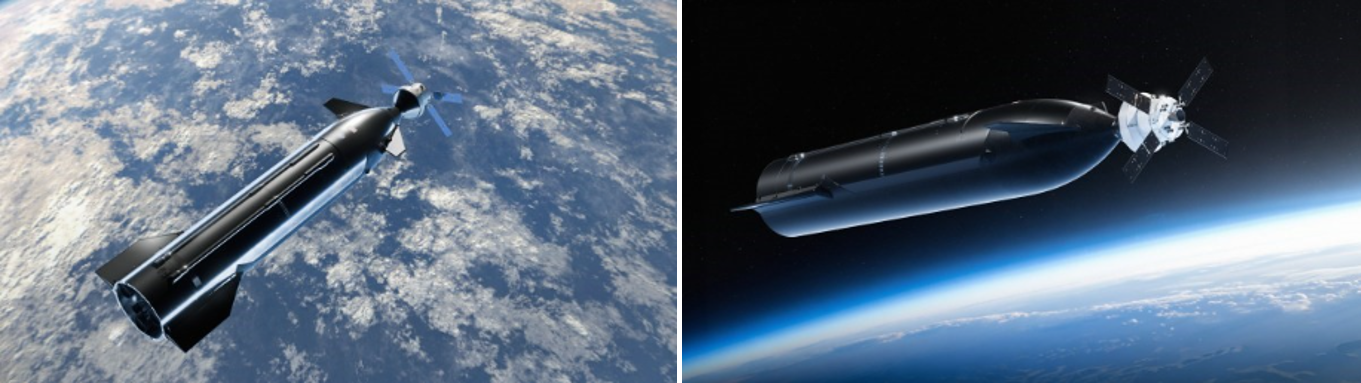
Orion will rendezvous and dock with the spacecraft during a test expected to last up to two hours. Crew will not enter Starship during this test. The demonstration is focused on validating how Orion and Starship interact as a docked system in space. NASA and SpaceX plan to evaluate spacecraft controllability, communications, integrated software performance, and the dynamics associated with docking and undocking operations.
The docking itself also presents a unique test, using different docking geometries. Orion will connect to a port beside Blue Moon’s crew cabin, then later align its forward docking system with the one at Starship’s nose. Testing both approaches during a single mission gives NASA an opportunity to assess different operational concepts while gathering valuable engineering data.
Together, the two docking campaigns will demonstrate how Orion interfaces with two very different commercial lander architectures during a single mission.
Testing Orion for future exploration
Even after docking activities are complete, Artemis III will continue generating data that supports future missions.
Once the Starship demonstration is complete, Orion and its crew will have up to five additional days available in orbit before beginning preparations for the journey home. NASA plans to use this time to complete a variety of test objectives that support future Artemis missions, including additional evaluations of the Orion Crew Survival System suits, docking sensor tests, acoustic and thermal measurements, human-factors assessments, and a range of science and technology demonstrations.
Several investigations led by NASA will build on studies conducted during Artemis II, collecting additional data that will help inform future deep-space missions. The crew also will conduct a proof-of-concept study examining how astronauts could perform health-related assessments when they are unable to communicate directly with mission control, an important capability for future lunar surface expeditions and other missions farther from Earth.
NASA also plans to fly a cellular biology experiment during the mission while researchers use the flight to test concepts for returning lunar samples to Earth. Teams will evaluate how future samples could be transported, received, and moved into curation facilities after landing, while also conducting assessments of Orion’s environment to better understand potential contamination considerations for future lunar missions.
The mission also will include Earth and solar observations that help astronauts continue developing critical observation skills while taking advantage of the spacecraft’s unique orbital vantage point. Plant seeds will fly aboard Orion as well, providing opportunities for scientific study and educational engagement following the mission.
Mission planners have also built flexibility into the flight timeline, providing additional opportunities to complete test objectives depending on how operations unfold in real time.
When ready, Orion will begin phasing for return, and the crew will configure the cabin for reentry and splashdown, which will occur in the Pacific Ocean, off the coast of California. Orion and its crew will be recovered by NASA personnel and the United States Navy.
Practicing for Moon missions
Every activity performed during Artemis III supports a larger goal: reducing risk before astronauts return to the lunar surface.
The mission will provide NASA with experience operating alongside multiple commercial partners while managing complex rendezvous and docking operations involving three different spacecraft. Engineers will gain insight into spacecraft interoperability, mission-control coordination, communications architecture, crew operations, and hardware performance.
By the time Artemis III concludes with Orion’s splashdown on Earth, NASA will have demonstrated technologies and operational concepts that future lunar crews will rely on as they travel to and from the Moon.
Most importantly, Artemis III will provide the operational experience needed to transform plans for future lunar landings into proven flight procedures. The lessons learned throughout the mission will help refine future exploration plans, strengthen partnerships with industry, and ensure astronauts are prepared for humanity’s next giant leap at the Moon.
As part of a Golden Age of innovation and exploration, NASA will send Artemis astronauts on increasingly difficult missions near the lunar South Pole to explore more of the Moon than ever before. In addition to providing economic benefits and advancing scientific discovery through its Moon missions, NASA will establish an enduring human presence on the lunar surface and build on the agency’s foundation for the first crewed mission to Mars.
Quelle: NASA