
21.10.2026
NASA's Perseverance Rover Breaks the Distance Record for Driving Off-World
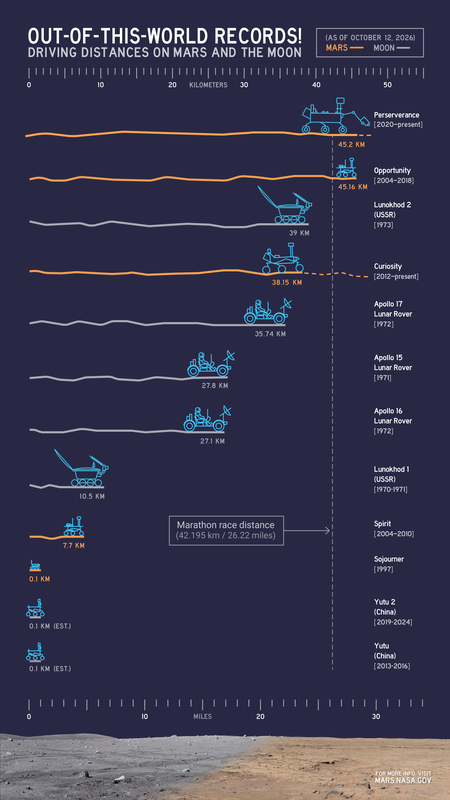
On October 11, NASA's Perseverance rover broke the record for the furthest distance traveled by a vehicle on another world. Initially set by NASA's Opportunity rover in 2014, Perseverance has now driven 28.1 miles, navigating—largely autonomously—boulder fields and sandpits on the Red Planet.
We chatted with former Perseverance project scientist Ken Farley, the W. M. Keck Foundation Professor of Geochemistry at Caltech, about the rover's achievements and what the distance record means for Martian exploration.
What has Perseverance been up to lately?
We are at a very interesting place scientifically! The rock types where we are now are different than we've seen before, and they look very much like the kind of rock that one would expect the early Martian crust to have been made out of. These are likely extremely ancient rocks, older than rocks that we've looked at before—probably older than 4 billion years. There are few rocks on Earth older than 4 billion years. So we are in an area that is very deep in the history of the solar system.
Perseverance has self-driving capabilities; what level of input do scientists give to the rover?
First, scientists decide where we want the rover to go for scientific investigation by looking at detailed images of the Martian surface taken by orbiters in space. We can see where it's hilly, where it's rocky, where there are giant fields of sand, or cliffs. Engineers will then give the rover a rough sketch of a route to avoid big hazards, but the rover has to, by itself and based on imaging collected with the cameras and an algorithm, actually figure out how to go around rocks and minor obstacles.
Though it is the most advanced technology that's off of Earth, it still has to take pictures and think about what it sees, where it's safe to go, where it's not safe to go, and how to drive around any hazards that it detects. It's a very slow process; the rover takes five or six hours to go about 100 meters as it's navigating its way through hazards. It's kind of like a self-driving car, except running on a very different and much slower computer.
Perseverance is the size of an SUV, what kind of off-road capabilities does it have to handle the Martian surface?
There's an interesting difference here between what it is possible to do and what it is best to avoid doing. If there's a rock that's bigger than, say, the size of a bowling ball, we go around it. If we have no choice, we can drive over it. The technical limit is much larger than that, but the goal, of course, is to keep the rover going for as long as possible by not overtaxing its capabilities.
The absolute No. 1 rule for the rover is: Don't get yourself into a situation that you can't get out of. The rover has an enormous amount of onboard safety checks. One very common thing that happens is that the rover will drive up to an area where there's a whole bunch of bowling-ball-sized rocks that it is trying to drive across. In some cases, the rover will reach a limit—it will just say, "I don't know what the solution is. I can't get over the hazards that I'm sitting on or are in front of me, so I'm going to stop." A different kind of hazard is sand. As soon as the wheels start slipping significantly because of sand, the rover can tell, "My wheels are spinning, but I'm not going forward. I need to stop." The engineers on Earth can look at these situations and figure out how to get the rover out of it. At least on Perseverance, humans are always smarter than the rover.
What kind of engineering enables a rover to achieve this kind of distance?
One of the motivating scientific justifications for the mission has been to collect samples. If you're going to go to all the trouble to collect samples and then fly them to Earth, you want to get the biggest diversity you can, and that means covering a lot of ground. So, in the development stage of the mission, the rover was designed to be remarkably capable. Right from the get-go, the scientists decided that the mission should land inside Jezero Crater and explore the lake and river system there and then drive up the crater rim and drive around on the external part outside of the crater. Everyone's jaw dropped. People said, "Oh my god, it would be amazing to be able to do that, but no mission has ever driven that far." But the engineers put together an extremely capable vehicle. From a science point of view, it's been really, really successful. JPL has the capability to design things that are remarkably robust.
The samples we've collected are really important, and I'm hoping that in the long run NASA will decide to retrieve them. A sample retrieval mission can teach us a lot about how to get to Mars and, importantly, to come back. If you want humans to be able to safely travel there, sample-return principles will be really useful.
What's your perspective on sending humans to Mars? Will it happen in our lifetimes?
Simply bringing back samples with a robotic mission is complicated, because you have to land something on Mars, then launch it back off and ferry it back to Earth.
What are your hopes for the future of the Perseverance rover?
The rover is currently in excellent health and testing has indicated that it is capable of continuing its mission lifespan. NASA's Curiosity rover has been going for 14 years, and we have every reason to believe that Perseverance will last at least as long as Curiosity. A major goal is collecting diverse samples. The more terrain and different geologic provinces you see, the more interesting things you can put in the sample collection, and the more interesting things that you can discover. My expectation is that we will continue to drive.
Why is Mars important?
There was water on the surface of Mars at the same time that life originated and expanded on Earth. If that happened on Earth, might it have happened on Mars? If not, why not? That's a really profound question. From a purely science perspective, Mars has a very long and rich geologic history in much the same way that Earth does, and we can use a lot of the tools that have been developed to understand Earth.
People say that we need to study extrasolar planets for evidence of life, but the place that will give the richest information is the one you can bring samples from.
Perseverance launched in the pandemic, in the summer of 2020. It was a heroic effort by JPL engineers to get Perseverance to the launchpad. We only have a launch period every two years, and if they hadn't gotten it to the launchpad, it would've cost hundreds of millions of dollars. You do not want to miss the launch period. When we successfully landed, the President made a statement about the importance to the American people of having done something great even in the pandemic. From my personal point of view, this is a purely human endeavor that is not profit-driven but driven by discovery. It allows us to go where we can never go individually, and everyone can feel good about it.
Quelle: Caltech
----
Update: 28.10.2026
.
NASA’s Perseverance Offers Clues to Protect Crews from Mars Dust
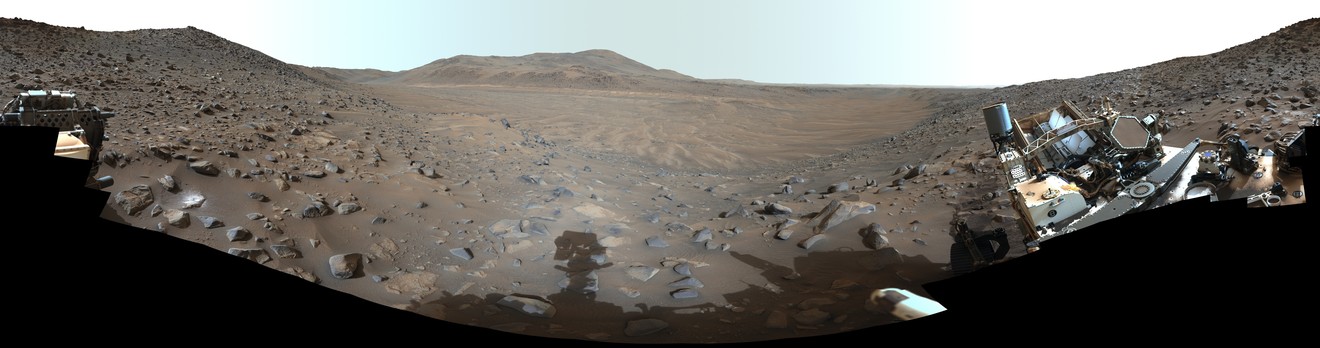
This 360-degree panorama from NASA’s Perseverance Mars rover shows Neretva Vallis, the dusty, long-dried river channel that cuts through the western rim of Mars’ Jezero Crater.
Credit: NASA/JPL-Caltech/ASU/MSSS
By studying tiny particles clinging to spacesuit samples aboard the rover, scientists could help develop better ways to reduce astronauts’ exposure to dust on Mars.
Over 1,645 Martian days, NASA’s Perseverance Mars rover measured the fine and ultrafine Martian dust particles found clinging to samples of spacesuit materials that are carried aboard the rover, including some that are small enough to penetrate the lungs and enter the bloodstream. The findings will be published Tuesday, Oct. 27, in the Proceedings of the National Academy of Sciences and could inform spacesuit and habitat design, dust-removal procedures, and crew health standards for future NASA missions to Mars.
“NASA has a long history of turning challenges into workable solutions and of finding creative ways to use the data that we have to answer questions beyond what it was originally collected for,” said Lindsay Hays, acting director, Planetary Science Division, NASA Headquarters in Washington. “Dust has been a surface-exploration challenge since the Apollo program. Perseverance is giving our engineers and flight surgeons measurements they can use to improve our existing designs well before the first American astronauts arrive on Mars.”
Lunar dust scratched visors, degraded outer spacesuit layers, and damaged their seals during NASA’s Apollo missions, and some crew members reported symptoms similar to hay fever.
Rounded by wind-driven collisions with other particles, dust grains on Mars are less abrasive than those on the Moon. They also are enriched in sulfur, chlorine, and iron and contain more silica than lunar dust. Regional and global dust storms on Mars can keep the grains recirculating throughout the atmosphere as well.
The rover carries a set of five samples of spacesuit material. The swatches, each three-quarters of an inch (20 millimeters) square, are part of a calibration targetused to test the settings of SHERLOC (Scanning Habitable Environments with Raman and Luminescence for Organics and Chemicals), an instrument on Perseverance’s robotic arm. The calibration target for another instrument that provided the dust measurements, called PIXL (Planetary Instrument for X-ray Lithochemistry), carries a sample of Teflon and of basaltic glass.
Because Teflon contains no elements that PIXL can directly detect, whatever elemental signals the X-ray spectrometer picks up from that sample comes from dust resting on it.
The team also analyzed swatches of Teflon and Vectran, two materials used in spacesuits, on SHERLOC’s calibration target. NASA sent the swatches to Mars to study how spacesuit materials hold up on the planet’s surface.
“Perseverance’s main job is to search for signs of ancient microbial life, but the mission was also designed to help prepare for human explorers. That effort includes technology demonstrations like MOXIE (Mars Oxygen In-Situ Resource Utilization Experiment) and Ingenuity, as well as the spacesuit samples,” said Katie Stack Morgan, Perseverance’s project scientist at NASA’s Jet Propulsion Laboratory in Southern California.
Fine, ultrafine
While earlier measurements on Mars resolved dust particles down to about 3 micrometers across, PIXL detected two categories of even smaller particles: fine particles measuring less than 2.5 micrometers (a human hair is about 70 micrometers wide) and ultrafine particles around 100 nanometers (about 700 times thinner than a human hair). Particles on PIXL’s Teflon target and SHERLOC’s Vectran swatch averaged about 2 micrometers. On PIXL’s basaltic glass and SHERLOC’s Teflon swatch, dust particle sizes ranged down to about 100 to 300 nanometers.
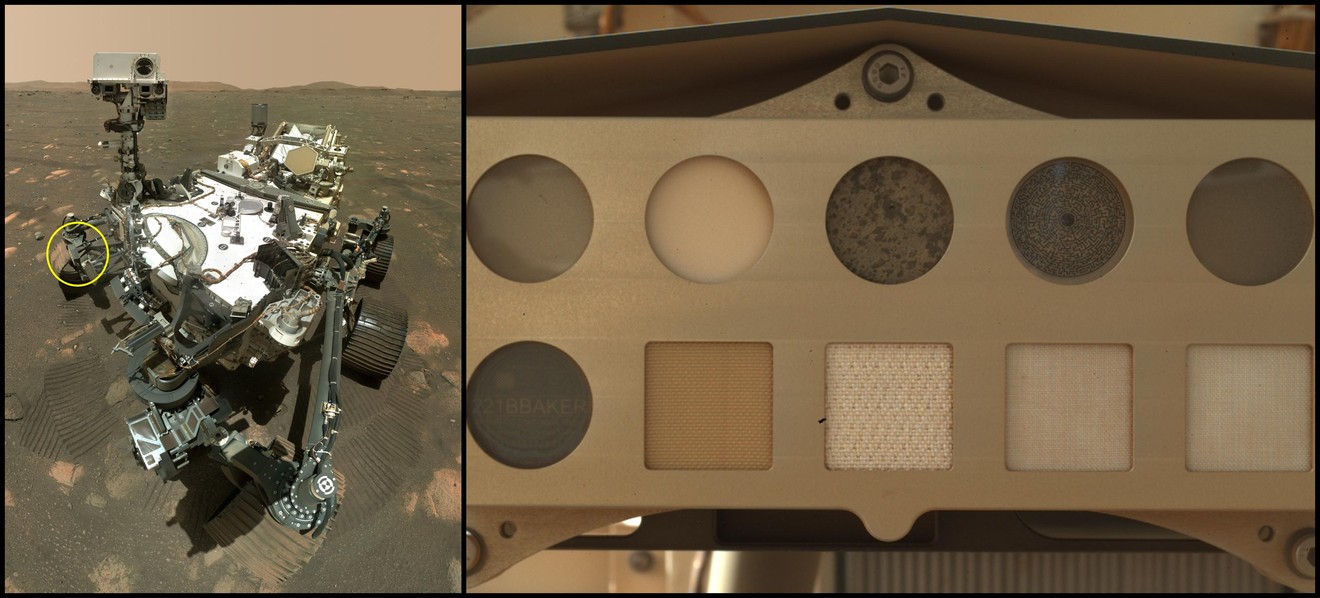
This annotated composite image shows the location on NASA’s Perseverance of the calibration target for rover’s SHERLOC (Scanning Habitable Environments with Raman & Luminescence for Organics and Chemicals) instrument. At right is a close-up of the calibration target.
Credit: NASA/JPL-Caltech
Static electricity appears to determine which size dust particles stick to which surface. Dust grains become charged as they collide in the air, and different materials on the calibration target attract grains of different sizes. The finest particles stayed attached through years of driving and drilling. Organic polymers like SHERLOC’s Teflon spacesuit sample are common in the outer layers of spacesuits, and the results show they readily collect fine dust.
The study also found that some materials hold less dust than others, which could guide future choices of materials and protective coatings for spacesuits and habitats. Designs such as suitports, which let astronauts enter a suit attached to the outside of a habitat, and dual-chamber airlocks could reduce how much dust gets inside astronauts’ living quarters.
“The existence of Mars dust at these ultrafine sizes has been predicted for a long time, and PIXL gave us the chance to measure it directly on Mars,” said Scott VanBommel, a Perseverance scientist at Washington University in St. Louis and the paper’s lead author. “The larger clumps, the Martian dust bunnies, get shaken off over time. But the smallest particles stay behind, and those are the ones that pose the greatest challenge for human support systems.”
Chemically, the dust matches the iron- and sulfur-rich composition that earlier missions measured. The PIXL instrument also found the dust to be enriched in phosphorus and detected signs of calcium sulfate.
Protecting crews
On Earth, airborne particles, or particulate matter, below 2.5 micrometers (that is, fine particles) are tied to a range of negative health effects because they can penetrate deep into the lungs and enter the bloodstream. Studies have shown that ultrafine particles (those no larger than 100 nanometers) can travel from the nasal cavity to the brain along the olfactory nerve.
Martian dust is composed predominantly of silicate minerals and carries chemically reactive compounds, including perchlorates that can disrupt thyroid function and reactive iron that induces cellular damage. Scientists believe that the health risks of Mars dust depend on the quantity of dust and length of exposure.
The PIXL results are the first on-site measurements of fine and ultrafine particles on Mars, and this research can inform broader efforts to refine indoor dust-exposure limits for astronauts, develop safe habits, and establish ways to remove dust while exploring Mars.
Quelle: NASA