
24.02.2026
Chinas mysterious Shenlong space plane recently launched on its 4th mission. What is it doing up there?
We don't know for sure, but there are some intriguing clues.

China's reusable space plane is circling Earth once again.
The Shenlong ("Divine Dragon") spacecraft launched from Jiuquan Satellite Launch Center in the Gobi Desert on Feb. 6, kicking off the robotic vehicle's fourth-ever orbital mission.
What exactly is it doing up there?
We don't know for sure. The Chinese government has revealed few details about Shenlong, whose three previous flights to low Earth orbit (LEO) launched in September 2020, May 2023 and September 2024 and lasted two days, 276 days and 266 days, respectively.
The official line is vague and anodyne: Shenlong helps test technologies that "will pave the way for more convenient and affordable round-trip methods for the peaceful use of space in the future."
That use case is similar to the one the U.S. military gives for its autonomous X-37B space plane, which Shenlong is thought to broadly resemble. And secrecy is a shared trait: Most X-37B payloads and activities are classified.
Analysts believe the Space Force owns two X-37B vehicles, each of which is 29 feet (8.8 meters) long and looks like a miniature version of NASA's old space shuttle orbiters. The X-37B reached orbit for the first time in 2010 and is currently flying its eighth mission, which launched last August atop a SpaceXFalcon 9 rocket.
Though military officials have always insisted that the X-37B is merely a technology testbed, the vehicle has aroused suspicion in some quarters. Early in its flying days, for example, China apparently viewed it as a space weapon. But these fears are overblown, experts say.
"To date, the X-37B has never approached or rendezvoused with any other known space object and generally orbits far below the vast majority of operational satellites," the nonprofit Secure World Foundation (SWF) wrote in its X-37B fact sheet. (There was one exception to that low-orbit rule, as the fact sheet notes: On the seventh X-37B flight, the vehicle got more than 24,000 miles, or 38,600 kilometers, from Earth on a highly elliptical orbit.)
The X-37B would also be a poor delivery system for space-to-ground weaponry, due to its small payload bay (about the size of a pickup truck bed) and limited power-generating capability.
"Hyperkinetic weapons dropped from the bay would need to be equipped with thrusters capable of performing a significant deorbit burn, which is unlikely given the available room," the SWF fact sheet states.
"The X-37B itself reenters like the space shuttle, landing at an estimated 200 mph (321 kph), which means it travels in the atmosphere much slower than a nuclear reentry vehicle on a ballistic arc or a hyperkinetic weapon," the fact sheet continues. "It thus would need to carry conventional explosives to do any significant damage. The X-37B after reentry would be a slow-moving, not-very-maneuverable glide bomb, easy prey for any air defense system along its path to the target."
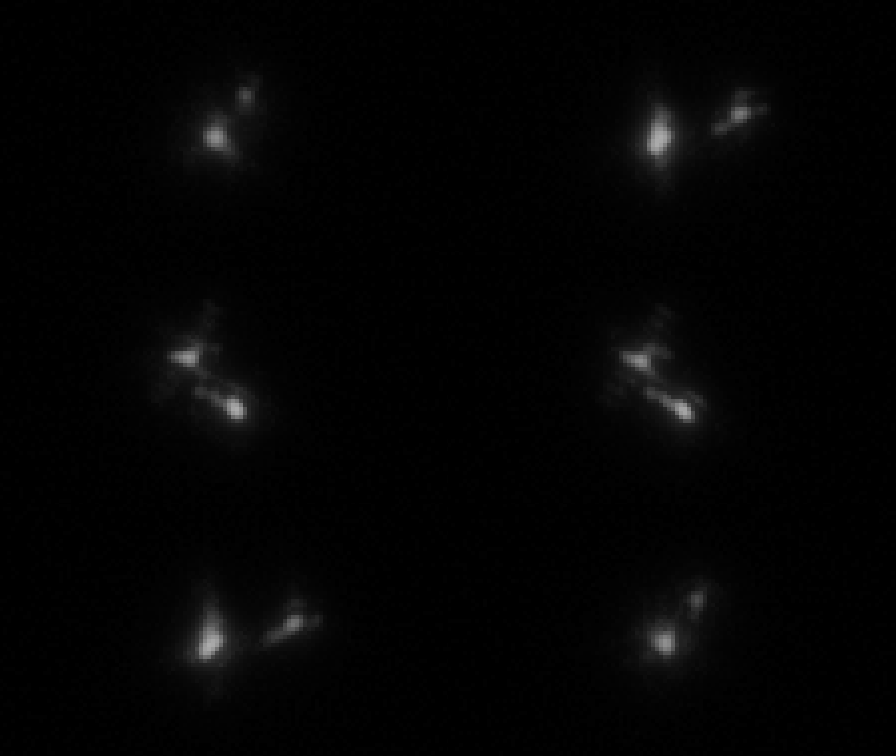
Much of this same reasoning holds for Shenlong. It's thought to be roughly the same size as the X-37B, for example, so we shouldn't worry about it raining bombs on Earth. However, unlike the X-37B, Shenlong has rendezvoused with other objects in space.
On each of its three previous missions, the space plane released one or more objects into orbit. We learned this not from the Chinese government but rather from the U.S. military, private space situational awareness companies and amateur astronomers, who have tracked Shenlong and its activities.
"The satellite deployed during the first mission demonstrated transmission broadcast capabilities, and the satellite deployed during Shenlong's second mission is thought to have displayed independent propulsive capabilities," the SWF wrote in its Shenlong fact sheet. "Shenlong has conducted numerous close maneuvers and capture/ docking operations with the deployed satellites."
Indeed, such rendezvous and proximity operations (RPOs) — which we have not seen from the X-37B — may be a priority of the Shenlong program, as they seem to be for Chinese space officials overall.
"I think that tracks along with other things that they're doing — you know, conducting RPOs in LEO and GEO," said Victoria Samson, chief director of space security and stability for the SWF. ("GEO" is geostationary orbit, which lies 22,236 miles, 35,876 km, above Earth.)
This interest is not exactly surprising: Mastery of RPO tech would allow operators to refuel, refurbish, upgrade and deorbit their own satellites — and, potentially, inspect and/or tamper with adversary spacecraft.
"It's almost at the point now where, if you want to have space superiority, you need to be able to conduct RPOs," Samson said.
Shenlong's orbital work therefore worries some experts, who cite its anti-satellite potential. It's tough to know how warranted such concerns are, given the secrecy — an argument you could make about the X-37B as well.
More information about each program would go a long way toward allaying some of these fears, if indeed they are unfounded, Samson said.
"I think a little more transparency would help fill in some of the blanks, because otherwise, people tend to just imagine the worst-case scenario," she said.
Quelle: SC
----
Update: 28.10.2026
.

Quelle: X
+++
US intelligence report reveals first clear look at top-secret Chinese space plane that's been dumping unidentified objects above Earth
The Defense Intelligence Agency's latest "Challenges to Security in Space" report included a declassified satellite photo of China's Shenlong, or "divine dragon," space plane, which has released at least nine mysterious payloads into low Earth orbit since 2022.
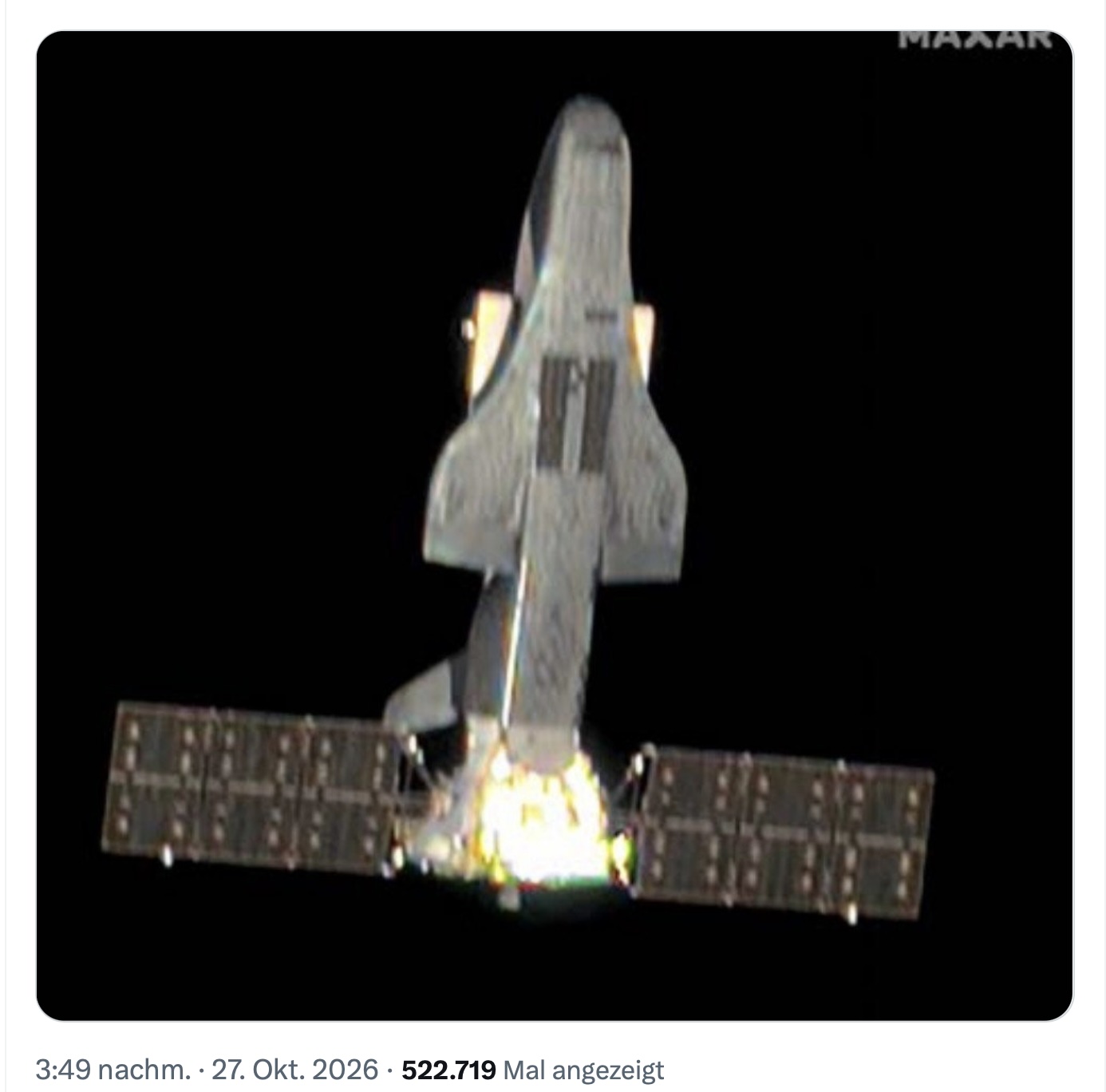
A new U.S. intelligence agency report has seemingly released the first clear photograph of China's mysterious "dragon" space plane in orbit around Earth. The surprise snap reveals that the top-secret vehicle is very similar to its American counterpart and provides new clues about its capabilities.
The image is widely believed to show China's secretive Shenlong, or "divine dragon," space plane, which has been in action for just over six years. During this time, the reusable winged spacecraft has repeatedly made headlines after deploying various unidentified objects in low Earth orbit (LEO). As a result, government officials, private companies and individual researchers have closely monitored the vehicle using tools such as ground-based radar.
Until now, the only direct images of the space plane have been blurry snaps of light reflecting off the uncrewed vehicle toward Earth's surface — offering no clear clues to its specific design, capabilities or intended purpose. China has also never publicly shared any photos of the vehicle or revealed any key information about its design
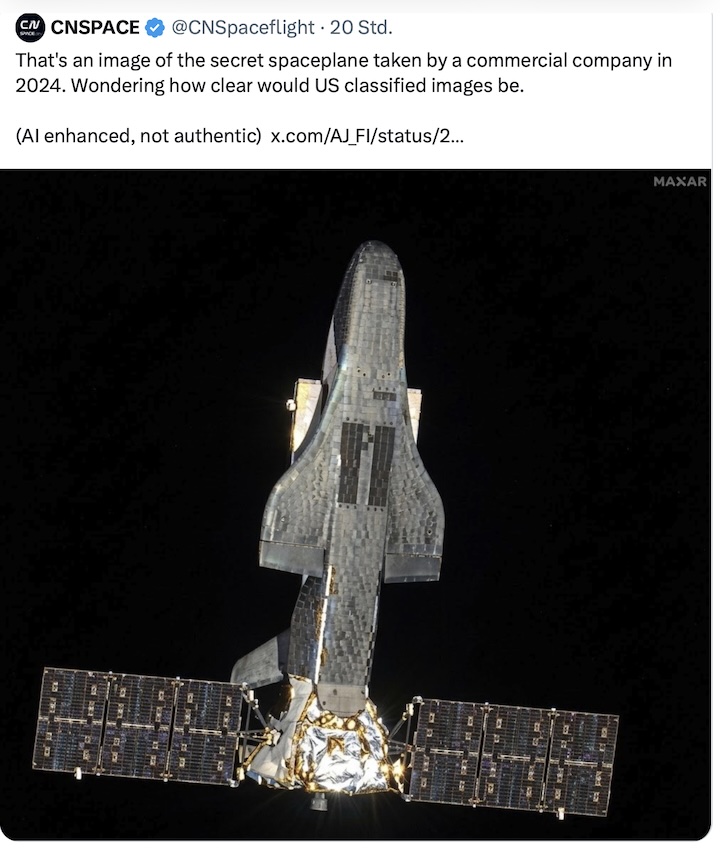
On Monday (Oct. 26), the Defense Intelligence Agency (DIA) released the latest version of its "Challenges to Security in Space" report, which assesses the various factors that pose a risk to American space assets. Deep within the 130-page document (on page 53), the authors included a previously unseen image of a "PRC [People's Republic of China] Spaceplane." The image's brief caption revealed that the photo had been taken in 2024 by a satellite belonging to the private space company Maxar Technologies, now known as Vantor.
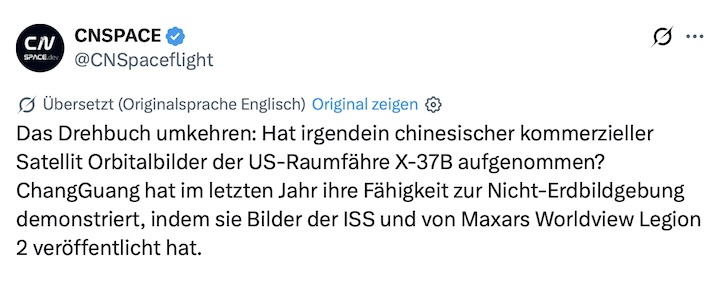
The surprise inclusion of the photo was spotted and shared on the social platform X by journalist Andrew Jones, who specializes in China's space program and has previously shared crucial information about other ongoing missions.
Neither the caption nor the related section of the report made any mention of the photo being the first of its kind or explained why it was previously classified, raising questions about whether the authors realized its significance.
There is one small caveat. The report notes that China has two active space plane designs — Shenlong and Tengyun, meaning "cloud rider" — and the image's caption does not specify which design we are looking at, according to The Aviationist.
However, there have been no confirmed launches of Tengyun to date. Existing photos of a potential prototype also hint that this vehicle's design looks markedly different from what we can see in the new photo. Therefore, most experts agree that the spacecraft in the image is most likely Shenlong.
What does the new photo tell us?
Until now, all we really knew about Shenlong is that it operates similarly to NASA's iconic space shuttles: It gets launched into space by a rocket and circles Earth before eventually gliding down to the planet's surface, where it can then be refueled and relaunched into LEO.
It is not the world's only active space plane. The U.S. Space Force has its own, the X-37B, which has already completed seven orbital missions since its first launch in 2010 and is currently in LEO experimenting with quantum navigation. Based on the new photos, Shenlong shares many similarities with its American counterpart.
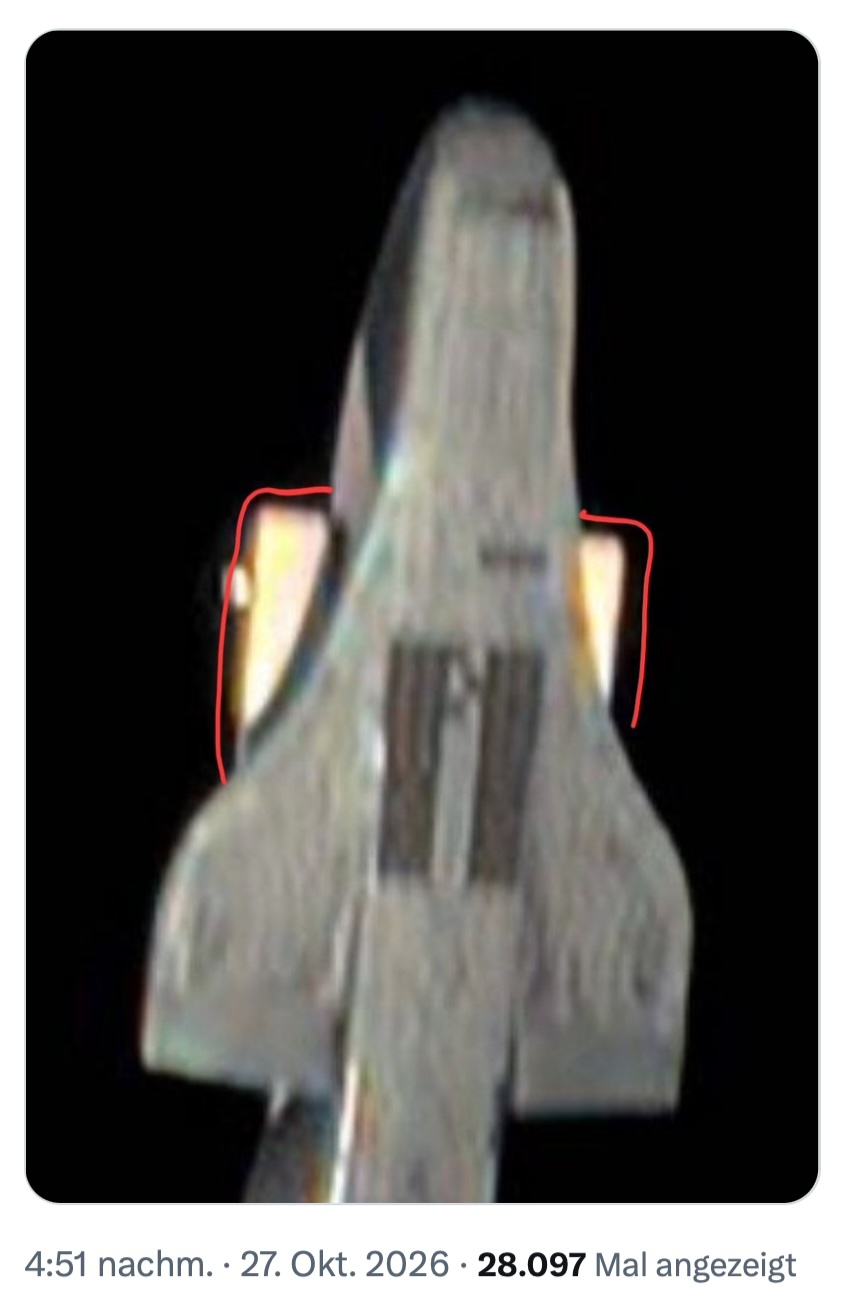
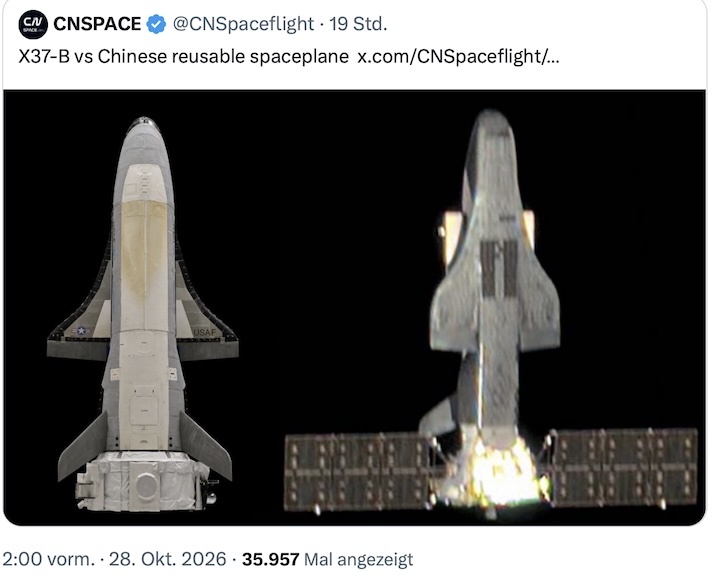
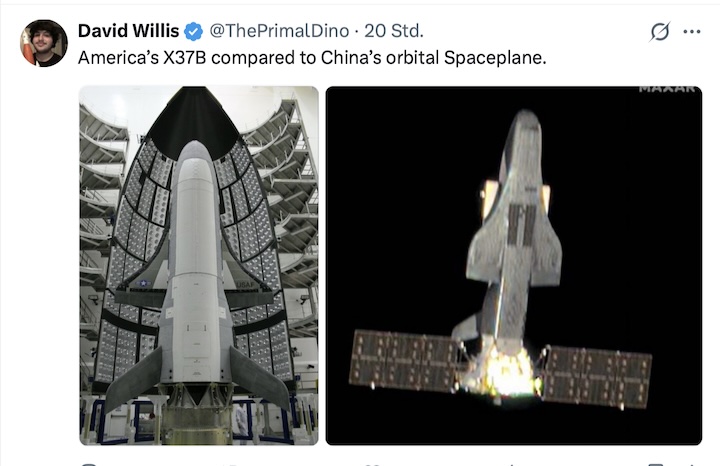
"The Chinese spaceplane has delta wings, payload bay doors, a dark heat shield, and a rear-mounted service module with power-generating solar arrays," technology news site ArsTechnica reported. "In other words, the design of the winged ship is, to a great degree, a copy of the X-37B spaceplane flown by the U.S. Space Force."
However, the two spacecraft are not exactly the same: "The overall arrangement resembles the American vehicle, although differences in wing geometry show that the two spacecraft are not externally identical," according to specialist news site Global Defense News.
It is still unclear how large Shenlong is. The X-37B is 29 feet (8.8 meters) long and has a wingspan of 15 feet (4.5 m), according to Popular Science.
The new image also indicates that Shenlong is most likely not a military asset, Global Defense News reported, noting that "the image does not establish a weapons role."
However, China likely has other space-based weapons, similar to the mysterious "in-orbit" American weapons recently confirmed by U.S. Air Force Secretary Troy E. Meink.
"China has developed and will continue to advance weapons for use against satellites in orbit to disrupt, damage, and destroy other nations' space capabilities," DIA representatives wrote in a separate section of the new report. "Beijing aims to become the preeminent leader in space," they added.
The Shenlong story so far
Since first launching into space on an initial two-day mission in September 2020, Shenlong has completed two feature-length missions: an eight-month stint in LEO between August 2022 and May 2023, and a nine-month spaceflight between December 2023 and September 2024. (The new image was taken during the latter mission).
The space plane is currently on its fourth mission, which launched Feb. 7 on board a Long March 2F rocket from China's Jiuquan Satellite Launch Center, Live Science's sister site Space.com previously reported. In total, Shenlong has racked up more than 800 days in orbit. However, it is unclear whether the same space plane was used on all four missions or if China has more than one space plane in use.
So far, Shelong has released at least nine unidentified payloads around Earth. These objects are most likely small satellites, known as cubesats, but their purpose remains unclear.
The most recent object was deployed in June this year, although astronomer Jonathan McDowell, who specializes in tracking spacecraft in LEO, has since suggested that the spacecraft retrieved the object, potentially with a robotic arm, and rereleased it in late August.
The new report also mentions that the space plane "appeared to maneuver with a companion satellite" during its second mission in November 2022, coming within 330 feet (100 m) of the smaller spacecraft and potentially even capturing and re-releasing it.
Quelle: Live Science