
17.07.2026
FLEX and Sentinel-3C arrive at Europe’s Spaceport
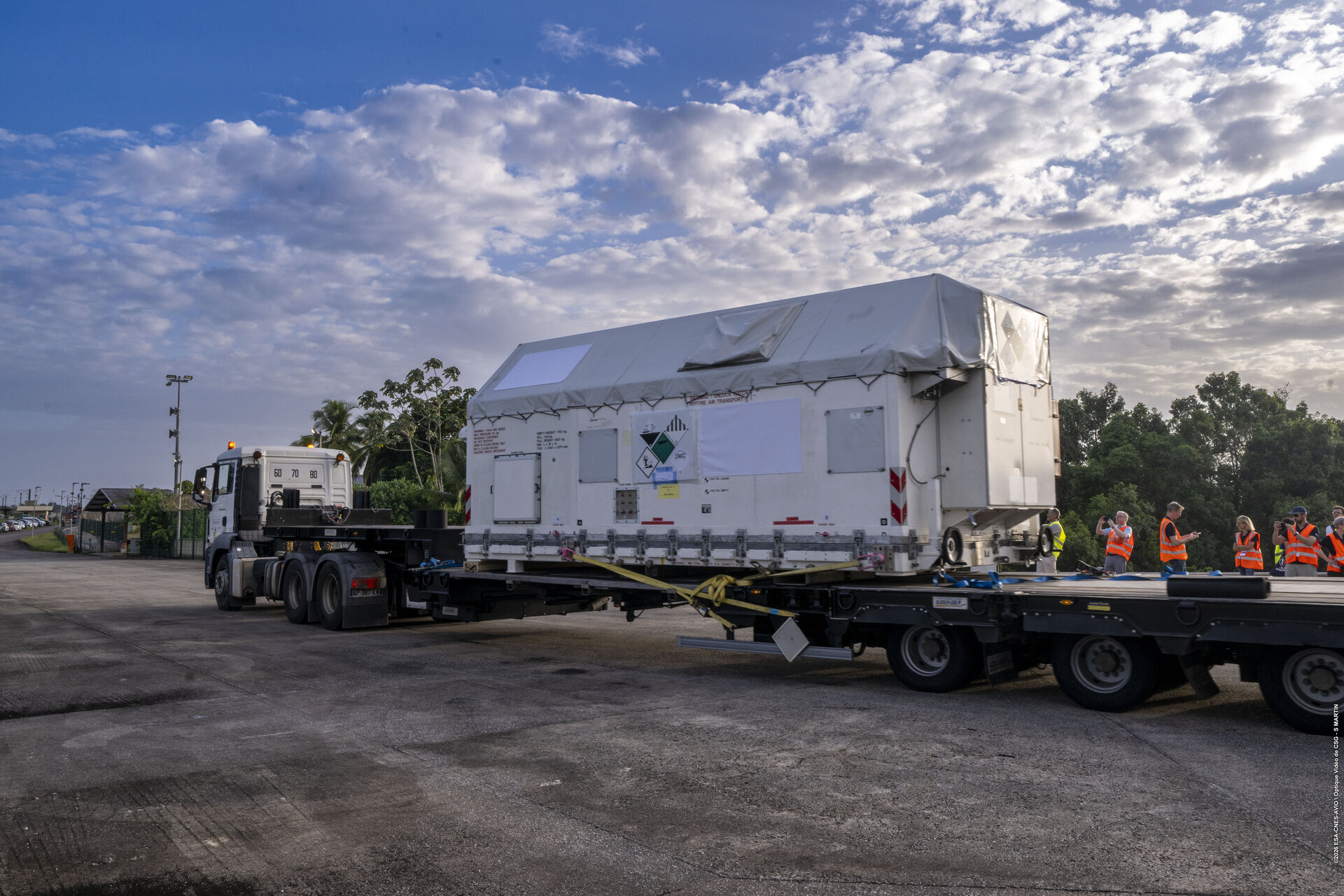
With liftoff scheduled for September, excitement is building at Europe’s Spaceport in French Guiana as two cutting-edge Earth observation satellites, FLEX and Copernicus Sentinel-3C, have arrived to begin their launch campaigns.
Over the coming weeks, engineers and mission teams will carry out a series of rigorous inspections and prepare the satellites to be installed atop their Vega-C rocket for their journey into orbit.
The satellites have just completed a two-week sea voyage from Nice, France, crossing the Mediterranean Sea and the Atlantic Ocean before docking at Pariacabo, the port of Kourou, on 12 July.
The satellite containers were offloaded the following day and transported by road to Europe’s Spaceport, where the satellites will be carefully unpacked and readied for their intensive eight-week launch campaigns. This includes comprehensive health checks and testing, fuelling, and final preparations to ensure FLEX and Sentinel-3C are ready to be encapsulated within the Vega-C rocket fairing.
Sentinel-3C will be injected into orbit first so it will be positioned above the FLEX satellite in the fairing.
Francois Bausier, ESA’s Launch Campaign Manager for Sentinel-3C, said, “It was great to see Sentinel-3C arrive safely in French Guiana after its long journey. Over the next nine weeks, we'll work through a demanding programme of inspections, testing and preparations to make sure the satellite is in perfect condition for launch.
"It's a busy period for the whole team, but having the satellite here at Europe’s Spaceport is the last step before launch – a step we welcome and one that comes after years of integration and rigorous testing.”

Frank de Bruin, ESA’s Launch Campaign Manager for FLEX, added, “Yes indeed, it's fantastic to reach this milestone and to see both satellites beginning their launch campaigns side by side. Although FLEX and Sentinel-3C have different scientific objectives, our teams will be working closely together as we prepare the satellites for their shared journey into orbit.
"There's a real sense of excitement across everyone involved, and we're looking forward to taking FLEX through these final stages before launch.”
With both satellites now at Europe’s Spaceport, the focus turns to completing the intensive launch campaign that will culminate in their shared liftoff aboard Vega-C.
Europe’s Vega-C rocket is an evolution of the Vega rocket family, offering greater performance, larger payload capacity and improved competitiveness. It can launch up to 3300 kg into space, ideal for carrying small scientific and Earth observation satellites into orbit.
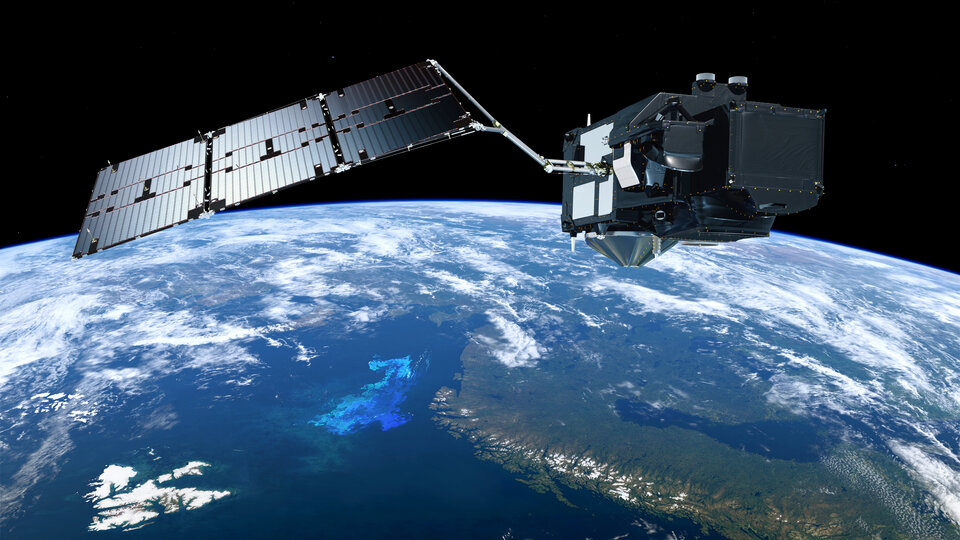
Sentinel-3C is the third satellite in the Copernicus Sentinel-3 series. Like its two older siblings in orbit, Sentinel-3C carries a suite of cutting-edge instruments that measure systematically Earth’s oceans, land, ice and atmosphere to monitor and understand large-scale global dynamics. It provides essential information in near-real time for ocean and weather forecasting.
ESA’s Earth Explorer FLEX will deliver the first global maps of vegetation fluorescence at a resolution of 300 m × 300 m to assess photosynthetic activity.
FLEX is equipped with the Fluorescence Imaging Spectrometer that will detect the faint fluorescence plants emit as they absorb sunlight during photosynthesis. Although invisible to the human eye, this subtle glow varies with plant health and environmental conditions.

In fact, the FLEX satellite will orbit in tandem with a Sentinel-3 satellite, which will be used to provide information on clouds, aerosols and water vapour as well as information about the land surface, such as the surface temperature, type of land cover and additional vegetation parameters. This integrated package of near-simultaneous measurements will provide an unprecedented view of global vegetation function and status.
Quelle: ESA
----
Update: 15.11.2026
.
Next Vega C Launch Edges Closer to Christmas Day as Satellites Arrive Late
Credit: ESA / S. Corvaja / Andrew Parsonson (edit)
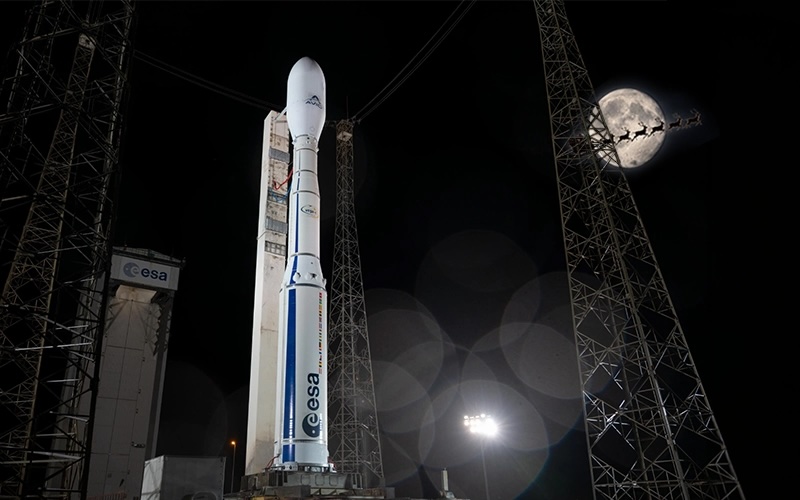
Italian rocket manufacturer Avio has revealed that delays in the delivery of customer satellites have pushed the third Vega C launch of 2026 back toward Christmas, several weeks later than previously planned.
Speaking during the company’s third-quarter earnings call on 11 November, Avio CEO Giulio Ranzo explained that the mission, which will carry six satellites, had been delayed as the company awaited the arrival of the final spacecraft.
“The satellites from the customers are a little bit late, so we are waiting for the last few of them to arrive,” said Ranzo. “It’s an interesting mission, six different satellites. They’re coming in a little bit late, so we are coming very close to Christmas Day.”
During the company’s half-year earnings call on 10 September, Ranzo said that the mission was scheduled for “the very beginning of December”. Based on his latest comments, the launch appears to have slipped by approximately two to three weeks.
The flight is expected to carry six satellites for Italy’s IRIDE Earth observation constellation. According to photographs published by the French space agency CNES, a shipment of the Thales Alenia Space-built satellites arrived in French Guiana by air on 9 November 2026. The spacecraft were then transported from Félix Éboué Airport to the Guiana Space Centre, arriving at the facility’s S3B payload preparation building the following day.
The latest setback is not the first time this year that Avio has blamed changes to its Vega C launch schedule on delays in the delivery of customer payloads.
During the same 10 September earnings call, Ranzo explained that the company could have conducted more than three Vega C launches in 2026, adding that “one satellite was somewhat late.”
So far in 2026, Avio has completed two Vega C launches. The most recent, conducted on 15 September, successfully deployed the European Space Agency’s FLEX satellite and the European Commission’s Sentinel-3C Earth observation satellite into orbit.
The company is working to increase Vega C’s annual launch cadence, with Ranzo indicating during the November earnings call that Avio was aiming to progress to four and eventually five launches per year, provided customers could meet their spacecraft delivery schedules.
During a May earnings call, Ranzo suggested that Avio could conduct as many as five Vega C launches in 2027, just one short of its medium-term target of six flights per year. However, speaking during the company’s November earnings call, Ranzo appeared to temper those expectations, outlining a more gradual increase to four and then five launches annually, suggesting that the company could now be targeting four flights in 2027. He qualified that outlook with a caveat, adding, “if the customers maintain their deadlines”.
Quelle: European Spaceflight