
24.11.2026
Euclid observes a supermassive black hole only 630 million years after the Big Bang.
To the point
- New record, quasar, black hole: Observations with ESA’s Euclid space telescope revealed the most distant known quasar, containing a supermassive black hole that already existed 630 million years after the Big Bang.
- Redshift, distance, age: The quasar J1504+6252, named Dún Aonghasa, has a redshift of z = 8.13 and existed 40 million years earlier than the previous record-holder.
- Growth mechanisms, direct collapse: The discovery supports a scenario in which supermassive black holes form through the direct collapse of large gas clouds and then continue to accumulate matter.
A team of astronomers led by Julien Wolf, a postdoc at the Max Planck Institute for Astronomy (MPIA), Heidelberg, Germany (now at the European Southern Observatory, Garching bei München, Germany), discovered the most distant quasar to date. First identified in the Euclid Wide Survey (EWS), subsequent observations with some of the most powerful telescopes on the ground and in space confirmed it to be a quasar. After the W.M. Keck Observatory and the Hubble Space Telescope (LBT) had already provided first hints, the Large Binocular Telescope and ultimately the James Webb Space Telescope finally revealed a redshift of z = 8.13, corresponding to a cosmic age of 630 million years after the Big Bang.
Redshift is a measure of how much the wavelength of the light emitted at the source has been stretched due to cosmic expansion by the time it reached the telescope. Depending on how the cosmos evolved over time, this redshift can be translated into a distance. Commonly referred to as J1504+6252 and nicknamed ‘Dún Aonghasa’ by the team, this quasar existed 40 million years earlier than the previous record holder and is the first quasar with a redshift greater than eight.
The brightest lasting objects in the Universe
 " alt="A prominent red dot, identified as a quasar, sits at the centre. The background contains numerous points of light and diffuse shapes in various colours, including white, yellow, and red, suggesting other celestial objects or galaxies. The scene conveys a deep view into space." data-src="/6491441/original-1794574580.jpg?t=ZXlKM2FXUjBhQ0k2TXpReExDSm9aV2xuYUhRaU9qTTBNU3dpWm1sMElqb2lZM0p2Y0NJc0ltWnBiR1ZmWlhoMFpXNXphVzl1SWpvaWFuQm5JaXdpYUdsbmFGOWtjR2tpT21aaGJITmxMQ0p2WW1wZmFXUWlPalkwT1RFME5ERjktLWVmNDFkNTM4NmQwMmZjNDViNzk2OWViZTdlYzBlNjQ0ODkxODAwNTU" />
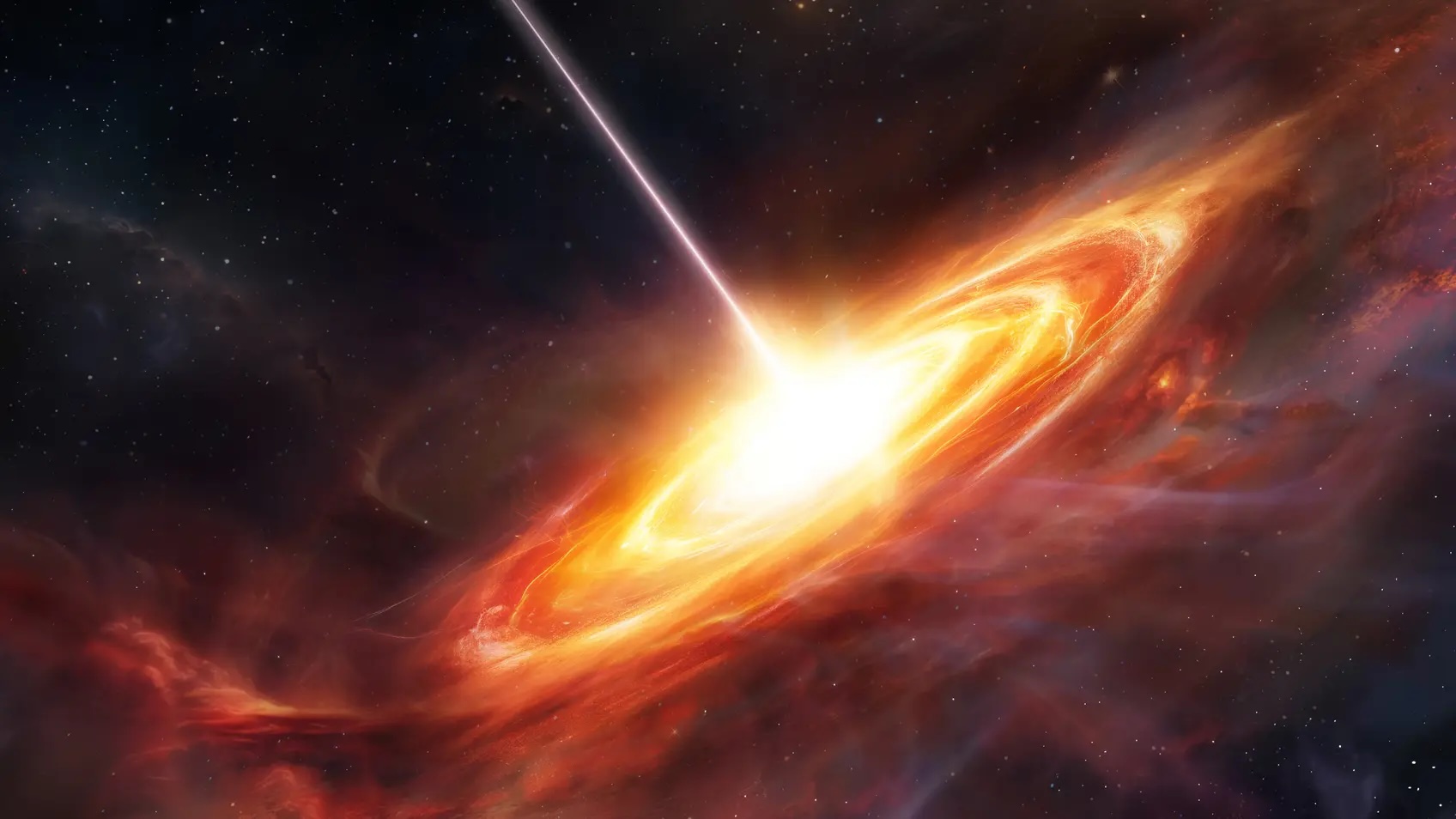
Quasars are intensely bright galaxy cores with supermassive black holes caught in the act of feeding: material in their immediate vicinity forms a turbulent swirl of gas that heats until it glows brighter than an entire galaxy before it falls into the black hole. Astronomers call this kind of process accretion. Quasars are the most luminous persistent sources in the Universe, which is why they can be studied in detail even within the first billion years of cosmic history. Follow-up observations revealed that Dún Aonghasa harbours a supermassive black hole with a mass of several hundred million times the Sun.
Looking for quasars at the earliest epochs of the Universe by pushing current observational capabilities to the extreme isn’t simply a mere hunt for new records, though. “Finding quasars at ever-increasing distances, at the edge of the observable universe, teaches us something about how the black holes in their centres grew,” says Julien Wolf. “The closer to the Big Bang we find them, the faster their black holes must have grown or the more massive they must have been at birth — or both.” This puts strict constraints on the mechanisms that helped increase their masses so vastly and quickly.
Scenarios of black hole growth
Wolf and his colleagues computed under which circumstances the proposed scenarios could produce black holes as massive as the one powering the quasar Dún Aonghasa. Considering reasonable growth rates, the latest discoveries seem to be consistent with a direct collapse scenario, in which a massive gas cloud condenses under its own gravity and directly forms a black hole which subsequently continues to grow. The growth rate is usually limited by a self-regulating mechanism that, at increasingly high temperatures, repels the collapsing gas, commonly labelled the Eddington limit.
Interestingly, observational data indicate that Dún Aonghasa is growing far below that limit, which shows that even the most distant quasars collect gas at varying rates. If this quasar had always grown this slowly, it would have required an extremely massive initial seed, which is difficult to explain with current formation models. Instead, an early black hole as massive as Dún Aonghasa supports the idea of a much more rapid accretion in the past, perhaps even beyond the theoretical Eddington limit.
Altogether, the conditions for a direct collapse to happen must have been rare during this era of cosmic evolution, which could explain the few quasars found at redshifts beyond 7.5 so far. If, at some point, astronomers discover quasars at considerably higher redshifts, i.e. approaching a cosmic age of just a few hundred million years, even the direct collapse scenario may become less likely.
In this case, astronomers may have to consider yet another, more exotic alternative: primordial black holes – hypothetical black holes formed right after the Big Bang which would function as massive seeds for gas to accumulate. Even without requiring extreme growth rates, such massive objects would provide a head start, giving the black holes ample time to gain weight worth millions upon millions of solar masses. Only future observations and discoveries of perhaps even more distant quasars will fully resolve the puzzle of how they formed.
“And this may happen sooner than we think,” says MPIA scientist Silvia Belladitta. She was responsible for the critical LBT follow-up observations that confirmed the source’s high redshift. The discovery of Dún Aonghasa came just a few months after the same team published the first 31 quasars in the first billion years of cosmic evolution, discovered in the Euclid Wide Survey (EWS), including the previous record holder. Belladitta adds: “This highlights how quickly Euclid is expanding our census of the most distant quasars. Each new discovery brings us closer to understanding how supermassive black holes formed and grew in the early universe.”
“It is unclear how far back in time these supermassive black holes powering luminous quasars exist, but Euclid has a good chance of finding out what that limit is,” concludes MPIA scientist and research group leader Eduardo Bañados.
Additional information
MPIA astronomers involved in this study were Julien Wolf (now at the European Southern Observatory), Silvia Belladitta (also at INAF-Osservatorio di Astrofisica e Scienza dello Spazio di Bologna, Italy), Eduardo Bañados, Raphael E. Hviding, Knud Jahnke, Sarah E. I. Bosman (also at Heidelberg University, Germany), Frederick B. Davies, Iva G. Momcheva, Anna de Graaff, Mischa Schirmer, Fabian Walter, Hans-Walter Rix.
Other researchers were: D. Yang (Leiden Observatory, The Netherlands [Leiden]), F. Guarneri (Hamburger Sternwarte, Germany [Hamburg] and INAF-Osservatorio Astronomico di Trieste, Italy), J. F. Hennawi (University of California, Santa Barbara, CA, USA and Leiden), J.-T. Schindler (Hamburg), D. J. Mortlock (Imperial College London, UK) and others.
Dún Aonghasa (IPA approximation: [duːn ˈeːŋgəsə]) is named after the prehistoric cliff-top fort on the island of Inis Mór, located west of Galway at the Atlantic edge of Ireland where land gives way to a vast oceanic horizon. Likewise, J1504+6252 stands at the current observational frontier of quasars, illuminating the threshold to even earlier cosmic times waiting to be explored.
Euclid is a European mission, built and operated by the European Space Agency (ESA), with contributions from its member states and NASA. The Euclid Consortium – consisting of more than 2000 scientists from 300 institutes in 15 European countries, the USA, Canada and Japan – is responsible for providing the scientific instruments and scientific data analysis. ESA selected Thales Alenia Space as prime contractor for the construction of the satellite and its service module, with Airbus Defence and Space chosen to develop the payload module, including the telescope. NASA provided the detectors of the Near-Infrared Spectrometer and Photometer (NISP). Euclid is a medium-class mission in ESA’s Cosmic Vision Plan.
Quelle: Max-Planck-Gesellschaft