
9.09.2026
September 8, 2026
— Sixty years after television audiences first tuned in to see the voyages of the Starship Enterprise, an astronaut on board the International Space Station has paid tribute to "Star Trek" by flying the badge of the franchise's latest fictional captain.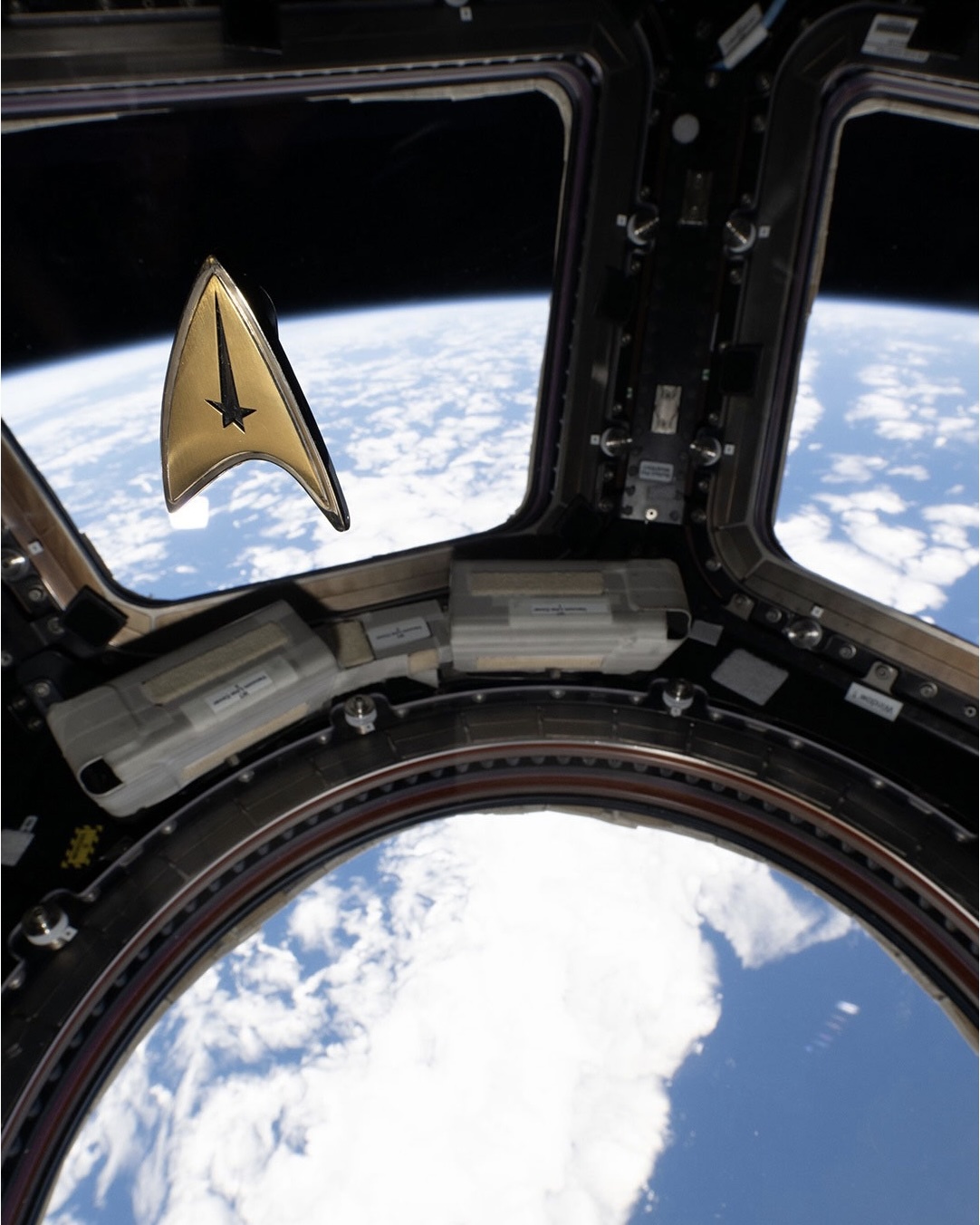
Expedition 75 flight engineer Sophie Adenot with ESA (European Space Agency) donned the Delta badge originally worn by actor Anson Mount for a video recorded from aboard the space station. Mount portrays Christoper Pike in the Paramount Plus streaming series "Star Trek: Strange New Worlds." Paramount and ESA both released the clip on their Instagram feeds.
"For 60 years, Star Trek has brought us stories of friendship and exploration. I'm wearing Captain Pike's badge aboard the ISS in celebration of continuing the real world work of science and exploration," said Adenot. "For me, exploration and science are about curiosity and cooperation daring to go a little farther together, learning from what we discover and build, and turning that knowledge into a better future for everyone."
"Happy 60th Star Trek. Live long and prosper," she said, displaying the traditional Vulcan salute.
'Explore. Discover. Do it together.'
In a post accompanying the video, ESA said that the pin was flown by Adenot as part of her European "Epsilon" mission as a way of representing what "Star Trek" has in common with the on going effort by humanity to explore.
"It's a small object, but it carries something bigger — 60 years of a story that taught us to dream about exploring together," reads the agency's post. "For more than 50 years, that's exactly what we've been doing. We've sent people and machines beyond Earth, built spacecraft with partners from dozens of countries and kept asking the same question 'Star Trek' never stopped asking: what's out there, and what can we learn from it?"
"Science fiction imagines the future. We build it," ESA officials wrote. "From the crew of the USS Enterprise to the crews on the International Space Station, the mission hasn't really changed. Explore. Discover. Do it together."
For almost half of the time since "The Original Series" introduced the world of Starfleet and the United Federation of Planets, representatives from 12 countries have maintained a continuous human presence in Earth orbit on the International Space Station. An additional 14 nations have sent visitors.
'What if' into 'why not'
Adenot "boldly" went where no female citizen of France had gone before when she became the first French woman to perform a spacewalk earlier this year. She was not, however, the first to sport a "Star Trek" costume piece in space.
Italian astronaut Samantha Cristoforetti, also with ESA, paid tribute to the franchise's first female captain, Katherine Janeway, by wearing a uniform like herswhile become the first astronaut to brew an espresso on the space station in 2015. Cristoforett quoted Janeway (played by actress Kate Mulgrew) when later describing the experience, "Coffee: the finest organic suspension ever devised."
Throughout the past six decades and its television series and movies, "Star Trek" has paid tribute to real space exploration history, all while scientists and engineers have worked to bring the technology invented for the show to reality. The tablet computers, handheld medical devices and replicators (3D printers) used on Earth and on the station were first seen in space on "Star Trek."
"So here's to 60 years of a series that turned 'what if' into 'why not' and to every explorer it sent looking up at the stars," ESA's officials wrote.
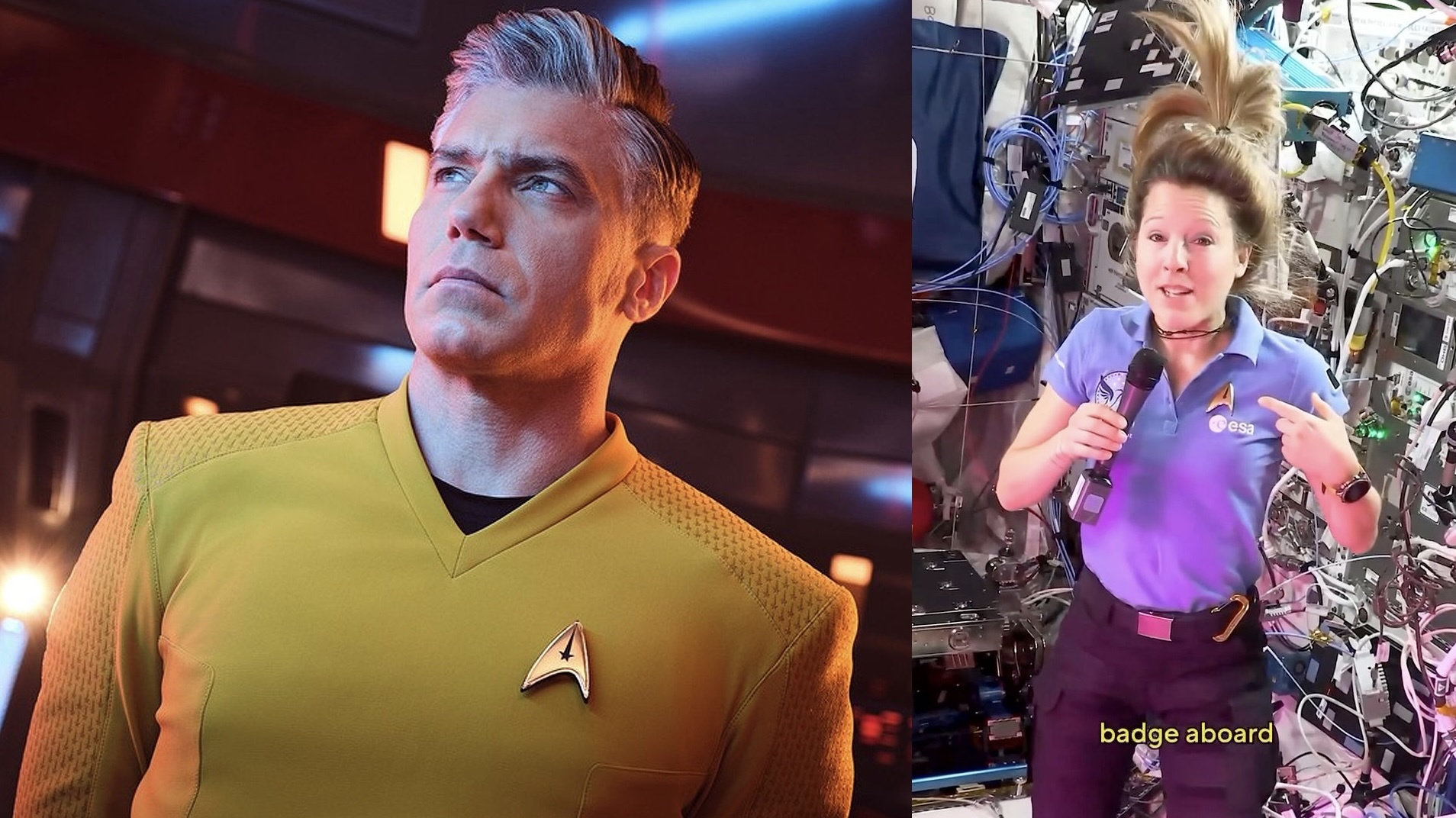
Actor Anson Mount wore the same Delta badge while portraying Captain Christopher Pike on "Star Trek: Strange New Worlds" as is now on board the International Space Station and was donned by ESA astronaut Sophie Adenot for the franchise's 60th anniversary. (Paramount/ESA)
Quelle: CS
+++
‘Star Trek’ and NASA have intertwined legacies – the show championed diversity and inspired generations of real space scientists
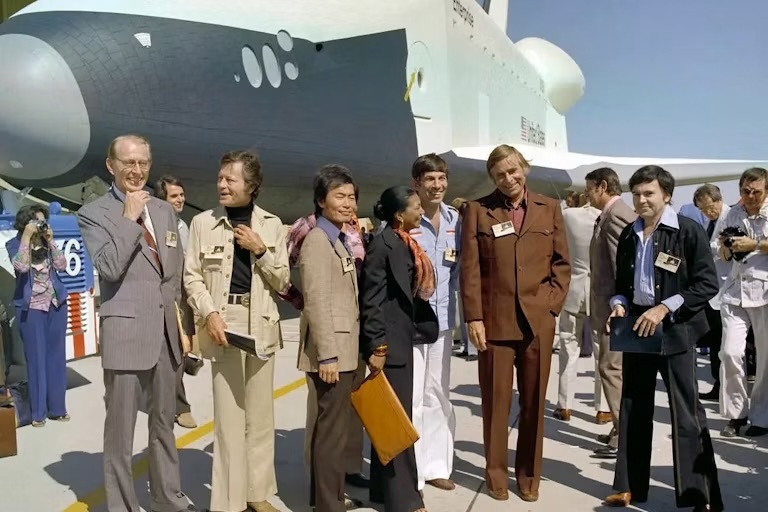
Gene Roddenberry, second from right, and Star Trek cast members visit the Space Shuttle Enterprise in 1976 with NASA Administrator James C. Fletcher, left. NASA
“Star Trek” began as a television series but grew into a cultural phenomenon.
When it premiered in 1966, no one could have predicted that it would lead to more than a dozen spinoff shows, more than a dozen movies and one of the most enduring fandoms in popular culture.
“Star Trek” is also unusual for its close connections to NASA, both in its storylines and in the real world. Decades of “Star Trek” adventures have ignited a love of spaceflight across generations, inspiring many who now work as space professionals.
I’m a cultural anthropologist who studies why people work in space exploration. I’ve interviewed astronomers, engineers, flight surgeons and astronauts. Although I focus more on science fact than science fiction, I’ve noticed in my interviews how much the two threads intertwine.
Because of this, I found myself at a “Star Trek” convention in early August 2026, just ahead of the show’s 60th anniversary on Sept. 8. The convention participants included people of widely different ages, appearances and identities. I was struck by just how much those gathered reflected the series’ values.
When NASA met Star Trek
In the original series, the show’s creator, Gene Roddenberry, came up with a philosophy held by the Vulcan people. He called it IDIC: infinite diversity in infinite combinations. It suggests that an ideal society is made up of many different types, all working together.
It represented Roddenberry’s rejection of conformity. It also explained why the Enterprise crew included a Russian alongside Americans, and Black, Japanese and female characters all in positions of responsibility and authority. While many ordinary viewers absorbed “Star Trek’s” lessons of camaraderie and acceptance, those involved in real space exploration also took notice.
Roddenberry established relationships with NASA personnelin the early days of his series. NASA provided photographs of planetary bodies and advice about the realities of spaceflight, as well as stock footage and access to certain NASA facilities.
Leonard Nimoy, who played the popular character Mr. Spock, was even brought to the National Space Club’s Goddard Memorial Dinner in 1967 as a special guest. Then-Vice President Hubert Humphrey gave the keynote speech. Afterward, though, it was Nimoy, not Humphrey, who found himself surrounded by the club’s members, including NASA employees, aerospace engineers, members of the military and government officials, all eager to meet the actor portraying the starship Enterprise’s first officer.
The relationship between NASA and “Star Trek” benefited the show by legitimizing the series. It also helped NASA by publicizing its work and depicting a positive future where its efforts to land on the Moon would eventually lead to visits to distant worlds – and amazing scientific advances like the show’s transporter and warp drive.
The connection between the space show and space agency was reflected in NASA’s decision to name its first space shuttle Enterprise, after some encouragement from the “Star Trek” fan community.
Inspiring astronauts
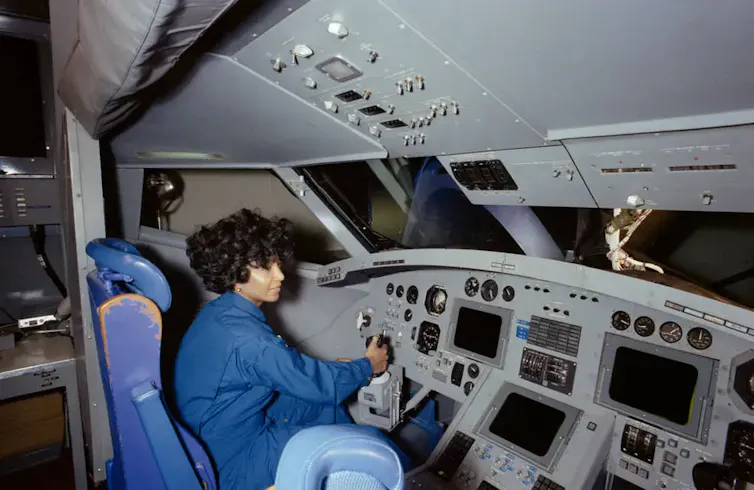
In 1977, actress Nichelle Nichols, who portrayed communications officer Uhura, was hired to recruit for NASA. The space agency had expanded its pool of astronauts to include scientists and other “mission specialists.” For the first time, an astronaut no longer needed to be a pilot to participate in a space mission.
NASA selected its first Black astronaut candidates and its first female astronaut candidates in 1978. While this move toward inclusivity may not have been directly influenced by infinite diversity in infinite combinations, it was compatible with it. “Star Trek” inspired many of NASA’s future employees. In interviews for my book “The Ultraview Effect,” a quarter of the space professionals I spoke with mentioned “Star Trek” as an influence.
An Apollo astronaut I interviewed, for instance, said he believed humans would eventually “be able to go anywhere in the universe, just like ‘Star Trek.’”
A young engineer who had grown up in the 1990s told me his motivation came from the “opening line of ‘Star Trek’… to explore strange new worlds.”
A space shuttle mission specialist emphasized Roddenberry’s decision to make the starship crew multicultural, explaining: “Today I look at the diversity of it … he was setting the stage back when it wasn’t acceptable [in order] to be acceptable!”
A changing future
That influence has accompanied a changing astronaut corps.
Both the 2025 astronaut class, which for the first time included more women than men, and the crew of Artemis II, which sent the first woman, first Black astronaut and first Canadian on a lunar mission, resemble the future that “Star Trek” imagined.
The “Star Trek” fans at the convention I attended were even more diverse. It was clear to me that Roddenberry’s “infinite diversity in infinite combinations” isn’t just a concept from the series, but something that has become a defining value of contemporary Trek fandom.
One such fan, Bjo Trimble, holds special status. She is credited with “saving ‘Star Trek’” when the series was almost canceled in 1968 after two seasons. Wearing a rainbow “IDIC” pin, she signed autographs at the SyFy Sistas booth, where T-shirts featuring Black “Star Trek” icons such as Uhura and Benjamin Sisko were on display.
However, with the Trump administration’s recent orders to dismantle all of NASA’s diversity, equity, inclusion and accessibility programs and policies, institutional support for “Star Trek’s” vision of acceptance and inclusivity, which flourishes in its fan base, is being undone. This rollback occurred just as NASA’s crews were reaching new milestones in representing the diverse future that “Star Trek” has encouraged for decades.
Sixty years later, some of the diverse future that “Star Trek” imagined has become part of everyday spaceflight. Other parts of that ideal remain unfinished.
Quelle: The Conversation