
9.09.2026
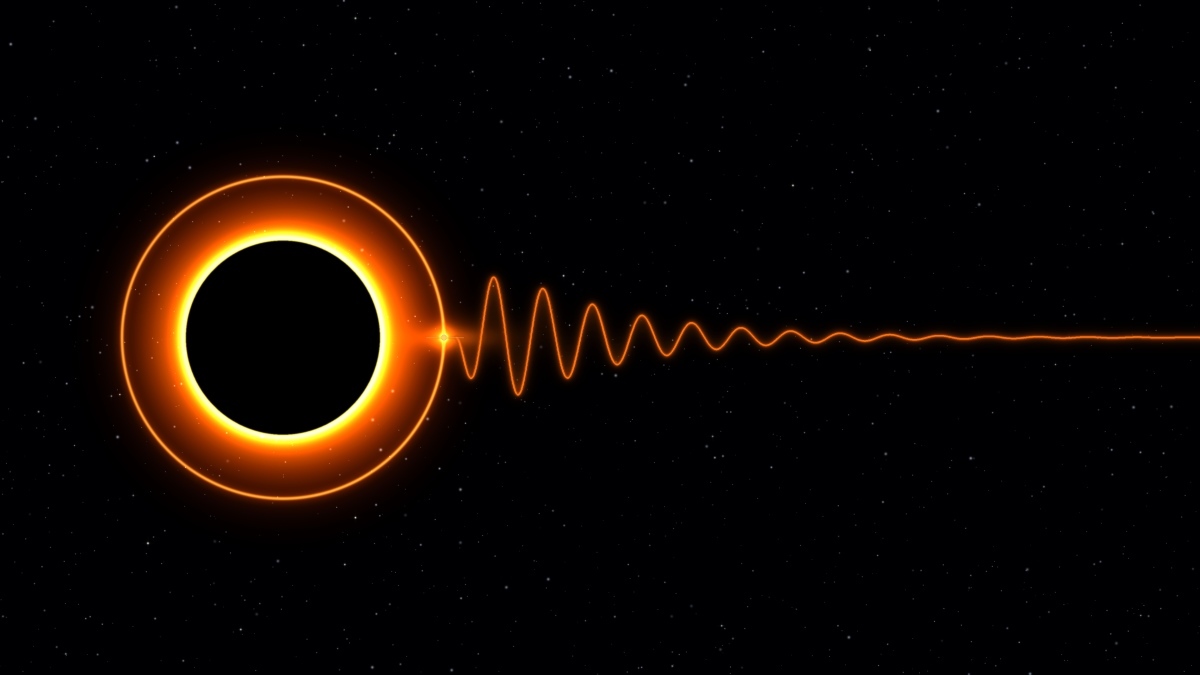
After a black hole is disturbed, it emits gravitational waves that fade over time, a signal called ringdown. Credit: Ariadna Uxue Palomino Ylla, Nagoya University
Researchers have suggested a new way to identify matter that may be hidden around black holes, sometimes called “black hole hair” by theoretical physicists.
When 2 black holes crash together and merge, the newly formed black hole sends out gravitational waves over vast cosmic distances. This fading pattern of waves is called a “ringdown” and it may hold secrets about what’s hiding around the black holes.
Einstein’s theories suggest that ringdown waves depend only on a black hole’s mass and how fast it spins.
New research, published in the Journal of Cosmology and Astroparticle Physics, asks what ringdown waves would look like if they were also influenced by hidden matter around the black holes.
Black hole hair signals can be difficult to decipher because different kinds of extra matter or exotic physics can alter how the ringdown waves are changed.
Not only does the new study give a better picture of what to look for, it also provides a further test of whether Einstein’s theory of general relativity is an adequate description of the extreme physics of black holes and any deviations that may exist around their simplest forms.
“Black hole hair may represent matter surrounding the black hole, or deviations from the simplest kind of black hole predicted by general relativity,” says first author Ariadna Uxue Palomino Ylla, a PhD student from Nagoya University in Japan.
“Because these may slightly change the ringdown signal, detecting or ruling out these changes could give us a new way to test gravity in this extreme region.”
Black holes distort spacetime enough to bend the path of light and gravitational waves. And the way light orbits near a black hole corresponds to the way its ringdown waves behave. Physicists can calculate one from the other.
Adding a small amount of matter to standard black hole models and applying Einstein's equations allowed Palomino Ylla and colleagues to calculate how that matter changes the ringdown's frequency and fade-out speed.
They tested 3 theoretical black hole models and found that hidden matter affects the waves differently depending on the type of black hole. The results also varied if the black hole was spinning and whether light was orbiting with or against this spin.
The differences between the models depend on how much hidden matter is present and how its pressure is arranged around the black hole.
“The ringdown waves may not only show that something extra is affecting the black hole; the way the signal changes could also give us clues about what this hidden matter is actually like,” says Palomino Ylla.
The team also found that spin direction affected the ringdown’s frequency and fade-out speed differently. The pattern was dependent on the type of hidden matter involved.
These results are early estimates, but offer a new way to learn about a black hole’s size, spin and potential black hole “hair” nearby.
Quelle: CONNECTSCI