
7.08.2025

ESA’s Hera mission has captured images of asteroids (1126) Otero and (18805) Kellyday. Though distant and faint, the early observations serve as both a successful instrument test and a demonstration of agile spacecraft operations that could prove useful for planetary defence.
Hera is currently travelling through space on its way to a binary asteroid system. In 2022, NASA’s DART spacecraft impacted the asteroid Dimorphos, changing its orbit around the larger asteroid Didymos. Now, Hera is returning to the system to help turn asteroid deflection into a reliable technique for planetary defence.
Hera enters the asteroid belt

Hera launched from Earth on 7 October 2024 and flew past Mars in March 2025, where it used the planet’s gravity to alter its trajectory and align it for arrival at the Didymos binary asteroid system in late 2026.
On 11 May 2025, as Hera cruised through the main asteroid belt beyond the orbit of Mars, the spacecraft turned its attention toward Otero, a rare A-type asteroid discovered almost 100 years ago.
From a distance of approximately three million kilometres, Otero appeared as a moving point of light – easily mistaken for a star if not for its subtle motion across the background sky.
![Hera's Asteroid Framing Camera (AFC) [A] incorporates two baffle-protected cameras for redundancy. Each AFC is a 1020x1020 monochrome visible light sensor produced by Jena-Optronik in Germany.](https://www.esa.int/var/esa/storage/images/esa_multimedia/images/2024/09/hera_asteroid_deck_and_instruments/26318085-1-eng-GB/Hera_Asteroid_Deck_and_instruments_article.jpg)
Hera captured images of Otero using its Asteroid Framing Camera – a navigational and scientific instrument that will be used to guide the spacecraft during its approach to Didymos next year. But this wasn’t just a sightseeing exercise.
Giacomo Moresco, Flight Dynamics Engineer at ESA’s European Space Operations Centre (ESOC) in Darmstadt, Germany, explains that the goal of the observations was to test the camera in conditions similar to those expected during Hera’s first sighting of Didymos.
“Didymos will also be a tiny, faint point of light among the stars when it first appears,” says Moresco. “The spacecraft will need to identify Didymos as soon as possible and keep the asteroid in the centre of the camera’s field of view as it approaches.”
An operational challenge
“The Hera spacecraft is performing very well,” notes Moresco. “So, we can use the cruise phase to test procedures and carry out other activities that will help us prepare for arrival, such as attempting to observe nearby asteroids.”
To carry out the observations, ESOC’s Flight Dynamics and Mission Analysis teams first compared Hera’s trajectory against those of hundreds of thousands of known asteroids. They found that Otero, thanks to its well-known orbit and relative brightness, was the best candidate.

Access the video
It then took Hera’s Flight Dynamics and Flight Control teams just a couple of weeks to prepare and execute the necessary spacecraft slews and observation sequences – a feat of flexibility and technical execution for a deep space mission.
Hera tracked Otero for three hours, capturing one image every six minutes. By aligning the star fields across frames, the team was able to create a time-lapse that highlighted the asteroid’s relative motion.
A useful technique for planetary defence

While science was not the primary objective of these observations, the operational lessons are significant. The successful observations of Otero demonstrate how a spacecraft in deep space can rapidly execute a precise observation of a new object.
This capability could be very useful for planetary defence. Earlier this year, astronomers around the world pointed their most powerful telescopes at the newly discovered asteroid 2024 YR4, a near-Earth object that raised concern due to its small chance of Earth impact in 2032, which has since been ruled out.
If a spacecraft like Hera had been in a suitable location, a similar operation may have enabled an impromptu observation of the asteroid. This could have given astronomers more information about its orbit and helped them to assess the hazard that it posed to Earth.
More recently, in July, astronomers confirmed the discovery of just the third object of interstellar origin passing through our Solar System. The object, named 3I/ATLAS, will pass close to Mars later this year, and the scientific community is currently assessing whether any spacecraft at the Red Planet may be able to observe it at the time.


Access the video
“By demonstrating that we can safely and efficiently command Hera to observe a new target on short notice, we are building confidence for the mission’s science phase, while also demonstrating a potential framework for rapid-response observations of interesting objects in deep space,” says Moresco.
Pushing the limits

“On 19 July, we pointed Hera’s camera towards another asteroid, (18805) Kellyday."
"Kellyday appeared roughly 40 times fainter than Otero," says Moresco. "So, these observations really pushed the limits of Hera’s faint object detection and of our image processing capabilities. But nonetheless, we spotted it!”
“These results are very encouraging for the performance of the camera during the approach to Didymos.”
Hera’s journey through the asteroid belt is a far cry from those seen in science fiction: there is no dodging and weaving through a chaotic and dense field of debris.
But each faint, fleeting glimpse of a rocky world helps Hera prepare for arrival at Didymos and Dimorphosnext year.
There, Hera will explore the aftermath of the DART spacecraft’s impact, turn the asteroids into two of the best studied in the Solar System, and help make asteroid deflection a well-understood and reliable method of planetary defence.
Quelle: ESA
----
Update: 27.03.2026
.
Like 'accelerating from stationary to supersonic flight': Europe's Hera probe boosts speed, stays on course for November asteroid rendezvous
"This is the Hera mission's largest maneuver in terms of fuel consumption."
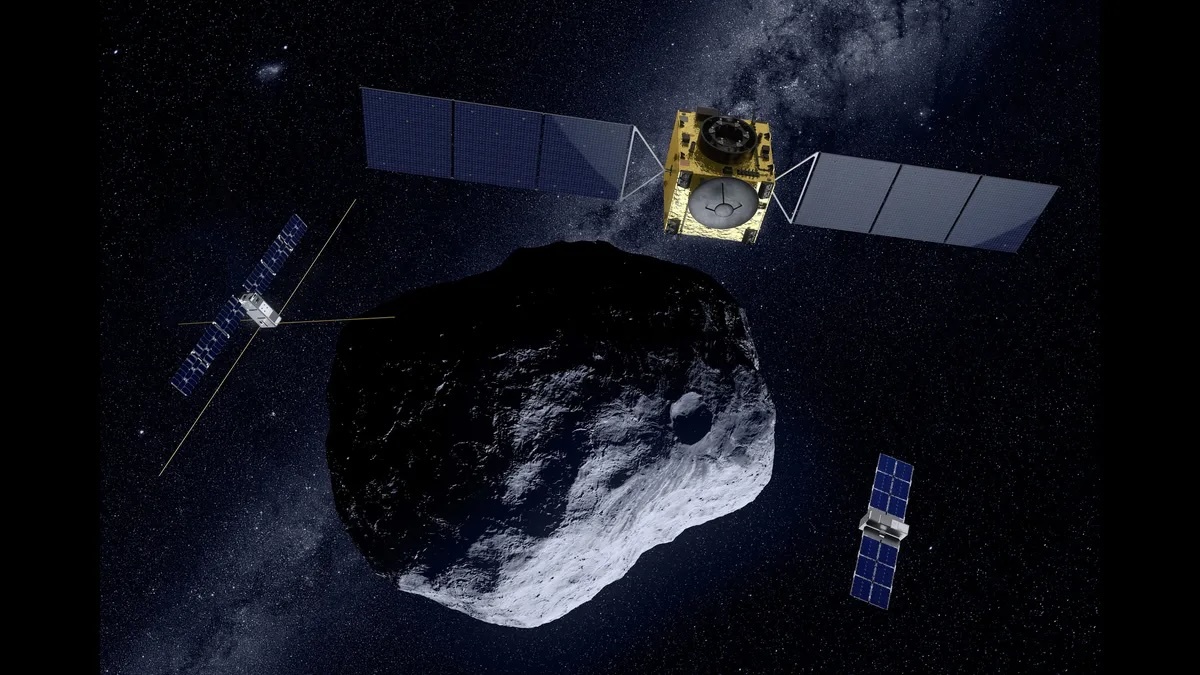
An artist's impression of Hera and its two ridealong cubesats, Juventas and Milani, in the Didymos binary asteroid system. (Image credit: ESA/Science Office
The European Space Agency's Hera spacecraft has completed a major deep-space maneuver, setting it on course to rendezvous late this year with the asteroid system targeted by NASA's DART mission back in 2022.
Hera launched on a SpaceX Falcon 9 rocket in October 2024, beginning its voyage to the Didymos binary asteroid system. Hera is designed to make follow-up observations of Dimorphos, the smaller of the two asteroids, which NASA's DART (Double Asteroid Redirection Test) spacecraft slammed into in September 2022.
The Hera spacecraft made a flyby of Mars one year ago, in March 2025, testing its autonomous vision-based navigation and training its cameras on the Martian moon Deimos, while also setting itself on course for the Didymos system.
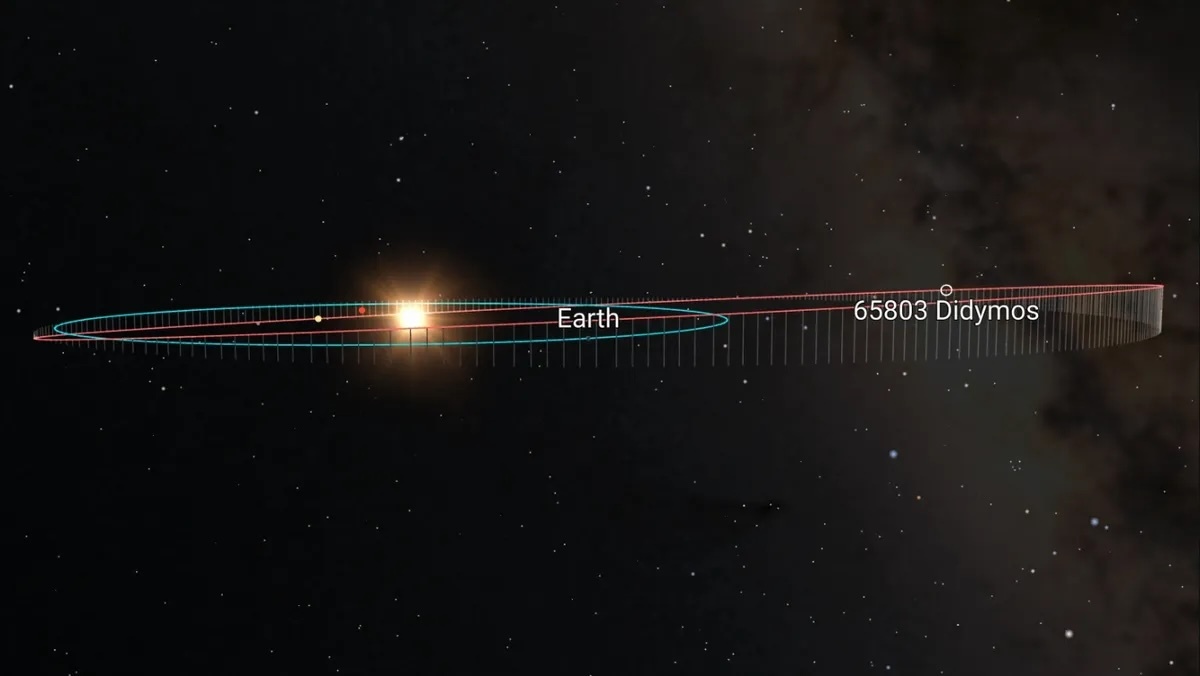
ESA's Hera mission conducted a deep space maneuver in February/March 2026 to align the inclination of the spacecraft’s orbit around the sun with that of its destination — the Didymos binary asteroid system. (Image credit: ESA)
Hera is now set up for its rendezvous with the asteroids in November 2026, thanks to a campaign of carefully planned engine burns that it performed in February and March.
"We divided the deep-space maneuver into three engine burns, plus one much smaller correction maneuver, carried out over a period of around four weeks," Francesco Castellini from the Flight Dynamics team at ESA's European Space Operations Centre in Germany, said in a March 17 statement.
"This is the Hera mission's largest maneuver in terms of fuel consumption, and we used it to test all of the systems that we will need during the braking and rendezvous maneuvers later this year as we arrive at Didymos," Castellini added.
These maneuvers burned 123 kilograms (271 pounds) of onboard hydrazine fuel and changed the spacecraft's velocity by 367 meters per second (1,204 feet per second) — about 821 mph (1,321 kph). This amounts to "a change comparable to an object accelerating from stationary to supersonic flight," ESA officials wrote in the same statement. ESA's Estrack network of deep space antennas confirmed the success of the engine burns.
Scientists are now beginning preparations for arrival at the asteroid system, including extensive onboard software updates.
Hera will begin a series of precision burns in October to shift the spacecraft out of its interplanetary cruise phase and set up rendezvous with the Didymos system. The spacecraft and its 12 payloads will spend at least six months studying the system, beginning with early global studies and then deploying its Milani and Juventas cubesats, before then embarking on a more detailed mapping exercise. The primary mission will culminate in an experimental, close-up inspection of the DART impact crater from an altitude of around 1 kilometer (0.62 miles).
The aim of the series of detailed follow-up studies of Dimorphos is to help transform DART's one-off kinetic impactor experiment into a repeatable, scalable asteroid-deflection method.
While humanity's knowledge of our solar system's small worlds is slowly growing thanks to missions from across the globe, such as NASA's OSIRIS-REx (now OSIRIS-APEX), JAXA's Hayabusa2 and China's Tianwen-2, Hera will also be performing the first survey of a binary asteroid system.
Scientists recently revealed that DART slamming into the 560-foot-wide (170 m) Dimorphos also altered the orbit of Didymos, the much larger asteroid of the pair at roughly 2,788 feet (850 m) across. This unexpected outcome could provide new insights into binary asteroid systems and, crucially, how their orbits change after impacts.
Quelle: SC
----
Update: 10.07.2026
.
Deep space software upgrade for Hera’s asteroid visit
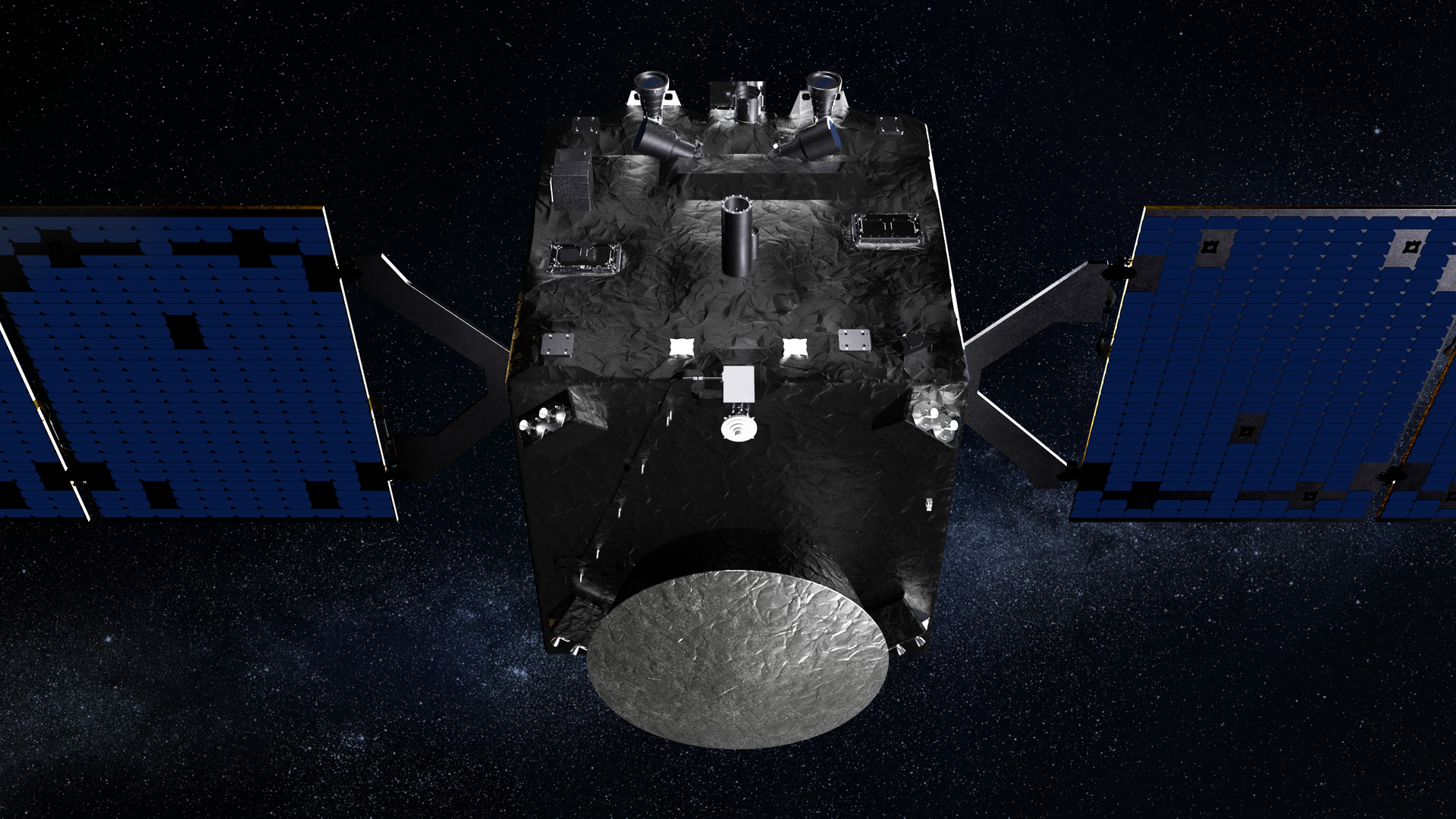
Operating across 140 million km of space, the control team for ESA’s Hera mission have succeeded in upgrading the software running the spacecraft, leaving it ready to explore the distant Dimorphos and Didymos asteroids this autumn.

Imagine being tasked to install new software onto a multi-million-euro computer, sight unseen. You don’t get to touch the hardware in question because it is already busy overseeing a spacecraft in deep space, in onward motion at more than 12 km per second.
Instead you send instructions by text message, relayed via 35-m diameter communication antennas directed at precisely the right patch of sky, working around a nearly eight-minute one-way signal delay due to the inherent distance involved.

Having uploaded the software successfully, then comes the crucial phase when the entire spacecraft needs to be rebooted – twice!
Hera’s onboard computer, overseeing all its instruments and subsystems, runs on parallel processor streams for redundancy. A pair of reboots allowed each to be evaluated in turn. The seven-strong core Hera team stood ready in their control room in case the spacecraft did not signal back as scheduled, but thankfully it rebooted nominally on each occasion, right on time.

“The success of this more that two week operation leaves Hera finally ready for what we call its ‘asteroid phase’,” says Anna Schiavo, Hera Spacecraft Operations Engineer. “The update will allow us to commission all of the spacecraft’s remaining instruments and to use the autonomous functionality that Hera will rely on to navigate around its target asteroids – along with the inter-satellite links Hera will employ to communicate with the two CubeSats it will deploy early next year.”
Before being applied in flight the software underwent one of the most complicated test campaigns ever undertaken at ESA’s ESOC mission control centre in Darmstadt, Germany. Occurring over a year and a half and requiring 50 ground test days in all, this involved rehearsing all Hera’s autonomous functionality around its two target asteroids and also interactions with its CubeSats.

Sylvain Lodiot, heading ESA’s Outer Solar System and Planetary Defence Operations, explains: “The testing involved running the software on a functional replica of Hera located at the mission’s prime contractor OHB in Bremen, called the ‘Bench’, flying around simulated models of the asteroids and communicating with actual CubeSat replicas though the inter-satellite links.”
Caglayan Guerbuez, Hera Spacecraft Operations Manager.: “It’s not so unusual that a deep space mission is launched without its final software aboard, but Hera was really a mission in a hurry: it had to launch when it did in October 2024 in order to benefit from a flyby past Mars the following spring, otherwise the mission would have taken years longer to reach Dimorphos.

“So we have been kept busy during the cruise phase to catch up, with the valued support of software provider Spacebel as well as OHB.”
Hera is ESA’s first planetary defence mission. The van-sized spacecraft is headed to the Dimorphos asteroid, which orbits in turn around the larger Didymos asteroid. Dimorphos is already historic as the first object in the Solar System to have had its orbit changed by human action – when NASA’s DART spacecraft impacted it in September 2022.

DART’s impact caused a brightening visible from distant Earth telescopes, but nobody knows what it did to Dimorphos itself. Hera is going there to perform a close-up crash site survey, to help turn DART’s kinetic impact experiment into a well understood planetary defence that might be tailored against incoming objects if required.

Access the video
Name our dino – ESA’s Hera asteroid mission mascot!
The European Space Agency’s Hera asteroid mission for planetary defence has a cartoon dinosaur for its mascot – because dinos were made extinct after an asteroid impact, but while they didn't have a space agency, people do! Now we’re asking you to supply our dino with a name, to win a place at November’s Hera arrival celebration.
Ian Carnelli, Hera’s mission manager, comments: “Hera’s dino, riding inside its air balloon, features in all our animations, in our LEGO models and, in sticker form, is emblazoned on all our team laptops!

“And what I can exclusively reveal is that our little dino is also present aboard the spacecraft itself – its appearance to be debuted around the time we reach our target asteroids.
“In the meantime our dino needs a name, and we’re looking forward to hearing your suggestions! Whoever comes up with the chosen name, as selected by a Hera team jury, will be invited to our unveiling of the first images from Hera after reaching the Didymos and Dimorphos asteroids, on 25 November in Berlin.”
Hera for planetary defence
Hera is ESA’s first planetary defence mission. The small-car-sized spacecraft is headed to the Dimorphos asteroid, which orbits in turn around the larger Didymos asteroid. Dimorphos is already historic as the first object in the Solar System to have had its orbit changed by human action – when NASA’s DART spacecraft impacted it in September 2022.
DART’s impact caused a brightening and a change in Dimorphos orbital period around Didymos visible from distant Earth telescopes, but nobody knows what it did to Dimorphos itself. Hera is going there to perform a close-up crash site survey, to help turn DART’s kinetic impact experiment into a well understood planetary defence technique that might be tailored against incoming objects if required.

Of dinosaurs and asteroids
Dinosaurs – currently back in cinemas in The End of Oak Street – have been a perennial cultural obsession. These prehistoric giants ruled over the entire planet for millions of years until, very suddenly, they didn’t.
Dinosaurs and asteroids have been linked in public consciousness ever since the father and son Alvarez scientists deduced the otherwise mysterious extinction of the dinosaurs was connected to an enormous body impacting Earth.

This milestone discovery, today linked to the Chicxulub impact crater off the coast of Mexico, demonstrates how impact events have punctuated the history of life on Earth – and how they still pose a risk to us today.
As science fiction writer Larry Niven was the first to observe: “The dinosaurs became extinct because they didn’t have a space programme.”

To improve on dinosaur-level survivability, ESA’s Space Safety programme includes a significant Planetary Defence element, with Hera and other asteroid missions (including Ramses to rendezvous with the Apophis asteroid as it passes Earth in 2029 and Neomir to detect asteroids from orbit).
These missions are supplemented by ESA’s Near-Earth Object Coordination Centre in Frascati, Italy, which coordinates observations of small bodies venturing near to Earth to evaluate and monitor their impact threat.
So how did Hera gain its dino mascot? The Science Office company in Portugal developed the mission's animated series, including designing characters for the Hera spacecraft and its two CubeSat passengers.

Executive Director Mariana Barrosa recalls: ‘We were storyboarding the initial cartoon episode and included a shot of some dinosaurs protesting in favour of planetary defence. From there came the idea: “Wouldn’t it be funny if Hera had a pet dinosaur?”’
The one thing Hera’s dino – riding comfortably inside its balloon – does not have is a name. That’s where you come in!
How to enter
To enter the dino naming contest, fill in your own name, email, name idea, a supporting explanation and an optional video via the form linked here:
https://blogs.esa.int/forms/name-heras-dinosaur-competition/
or else email these details via hera.challenge@esa.int

The contest is open to any citizen of ESA Member States, Participating States and Associate States, the closing date is Friday 23 October.
The prize is attendance to the Hera first image unveiling event in Berlin on 25 November.
