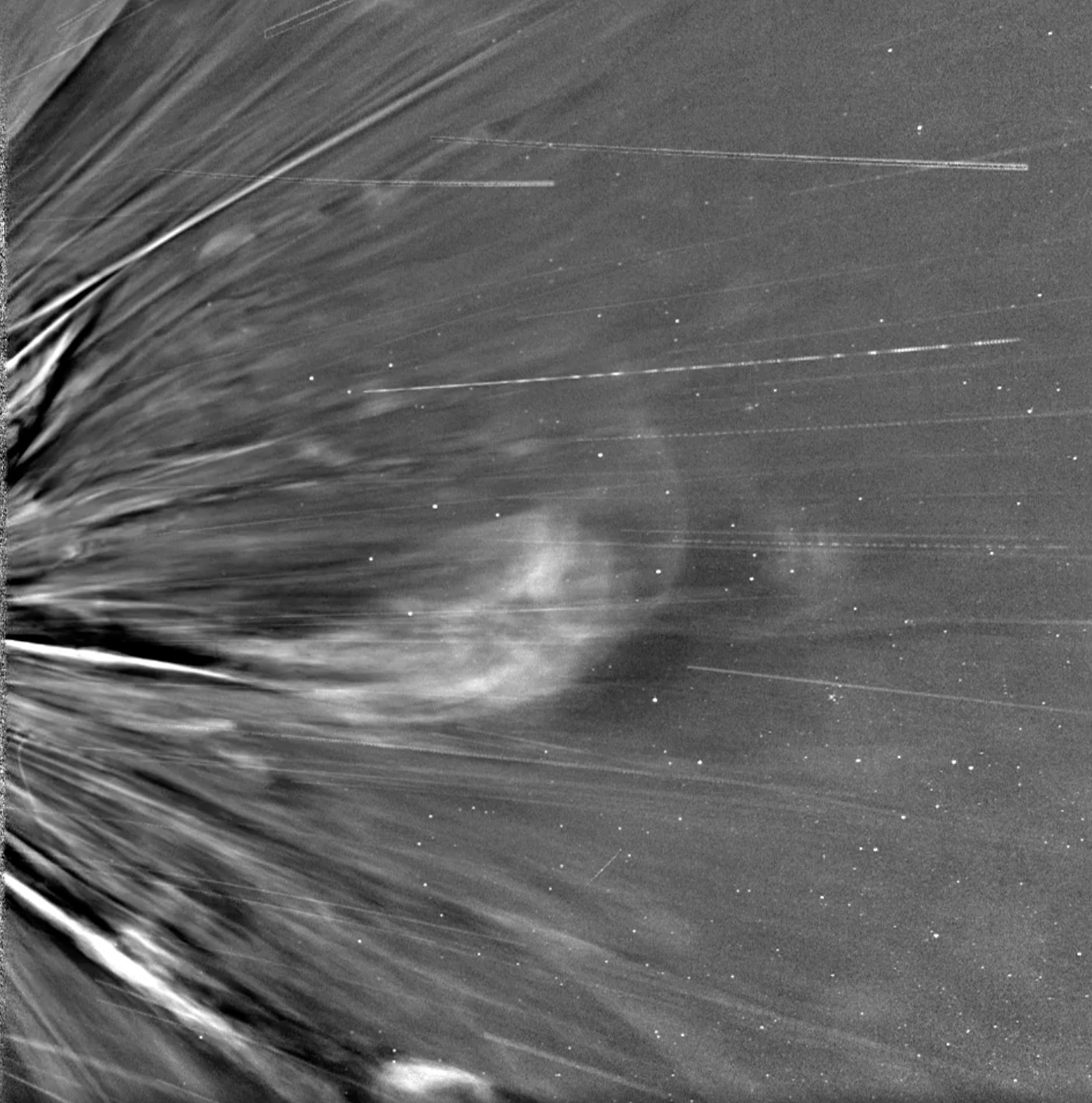
Images captured by NASA’s Parker Solar Probe as the spacecraft made its record-breaking closest approach to the Sun in December 2024 have now revealed new details about how solar magnetic fields responsible for space weather escape from the Sun — and how sometimes they don’t.
Like a toddler, our Sun occasionally has disruptive outbursts. But instead of throwing a fit, the Sun spews magnetized material and hazardous high-energy particles that drive space weather as they travel across the solar system. These outbursts can impact our daily lives, from disrupting technologies like GPS to triggering power outages, and they can also imperil voyaging astronauts and spacecraft. Understanding how these solar outbursts, called coronal mass ejections (CMEs), occur and where they are headed is essential to predicting and preparing for their impacts at Earth, the Moon, and Mars.
Images taken by Parker Solar Probe in December 2024, and published Thursday in the Astrophysical Journal Letters, have revealed that not all magnetic material in a CME escapes the Sun — some makes it back, changing the shape of the solar atmosphere in subtle, but significant, ways that can set the course of the next CME exploding from the Sun. These findings have far-reaching implications for understanding how the CME-driven release of magnetic fields affects not only the planets, but the Sun itself.
“These breathtaking images are some of the closest ever taken to the Sun and they’re expanding what we know about our closest star,” said Joe Westlake, heliophysics division director at NASA Headquarters in Washington. “The insights we gain from these images are an important part of understanding and predicting how space weather moves through the solar system, especially for mission planning that ensures the safety of our Artemis astronauts traveling beyond the protective shield of our atmosphere.”
As Parker Solar Probe swept through the Sun’s atmosphere on Dec. 24, 2024, just 3.8 million miles from the solar surface, its Wide-Field Imager for Solar Probe, or WISPR, observed a CME erupt from the Sun. In the CME’s wake, elongated blobs of solar material were seen falling back toward the Sun.
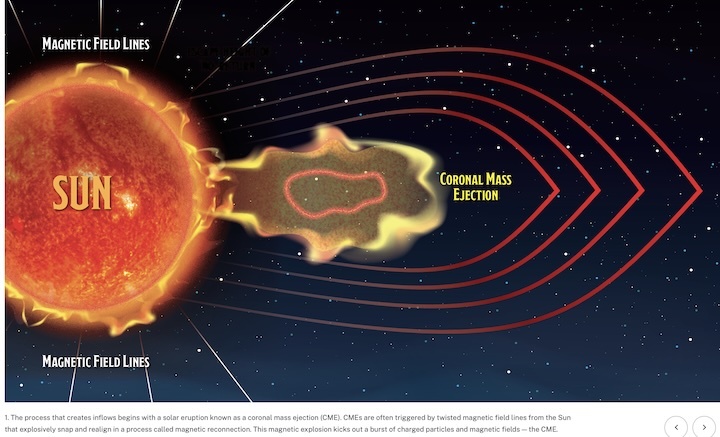
The CMEs are often triggered by twisted magnetic field lines that explosively snap and realign in a process called magnetic reconnection. This magnetic explosion kicks out a burst of charged particles and magnetic fields — a CME.
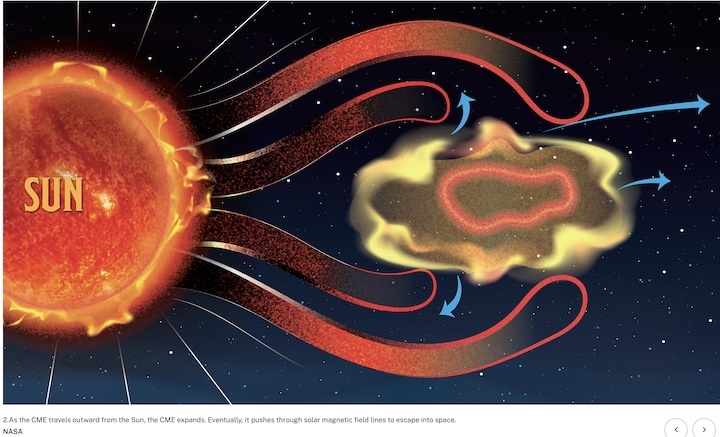
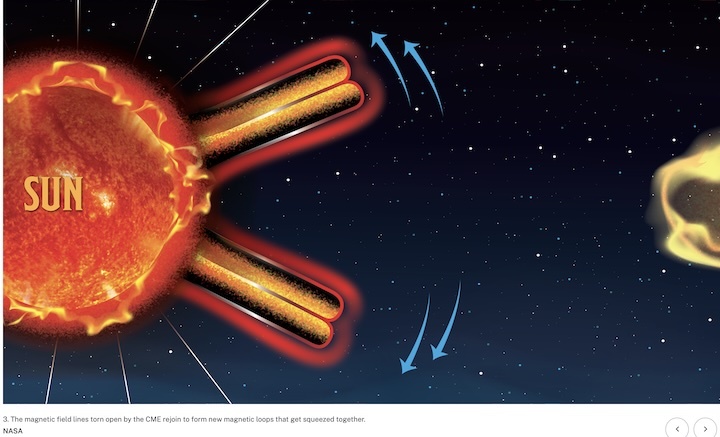
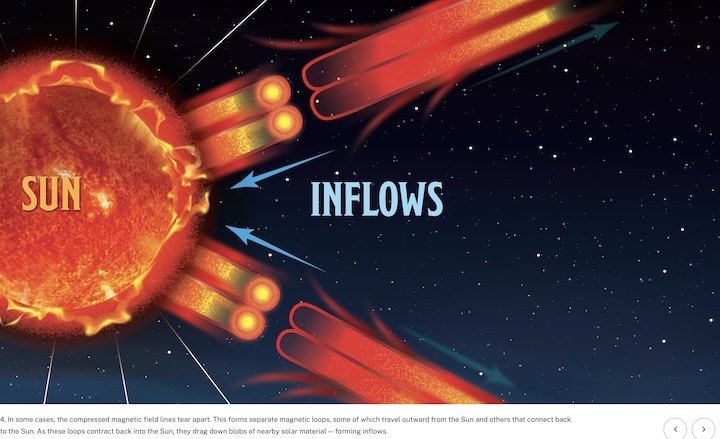
As the CME travels outward from the Sun, it expands, in some cases causing nearby magnetic field lines to tear apart like the threads of an old piece of cloth pulled too tight. The torn magnetic field quickly mends itself, creating separate magnetic loops. Some of the loops travel outward from the Sun, and others stitch back to the Sun, forming inflows.
“It turns out, some of the magnetic field released with the CME does not escape as we would expect,” said Angelos Vourlidas, WISPR project scientist and researcher at Johns Hopkins Applied Physics Laboratory. “It actually lingers for a while and eventually returns to the Sun to be recycled, reshaping the solar atmosphere in subtle ways.”
An important result of this magnetic recycling is that as the inflows contract back into the Sun, they drag down blobs of nearby solar material and ultimately affect the magnetic fields swirling beneath. This interaction reconfigures the solar magnetic landscape, potentially altering the trajectories of subsequent CMEs that may emerge from the region.
“The magnetic reconfiguration caused by inflows may be enough to point a secondary CME a few degrees in a different direction,” Vourlidas said. “That’s enough to be the difference between a CME crashing into Mars versus sweeping by the planet with no or little effects.”
Scientists are using the new findings to improve their models of space weather and the Sun’s complex magnetic environment. Ultimately, this work may help scientists better predict the impact of space weather across the solar system on longer timescales than currently possible.
“Eventually, with more and more passes by the Sun, Parker Solar Probe will help us be able to continue building the big picture of the Sun’s magnetic fields and how they can affect us,” Rawafi said. “And as the Sun transitions from solar maximum toward minimum, the scenes we’ll witness may be even more dramatic.”
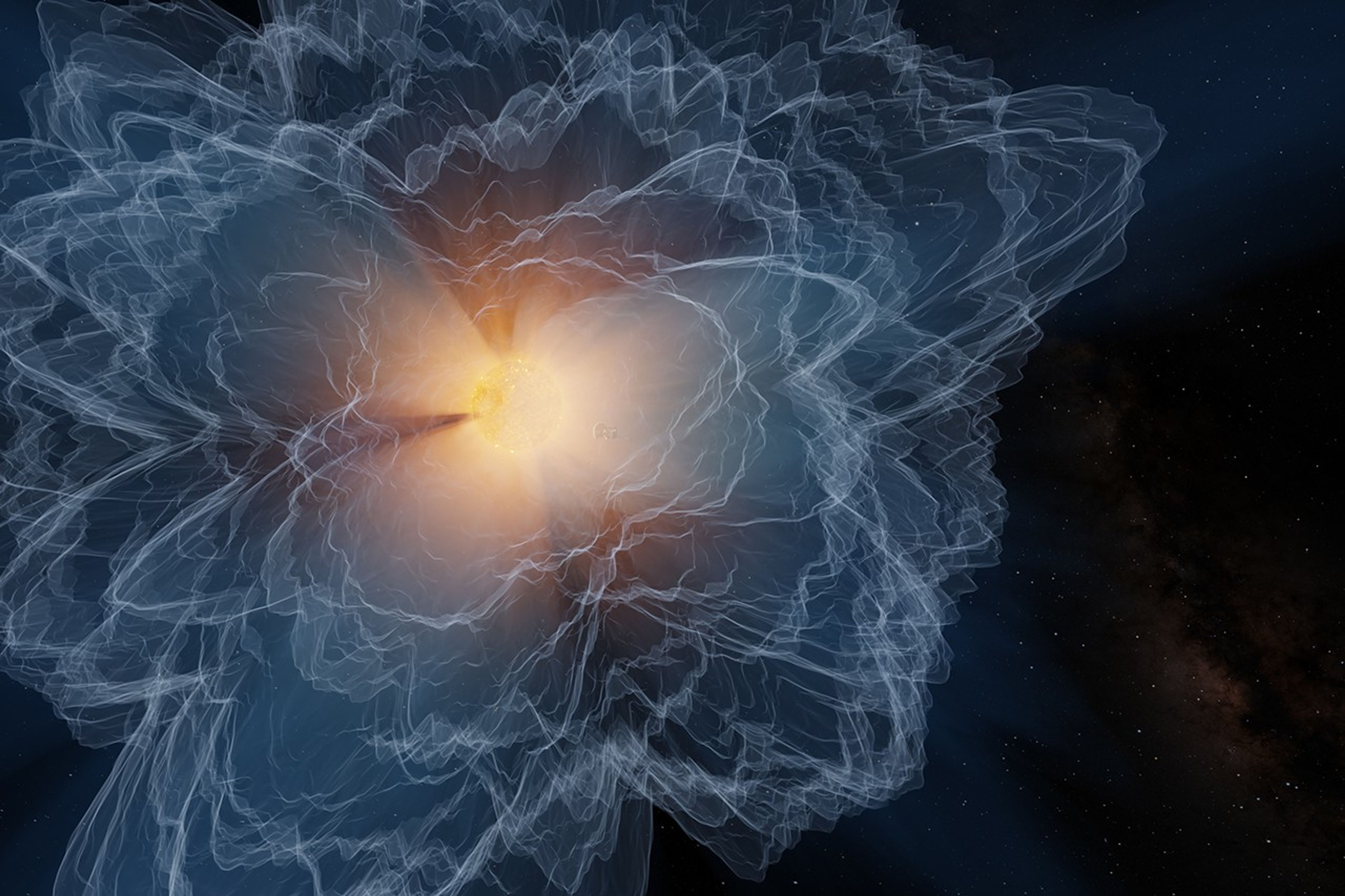
This artist’s concept depicts the boundary of the Sun’s atmosphere, known as the Alfvén surface. The area appears to shift between spiky and frothy, and it is the point of no return for material that escapes the Sun’s magnetic grasp. Deep dives through the Alfvén surface using NASA’s Parker Solar Probe combined with solar wind measurements from other spacecraft have allowed scientists to track the evolution of this structure throughout the solar cycle and produce a map of this previously uncharted boundary.
With the help of NASA’s Parker Solar Probe, astronomers have made the first continuous, two-dimensional maps of the outer edge of the Sun’s atmosphere.
At this boundary, which scientists call the Alfvén surface, solar material escapes from the Sun to become the solar wind, a million-mile-per-hour stream of particles that flows outward in all directions across the solar system, striking planets, spacecraft, and anything else in its way.
Published Thursday in the Astrophysical Journal Letters, results using Parker Solar Probe’s Solar Wind Electrons Alphas and Protons (SWEAP) instrument show that this boundary grows larger, rougher, and spikier as the Sun becomes more active during its 11-year solar cycle.
Scientists have been using other solar observatories, such as the NASA/ESA (European Space Agency) Solar Orbiter and NASA’s Wind, to begin mapping the boundary between the Sun’s atmosphere and the solar wind. However, Parker Solar Probe gets closer to the Sun than any other spacecraft in history — so close that it repeatedly flies through this boundary, providing direct validation of the maps and showing how the boundary changes as the Sun’s activity varies.
Knowing exactly where this critical boundary is could help scientists answer big questions about the Sun’s outer atmosphere, known as the corona, and help us understand how solar activity impacts the rest of the solar system, including life on Earth and our technology.
Quelle: NASA
----
Update: 18.03.2026
.
NASA’s Parker Solar Probe Makes 27th Swing Around the Sun
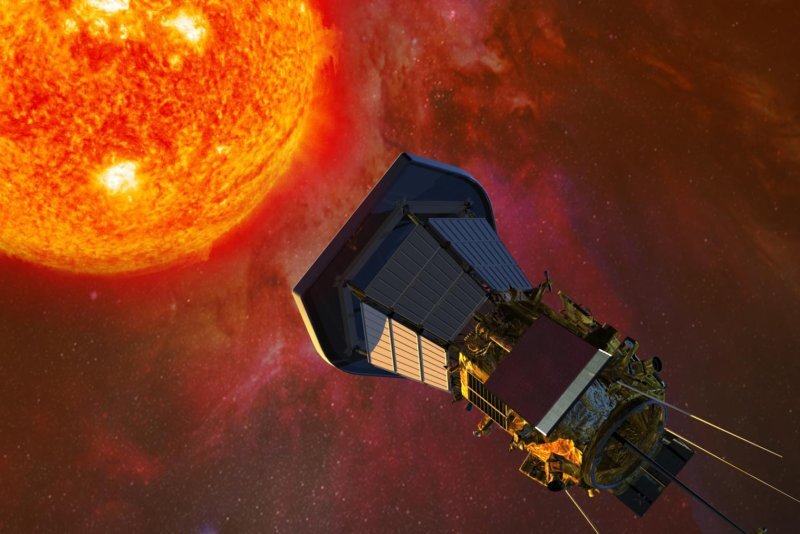
NASA’s Parker Solar Probe completed its 27th close approach to the Sun on March 11, again matching its record distance of 3.8 million miles (6.2 million kilometers) from the solar surface. The flyby allowed the spacecraft to conduct measurements of the solar wind and solar activity, contributing to our understanding of how the Sun’s atmosphere changes throughout the solar cycle.
The durable spacecraft checked in with flight controllers at the Johns Hopkins Applied Physics Laboratory (APL) in Laurel, Maryland — where Parker Solar Probe was also designed and built — on March 14, transmitting a beacon tone indicating that its systems were operating normally. Speeding on a path around the Sun that limited communications with Earth, Parker had been out of contact and operating autonomously, as planned, for about a month leading up to, and during, closest approach.
During this solar encounter, from March 6 through March 16, Parker’s four scientific instrument packages gathered data from inside the Sun’s atmosphere, or corona. Parker will begin returning detailed telemetry on its status on March 17, with science data transmission for this solar encounter set to start the following day.
Parker’s observations of the solar wind and solar events, such as coronal mass ejections and the aftermaths of flares, are critical to advancing humankind’s understanding of the Sun and the phenomena that drive high-energy space weather events that pose risks to astronauts, satellites, air travel, and even power grids on Earth. Understanding the fundamental physics of space weather enables more reliable prediction of astronaut safety during future deep-space missions to the Moon and Mars.
Parker also equaled its record-setting speed of 430,000 miles per hour (687,000 kilometers per hour) — a mark that, like the distance to the Sun, was set during a close approach on Dec. 24, 2024, and matched during 2025 flybys on March 22, June 19, Sept. 16 and Dec. 13.
Parker launched in August 2018. At the time, the Sun was near the minimum of its 11-year activity cycle. In 2024, representatives from NASA, the National Oceanic and Atmospheric Administration (NOAA), and the international Solar Cycle Prediction Panel announced that the Sun has reached its solar maximum period. Parker’s 27 encounters with the Sun reflect this change over time, sampling the Sun’s atmosphere from quiet to very active periods. Parker Solar Probe will remain in this orbit around the Sun and continue making observations into the declining phase of solar activity.
The next steps for the mission in late 2026 and beyond are formally under NASA review.
Parker Solar Probe was developed as a part of NASA’s Living With a Star (LWS) program to explore aspects of the Sun-Earth system that directly affect life and society. The LWS program is managed by the agency’s Goddard Space Flight Center in Greenbelt, Maryland, for NASA’s Science Mission Directorate in Washington. Johns Hopkins APL manages Parker Solar Probe for NASA and designed, built, and operates the mission.
Quelle: NASA
----
Update: 13.06.2026
.
Parker Solar Probe Makes 28th Close Pass of Sun
NASA’s Parker Solar Probe completed its 28th close approach to the Sun on June 8, again matching its record distance of 3.8 million miles from the solar surface. The flyby allowed the spacecraft to continue its measurements of the solar wind and solar activity at their source, while adding to our understanding of how the Sun’s atmosphere changes throughout the solar cycle.
The spacecraft checked in with flight controllers at the Johns Hopkins Applied Physics Laboratory (APL) in Laurel, Maryland — where Parker Solar Probe was designed and built — on Thursday, transmitting a beacon tone that indicated its systems were operating normally. Zooming around the Sun on a trajectory that limited communications with Earth, Parker had been out of contact and operating autonomously for nine days around its closest approach, as planned.
During this solar encounter, which started June 3 and ends Saturday, June 13, Parker’s four scientific instrument packages gathered data from inside the Sun’s atmosphere, or corona. Parker will begin returning detailed spacecraft telemetry on June 14, with science data transmission set to run from Wednesday, June 17 to Tuesday, June 30.
Parker’s observations of the solar wind and solar events, such as coronal mass ejections and the aftermaths of flares, are critical to advancing humanity’s understanding of the Sun and the phenomena that drive high-energy space weather events that pose risks to astronauts, satellites, air travel, and even power grids on Earth. Understanding the fundamental physics of space weather enables more reliable prediction of astronaut safety during future deep-space missions to the Moon and Mars.
Parker also equaled its record-setting speed of 430,000 mph — a mark that, like Parker’s distance to the Sun, was set during a close approach on Dec. 24, 2024, and matched during five flybys since, most recently on March 11. Parker will continue matching these speed and distance records during future flybys.
Through all six close approaches, mission leads say, the spacecraft has remained in excellent condition. While Parker doesn’t have a temperature sensor on the front of its heat shield — known as the Thermal Protection System, or TPS — the team can estimate through models that the heat shield reaches temperatures of about 1,700 degrees Fahrenheit at closest approach.
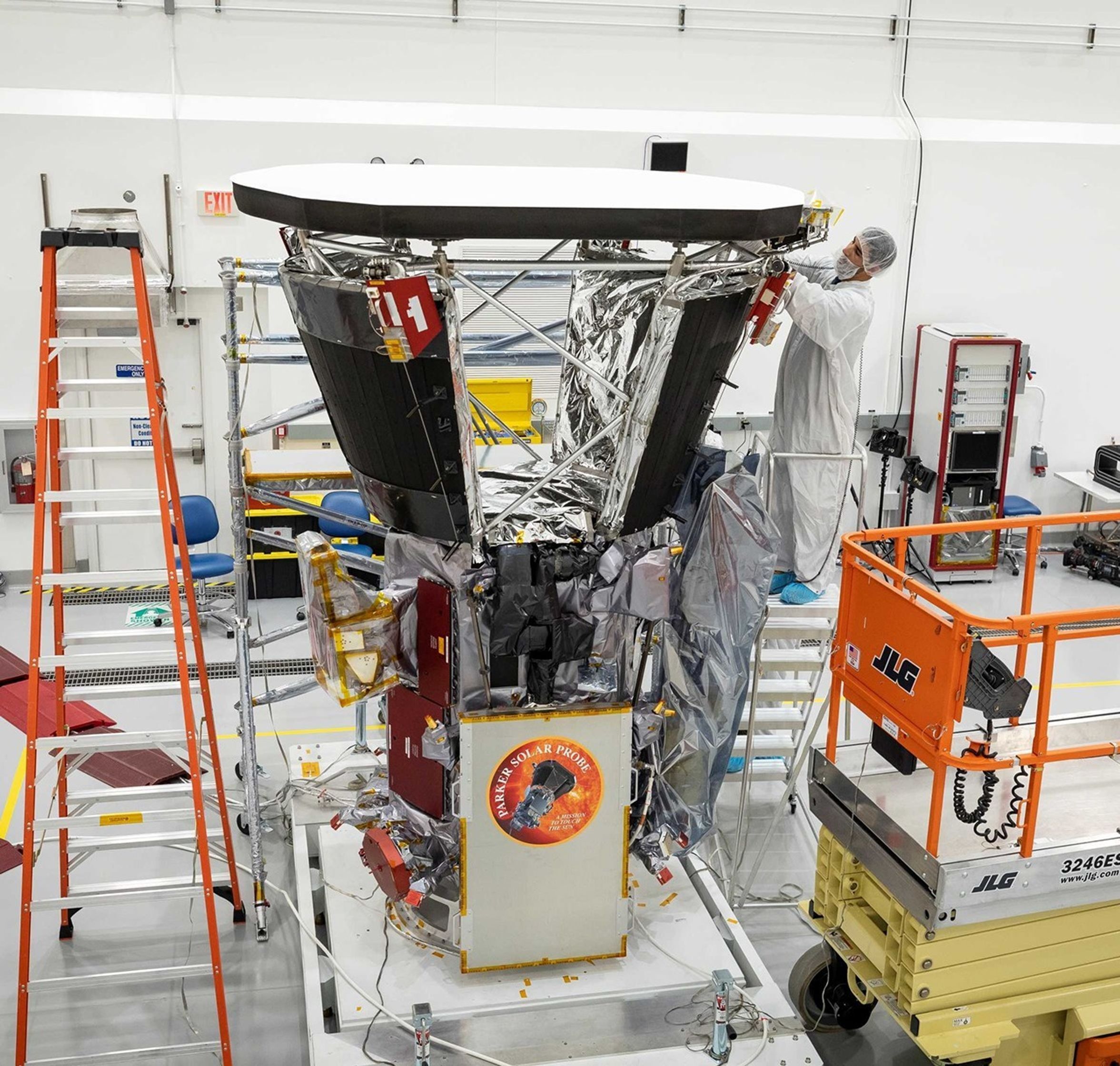
In this image from June 2018, about two months before Parker Solar Probe’s launch, technicians put the final touches on the thermal blankets below the spacecraft’s signature heat shield, the Thermal Protection System (TPS). After nearly eight years in space and through 28 solar en-counters, the TPS remains in excellent condition, even after withstanding temperatures of about 1,700 degrees Fahrenheit during its closest approaches to the Sun.
NASA/Johns Hopkins APL/Ed Whitman
“The heat shield material is incredibly light and fragile, but the thermal design, as well as the software that keeps the spacecraft pointing the TPS toward the Sun, have been outstanding,” said John Wirzburger, Parker Solar Probe mission systems engineer at APL. “It’s a real tribute to the team that designed, built, and operates Parker Solar Probe.” Meanwhile, the team can measure the temperature of the barrier blanketing below the heat shield, and the actual spacecraft temperature has remained consistent on each pass.
“That temperature consistency is a major indicator of spacecraft health,” said Wirzburger. “It tells us the heat shield isn’t degrading. If it were cracking or weakening, we’d see temperatures drift upward as more heat leaked through.”
Parker launched in August 2018. At the time, the Sun was near the minimum of its 11-year activity cycle. In 2024, representatives from NASA, the National Oceanic and Atmospheric Administration (NOAA), and the international Solar Cycle Prediction Panel announced that the Sun had reached its solar maximum period. Parker’s 28 encounters with the Sun reflect this change over time, sampling the Sun’s atmosphere from quiet to very active periods. Parker Solar Probe will remain in this orbit around the Sun and continue making observations into the declining phase of solar activity.
The next steps for the mission in late 2026 and beyond are under NASA review.
Parker Solar Probe was developed as a part of NASA’s Living With a Star (LWS) program to explore aspects of the Sun-Earth system that directly affect life and society. The LWS program is managed by the agency’s Goddard Space Flight Center in Greenbelt, Maryland, for NASA’s Science Mission Directorate in Washington. Johns Hopkins APL manages Parker Solar Probe for NASA and designed, built, and now
operates the mission.
Quelle: NASA
----
Update: 12.09.2026
.
After Latest Swing Past Sun, NASA’s Parker Solar Probe Checks in
NASA’s Parker Solar Probe completed its 29th close approach to the Sun on Sept. 4, again matching its record speed and distance from the solar surface. This time, the spacecraft trained its camera on structures and activity near the Sun’s north pole.
The spacecraft transmitted a beacon tone indicating that its systems were operating normally on Sept. 7. Flying around the Sun on a trajectory that limited communications with Earth, Parker had been out of contact and operating autonomously, as planned, for nine days centered around closest approach.
The flyby, which brought Parker to within 3.8 million miles of the Sun at a top speed of 430,000 miles per hour, allowed the spacecraft to race through and sample almost 40% of the solar circumference within one day during this encounter. During this solar encounter, which started Aug. 30 and ended Sept. 9, Parker’s four scientific instrument packages gathered data from inside the Sun’s atmosphere, or corona.
Parker will begin returning detailed spacecraft telemetry on Friday, Sept. 11, with science data transmission set to run from Sunday, Sept. 13 through Sunday, Sept. 27.
The spacecraft’s observations of the solar wind and solar events, such as coronal mass ejections and the aftermaths of flares, are critical to advancing humanity’s understanding of the Sun and the phenomena that drive high-energy space weather events that pose risks to astronauts, satellites, air travel, and even power grids on Earth. Understanding the fundamental physics of space weather enables more reliable forecasts, helping protect astronauts during future deep-space missions to the Moon and Mars.
Parker Solar Probe launched in August 2018. At the time, the Sun was near the minimum of its 11-year activity cycle. In 2024, representatives from NASA, the National Oceanic and Atmospheric Administration, and the international Solar Cycle Prediction Panel announcedthat the Sun had reached its solar maximum period. Parker’s 29 encounters with the Sun reflect this change over time, sampling the Sun’s atmosphere from quiet to very active periods. Parker Solar Probe will remain in this orbit around the Sun and continue making observations into the declining phase of solar activity.
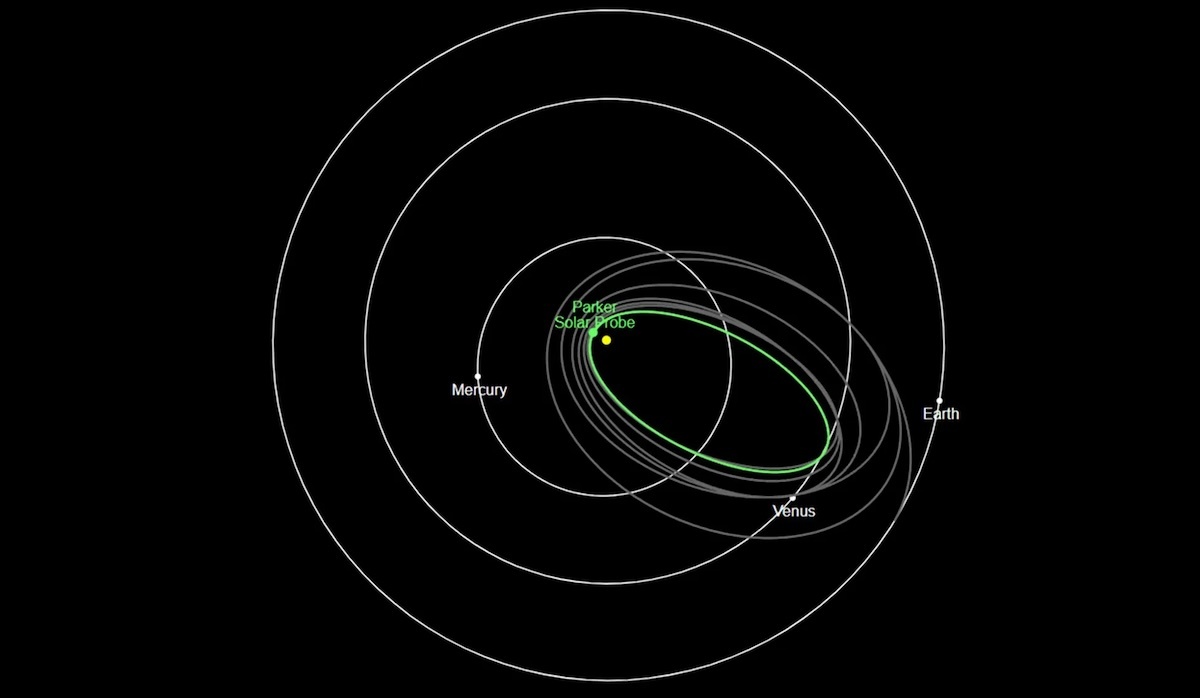
Overhead view (not to scale) of Parker Solar Probe’s journey through the inner solar system. The gray lines indicate Parker’s path since its launch in 2018; the green oval indicates its current orbit, which brings the spacecraft to within just 3.8 million miles from the solar surface, with a top speed of 430,000 miles per hour. Both the speed and distance are records set during Parker Solar Probe’s close approach to the Sun on Dec. 24, 2024, and matched during seven flybys since, most recently on Sept. 4, 2026
The Parker Solar Probe mission has been extended into 2029 as a result of the 2026 Heliophysics Senior Review.
Parker Solar Probe was developed as part of NASA’s Living With a Star program to explore aspects of the Sun-Earth system that directly affect life and society. The program is managed by the agency’s Goddard Space Flight Center in Greenbelt, Maryland, for NASA’s Science Mission Directorate in Washington. Johns Hopkins Applied Physics Laboratory (APL) in Laurel, Maryland manages Parker Solar Probe for NASA and designed, built, and operates the mission.
Quelle: NASA