
28.08.2026
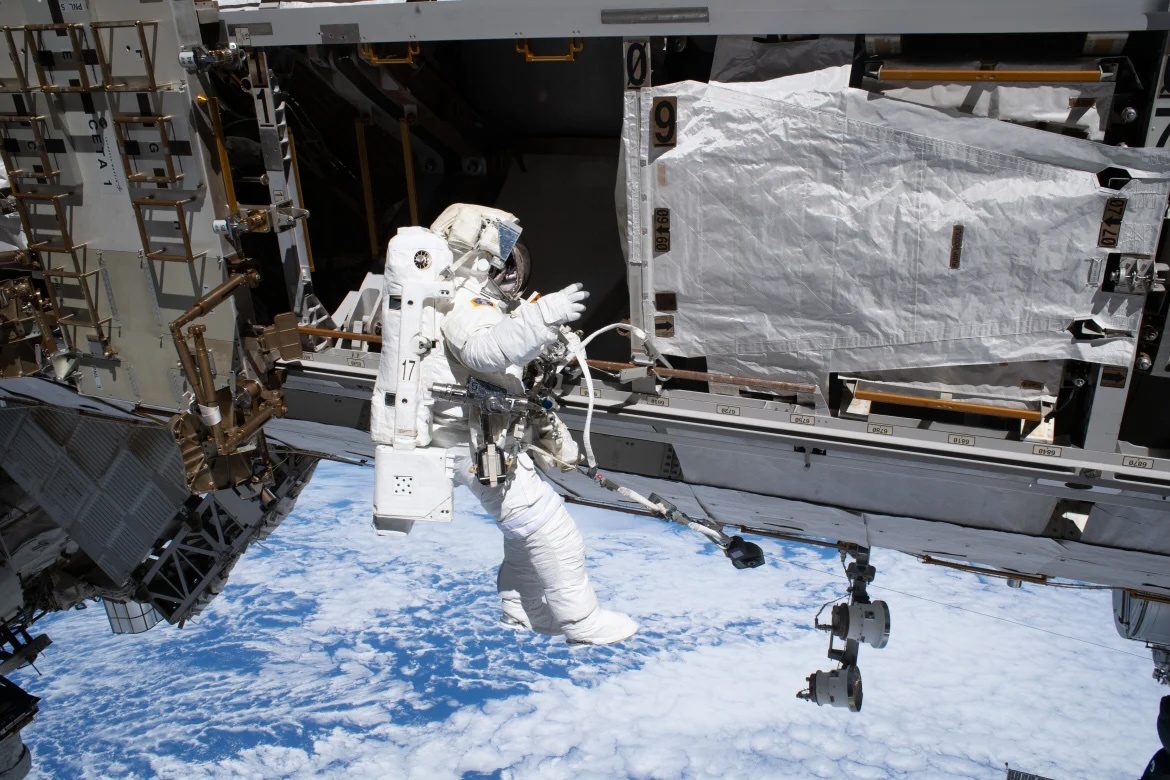
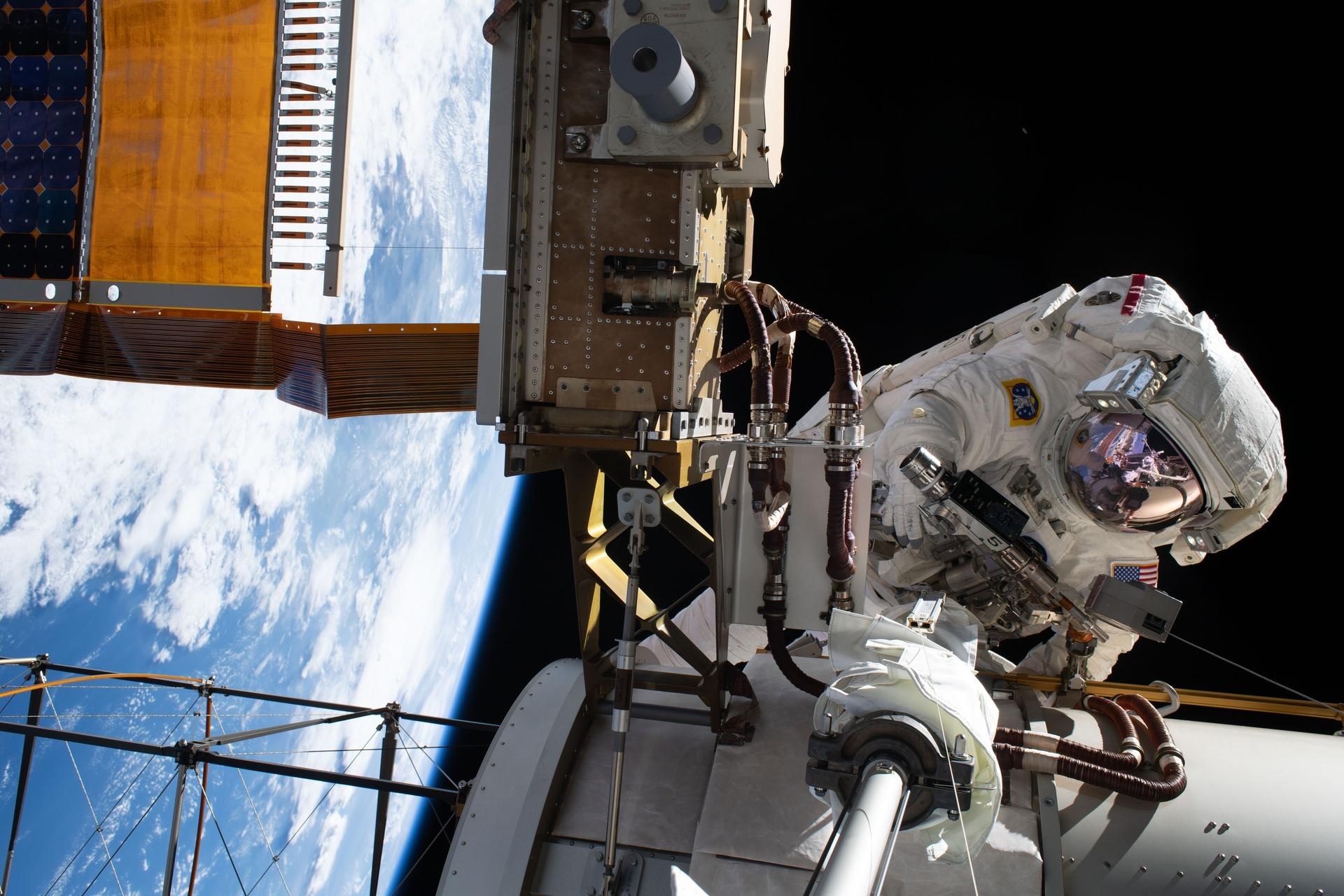
Following the departure of the Soyuz MS-28 crewed spacecraft from the International Space Station on July 26, Expedition 75 officially commenced onboard the orbiting laboratory. One of the first tasks for the Expedition 75 crew was three spacewalks, which were successfully completed over a three-week period. Furthermore, the crew has stayed busy with numerous science experiments and technology demonstrations.
Arrivals, departures. and spacewalks
On July 26, Roscosmos cosmonauts Sergey Kud-Sverchkov and Sergei Mikaev, and NASA astronaut Chris Williams, departed the International Space Station (ISS) after 241 days in space, returning aboard the Soyuz MS-28 vehicle. The vehicle undocked from the Rassvet nadir port at 07:02:55 UTC, and the crew landed on the Kazakh Steppe at 10:27:25 UTC.
NASA astronauts Anil Menon and Jessica Meir, each on their first and sixth spacewalk respectively, conducted the first spacewalk of the month on Aug. 6, which lasted six hours and 27 minutes. U.S. Spacewalk 96 began at 12:33 UTC, with the duo preparing a 3B power channel. This will enable the future installation of roll-out solar arrays, called IROSAs, which will provide additional power for the Station and its inhabitants. This power will provide additional support for critical systems, such as life support, and ultimately for the Station’s safe, controlled deorbit in the 2030s. The extravehicular activity (EVA) was the 281st spacewalk to support Station assembly, maintenance, and upgrades.
European Space Agency (ESA) astronaut Sophie Adenot and Anil Menon completed the second spacewalk of the month on Aug. 18. Exiting the Station through the Quest airlock, the pair spent six hours and 23 minutes in the vacuum of space, with the spacewalk concluding at 18:52 UTC. The astronauts removed a failed Space-to-Ground antenna that supports vital communications between the ISS crew and Mission Control.
However, the task took longer than expected due to difficulty disconnecting electrical cables and loosening bolts, resulting in the unit’s installation being deferred to the next spacewalk. The duo also completed a long-duration tie-down of the unit on the ISS’s truss structure.
Sophie Adenot and Anil Menon began the third and final spacewalk of the month on Aug. 25. The EVA began at 12:27 UTC, and the two astronauts aimed to replace the Space-to-Ground antenna that was worked on during the previous spacewalk. During the six-hour-and-30-minute spacewalk, Menon and Adenot successfully installed and connected the spare Space-to-Ground antenna, and also secured the broken unit and moved it to a spare parts platform on the Station’s truss structure.
Science experiments and technology demonstrations
Although spacewalks have filled much of Expedition 75’s calendar, Station officials still find time for astronauts to complete a variety of science experiments and technology demonstrations. Current ISS commander Jessica Meir took part in an advanced eye examination on July 29. Meir wore a set of Virtual Reality goggles called the Nevada Screening Vision system; this head-mounted display measures visual function using several vision-screening apps that test visual acuity and contrast sensitivity. Astronauts’ vision is known to be affected by microgravity, with fluid shifts being one of many reasons astronauts routinely test their own and other crew members’ eyes in space.
A vital part of life in microgravity is the ability for astronauts to exercise regularly to counteract the effects of muscle atrophy. On July 30, Adenot and NASA astronaut Jack Hathaway conducted exercise research using the EasyMotion-2 demonstration. This electro-muscle stimulation (EMS) suit delivers electrical impulses that trigger muscle contractions, thereby increasing muscle stiffness and tone. The duo took turns wearing the suit, with Adenot working out on the COLBERT treadmill in the Tranquility module while Hathaway performed a rowing session on the European Enhanced Exploration Exercise Device (E4D).
On Aug. 4, Hathaway used the E4D to work out his upper and lower body to test the device’s effectiveness in the Columbuslaboratory module. He then installed ClimCam hardware that analyzes real-time Earth imagery to monitor weather and climate changes. ClimCam will collect imagery of Eastern Africa, monitor environmental changes and weather-related effects on agriculture and natural resources, and eventually be robotically placed outside the Station.
On Aug. 11, Hathaway performed vein scans of Jessica Meir to assess her internal jugular veins. The pair then conducted a second set of vein scans on Anil Menon, Sophie Adenot, and Roscosmos’s Pyotr Dubrov and Anna Kikina. Doctors on Earth monitored the vein scans in real time for blood flow anomalies and blood clots that may form during long-term spaceflight.
NASA’s next mission to the Station, Crew-13, is scheduled to launch no earlier than Sept. 12. The crew includes NASA astronauts Jessica Watkins and Luke Delaney, as well as Canadian Space Agency astronaut Joshua Kutryk and Roscosmos cosmonaut Sergey Teteryatnikov. Crew-13 will launch on a currently unknown Crew Dragon from Space Launch Complex 40 (SLC-40) at the Cape Canaveral Space Force Station in Florida.
Quelle: NSF