
30.05.2026
MTG-I2 embarks on journey to Europe’s Spaceport
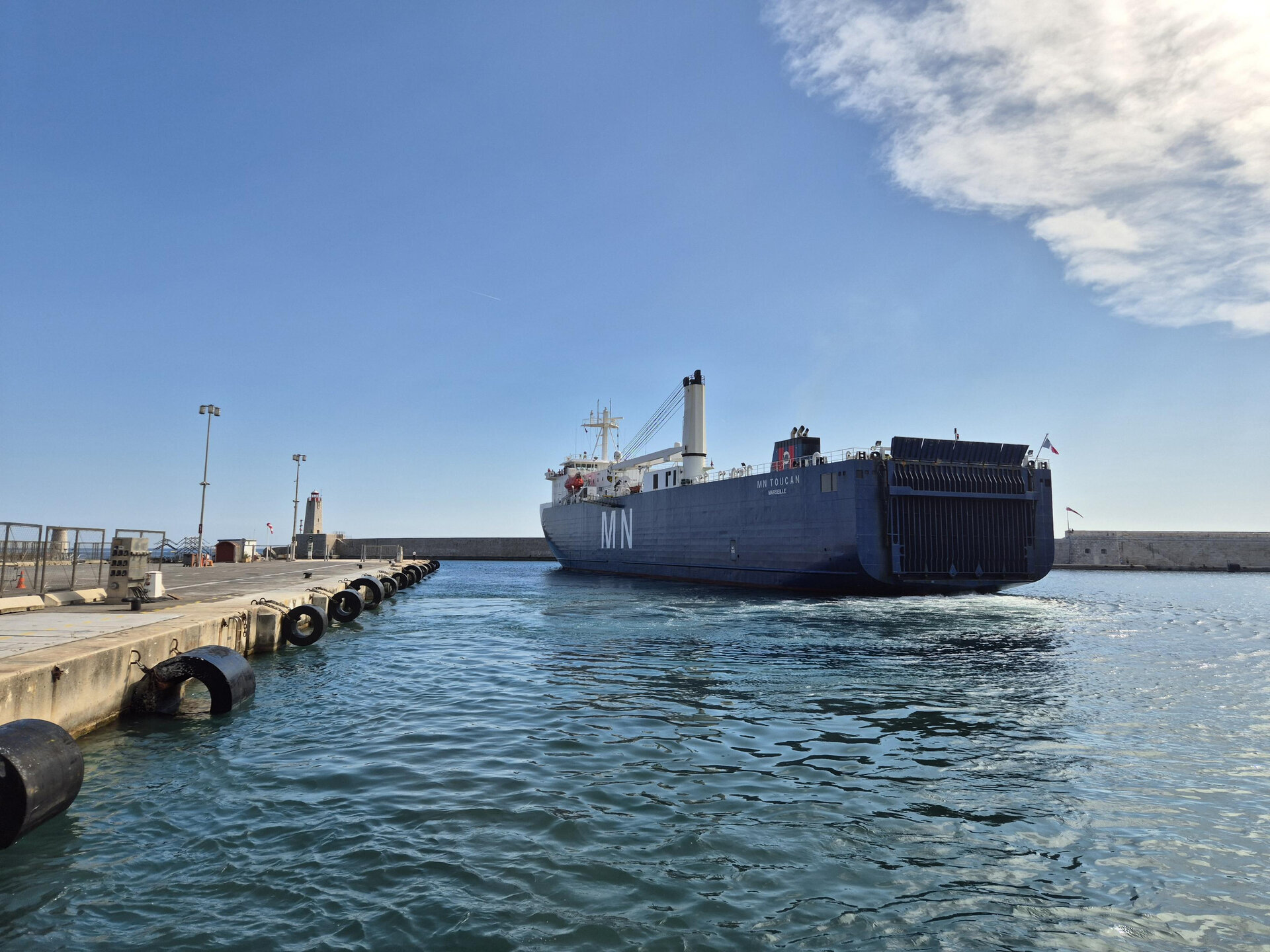
The Meteosat Third Generation-Imager2 (MTG-I2) satellite has set out on its journey from France to French Guiana, departing yesterday from Nice harbour.
The satellite, together with support equipment needed on the ground before launch, will be travelling through the Mediterranean then across the Atlantic, before arriving at Europe’s Spaceport in June.
Until now, the satellite has been held in the cleanrooms at Thales Alenia Space in Cannes, France. Thales Alenia Space France leads the industrial consortium for MTG as the overall prime contractor for the MTG mission.
Part of the MTG constellation developed by the European Space Agency (ESA) for Eumetsat, MTG-I2 will launch this summer on Ariane 6 to join the two MTG satellites already in orbit. The mission is designed to produce images in unprecedented detail. It provides completely new data products and capabilities for European weather forecasting, especially suited to nowcasting of severe weather events.
The MTG-Imager satellites carry two instruments: a Lightning Imager and a Flexible Combined Imager.
- The Lightning Imager offers completely new capabilities for European meteorological satellites by continuously monitoring for lightning. By doing this from geostationary orbit, which is at an altitude of about 36 000 km above the equator, it can scan more than 80% of Earth’s surface seen from that viewpoint.
- The Flexible Combined Imager, on the other hand, builds a picture of fast-evolving weather systems and can be used to issue timely weather warnings. It is particularly relevant for air traffic safety. It is able to scan the entire Earth disc in just 10 minutes and can scan Europe and northern Africa every 2.5 minutes.
When MTG is fully operational, it is expected to produce at least 50 times more data than the previous Meteosat Second Generation (MSG) satellites.
Quelle: ESA
----
Update: 8.08.2026
.
The team behind Europe’s latest weather satellite
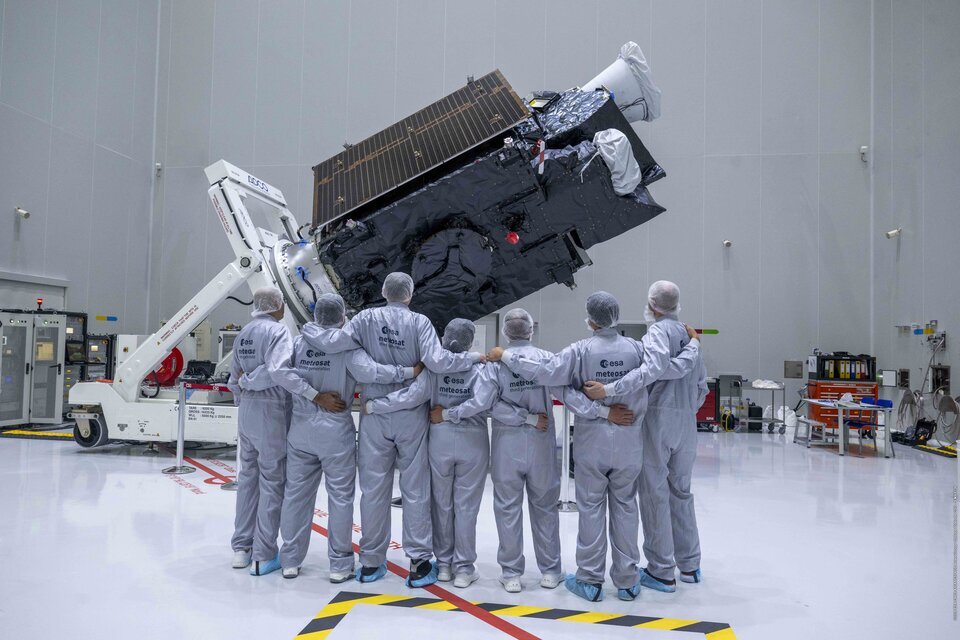
MTG-I2 will be in orbit around Earth for at least the next eight-and-a-half years.
Since the second Meteosat Third Generation Imager satellite (MTG-I2) began its launch campaign last month, it has undergone rigorous pre-launch inspections that ensure the electronic and mechanical systems are working correctly. How does a team of experts, including scientists, engineers, launch coordinators and mission operation specialists, ensure everything is running smoothly behind the scenes, both during and after liftoff?
MTG-I2 is set to ride into orbit on board an Ariane 6 rocket on 27 August. With just a few weeks to go before launch, the satellite is undergoing a series of checks to ensure everything will work smoothly on launch day.
Behind the scenes a team of experts has been inspecting every hinge, bolt and surface to ensure the satellite and all its parts are ready. It will be in orbit around Earth for at least the next eight-and-a-half years, capturing imaging data of lightning, atmosphere, clouds and developing storms in unprecedented detail – so everything must be checked.
Positive team spirit has been a constant throughout the development of MTG-I2, according to ESA’s MTG Project Manager, James Champion. He attributes the camaraderie to the lack of a rigid team structure. Instead, team members are empowered to act in a variety of roles. More than 30 ESA personnel are currently involved in the pre-launch preparations. “The team has worked incredibly hard to ensure this launch campaign runs as smoothly as possible. Many members of the team are able and willing to cover for others if needed – and that has meant we are all pulling in the same direction.”
Pre-launch checks
Over the next few weeks, as launch preparations continue, one of the key responsibilities is that of Francesco Cainero, ESA’s MTG Lead Space Segment Engineer and launch campaign manager for this launch. “I am responsible for ensuring that the MTG-I2 spacecraft remains safe, controlled, and flightworthy throughout the campaign,” explains Francesco, who has a background in specialised electronics engineering. “This includes planning and coordinating all verification activities, allocating the necessary resources as well as managing interfaces among up to 100 personnel from ESA, Eumetsat, Arianespace, CNES and Thales Alenia Space.”
He adds, “The most rewarding part is seeing a complex, multi-disciplinary system come together and successfully transition from preparation to launch readiness – it is the tangible result of months or years of coordinated effort.”

Combined operations
Safety and controls are very much order of the day in the lead up to launch, with no aspect of the satellite’s functionality left uninspected. It’s the role of Martin Peccia, MTG Product Assurance and Safety Manager, to check correct satellite configuration and contamination control as well as ensure any non-conformities are resolved in a timely way.
“Combined operations is my favourite moment of the pre-launch campaign,” says Martin, who has a background in aeronautical engineering, and speaks six languages. “You have to hit the ground running as the combined operations schedule affects so many parties across the satellite and launcher teams. When issues arise, you have to react quickly in order to avoid any launch delay. We have an experienced team on both ESA and the industry side, so we are working well together and have a good network across ESA in case we need an expert opinion.”
One of the key moments during the campaign is when the satellite is fitted, or ‘mated’, with the launcher, in this case an Ariane 6 rocket. “This is special because they are the last moments before encapsulation – the last time a human will see the satellite,” says Martin.
During the launch campaign, the MTG System and Payload Manager, Pieter Van den Braembussche, is tasked with following up and observing the platform and instrument tests. However, his main role begins after launch, when the instruments are commissioned.
“MTG satellites observe Earth from 36 000 km away, where even the smallest spacecraft motion can affect image quality,” notes Pieter, whose background is in attitude and orbit control systems (AOCS) and systems engineering. “One of our challenges was therefore to make sure the spacecraft remains extremely stable, even with small vibrations from onboard mechanisms, called micro-vibrations. Together with industry, we characterised these vibration sources, assessed their effect on the images, and put the right mitigation measures in place. The sharp images and scientific data from MTG-I1 show that this effort was successful.”
Preparing for a critical phase
Immediately after liftoff is when the launch and early operations phase begins. Known in the business as LEOP, it is one of the most critical phases of satellite operations. After the satellite separates from the Ariane 6 launcher, the first important event is the acquisition of signal: receiving satellite data on the ground as soon as possible is essential to assess the satellite's health after the huge pressure and vibrations of the launch.

Emilia Barbagallo, MTG Lead Operations Interface Engineer, coordinates between the team working on the satellite before launch and the operations team working on the ground after launch. “Any anomalous behaviour during LEOP has to be addressed promptly and safely: the operations and the project support teams are well trained to respond to contingencies, investigate any issues and recommend ways forward in line with the agreed formal process,” Emilia notes.
With a background in electronics engineering and experience working on several other ESA missions, Emilia explains, “During the launch campaign there are a number of activities needed for LEOP. First of all, after satellite fuelling, the mass of the satellite is recomputed and needs to be transferred to the LEOP team together with any last-minute change in the satellite configuration to align the ground segment configuration and procedures.
“Another important activity is the rehearsal of the countdown sequence: in this final phase before launch, the satellite is switched on and configured for launch and the LEOP mission control centre is connected to the launch pad allowing the operations team to carefully follow such critical activity, making sure the configurations of the ground segment and of the satellite are aligned.”
But as the launch campaign progresses and leads up to the day of liftoff, the final word will go to the launch campaign manager. Francesco will fulfil a crucial duty when all eyes are on the countdown clock. After assessing spacecraft readiness for launch, he’ll provide the final ESA recommendation to “Go for launch!”
Launch details
Launch is scheduled for 27 August 2026, on board flight VA270 on an Ariane 6, from Europe’s Spaceport in French Guiana.
This will be the ninth launch of Europe’s heavy-lift rocket Ariane 6. For the August launch, Ariane 6 will be configured with two P120C-based solid-propellant rocket motors to liftoff and launch MTG-I2 to a geostationary transfer orbit. This will be the first mission to this destination for Ariane 6 and the farthest the rocket will have flown so far. ESA manages the Ariane 6 development programme, ensuring autonomous access to space for the benefit of European citizens. Arianespace is the launch service provider for flight VA270.
Quelle: ESA
----
Update: 26.08.2026
.
MTG-I2 in the starting blocks!
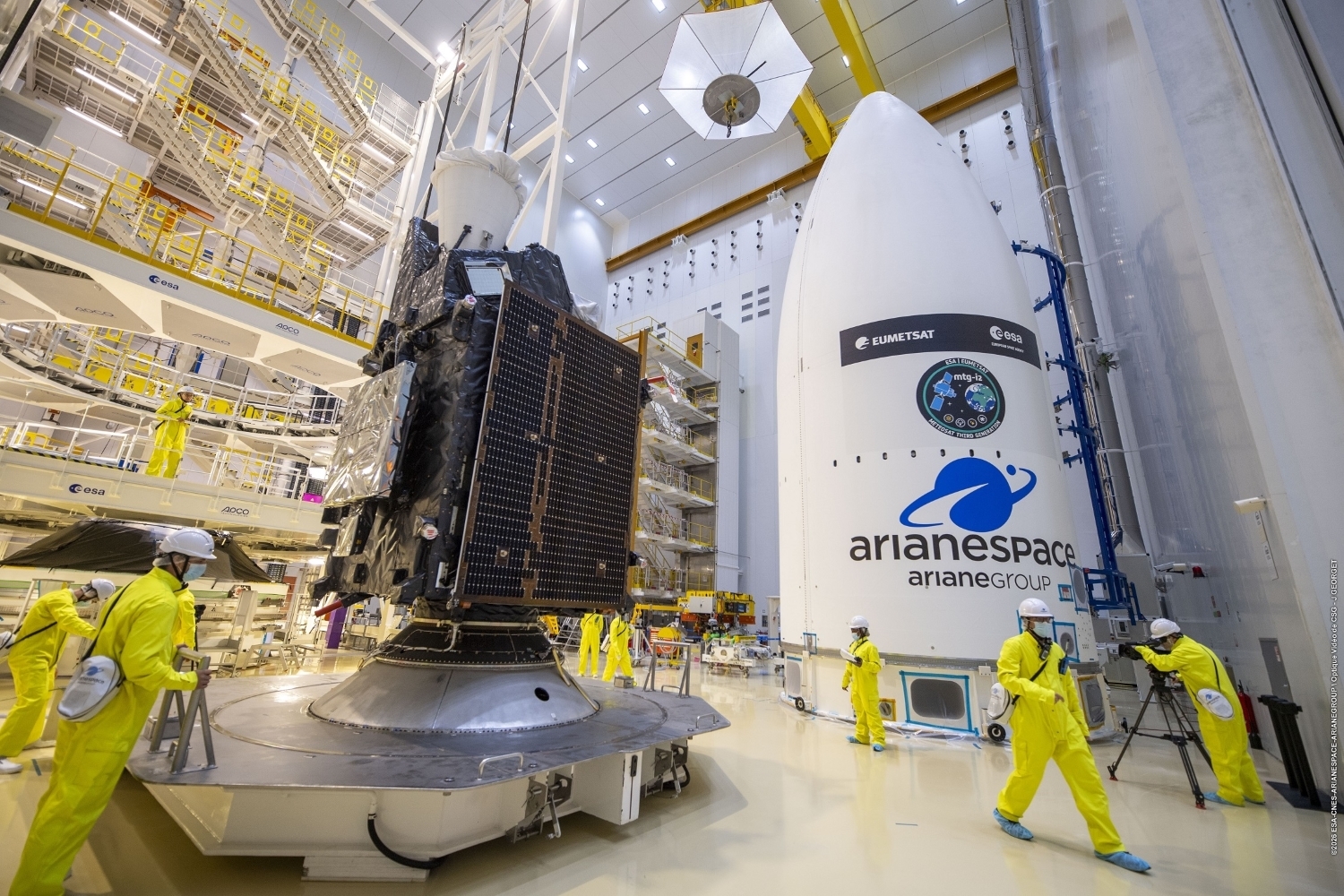
MTG-I2 being encapsulated © 2026 ESA-CNES-ARIANESPACE-ArianeGroup / Optique Vidéo de CSG – S MARTIN
On August 27, the second imaging satellite in the Meteosat Third Generation (MTG) fleet, MTG-I2, will lift off from Europe's Spaceport in French Guiana aboard an Ariane 62 rocket. Built under Thales Alenia Space's prime contractorship, MTG-I2 will complete the Meteosat Third Generation (MTG) system dedicated to improving weather forecasting in Europe and Africa.
Intense activity in Kourou!
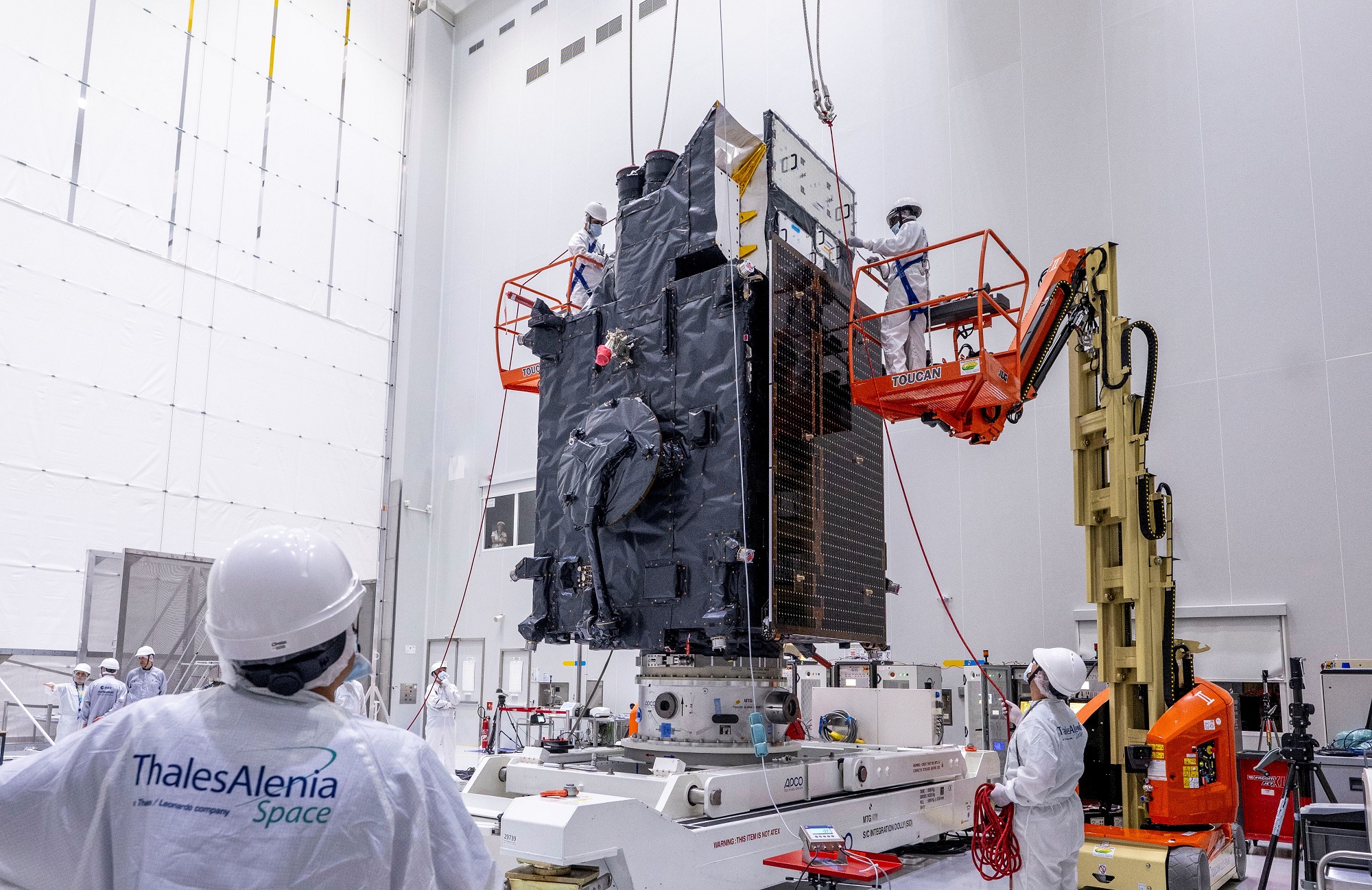
Alongside teams from the European Space Agency (ESA) and Arianespace, Thales Alenia Space engineers and technicians successfully completed all final functional tests on the MTG-I2 satellite in preparation for its launch.
MTG: a new era for space-based meteorology

In recent months, Europe has seen a surge in extreme weather events, such as storm Goretti, underscoring the critical need to improve the accuracy and speed of weather forecasting. As these events intensify, reliable alerts are more essential than ever to protect populations and infrastructure. Led by Thales Alenia Space as prime contractor, the MTG program, comprising six satellites in geostationary orbit, four imagers and two atmospheric sounders, aims to revolutionize space-based meteorology in Europe and Africa.
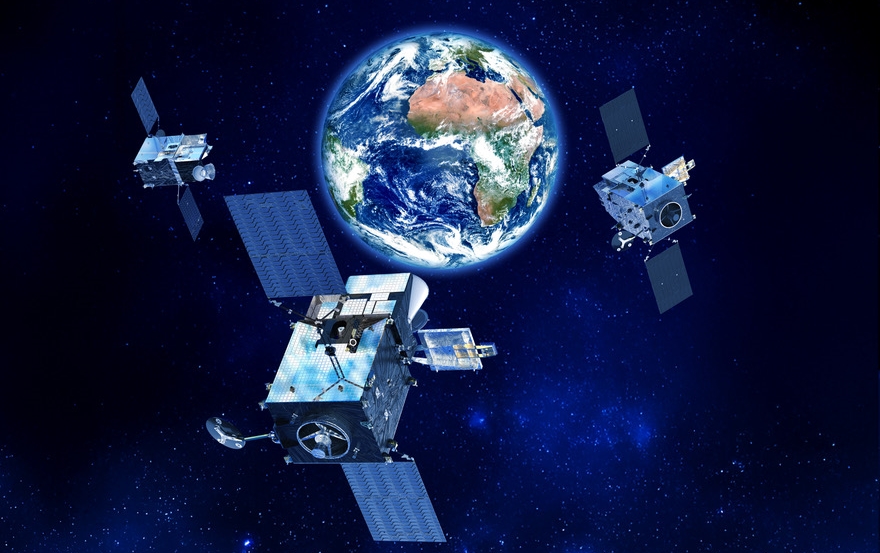
The MTG-I2 satellite will join the Meteosat-12 imaging satellite (formerly MTG-I1) and the MTG-S1 atmospheric sounding satellite in orbit, launched in 2022 and 2025 respectively. MTG-I2 will operate in tandem with Meteosat-12. While Meteosat-12 provides images over Europe and Africa refreshed every 10 minutes, MTG-I2 will capture images over Europe updated every 2.5 minutes, thereby delivering weather imagery of unmatched accuracy at an unprecedented rate.
High-resolution imagery from the Meteosat-12 and MTG-I2 imaging satellites, combined with cutting-edge sounding data provided by MTG-S1, will take weather forecasting capabilities to the next level, particularly for nowcasting. This will enable near-real-time monitoring of severe weather events, making it possible to quickly alert at-risk populations and decision-makers to the growing threats posed by storms, violent thunderstorms and heatwaves.
Thanks to observations that are both more precise and faster, MTG will make it possible to more effectively anticipate the impacts of extreme events, strengthening the resilience of territories and the safety of populations.
Once the MTG-I2 satellite is operational in orbit, Europe will benefit from the world's most sophisticated meteorological services from a geostationary orbit.
The genesis of the Meteosat satellites
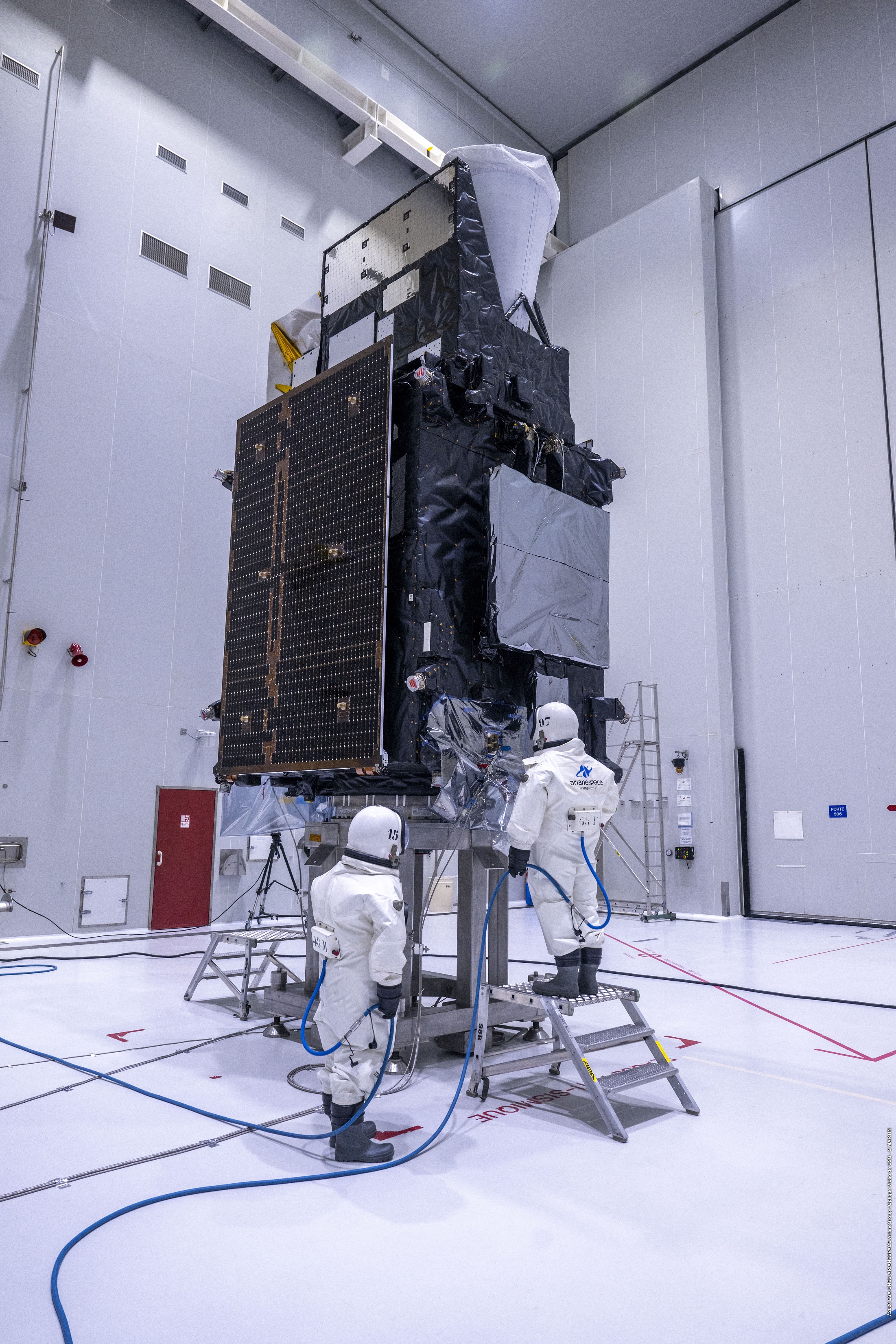
Designed to succeed the Meteosat Second Generation (MSG) series, the Meteosat Third Generation (MTG) program is a cooperation between the European Space Agency (ESA) and EUMETSAT to ensure the continuity of high-resolution weather monitoring beyond 2040. ESA is responsible for developing the MTG satellites and procuring the hardware, while EUMETSAT is responsible for operating the satellites throughout their lifetime and delivering data to users.
Thales Alenia Space has been the prime contractor for Meteosat satellites on behalf of ESA for nearly 50 years. Thales Alenia Space has delivered into orbit 7 first-generation Meteosat satellites (the first of which was launched in November 1977), 4 Meteosat Second Generation satellites and, to date, 2 Meteosat Third Generation satellites.
Since 1977, Meteosat satellites have been a crucial source of weather data for Europe and Africa. Data from these satellites is one of the key contributions made by ESA and EUMETSAT to the World Meteorological Organization's global observing system.
Quelle: Thales Alenia Space