
28.08.2026
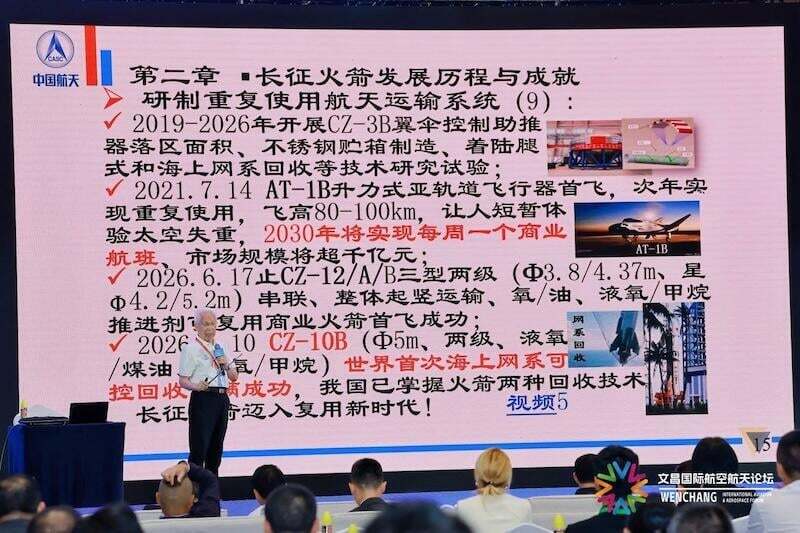
Chinese rocket designer Long Lehao addresses the Wenchang International Aviation and Aerospace Forum.
SINGAPORE—China’s previously undisclosed suborbital reusable space vehicle has been designated AT-1B, with China Aerospace Science and Technology Corporation (CASC) targeting commercial missions from around 2030.
The vehicle was first launched on July 14, 2021, from the Jiuquan Satellite Launch Center in the Gobi Desert and subsequently landed horizontally at Alxa Right Banner Airport in Inner Mongolia. China has disclosed few details about the mission and the vehicle's development.
At the Wenchang International Aviation and Aerospace Forum, Long Lehao, chief designer of China’s Long March rocket program at CASC, outlined potential commercial applications for AT-1B, including space tourism. The vehicle could allow passengers to experience brief periods of weightlessness during suborbital flights.
CASC is targeting a launch cadence of approximately one mission per week from the 2030s, potentially positioning the vehicle for a commercial spaceflight market worth billions of dollars.
AT-1B is one of several reusable space vehicle programs being pursued by China. The country is also developing the Chongfu Shiyong Shiyan Hangtian Qi, which translates as reusable experimental spacecraft. China has conducted four orbital missions with the spacecraft. The latest mission has seen it remain in orbit for more than 190 days.
Quelle: AVIATION WEEK