
Foreshadowed in this column, the spectacular collision of the Double Asteroid Redirection Test (DART) was not a wanton act of vandalism but a carefully crafted experiment that might one day help us avoid a catastrophic asteroid impact.
The experiment was made possible by the particular circumstances surrounding a 760m asteroid called Didymos and its tiny moon Dimorphos. During each orbit, the 150m moon passes in front of and then behind Didymos, as seen from Earth, changing its apparent brightness and allowing very accurate measurements to be made.
The outcome of the experiment was that Dimorphos’s 12-hour orbit was shortened by 33 minutes. The so-called ‘kinetic impact’ was enhanced by the explosive thrust of the debris cloud lifted from its surface. With no risk of accidental impact on Earth, the experiment was an outstanding success.
But further analysis has shown that DART didn’t only alter the orbit of Dimorphos around its parent asteroid; it also changed the pair’s 770-day orbit around the Sun. It wasn’t by much, as this was not the object of the experiment, but the 0.15-second change is significant.
That vanishingly small number has been verified by occultations – when asteroids pass in front of a distant star as seen from different locations on Earth. Observed by dozens of volunteer astronomers, the results lend confidence in the challenge to deflect an asteroid’s trajectory should it ever be needed.
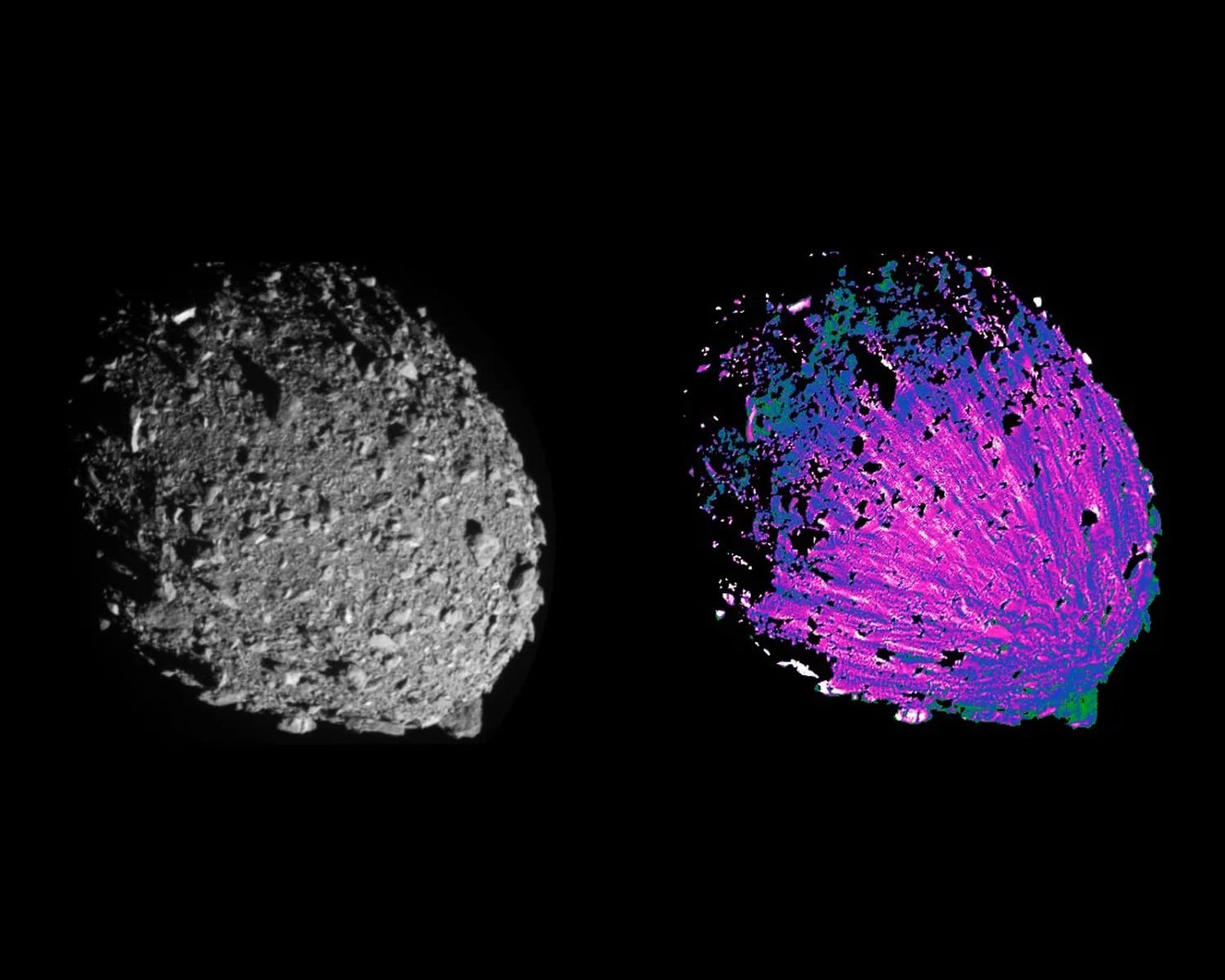
Scientists at the University of Maryland have uncovered a further surprise. DART carried a forward-facing camera that transmitted footage of Dimorphos as the spacecraft made its death dive. Careful processing of the final frames taken seconds before impact revealed an unexpected feature.
The asteroid’s surface is a familiar patchwork of rocks and boulders, typical of the loose ‘rubble-pile’ category of asteroids to which both Didymos and its moon belong. But when the shadows of these boulders are digitally removed, an underlying pattern is revealed of fan-like streaks radiating from a point on Dimorphos’s equator.
Through laboratory experiments and computer simulations, the scientists have concluded that the streaks are material from Didymos that has been gently ejected into space by virtue of its fast rotation. It’s the first direct evidence of matter being transferred from one asteroid in a pair to its companion – a remarkable breakthrough.
Quelle: Australian Geographic