
31.10.2025
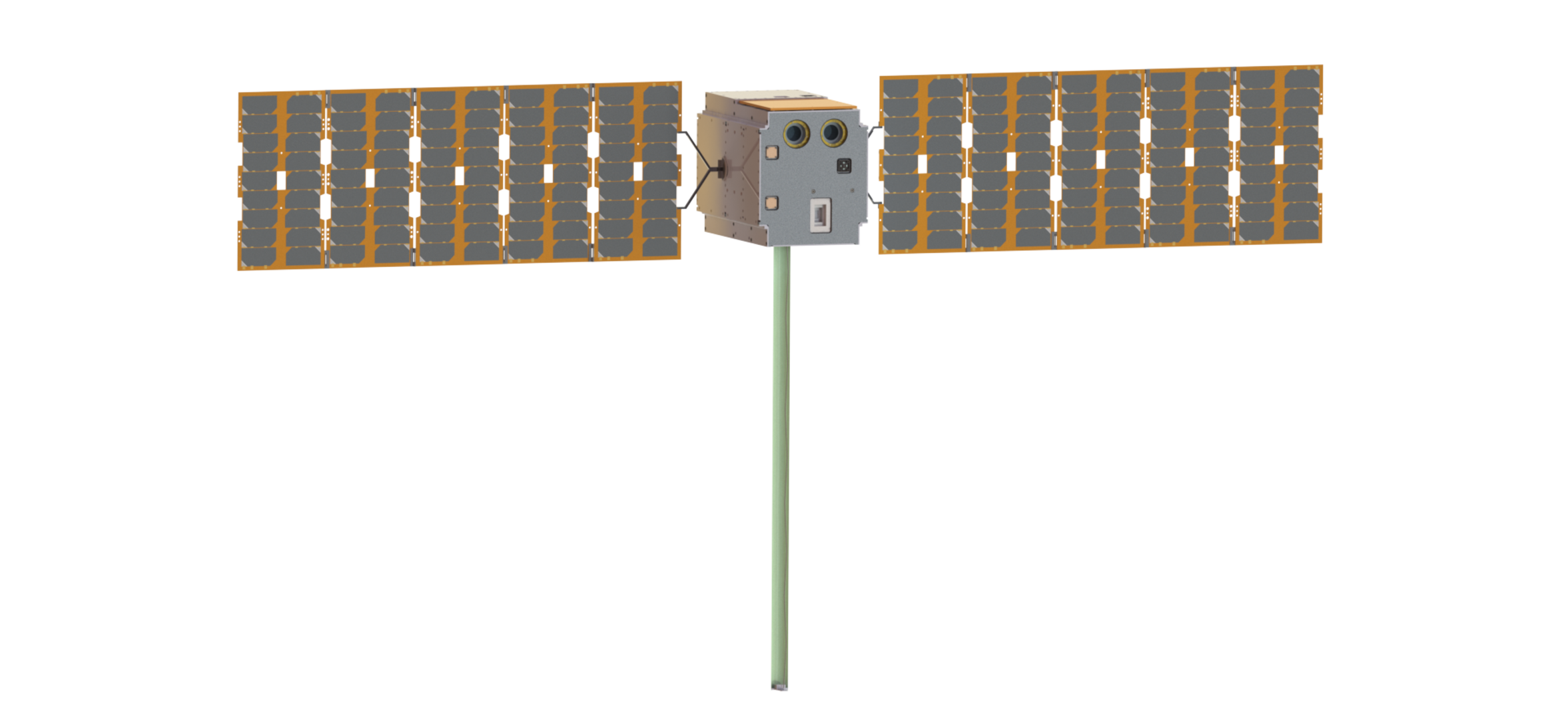
The European Space Agency’s upcoming Henon mission will be the first ever CubeSat to independently venture into deep space, communicate with Earth and manoeuvre to its final destination without relying on a bigger spacecraft. Once in its orbit around the Sun, the carry-on luggage-sized CubeSat will observe the Sun’s emissions to demonstrate technologies capable of providing advanced warnings of solar storms hours before they reach Earth.
Henon’s firsts

ESA’s Heliospheric Pioneer for Solar and Interplanetary Threats Defence, Henon for short, is set to be the first ever stand-alone CubeSat to perform significant manoeuvres on the way to its far-away destination – an orbit that will take the spacecraft up to 24 million km from Earth, far beyond the 2 million km boundary of where deep space is said to begin.
While Henon will not be ESA’s first CubeSat to fly so far from Earth – Hera mission’s Juventas and Milani will claim that title – it will be the first to fly alone, without a parent spacecraft.
Roger Walker, ESA’s Technology CubeSats manager, explains: “Juventas and Milani will communicate with the larger Hera spacecraft via radio-based inter-satellite links, leaving Hera to transmit their findings back to Earth. Henon, on the other hand, will be able to independently communicate with ground stations through ESA’s Estrack network, thanks to a new miniaturised deep-space transponder currently under development.”

There is another reason for the word ‘pioneer’ in Henon’s name. To be able to execute the manoeuvres that will position it in its orbit, the spacecraft will be sporting a tailor-made electric propulsion system.
This first-of-its-kind miniature ion engine, powered by electricity generated from Henon’s solar panels, will use charged xenon gas atoms to propel the spacecraft forward, allowing for an unprecedented manoeuvre capability for such a miniaturised spacecraft.
“This new propulsion system, once demonstrated, will open up opportunities for future low-cost missions to the Moon, asteroids, and even in Mars orbit,” adds Roger.
Henon’s design completed

In March this year, Henon’s prime contractor Argotec kicked-off the mission’s final implementation phase. Argotec’s mission engineers have since designed a detailed model of the spacecraft, which has recently passed an important milestone in the mission development process, the Critical Design Review.
Davide Monferrini, Henon Program Manager at Argotec, comments: “This milestone is the result of remarkable teamwork, collaborative spirit, and professionalism from all members of the consortium. It showcases our collective commitment to achieving technical and programmatic excellence while validating a truly innovative configuration featuring three payloads and multiple miniaturized subsystems, including our Curie Power Suite, the advanced Power Conditioning and Distribution Unit (PCDU) that will serve as Henon’s ‘electric heart’. Together, we remain committed to maintaining this high standard of excellence as we move forward.”
With the mission’s detailed design finalised and confirmed, the team will now move on to the next step – using a FlatSat, a prototype of the Henon spacecraft with all the electronic components interlinked and laid out on a table, they will easily access and test both the spacecraft’s software and hardware.
At the same time, they will build a specialised model of the spacecraft and subject it to rigorous testing to make sure Henon’s structure can withstand the vibrations of launch, as well as the vacuum, radiation, and extreme temperature conditions of deep space.
A very special orbit

Henon is expected to piggyback on the launch of a larger spacecraft planned for late 2026. The launcher will take the CubeSat to the Sun-Earth Lagrange point 2, some 1.5 million km beyond Earth in the direction away from the Sun.
From here, the CubeSat will use its new electric propulsion system to fly to a Distant Retrograde Orbit (DRO) around the Sun – an orbit similar to but more elliptical than that of the Earth, first invented by French astronomer Michel Hénon in 1969.
The mission – Hénon’s namesake – will be the first ever spacecraft to fly in this type of orbit, which will take it 12 million km from Earth at its closest point, and 24 million km away at the farthest. As both Earth and Henon will be orbiting the Sun, their relative orbits will make for an interesting situation – Henon will appear as if it’s orbiting Earth in the shape of an ellipse instead.
Advanced solar storms forecast
The Henon mission is being developed with funding from ESA’s General Support Technology Programme(GSTP), which enables ESA to pioneer new technologies through In-Orbit Demonstration experiments.
As is the case with the majority of ESA’s innovative technology demonstration missions, Henon’s purpose will be two-fold: pushing the boundaries of space technology while ensuring it serves real-life applications.
Roger clarifies: “The mission will leverage its unique proximity to the Sun on the sunward side of the DRO to demonstrate miniaturised-instrument technologies that can confirm the impending arrival of solar storms well before they reach Earth, providing a warning up to 3-6 hours in advance. This is a considerable improvement compared to the current warning time provided by spacecraft located at Sun-Earth Lagrange point 1, which is about 15 to 60 minutes.”
Juha-Pekka Luntama, Head of ESA’s Space Weather Office, concludes: “Demonstrating this warning capability with Henon will open up a new pathway to develop a future constellation of small spacecraft that would operate in the DRO and keep a close watch on the progress of solar storms. This constellation would provide a continuous warning service for operators of critical infrastructure, like electrical power grids, on ground, giving us ten times more time to implement mitigation measures to prevent damage.”
Quelle: ESA
----
Update: 19.07.2026
.
Deep space pioneer Henon signs to launch with Plato
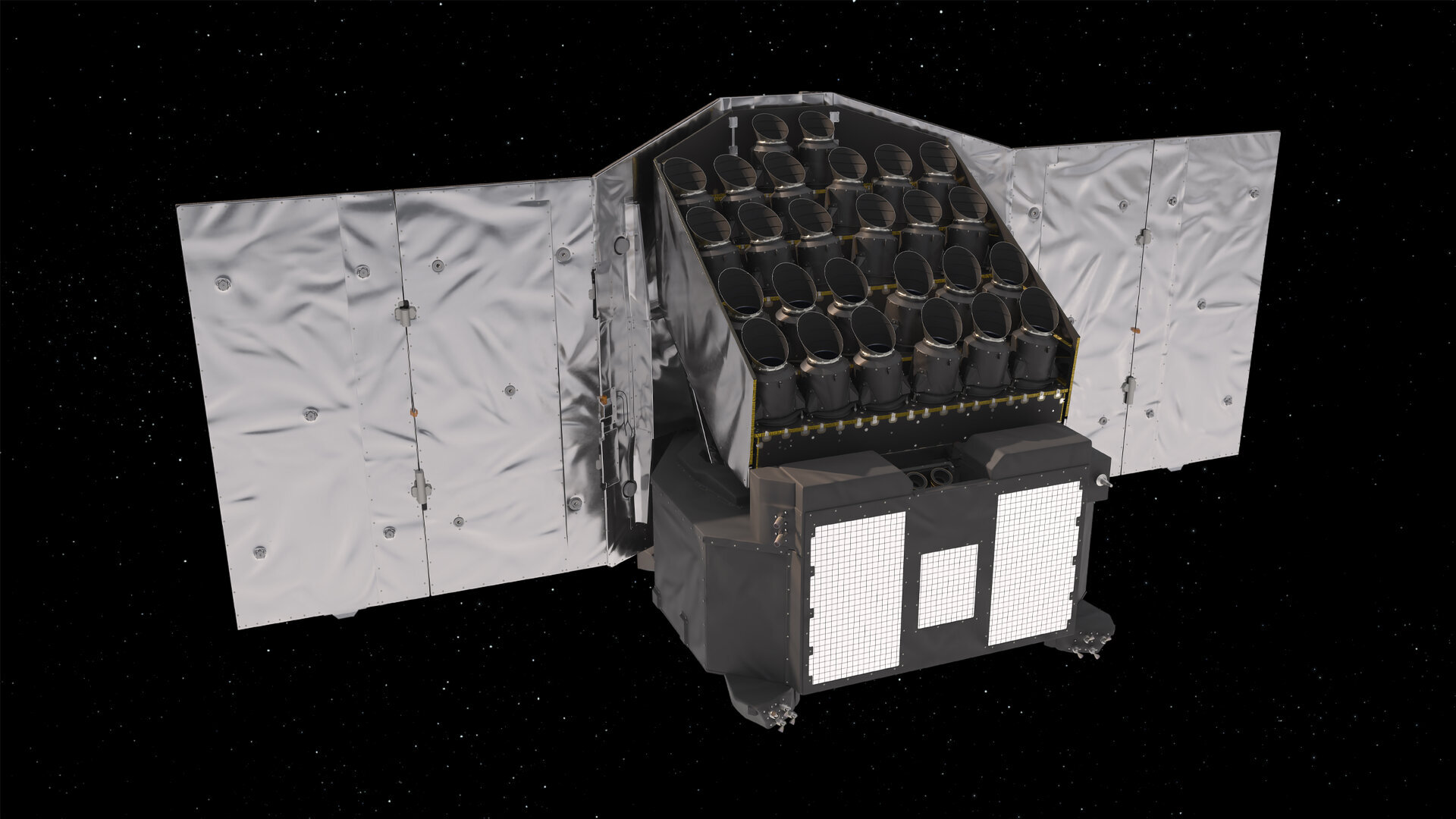
This week the launch services contract was signed for the Heliospheric Pioneer for Solar and Interplanetary Threats Defence (Henon) mission, ESA’s first stand-alone deep-space CubeSat, confirming that the pioneering spacecraft will fly onboard Ariane 6, alongside ESA’s Plato mission.
The agreement marks a milestone for the tiny technology demonstration mission, which is being developed through ESA’s General Support Technology Programme (GSTP) with Argotec, Italy, as the prime contractor. With arrangements now in place, the team can focus on spacecraft integration and testing before launch in early 2027.
“Everything has now been agreed and we can confirm that Henon will launch with Plato. It unlocks the next phase of our preparations and allows us to move forward with high motivation,” explains Roger Walker, Head of CubeSat missions at ESA.
“We are delighted by this milestone toward securing in-orbit operations services for Henon, marking a significant contribution to the mission's operational readiness and overall success,” said Davide Monferrini, program manager at Argotec.
Brave little pioneer
The spacecraft may be small, but its ambitions are not. Henon will become the first CubeSat ever to independently venture into deep space, communicate directly with Earth and manoeuvre to its final destination without relying on a larger ‘parent’ spacecraft.
“This is a new class of spacecraft,” explains Roger. “If you think about it, it’s a spacecraft roughly the size of a mini fridge heading out into deep space on its own. Not a large mission like Rosetta or BepiColombo but a tiny explorer proving what future low-cost interplanetary missions will be capable of.”
Once in its operational orbit, it will monitor solar activity from a new vantage point, to demonstrate the provision of warnings of solar storms hours before they reach Earth, helping to protect critical infrastructure and future space missions.
This joint technology solution delivers advanced Space Situational Awareness capabilities, enabling civil, commercial, and governmental users to anticipate potential threats, reduce operational risks, and ensure the continuity, resilience and security of essential services and missions.
Now the launch contract is in place preparations for the brave little pioneer’s great adventure continue “Now we are preparing for spacecraft integration, with flight hardware arriving and work progressing as planned.”
The structural and thermal qualification testing and FlatSat functional test campaigns have successfully reduced mission risks, while the first flight hardware is arriving for spacecraft integration activities planned during the summer.
Multiple technology frontiers

Henon isn't just demonstrating propulsion and communications technology but it's also helping prove a future operational model for launching small deep-space spacecraft. Launching with Plato will give Henon access to the deep-space injection it needs without requiring a dedicated launcher, but a feasibility study had to be undertaken with ArianeSpace to confirm whether or not it was possible to safely accommodate CubeSats onboard Ariane 6as secondary passengers.
“Henon was a reference case, but we also looked at how many CubeSats could be accommodated in this launch architecture. We can fit up to four 16U CubeSats in fact."
“A future constellation, four space weather satellites for example, would be taken care of with that launch solution," Roger continues.
“Henon is the first of its kind. If we can prove that a CubeSat can travel independently into deep space and operate there successfully by performing significant manoeuvres, then we open the door to future constellations or swarms in deep space, asteroid rendezvous missions and new forms of exploration that simply aren't possible today,” he concludes.

Henon is funded through the Italian Space Agency’s ALCOR programme, along with contributions from the United Kingdom and Finland and the Istituto di Astrofisica e Planetologia Spaziali as scientific principal investigator. HENON’s team also includes the Aboa Space Research Oy, the University of Turku, Imperial College London, the Charles University, SpaceDys, IMT, the University of Calabria, and the University of Florence.
Quelle: ESA