
19.09.2026
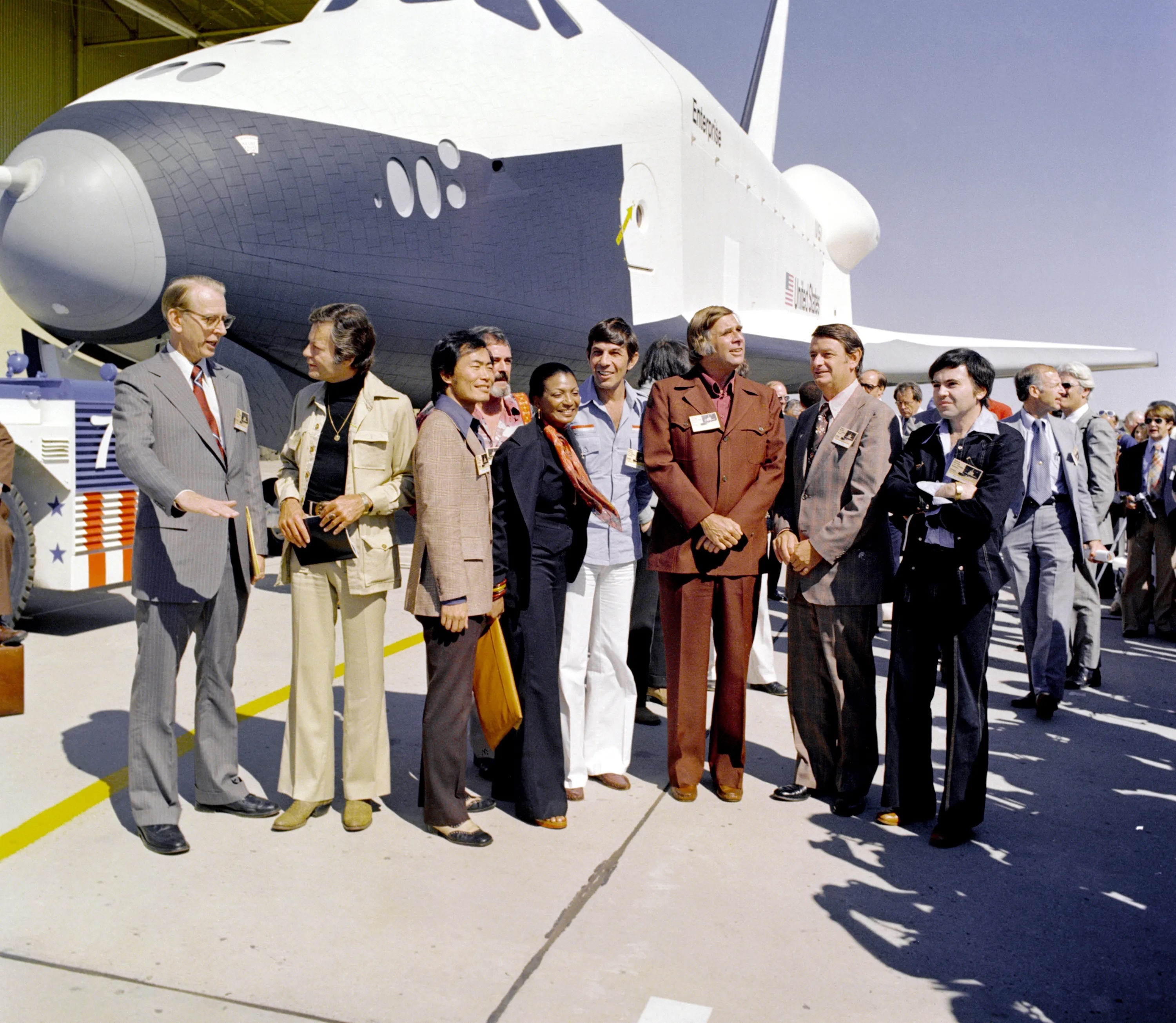
Fifty years ago, on Sept. 17, 1976—Constitution Day of America’s bicentennial year—NASA unveiled its first space shuttle orbiter, OV-101, to the public. NASA had originally planned to name the vehicle Constitution, but a letter-writing campaign changed the agency’s plans. Nearly 100,000 fans of the Star Trek television series wrote the White House urging that the shuttle be named after the USS Enterprise, the fictional starship featured in the series. In a memo, President Gerald Ford directed NASA to christen the shuttle Enterprise saying he was “partial to the name”. The name Enterprise, long celebrated in U.S. naval history, had earlier been bestowed on the first nuclear-powered carrier, a World War II carrier, and an American vessel of the Revolutionary War.
Hundreds of invited guests attended the rollout ceremony at Rockwell’s Palmdale facility in southern California, including Star Trek creator Gene Roddenberry and several cast members. Pictured from left to right in this photo are NASA Administrator James C. Fletcher, DeForest Kelley (Dr. “Bones” McCoy), George Takei (Mr. Sulu), James Doohan (Chief Engineer Montgomery “Scotty” Scott), Nichelle Nichols (Lt. Uhura), Leonard Nimoy (Mr. Spock), series creator Gene Rodenberry, U.S. Rep. Don Fuqua (D.-Fla) and Walter Koenig (Ensign Chekov).
Even though Enterprise was not designed to fly in space, it performed the essential atmospheric test flights that paved the way for the shuttle program’s first spaceflights in 1981. The orbiter is now on display at the Intrepid Museum in New York City.
Quelle: NASA
+++
50 years ago, NASA rolled out its 1st space shuttle Enterprise. The shuttle 'was one of the things that really inspired me,' ISS astronaut says
The space shuttle Enterprise debuted on Sept. 17, 1976, preceding by years the personal histories of the International Space Station's current crew
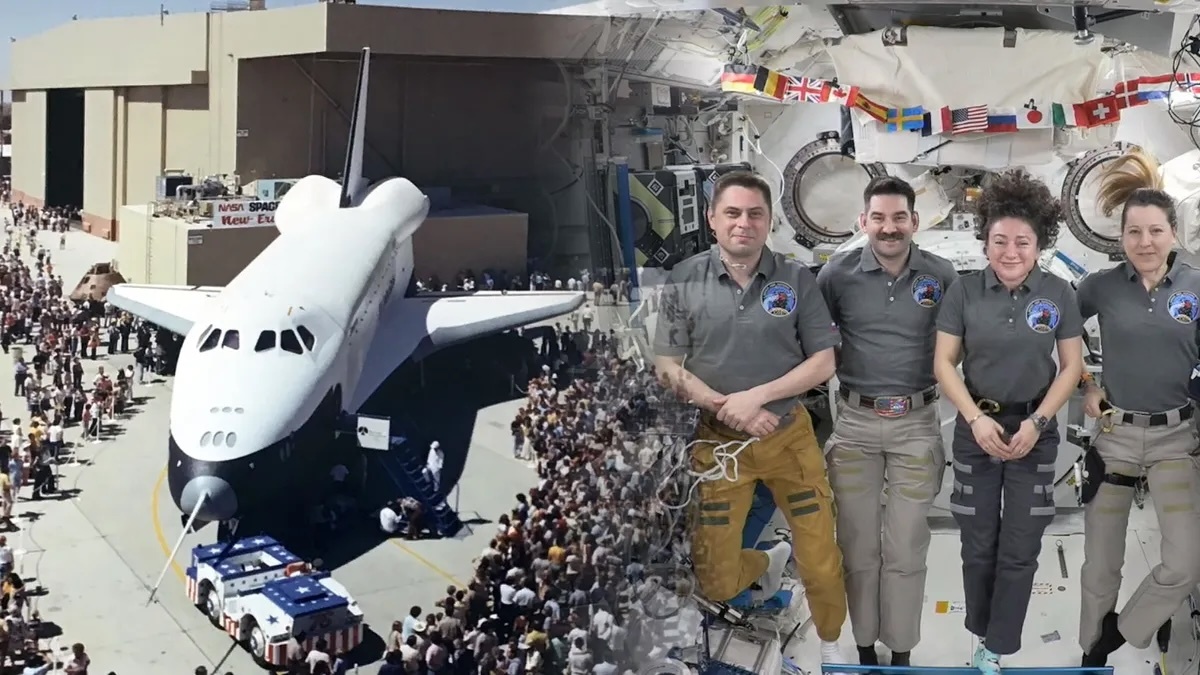
Separated by 50 years, the space shuttle Enterprise rolls out on Sept. 17, 1976 (at left) while the four members of SpaceX's Crew-12 mission — Roscosmos cosmonaut Andrey Fedyaev, NASA astronauts Jack Hathaway and Jessica Meir and ESA astronaut Sophie Adenot — participate in a press conference from aboard the International Space Station on Sept. 16, 2026. (Image credit: NASA)
Like most test pilots, Jack Hathaway was always looking for a faster and more capable winged vehicle to fly. Even as a kid, he dreamed of being at the controls of the "coolest plane out there."
Unfortunately for him, he was a few years too young.
NASA's first space shuttle orbiter, OV-101 or "Enterprise," made its debut 50 years ago today (Sept. 17). Though only a prototype used for atmospheric and ground tests, Enterprise proved that a spacecraft could launch like a rocket and land as a glider, enabling the world's first reusable orbital platform.
Enterprise became a museum piece in 1985. Twenty-six years later, the three-surviving space-worthy orbiters followed, permanently landing in institutions on both U.S. coasts. Hathaway did not become an astronaut until a decade after that.
"It was definitely one of my goals to be able to fly something like it someday, and didn't quite make it. Maybe [had I] been a couple years older I would have, but I look back at it and it was pretty awesome," said Hathaway on Wednesday (Sep. 16), taking part in a press conference from on board the International Space Station. "It built this space station, which [people] have inhabited now for over 25 years, which is pretty awesome.
"We're thankful for the people that flew the space shuttle who came before us," he said.
'A great day'
"Would you now roll out orbiter 101, now christened the 'Enterprise,'" directed Jim Fletcher, then the NASA administrator, on Sept. 17, 1976, as he stood before an audience outside the vehicle's manufacturing plant in Palmdale, California.
As the crowd caught its first glimpses of the now familiar black-and-white winged spacecraft, a marching band performed the theme to "Star Trek." Most of the TV show's primary cast were there as NASA's invited guests. OV-101 was originally going to be named the "Constitution" before a grassroots letter writing campaign convinced the government to name its first space shuttle after the show's fictional starship.
"We are on the verge of a new era," said Barry Goldwater, the then-ranking minority member of the U.S. Senate's Committee on Aeronautics and Space Sciences. "As we witness today the rollout of the space shuttle, we are on the verge of a new era, not only in spaceflight, but in the lives of men and women and children all across this Earth."
"I submit that the space shuttle will present us with a remarkable opportunity to exploit the new frontier of space for the benefit of all mankind and to continue to expand our knowledge of the space environment in which we live," he said.
"What a great day that was in 1976!" recalled Star Trek's Spock, actor Leonard Nimoy, as the Enterprise arrived in New York for its display at the Intrepid Museum in 2012. "It was a great day for America, a great day for us to be connected to that history."
An inspiration
NASA astronaut Jessica Meir was born 10 months after Enterprise's reveal. Like Hathaway, her Expedition 74 and SpaceX Crew-12crewmate, she grew up watching the space shuttle fly.
"I do think that the space shuttle program had a huge part in inspiring me," she said from on board the ISS in response to a question from collectSPACE. "When people ask me what made me want to be an astronaut, you know, there wasn't one moment that I describe, but I very vividly recall in the classrooms [watching] space shuttle launches."
In February 1977, five months before Meir was born, Enterprise made its first flight mounted to the top of NASA's Shuttle Carrier Aircraft. It flew a total of 16 times, of which five saw it separate from the 747 and land on its own on the dry lakebed at Edwards Air Force Base in California. Two pairs of two astronauts each took turns flying the tests: Fred Haise and Gordon Fullerton as one crew and Joe Engle and Richard Truly as the other.
Before turning Enterprise over to the Smithsonian, one of the last uses NASA had for the orbiter was to inspire and engage the public. The orbiter was the only one in history to be carried atop a Boeing 747 on a transatlantic tour of European countries and be displayed at the Paris Air Show in France in 1983. It was also exhibited at the 1984 Louisiana World Exposition in New Orleans.
"Seeing them when we were growing up as kids in the classroom, seeing it on the evening news — I think that was one of the things that really inspired me and got me interested in spaceflight and exploration in general," Meir said.
Quelle: SC