
15.09.2026
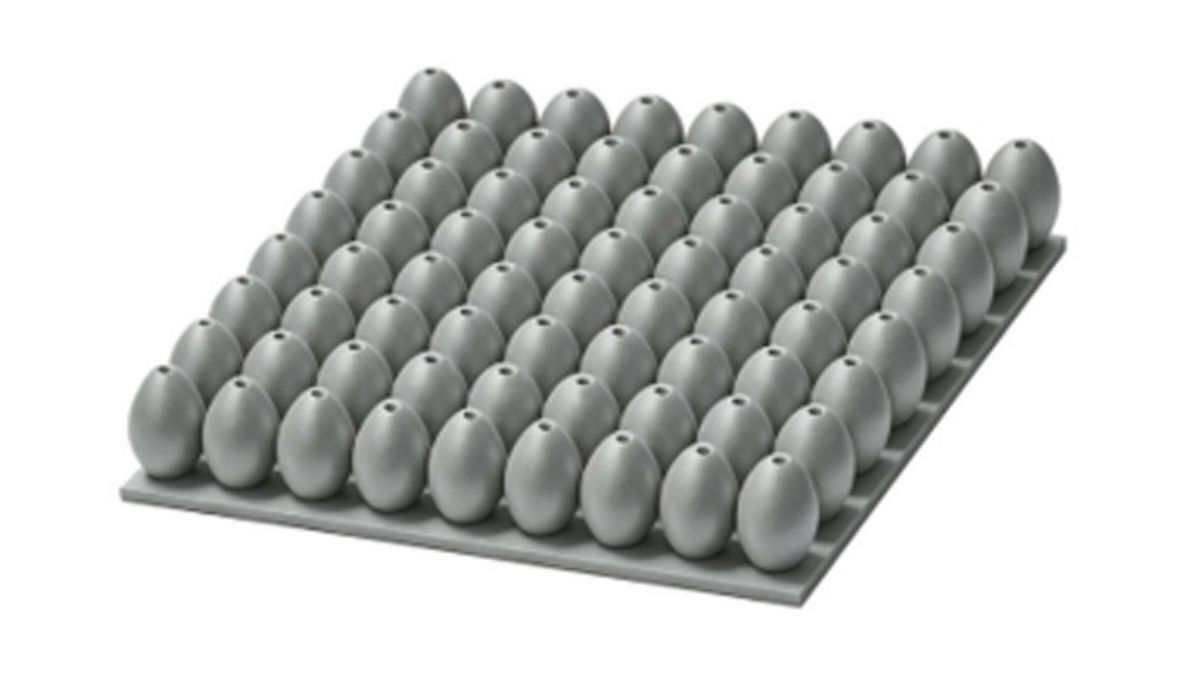
The water-filled aluminium eggshell array metastructure. The second aluminum plate (excluded to visualise the eggshell geometry) is placed on top and faces towards incoming projectiles. Credit: Wang et al
Aerospace engineers have taken inspiration from the humble eggshell to design spacecraft shielding which protects against damage from ultra high-velocity space debris and micrometeorites.
The water-filled aluminium “eggshells” are arranged into an array with the narrow ends facing upwards like in an egg carton. This structure is then sandwiched between 2 aluminium impact plates.
Simulations estimate the material would reduce the velocity of an impact projectile by almost 65%, while a single-layer aluminium plate achieves a 51% reduction.
The findings are published in a study in the Journal of Applied Physics.
The threat of space debris
Earth’s orbital environment is getting more congested as the number of new satellites in orbit rises exponentially.
Debris in orbit around Earth has been rising since the beginning of the space age and is a major threat to the long-term sustainability of spaceflight.
Old, abandoned satellites, discarded rockets and other materials from launches, and the debris of in-orbit collisions whipping around the planet can reach relative velocities of up to 18km/s.
According to the European Space Agency, as of February 2026 the estimated number of space debris objects numbered:
-
68,450 objects greater than 10cm in size (including 11,300 active ones such as satellites).
-
1.5 million objects 1–10cm in size.
-
230 million space debris objects from 1mm to 1cm.
Ensuring space stations, satellites and spacecraft can withstand high-speed impacts during missions has never been more critical.
Eggs-ellent protection
The eggshell-inspired structure is designed to increase the impact resistance of a type of space armour called a Whipple shield.
Whipple shields have a thin outer wall placed away from the main wall of a spacecraft. This outer wall breaks up incoming high-velocity space debris into fragments which fan out, dispersing the impact energy over a larger area.
The researchers used 3D printing to fabricate the eggshell array and then filled them with water.
They used a computer model to simulate a 7.5km/s impact against the water-filled eggshell array, a single-layer aluminium plate and an array of water-filled aluminium spheres.
The sandwiched, water-filled eggshell material performed best.
“Natural biological structures have evolved to demonstrate excellent energy absorption performance over long-term adaptation,” says co-author author Yuxin Wang of Dalian University of Technology, China.
“A single eggshell breaks easily under local force, but the protection mechanism of the eggshell array is completely different.
“The cooperative deformation of these eggshell units transforms the local impact load into distributed energy dissipation across the metastructure, thereby significantly enhancing the anti-impact performance of the target plates.”
The sloshing motion of water inside the aluminium eggshells also prevents impact waves from propagating easily through the material.
The work isn’t done
“This work demonstrates that bionic, lightweight metastructures are a promising route for hypervelocity-impact protection,” Wang says.
The geometry and filling of the aluminium eggshell arrays will need to be further optimised and tested against impacts in real life before the material can be used as lightweight shielding on spacecraft.
First, the researchers plan to refine the thickness of the aluminium eggshells, their shape and layout to improve the material’s protective energy absorption properties.
“We hope this research can attract more attention to bio-inspired protective structures,” says Wang.
Quelle: CONNECTSCI