
27.07.2026
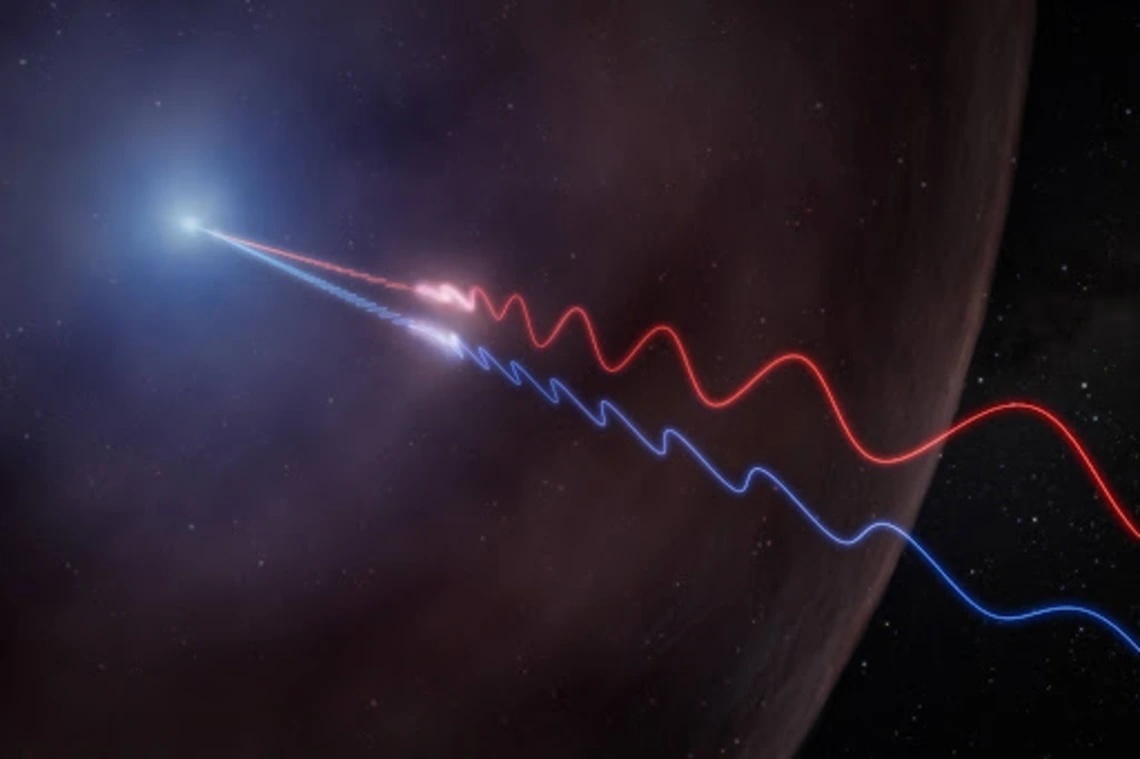
This illustration depicts Faraday rotation in the afterglow of a gamma-ray burst. A powerful jet (upper left) sends polarized radio waves through an H II region, a bubble of magnetized gas. The magnetic field twists the waves' polarization angle. Because the effect is stronger at longer wavelengths, the red and blue waves exit the bubble oscillating in different directions. By measuring this difference, astronomers mapped the magnetic environment surrounding GRB 260310A for the first time.
NSF/AUI/NSF NRAO/M.Weiss
An international team led by researchers at the University of Arizona and the University of Utah has made a series of landmark observations of one of the universe's most violent events.
Using the U.S. National Science Foundation Very Large Array radio telescope, operated by the National Radio Astronomy Observatory, the team detected polarized light from a gamma-ray burst afterglow for the first time at radio wavelengths. They also made the first detection of Faraday rotation in a gamma-ray burst – known as a GRB – a phenomenon in which magnetic fields cause the polarization of light to twist as it travels through space.
The findings, described in a paper submitted to The Astrophysical Journal and available on the open-access archive arXiv, offer a new window into the extreme physics behind gamma-ray bursts and may help astronomers better understand how the universe's most massive stars end their lives.
"We're effectively using the universe as our laboratory to test our understanding of how physics operates under such extreme conditions," said Kate Alexander, assistant professor of astronomy at the University of Arizona's Steward Observatory and co-author of the study.
What are gamma-ray bursts?
Gamma-ray bursts are the most powerful explosions in the universe, releasing in a matter of seconds as much energy as the sun will emit over its entire lifetime. Long-duration gamma-ray bursts are thought to occur when massive stars die and collapse to form black holes, launching narrow jets of particles traveling at nearly the speed of light. Those jets produce a radio "afterglow" that can linger for months.
Despite decades of study, astronomers still do not fully understand how those jets are launched. Because magnetic fields are thought to power and shape these jets, directly measuring them has remained one of the field's greatest challenges.
"Exactly how you go from a dying star to launching a beam of plasma traveling at nearly the speed of light is still not a solved problem," said Collin Christy, lead author of the study and a graduate student at the University of Arizona.
GRB 260310A reveals polarized radio waves
The team's observations focused on a gamma-ray burst known as GRB 260310A. Although the burst occurred about 2 billion light-years from Earth, it was remarkably close by cosmic standards making its radio afterglow one of the brightest observed in about a decade. This gave astronomers a rare opportunity to study the explosion in unprecedented detail.
By observing the fading radio afterglow with the NSF Very Large Array telescope, the team detected polarized radio emission from a gamma-ray burst for the first time. In polarized light, the waves oscillate in a preferred direction rather than vibrating randomly. The same property is exploited by polarized sunglasses, which reduce glare by blocking partially polarized light reflected from water and other smooth surfaces.
Faraday rotation in a gamma-ray burst
Detecting polarized radio waves alone would have been an exciting first for the telescope. But the team made an even more extraordinary discovery: The polarization signal changed across different wavelengths, a phenomenon known as Faraday rotation. Never before detected in a gamma-ray burst, the effect acts like a magnetic fingerprint, encoding information about the strength and structure of the magnetic fields the radio waves encountered on their journey to Earth.
Just as a prism bends different colors of visible light by different amounts, magnetized plasma rotates the polarization angle of radio waves by different amounts depending on their wavelength. Together, the polarization and its twisting reveal two pieces of the puzzle: The magnetic fields powering the jet itself and the magnetized environment the radio waves passed through on their way to Earth.
The observations revealed a magnetic field along the light's path that was thousands of times stronger than could be explained by the Milky Way or the space between galaxies alone. Instead, the measurements point to an exceptionally dense, magnetized cloud surrounding the star before it exploded to produce GRB 260310A.
Clues for gamma-ray burst origins
The observations suggest GRB 260310A exploded within an H II region – a dense bubble of ionized hydrogen gas created by the intense ultraviolet radiation and stellar winds of a massive young star. The finding supports the idea that long-duration gamma-ray bursts arise from the deaths of the most massive stars while offering new clues about the environments that produce these extreme events.
"Each new observation reveals another layer of the magnetic story these explosions are telling us," Christy said.
Unlocking those clues required observing the burst in a way that hadn't been possible before. Previous polarization studies relied on shorter radio wavelengths and had to be conducted soon after a burst before the afterglow faded. By observing GRB 260310A at longer, centimeter wavelengths with the NSF telescope, the team made the first detection of Faraday rotation in a gamma-ray burst, a breakthrough that was the result of years of preparation.
"We had been developing the tools and techniques to do polarization measurements of previous gamma-ray bursts," Christy said. "And then we got lucky that the universe offered one of the brightest radio afterglows seen in decades, just in time for us to use this new technology."
Why it matters
With this discovery, astronomers can begin to track how magnetic fields evolve in the aftermath of gamma-ray bursts.
"Future monitoring of GRB afterglows with the NSF VLA and other radio telescopes will allow scientists to watch magnetic field structures evolve in real time," said Alexander. "This is a capability that could transform our understanding of how near-light-speed jets form, how they are powered, and how magnetic energy is released in the most extreme environments the universe has to offer."
Quelle: The University of Arizona