
17.11.2026
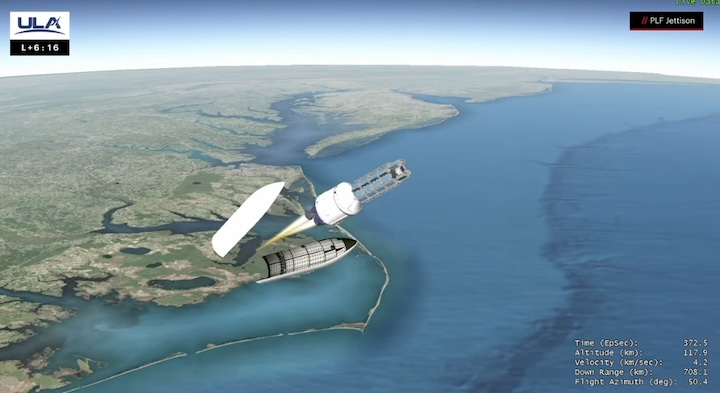
Shortly after a United Launch Alliance Vulcan soared from Cape Canaveral Space Force Station on its highly anticipated return-to-flight mission, the rocket suffered an anomaly and failed to deliver 40 Amazon Leo satellites to low-Earth orbit.
ULA reported the setback occurred 10 minutes after the Vulcan's 12:40 p.m. liftoff Sunday, Nov. 15, from Launch Complex 41 on the Amazon Leo 1 mission. The failure sparked serious concern about the short-term viability of ULA's Vulcan program.
The launch marked ULA's first Vulcan launch in nine months. A solid rocket booster malfunction marred the Feb. 12 USSF-87 national security liftoff, grounding the 215-foot rocket until this past weekend.
After the failed flight, Federal Aviation Administration officials announced ULA must conduct a mishap investigation. No timeline has been set. ULA will be required to submit a final report for approval that determines the root cause of the anomaly and identifies corrective actions to avoid it from happening again.
"During the launch, the FAA activated two debris response areas and briefly slowed aircraft outside the area where space vehicle debris was falling or stopped aircraft at their departure location," an FAA statement said.
In a media update issued shortly after Sunday's anomaly, ULA officials said they will work closely with Amazon and other organizations "to find the cause, determine the appropriate corrective action, and return to flight as quickly as possible."
"Every flight generates data, and every flight teaches us something. Since the anomaly just occurred, we don’t have any specific data yet to understand what occurred today," ULA's media update said.
"ULA exists to provide assured access to space for our nation and for the customers who depend on us. That purpose is why we take on some of the hardest missions in spaceflight, and why we hold ourselves to the standard of mission success," the update said.
"Today, we did not meet that standard," the update said.
unday's ill-fated Amazon Leo 1 mission was slated as the kickoff of a 38-launch contracted partnership between ULA and the ecommerce giant.
The Vulcan rocket is expected to serve as Amazon Leo's "primary workhorse" as the company builds a constellation that will surpass 3,000 broadband satellites to connect with tens of millions of customers around the world. Per a ULA mission update, the enterprise-grade terminal (Leo Ultra) will provide downlink speeds of up to 1 Gbps, while two compact terminals — Leo Pro and Leo Nano — will provide downlink speeds up to 400 Mbps and 100 Mbps, respectively.
The mission marked Amazon Leo's first aboard a Vulcan rocket, which was outfitted with six solid rocket boosters for additional power to push the 40 satellites skyward. ULA reported this was the the company's largest and heaviest payload ever, clocking in at more than 50,000 pounds.
This was also "the first mission to fly a shorter, optimized version of ULA’s Centaur V upper stage, enabling Vulcan to carry more satellites to low Earth orbit," an Amazon news release said.
"There is risk with any launch, and that’s especially true for inaugural missions like (Amazon Leo 1). ULA has been a trusted partner for Amazon, and we believe they’ll learn from this mission and deliver on their long-term plans for Vulcan," Amazon Leo officials said in a tweet after Sunday's anomaly.
The Amazon Leo 1 mission marked ULA's fifth launch of the Vulcan rocket, which debuted in January 2024.
In a tweet after Sunday's anomaly, NASA Administrator Jared Isaacman offered his agency's assistance.
"Appreciate you quickly keeping the public and your partners informed. The team at @NASA is available to assist in all matters related to the investigation and remediation effort. Artemis, Moon Base, and the nation need ULA. We are in your corner and here to help," Isaacman said.
ULA and NASA are teaming up to develop a larger version of the company's Centaur upper stage for future Artemis missions.
Per ULA's final mission update shared with the public on Sunday, the Vulcan's Centaur V upper stage had ignited and the payload fairing had jettisoned six minutes after liftoff and was traveling 95 miles above Earth east of Charleston, South Carolina. The Centaur was flying faster than 11,000 mph.
Quelle: Florida Today