
16.05.2026
Water erupted from cryovolcanoes may freeze into thick but fragile layers on Europa and Enceladus
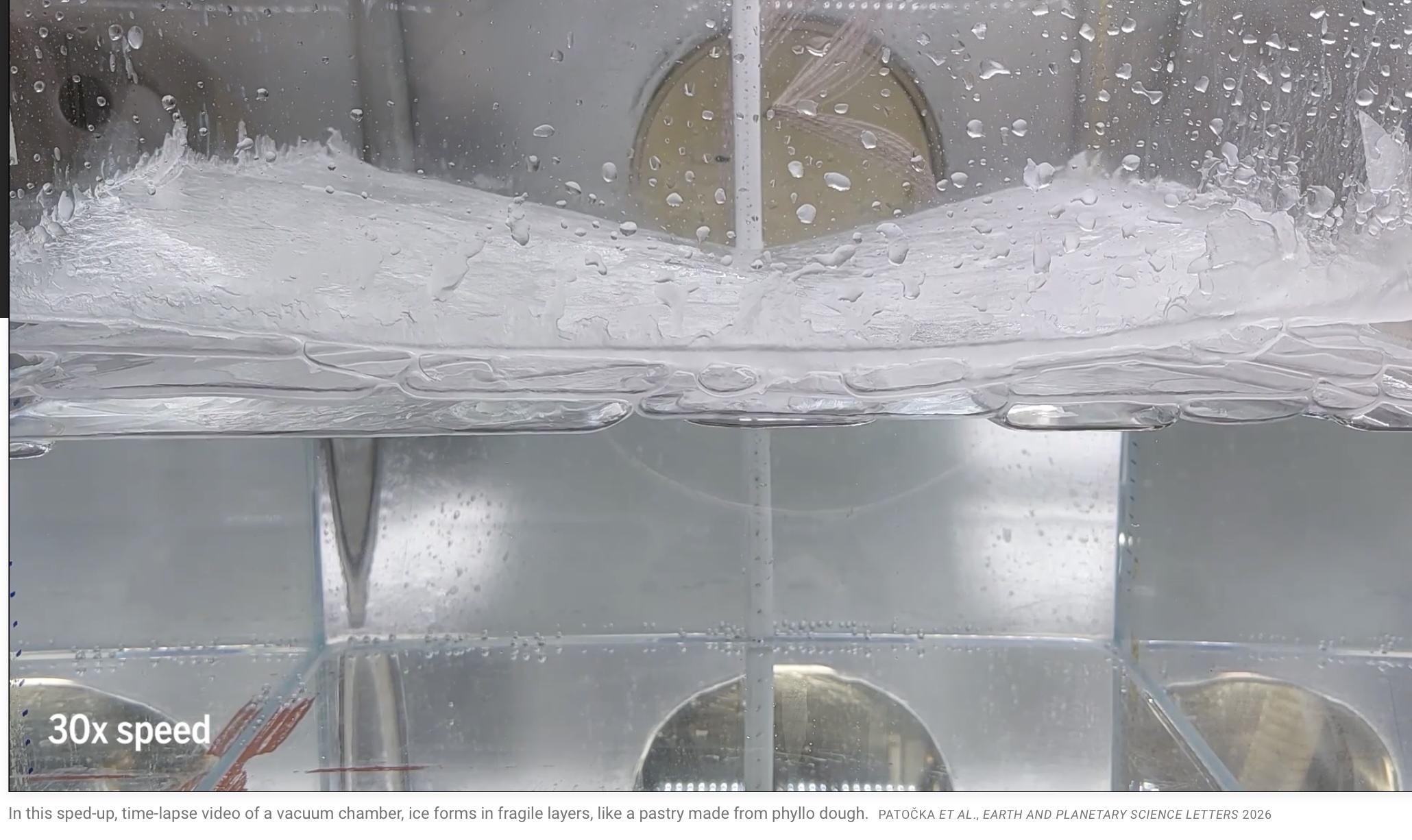
When water erupts on the ocean moons of Jupiter and Saturn, it could freeze into fluffy ice with the texture of a croissant, presenting a hazard for future lander missions.
That’s the conclusion of a vacuum chamber experiment presented last week at the General Assembly of the European Geosciences Union. The work, also published in Earth and Planetary Science Letters on 16 April, shows water freezing into brittle, layered sheets 20 centimeters thick. In the low-gravity environment of Jupiter’s moon Europa, that would translate to fluffy ice several meters thick, the researchers say. On Saturn’s moon Enceladus, the ice could be as much as 20 meters thick. Spacecraft landing on the ice could crash straight through its many fragile layers.
“If the surface is really covered with this type of highly porous, fragile water ice, that would definitely pose some serious engineering issues,” says Ingrid Daubar, a planetary scientist at Brown University and a scientist on NASA’s Europa Clipper orbiter mission. “We’d have to re-envision the types of landing mechanisms we thought might work on Europa.”
The relatively simple study “seems like the kind of thing that would have been done already,” says Vojtěch Patočka, a geophysicist at Charles University. He and his colleagues placed a fish tank of water inside a large vacuum chamber. Inside the chamber, they dropped the temperature and pressure to mimic the conditions water would experience on the surface of the outer Solar System moons. Then they videotaped what happened.
Without enough pressure to keep the water liquid, it first begins to boil. Layers of icy crusts then form while vapor puffs through them like steam through pastry dough, buckling the crusts and rapidly pushing them up. Layer on layer accumulates, with the fragile texture of a wasp’s paper nest, until the weight of the overlying ice finally suppresses the boiling. From then on, the water freezes solid.
The key to the experiment was a specialized grime-proof vacuum chamber named George,big enough for a human to crawl into (as Patočka had to do several times to clean up after experiments). Most vacuum chambers are small and aren’t built to handle so much moisture or mess. So although scientists have frozen small amounts of water under such conditions before, “these are the first experiments of this scale, where they froze such a large volume of water,” Daubar says. She says the work will help prepare scientists to study Europa’s surface when the Europa Clipper arrives at the Jupiter system in 2030. (NASA originally planned a Europa lander mission to complement the Clipper orbiter, but it was scrapped in 2019.)
Patočka thinks this kind of fragile, “phyllo-cellular” ice could form where ice volcanoes erupt water from the moons’ subsurface oceans onto the surface. If fluffy ice exists on Europa, its porous layers should produce a radar signature that Europa Clipper could detect—and point future landers away from fields of frosty pastry that would be anything but sweet.
Quelle: AAAS