
23.04.2026
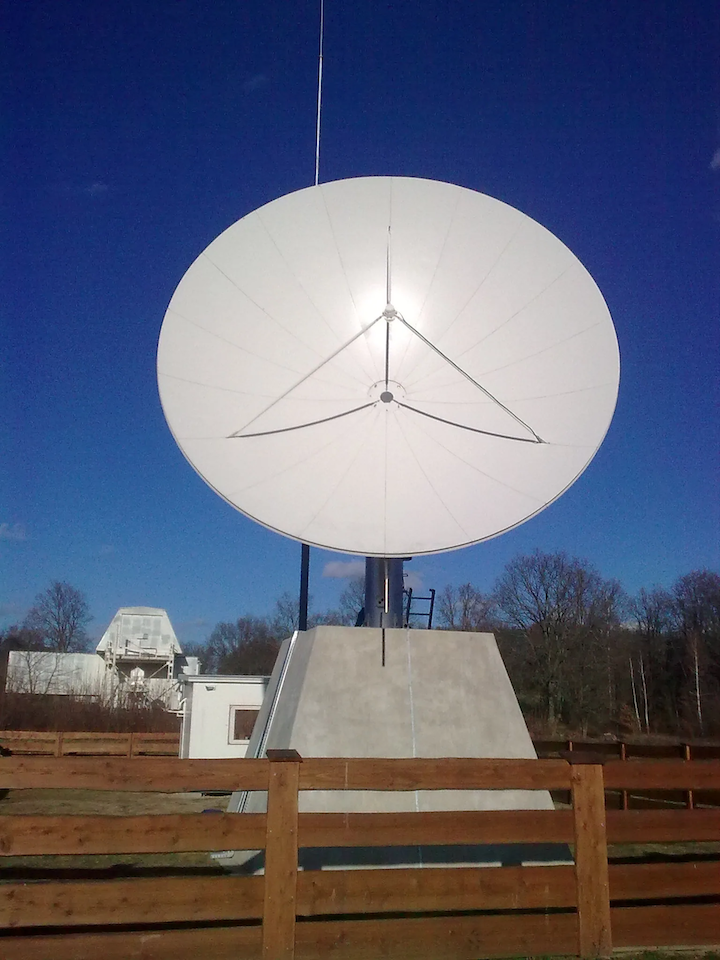
A new station in Poland has begun monitoring the Sun for the early warning signs of disruptive space weather phenomena. The six-metre radio dish, known as ROSIE, will contribute to the protection of key European infrastructure in orbit and on Earth.
The Sun poses a persistent hazard to the technology and infrastructure on which our modern societies depend. Space weather generated by the Sun emanates through the Solar System and can significantly disrupt navigation systems, power grids, satellite operations and many other industries when it arrives at Earth.
Solar radio outbursts represent an important early warning sign, as they are associated with disturbances in Earth’s atmosphere caused by space weather. Detecting these warning signs gives infrastructure operators time to take action to protect their sensitive systems.

The European Space Agency (ESA), Polish Space Agency (POLSA) and University of Wrocław have jointly facilitated the development and operations of a new solar monitoring station that will provide Europe with a source of data on the solar radio emission and outbursts.
Known as Radio Observations of the Solar Indicative Emissions (ROSIE), the station is located at the Astronomical Observatory in Białków, Poland. The project is led by the University of Wrocław in collaboration with the Polish company ITTI Sp. z o.o.
ROSIE was inaugurated on 10 March 2026 and has begun routine monitoring solar radio emissions.
Tuning in to solar radio
The ROSIE station features a six-meter radio dish that points towards the Sun and ‘tunes in’ to solar radio emissions. Two high-speed radio spectrographs filter the incoming radio waves to monitor two specific frequencies that are useful indicators of solar activity.
These frequencies are often referred to as ‘solar radio indexes’ and named after the wavelengths of the emissions: F30 (1 GHz; 30 cm) and F10.7 (2.8 GHz; 10.7 cm).

The indexes are used as reliable proxies for the emission of extreme ultraviolet radiation, which cannot be observed directly from the ground, and which plays a significant role in ionising and heating the upper layers of Earth’s atmosphere.
Heating causes the atmosphere to swell and expand, pushing satellites in low-Earth orbit off of their desired trajectories.
Accounting for this disturbance is important for safe space traffic management and preventing collisions in orbit.
Crucially, these effects are felt as much as a few days after the initial radio outburst, making the F30 and F10.7 indexes very useful for forecasting potential disruption.
Ionisation in the upper layers of the atmosphere by ultraviolet radiation from the Sun can degrade, delay or disturb signals travelling from satellites to Earth. This can result in inaccurate positioning and navigation services for industries such as transportation, aviation, and precision agriculture. ROSIE's measurements will help to monitor these disturbances and mitigate their impacts on GNSS based applications.
Poland boosts European space weather resilience

By monitoring these indexes throughout the European daytime, ROSIE strengthens the continent’s resilience to space weather disruption.
“ROSIE highlights the increasing role that Poland is playing in Europe’s space weather monitoring efforts,” says Juha-Pekka Luntama, Head of the ESA Space Weather Office.
“The Polish space industry and academia are also playing a leading role in our upcoming space weather satellite mission, SAWA, which will provide a complementary source of near-real time data on the state of the atmosphere from orbit.”
“The observations of ROSIE can also be adapted and extended to detect strong solar activity, such as flares and CMEs, providing a warning of their potential impact on important radio frequencies used for telecommunications and geolocation,” says Professor Paweł Rudawy from the University of Wrocław.
ROSIE’s data will be made available to users via ESA’s Space Weather Service Portal and via the ROSIE web portal. ESA’s Space Weather Service Portal acts as a single point of access to hundreds of space weather services provided by a federated network of European Expert Service Centres.
Together, these services provide reliable, actionable information about current and future space weather conditions to the operators of critical European infrastructure on Earth and in orbit that may be affected.
Quelle: ESA