
21.04.2026
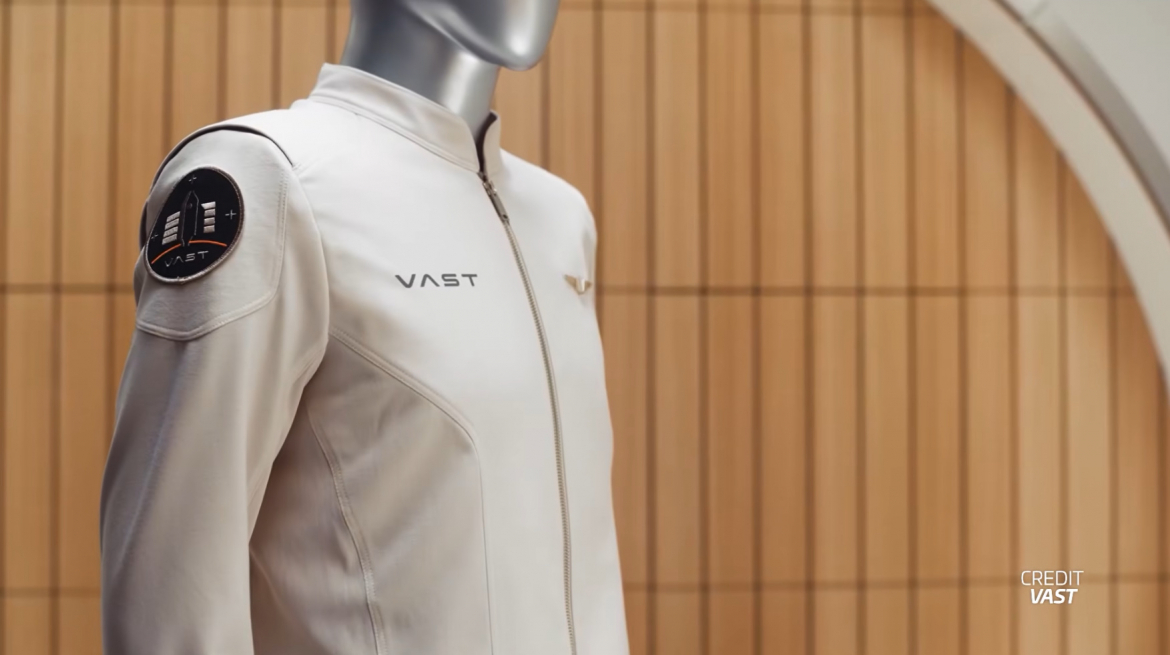
Commercial space station developer Vast has blended fashion with functionality while laying groundwork for the next generation of orbital infrastructure.
The company revealed its new Astronaut Flight Suit, designed for crews on its upcoming Haven-1 station and future missions, alongside a groundbreaking Large Docking Adapter that promises to overcome longstanding limitations in how spacecraft and station modules connect in orbit.
Vast’s Astronaut Flight Suit marks a deliberate departure from the casual attire often seen aboard the ISS, where crews typically wear standard polo shirts and pants. Instead, the company has created a tailored, professional-looking garment that serves multiple roles: training on Earth, public events, and daily operations aboard Haven-1.
Developed with input from experienced astronauts, including Vast’s lead astronaut Drew Feustel, who flew to the ISS on both Shuttle and Soyuz, the suit emphasizes mobility, comfort, and practicality in microgravity.
It features a jacket and trousers equipped with numerous zippers, pockets, and hook-and-loop (Velcro) fasteners strategically placed for easy access and attachment of tools or personal items. These details reflect real operational needs in a weightless environment where everything must be secured.
One notable element is the inclusion of boots, which stand out because astronauts on the ISS often simply wear socks once aboard, as there is no traditional “floor” to stand on.
Whether the boots will see active use in orbit or primarily during ground activities remains to be seen, but they contribute to the suit’s polished, aviation-inspired aesthetic that nods to the heritage of flight suits while signaling a new commercial chapter.
“The suit represents the crew and the mission, but it’s also something astronauts can actually use day to day,” Feustel said in a statement. “This is the flight suit for the commercial, crewed spaceflight era, and it’s really just the beginning.”
Vast CEO Max Haot noted that the suits are custom-tailored for each crew member and will likely evolve based on flight experience and customer feedback. Crews will wear the suits during Vast’s planned private astronaut mission to the ISS (its sixth such collaboration with NASA), providing an early real-world comparison against existing garments.
Haven-1, Vast’s inaugural commercial space station, is designed to host crews of four for two-week missions.
The company aims to use the single-module outpost to gain operational experience before scaling up to the larger, multi-module Haven-2 and beyond. Integration of Haven-1 hardware is underway, with the station now targeted for launch in the first quarter of 2027 after a schedule adjustment from earlier 2026 goals.
Vast’s other major reveal may prove more transformative for the long-term architecture of space stations: the Large Docking Adapter.
Current crewed spacecraft visiting the U.S. segment of the ISS rely on the International Docking Adapter (IDA), which implements the International Docking System Standard.
This system traces its lineage back to the 1975 Apollo-Soyuz Test Project, evolving through the APAS-95 used by the Space Shuttle with Russia’s Mir station and later adapted for NASA’s Commercial Crew Program vehicles like SpaceX’s Dragon and Boeing’s Starliner. Similar implementations appear on NASA’s Orion spacecraft and India’s Gaganyaan program.
The IDA’s pressurized opening, however, measures just 80 centimeters in diameter — a bottleneck that restricts the transfer of large equipment or cargo between vehicles.
For bigger payloads, the ISS uses the Common Berthing Mechanism (CBM), with its 1.6-meter opening, but berthing is a passive process requiring the station’s robotic arm (Canadarm2) to grapple and position the visiting spacecraft. This method works well for uncrewed cargo but is too slow and infrastructure-dependent for crewed emergency scenarios.
Vast’s Large Docking Adapter addresses these constraints head-on with a dramatically larger 2.9-meter pressurized opening — more than triple the IDA’s diameter and substantially exceeding the CBM.
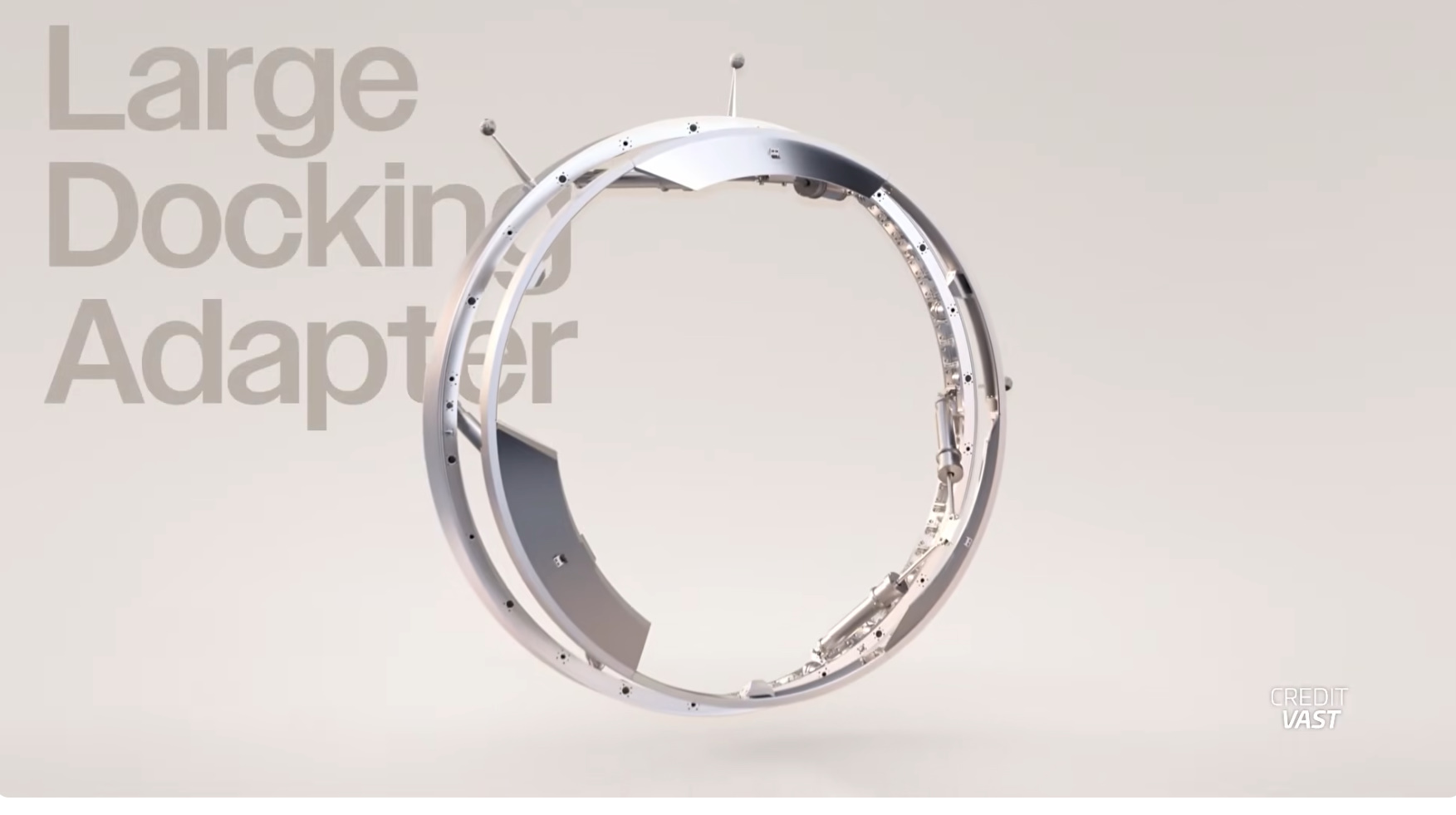
The design features three alignment petals, latches, actuators, and an androgynous architecture, allowing either side to act as the active or passive half. It includes a soft-capture system and a hard-capture mechanism with 12 powered bolts and redundant pressure seals.
The adapter is engineered for significantly higher structural demands. Vast claims it is up to 30 times more rigid than the current IDA, making it suitable for connecting massive modules and supporting stations that could one day rotate to generate artificial gravity. Such connections will need to withstand substantial forces without compromising structural integrity.
Beyond spacecraft-to-station docking, the Large Docking Adapter could also serve as the interface between a space station module and its launch vehicle, potentially streamlining assembly of large orbital habitats. It is specifically tailored for the era of Starship-scale vehicles and modules, enabling the transfer of oversized equipment that simply cannot pass through today’s narrower ports.
The pressurized opening area reaches up to 6.6 square meters — offering roughly 13 times more area than the IDA.
Importantly, the new adapter will not fly on the initial Haven-1 station and may or may not appear on early versions of Haven-2, depending on how Vast aligns with NASA’s evolving plans for commercial successors to the ISS. Instead, Vast is positioning the technology for broader industry adoption.
The company plans to open-source the Large Docking Adapter Standard next month, inviting other spacecraft and station developers to implement it. Hardware is already in development at Vast’s headquarters, with prototypes undergoing testing, and the adapter is available for purchase by partners.
These announcements come as the space industry prepares for the eventual retirement of the ISS around 2030 and a shift toward commercially operated platforms. Vast’s approach — combining practical crew apparel with forward-looking docking technology — underscores the company’s ambition to make long-duration stays in orbit more comfortable, productive, and scalable.
By addressing both the human experience and the hard engineering challenges of connecting ever-larger structures, Vast is betting that its innovations will help usher in an era of expansive commercial space stations capable of supporting more crew, more science, and eventually artificial gravity environments.
If other players adopt the open-sourced docking standard, it could become a de facto interface for future orbital infrastructure, much as the current IDA has standardized crewed visits to the ISS.
With Haven-1’s hardware progressing through integration and environmental testing, and the new docking adapter ready for collaboration, Vast is signaling confidence in its roadmap.
Quelle: NSF