
7.04.2026
FLIGHT VV29 LAUNCH POSTPONEMENT
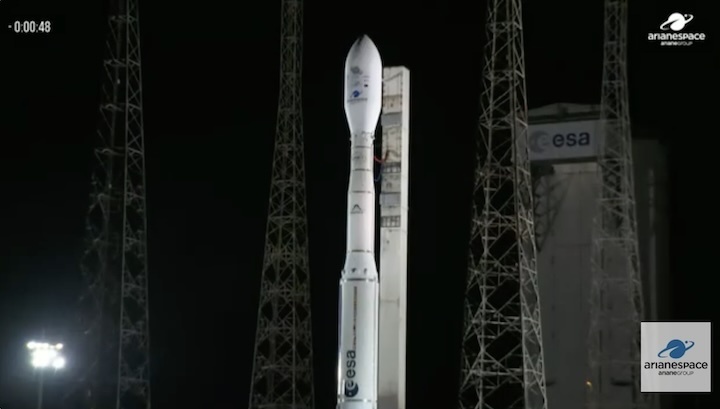
Kourou (French Guiana) - The launch of the Smile satellite has been
postponed, due to a technical issue occurred on a subsystem component production line after VV29 launcher integration.
Additional investigations are needed to exclude any relation between such issue and the VV29 launcher in order to safeguard flightworthiness.
The new launch date will be announced following the completion of these activities, as agreed with the supplier.
Vega C and its passenger, the Smile satellite, are in stable and safe conditions.
Quelle: AVIO
----
Update: 24.04.2026
.
Smile set to launch on 19 May
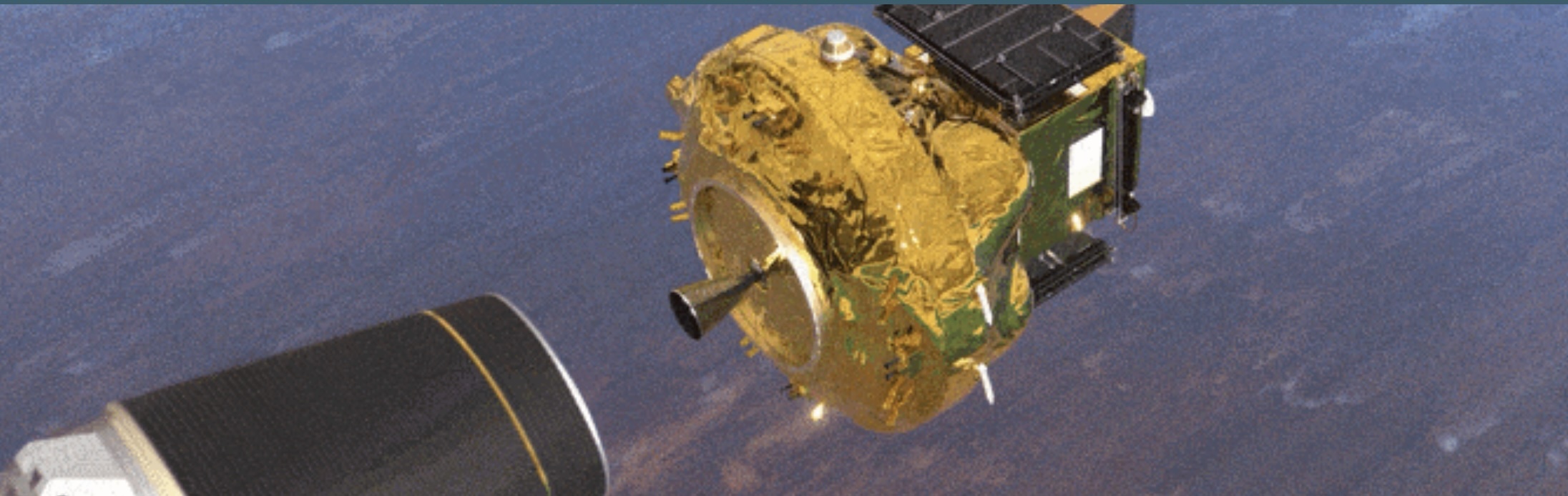
The European-Chinese Smile mission is due to launch on Tuesday 19 May 2026, at 05:52 CEST / 04:52 BST / 00:52 local time on a European Vega-C rocket.
The initial launch date was postponed as a precautionary measure, after a technical issue was identified on the production line of a Vega-C subsystem component. Both Smile and the Vega-C that will take it to space remain stable and safe.
Following the completion of careful investigations into the issue, all partners have agreed on 19 May as the new launch date.
Smile is a collaboration between the European Space Agency (ESA) and the Chinese Academy of Sciences (CAS). It will reveal how Earth responds to the streams of particles and bursts of radiation from the Sun, using an X-ray camera to make the first X-ray observations of Earth’s magnetic field, and an ultraviolet camera to watch the northern lights non-stop for 45 hours at a time.
Launch preparations are progressing well at Europe’s Spaceport in French Guiana. In March, Smile was fuelled, integrated with the Vega-C rocket adapter, and enclosed inside the rocket fairing.
During the launch, the four stages of the Vega-C will separate one by one, before finally releasing Smile after 57 minutes. Smile’s solar panels will unfold after 63 minutes – the milestone that confirms launch success.
The launch will drop Smile off into a low-Earth orbit. From there, the spacecraft will take over to bring itself to its final, egg-shaped orbit that goes 121 000 km above the North Pole to collect data, before coming 5000 km above the South Pole to deliver it to waiting ground stations.
For the latest updates on the launch, visit our dedicated page and follow @science.esa.int and @transport.esa.int (Bluesky) and @esascience and @ESA_transport (X).
Our Smile launch kit is a set of infographics providing an overview of the mission, its science goals and the launch timeline. It is available in English, French, German, Spanish, Italian, Dutch and Chinese.
Our mission minisite gives an overview of all-things-Smile.


Access the video
Chinese-European mission to reveal shape of Earth’s magnetic shield
SMILE orbiter will use x-rays to map how the solar wind batters the magnetosphere
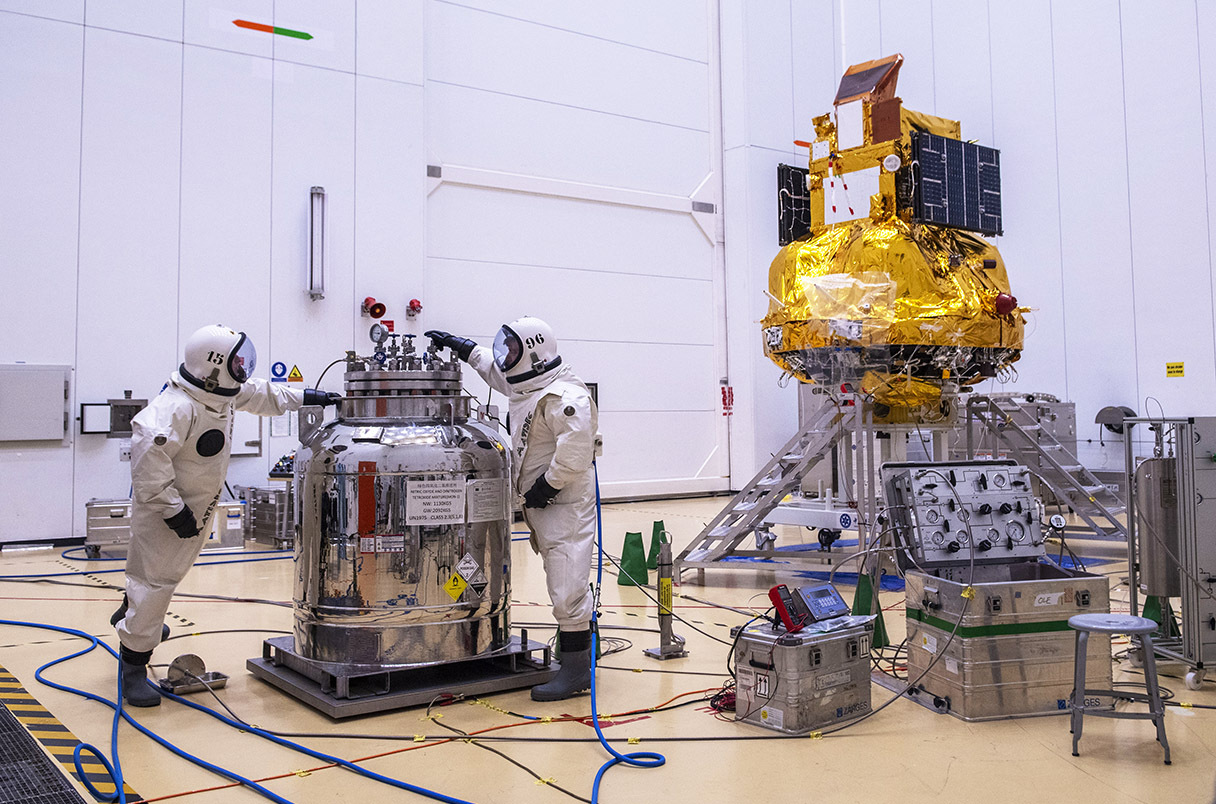
Technicians fuel the Solar wind Magnetosphere Ionosphere Link Explorer ahead of its launch. The spacecraft requires propellant to put it into a highly elliptical orbit.EUROPEAN SPACE AGENCY/CNES/AVIO/CSG VIDEO OPTICS – J. GEORGET
If all goes as planned, a new spacecraft will soon give researchers an expansive and unique view of how the solar wind batters and bends Earth’s invisible magnetic shield. The Solar wind Magnetosphere Ionosphere Link Explorer (SMILE), expected to launch on 19 May from Europe’s spaceport in French Guiana, will use a novel technique to map the magnetic field, which helps make the planet habitable by deflecting most of the charged particles that stream from the Sun. Surges in this solar wind can disrupt satellites, radio communications, and even power grids. SMILE, a joint European-Chinese mission, could improve researchers’ understanding of the underlying physics—and forecasts of solar storms.
“I believe that there will be significant findings,” says Simon Wing, a space physicist at Johns Hopkins University who is not participating in the mission.
Numerous spacecraft have probed the magnetosphere–but from within, limiting observations to each satellite’s location. “What we really want to be able to do is image as much of the magnetosphere as possible, so that we can see the global dynamics,” said Colin Forsyth, a plasma physicist at University College London who is the mission’s co–principal investigator for the European Space Agency (ESA), at a prelaunch briefing in March.
To gain that global view, SMILE will be launched into a highly elliptical orbit that puts the spacecraft as far as 121,000 kilometers above the North Pole. From that perch, SMILE’s core instrument, a soft x-ray imager, will monitor the entire Sun-facing edge of the magnetosphere. When charged particles in the solar wind capture electrons from neutral atoms in Earth’s upper atmosphere, the electrons emit x-rays as they settle into a lower energy state. Mapping this radiation in the narrow boundary where the solar wind meets the magnetosphere will allow SMILE to track how Earth’s magnetic shield responds in near real time. The observations should produce “a far better understanding of this interaction between the Sun and the Earth,” Forsyth says. Watching how the magnetosphere changes shape during coronal mass ejections—solar eruptions that spew plasma—could also improve predictions of how solar storms threaten electronic infrastructure, he says.

A second instrument on SMILE will investigate one of nature’s most awesome spectacles: aurorae. The solar wind is funneled toward Earth’s magnetic poles where the charged particles cause atmospheric gases to glow in a rainbow of colors. Most of the emitted radiation, however, is at invisible ultraviolet wavelengths, which SMILE’s ultraviolet imager will observe. Together, the two instruments should reveal how solar particles penetrate the magnetosphere and enter Earth’s atmosphere. “Imaging of the aurora is an important aspect of the SMILE mission which is sorely missing from international programs right now,” says Vassilis Angelopoulos, a space scientist at the University of California, Los Angeles.
The mission also highlights growing collaboration between Europe and China. SMILE is the first mission jointly conceived, developed, and operated by ESA and the Chinese Academy of Sciences (CAS). “SMILE is a 50-50 collaboration,” said Carole Mundell, director of science at ESA, at the prelaunch briefing. If the data are shared as expected, “the observations will be a boon to international collaboration in space,” Angelopoulos says.
Both sides are open to further cooperation, though there are no current plans, said Li Jing, SMILE project manager for CAS, at the briefing. “Maybe in the future, we can find some common interesting fields” to explore, he says.
Quelle: AAAS