
23.09.2026
NASA
Analysis of ancient meteorites has offered new insights into the origin of oxygen in the protoplanetary phase of the solar system.
The study, published in the Proceedings of the National Academy of Sciences, could help answer questions about the origin of life on Earth and aid in the search for life on other planets in our solar system and beyond.
Organic molecules without the organisms
“Oxygen is one of the most abundant elements in the solar system and a major component of many organic molecules,” Daniel Crocker, first author from Harvard University in the US, tells ConnectSci News.
“It plays an important role in determining how organic molecules form, change and interact with their environment. By studying the isotopes of oxygen, we can trace the chemical reactions that shaped these molecules billions of years ago.”
Organic molecules aren’t necessarily those that are produced by biological processes.
Chemists refer to any compound built primarily around chains or rings of carbon atoms, or a central carbon atom, as organic. Simple gases like carbon monoxide and carbon dioxide are usually excluded from this classification.
Organic molecules are essential to carbon-based life on Earth in the form of carbohydrates, lipids, proteins and nucleic acids.
But many organic compounds, particularly in their simple forms, can form abiotically – without the presence of living organisms.
In fact, scientists theorise that the abiotic mixing of these organic compounds under the right conditions led to the emergence of life on Earth and possibly other planets too.
The question is how those organic compounds formed in the first place.
Recent evidence has pointed to the presence of thousands of organic compounds on asteroids in space. Some of the meteorites that have crashed onto Earth have also been studied, revealing a host of organic chemistry.
Time capsules for the solar system
Our solar system formed about 5 billion years ago.
First came the Sun. Around it formed a protoplanetary disc of matter that began to clump together to form the planets. The planets formed about 4.5 billion years ago. But a lot has changed – particularly on Earth – since then.
Volcanic eruptions, meteorites, weather, not to mention biological and human activity have all changed the geology of the planet. In order to study what the solar system was like 4.5 billion years ago, meteorites and asteroids are the only places scientists can turn.
“Meteorites are fragments of ancient asteroids that preserve some of the oldest materials in the solar system,” Crocker explains. “When these fragments occasionally fall to Earth, they act like natural time capsules, allowing us to study the chemistry and processes that operated more than 4.5 billion years ago.”
“We studied carbonaceous chondrites, a rare class of meteorites that contain abundant organic matter and are thought to preserve some of the most primitive materials from the early solar system.
“These meteorites are fragments of asteroids that formed about 4.56 billion years ago and are thought to have originated in the cold, outer regions of the solar system. Those cold conditions favoured the preservation of abundant organic compounds, making carbonaceous chondrites some of the best natural records of the primitive organic matter that existed before the Earth formed.”
Oxygen parent
Crocker and colleagues examined some of these meteorites that may have also provided the chemical ingredients for the development of life on Earth.
“We analysed organic matter extracted from 13 carbonaceous chondrite meteorites curated by various museums and research collections. Our collaborator, Dr Conel Alexander at the Carnegie Institution for Science prepared the organic material, and we then measured its oxygen isotopes,” Crocker says.
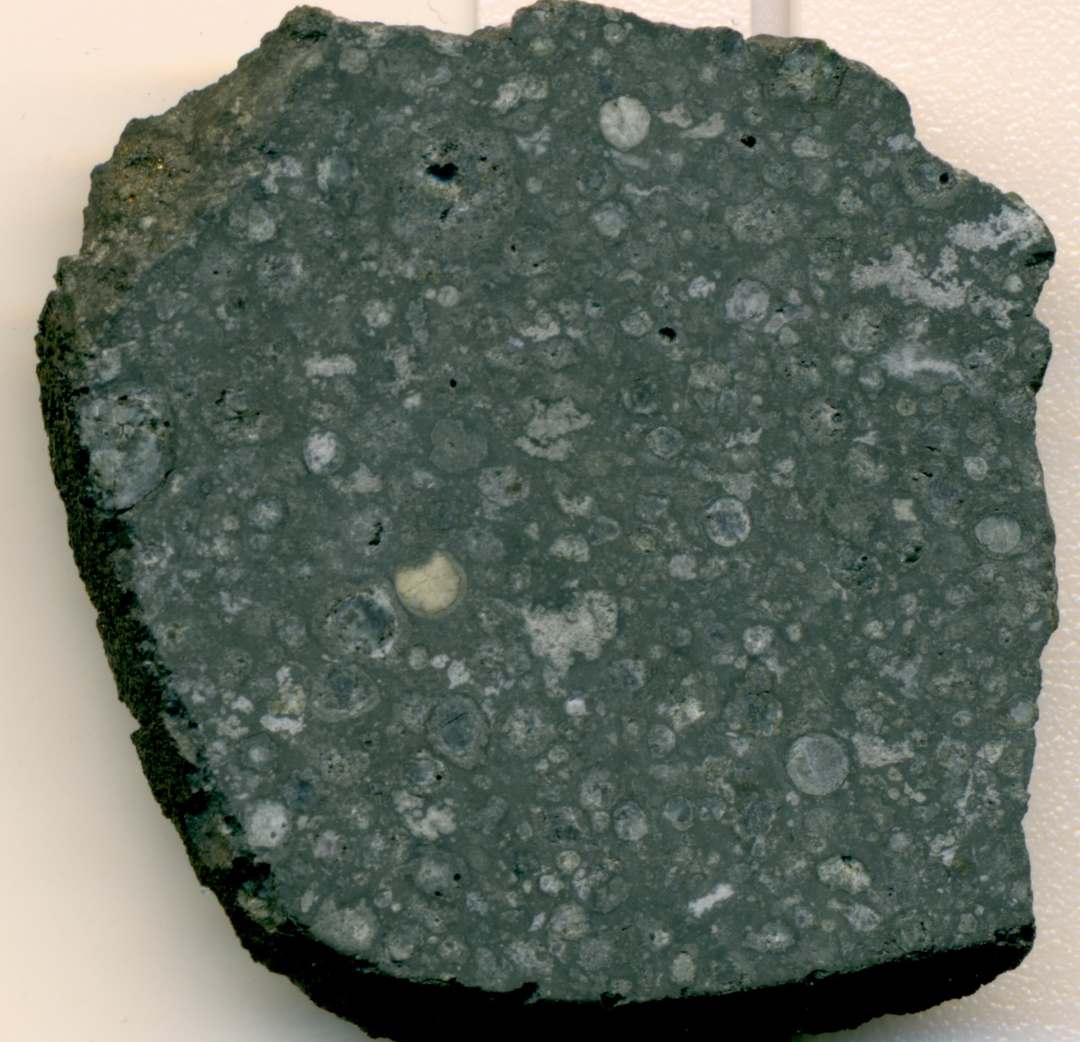
Interior slice of a carbonaceous chondrite meteorite containing organic matter from the early solar system. Credit: Michail I. Petaev (Harvard University, Cambridge, MA)
“We isolated the organic matter from each meteorite and measured the abundances of its 3 stable oxygen isotopes using a high-precision mass spectrometry technique developed in our laboratory. These measurements allowed us to detect subtle isotopic differences that record chemical processes occurring in the early solar system.
Crocker says the study helps builds a picture of how organic compounds were forming in the early solar system.
“Because these meteorites originate from a variety of parent body asteroids and experienced different histories, they allowed us to compare how organic matter formed and evolved across a range of early solar system environments.”
Their findings suggest that the original organic matter source likely formed in the outer reaches of the solar system before being well mixed throughout the protoplanetary disc and accreting into the chondrite meteorites.
“Previous studies of oxygen isotopes in meteoritic minerals have revealed that several distinct oxygen reservoirs existed in the earliest solar system,” Crocker adds. “Our measurements show that the organic matter in these meteorites also carries the isotopic signatures of those primitive oxygen reservoirs, suggesting that the organic molecules formed and evolved within the same or similar environment.
“This provides new clues as to when, where, and how this organic matter formed and became incorporated into asteroids.”
Life on… other planets?
“Our work does not directly address how life began, but meteorites likely delivered some of the organic molecules that contributed to the chemical inventory available on the early Earth,” says Crocker.
“By tracing how these molecules formed and evolved in the early solar system, we gain a clearer picture of the chemical starting point from which life eventually emerged.”
While the latest study doesn’t deal directly with the question of the emergence of life on Earth, it has implications for the spark of life on our planet and beyond.
“The isotope techniques we developed provide a new way to study the chemical history of extraterrestrial organic matter,” Crocker says.
“Understanding how primitive organic compounds were produced and distributed among asteroids and planets provides an important foundation for interpreting the organic inventories of other planetary systems, where similar processes may have occurred.
“In addition, as future missions return samples from asteroids, Mars, or other planetary bodies, these measurements could help distinguish between different chemical pathways that produce organic compounds and better assess their origins.”
Quelle: CONNECTSCI