
8.07.2026
We could see robots working on NASA's Habitable Worlds Observatory out in space.
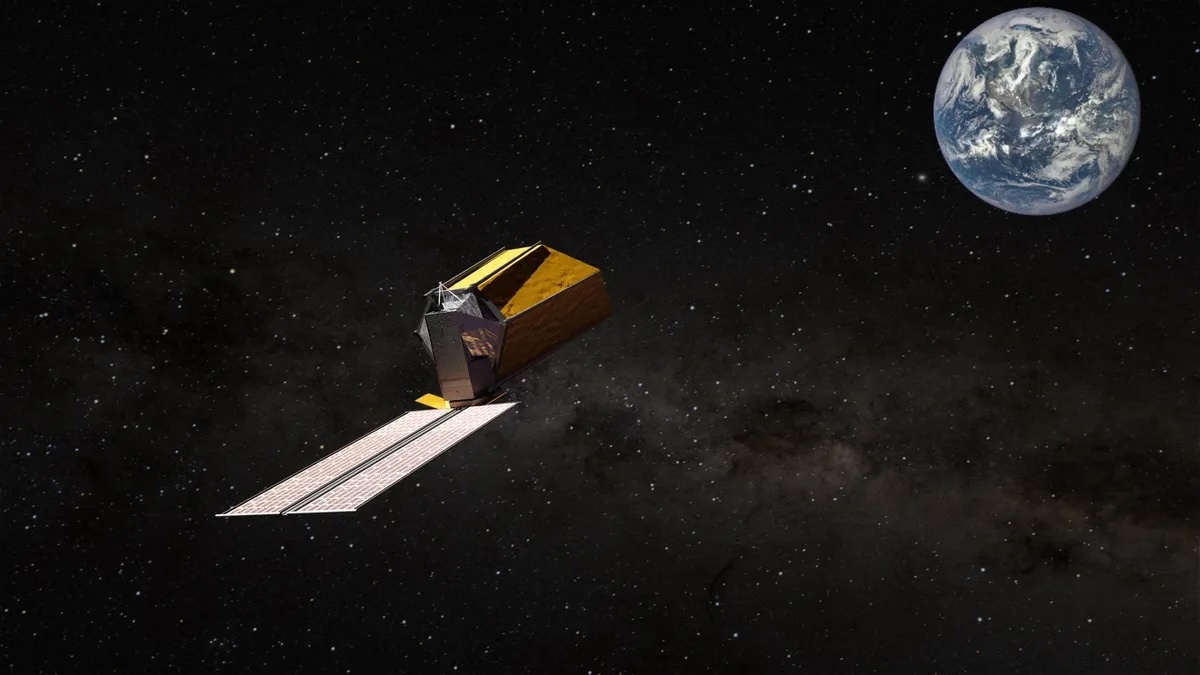
An artist's concept for the Habitable Worlds Observatory. (Image credit: NASA)
PASADENA, California — NASA's new alien-hunting telescope, the Habitable Worlds Observatory (HWO), will be serviceable out in space (and it will have gamma-ray detectors, to boot).
Do you remember seeing NASA's space shuttle astronauts working on the Hubble Space Telescope out in space? Well, it will likely be robots this time around, but NASA is planning for HWO to be serviceable, which means that they will need to figure out a way to work on, repair, and maintain the observatory while it operates roughly a million miles (1.5 million kilometers) away.
"HWO will have to be serviceable to some extent," NASA's astrophysics division director Shawn Domagal-Goldman told Space.com during a session at the American Astronomical Society's (AAS) 248th meeting in Pasadena, California.
From Hubble to HWO
The Habitable Worlds Observatory (HWO) is NASA's next planned flagship space telescope. But what separates it from previous space telescopes like Hubble or the James Webb Space Telescope (JWST) is its purpose: to look for and study rocky, Earth-like planets orbiting sun-like stars. In other words, to find planets that could hold life. The mission won't just hunt for aliens, but rather explore these habitable planets and their atmospheres, expanding our understanding of other worlds while also being used for a variety of astronomical purposes. And by making it serviceable, NASA will not just extend HWO's life, but it will also open the door for future technologies that can be used to enhance the observatory.
Hubble was a unique case. As the space telescope came about at roughly the same time as NASA's Space Shuttle program, and the telescope was designed to function in low-Earth orbit, it was a natural fit that astronauts go out to assemble, repair and maintain the observatory. "There were decisions made early on that the avionics would be modular in a way that astronauts could take the computer out and put a new computer in, or take a gyroscope out and put a new gyroscope in," former NASA astronaut and former NASA Chief Scientist John Grunsfeld, who today works independently as a consultant in the space industry, told Space.com.
However, HWO won't be so close to us. Instead, it will be located nearby L2, or the Sun-Earth Lagrange point 2, a point out in space roughly one million miles (1.5 million kilometers) away where the gravitational pull of the sun and Earth combine to keep objects in the same orbital period as Earth. This position, which is also home for the JWST, allows space telescopes to stay in sync with Earth, making communication easier. It also makes an astronaut mission quite difficult, if not nearly impossible with the technology we have today.
While the JWST was sent out to this distant vantage point without plans for servicing the telescope, HWO will "have to" be serviceable, according to Domagal-Goldman and further confirmed with NASA's press office. Servicing the observatory could look like anything from instrument swaps to regular maintenance or as-needed repairs, but it could also entail assembling the observatory itself. "If the telescope is too large to launch [fully assembled]," Domagal-Goldman added, it might need to be "assembled in space."
When the JWST went to L2, the mission team realized the problem with micrometeorites was a bit bigger than they anticipated. "We've learned that there's more micrometeorites and they're larger than we expected," said Grunsfeld, "and so you might be able to want to put a patch over a sunshield or a patch on a barrel to patch a hole — and, in principle, robotics could do that."
NASA has yet to confirm details about exactly how they plan to service the new observatory, which makes sense as the design of HWO itself is still in flux. But with L2 being so far away, it's logical to assume that it will need to be supported robotically, instead of with astronauts working out in space like with Hubble. We don't know what these future space telescope robot mechanics might look like, but they will have to be very capable to work on such a powerful observatory all the way out at L2.
"This will be by far the most challenging observatory that we've ever built," Grunsfeld said. "It's just remarkable that we are so bold as to think we can do it, and to be really close to showing that we can … so since we're just getting started, this is the time to have the discussion about should it be serviceable or not."
Quelle: SC