
16.12.2024
Northwestern joins Giant Magellan Telescope’s international consortium
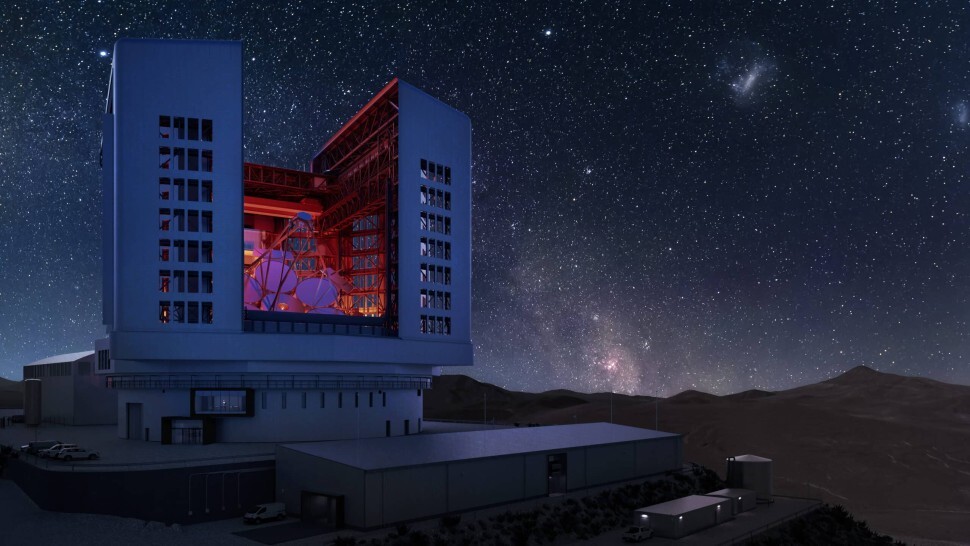
Northwestern University officially is a founding partner of the Giant Magellan Telescope (GMT), an enormous ground-based telescope currently under construction in Chile’s Atacama Desert.
Launching in the 2030s, GMT will be the world’s most powerful optical telescope. By producing images 10 times clearer than the Hubble Space Telescope, GMT will explore the distant universe, including the search for signs of life outside Earth’s solar system.
As a partner, Northwestern will contribute its expertise in astrophysics, artificial intelligence (AI) and engineering. Specifically, Northwestern researchers will develop and apply AI tools to enhance GMT’s abilities to search for Earth-like planets across the Milky Way, probe the universe’s most energetic explosions and explore the relationship between galaxies and black holes.
Northwestern already leads the world-renowned Center for Interdisciplinary Exploration and Research in Astrophysics (CIERA) and the newly established National Science Foundation (NSF)-Simons Foundation AI Institute for the Sky (SkAI, pronounced “sky”). The new GMT partnership will further expand opportunities for faculty and students across Northwestern.
“Northwestern's commitment to interdisciplinary research — particularly in astrophysics, AI, data science and engineering — positions us to lead the next wave of astronomical research,” Northwestern President Michael H. Schill said. “Our full partnership with the Giant Magellan Telescope Consortium is a testament to this vision. I am especially grateful for Vicky Kalogera’s leadership and efforts to secure this partnership. This collaboration will provide unparalleled opportunities for our students and faculty to push the boundaries of research and innovation as we seek to understand the universe.”
“I am thrilled Northwestern has reached a full partnership agreement with the Giant Magellan Telescope, which will be at the top of our field through the end of the century,” Kalogera said. “The telescope is poised to change our understanding of the universe and our place within it, offering tremendous opportunities to our students and faculty. We are excited to be a part of this historic effort.”
Kalogera is the Daniel I. Linzer Distinguished Professor of Physics and Astronomy at Northwestern’s Weinberg College of Arts and Sciences. She also is director of CIERA and the SkAI Institute.
Offering unprecedented power for astronomical discovery, GMT will deliver up to 200 times the resolution and sensitivity of today’s leading telescopes. Unique among the new class of “extremely large telescopes,” it will feature the widest field of view with adaptive optics to correct for blur caused by Earth’s atmosphere. GMT also will be the only scientific instrument capable of detecting and analyzing Earth-like planets in the reflected light of their host stars. This revolutionary capability moves the field beyond traditional transit detection methods to enable much more accurate observations — and bring hundreds of planets into view for the first time.
The international consortium comprises 15 distinguished institutions, including Harvard University, Carnegie Science, University of Chicago, Smithsonian Institution, University of Arizona, Arizona State University, University of Texas, Texas A&M University, the Weizman Institute for Science in Israel and Australian National University.
“Joining the Giant Magellan Telescope consortium is an incredible opportunity for Northwestern — one that will have a ripple effect across our entire campus,” said Eric Perreault, Northwestern’s vice president for research. “This partnership brings us to the forefront of groundbreaking astrophysics discoveries while tapping into our strengths as an interdisciplinary leader in areas like artificial intelligence, data science, astronomy and engineering. The collaboration will advance our understanding of the universe while producing significant economic benefits throughout our region.”
The State of Illinois already is experiencing those economic benefits. Construction recently began at the Ingersoll Machine Tools facility in Rockford for the telescope’s 12-story-tall precision mount. Constructing this mount, which is the largest telescope mount ever built, requires a large workforce of skilled engineers, designers and manufacturing professionals. Over the next six years, workers will assemble the mount using steel sourced from the United States. It then will be shipped to Chile and reassembled.
“Northwestern’s strengths in AI, astrophysics and engineering innovation make it an invaluable addition to our consortium, and we are delighted to welcome them,” said Walter Massey, GMT’s board chair and former director of NSF. “Their involvement further establishes the Giant Magellan Telescope as the telescope of choice for America’s top universities, now spanning across Arizona, Texas, Illinois, California, Massachusetts and Washington, D.C. This collaboration reflects a nationwide commitment to advancing astronomy and cementing U.S. leadership in manufacturing and scientific discovery.”
Quelle: Northwestern University
----
Update: 17.04.2026
.
This giant telescope could discover habitable exoplanets and secrets of our universe — if it gets its funding
"I believe the most remarkable discoveries that the GMT will make will be the ones that we haven't even imagined yet. There's no telling what we'll find."
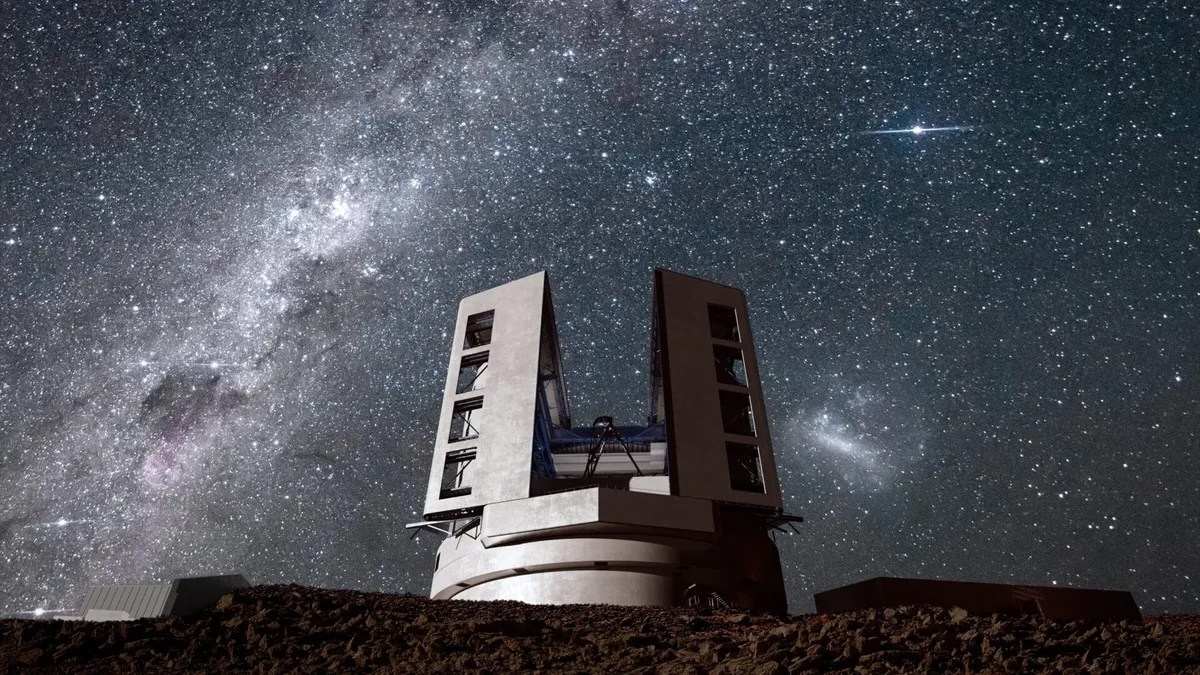
A rendering of what the Giant Magellan Telescope will look like when complete.(Image credit: Giant Magellan Telescope – GMTO Corporation)
The Giant Magellan Telescope project is gearing up for a crucial 12–24 months, with their final design phase underway as the team behind the project seek further funding to make the dream of the 25.4-meter (83 feet) multi-mirror telescope a reality.
The Giant Magellan Telescope (GMT) Consortium of 16 universities and research institutions held their first ever summit on April 14th. The summit acted as a way to update academics, the media and the public on how design and construction of the telescope is proceeding following the National Science Foundation (NSF) officially advancing the project to its final design phase in the summer of 2025.
"This is one of the final steps that the project must take before it can be considered for federal funding," Daniel Jaffe, who is the President of the GMT Consortium and a former head of astronomy at the University of Texas, Austin, said during the summit. "Over the past five years the telescope has passed every independent, federally required review. Now my immediate focus is in successfully completing the NSF's final design phase by mid-2027. Pending approval by the NSF and Congress, the Giant Magellan Telescope will enter the beginning of full-scale construction in the fiscal year 2028."
The GMT is one of three telescopes roughly in the thirty-meter (~98 feet) class that should come online in the 2030s. The Extremely Large Telescope (ELT) being built by the European Southern Observatory in Chile is already under full-scale construction and its 39-meter (128 feet) should be the first to enter service in 2029.
Complications
For the GMT and another huge next-gen telescope, called the Thirty Meter Telescope (TMT), the situation is more complex. Both are American telescopes being funded, at least in part, by the NSF. However, in 2024, the NSF had its giant-telescope budget capped at $1.6 billion, which is not enough to fully fund both observatories. This has sent both projects looking towards private and overseas donations.
Jaffe revealed that more than a billion dollars has so far been invested into the GMT project by its partners.
"These contributions, largely made possible by donors and supporters around the world, have enabled 40% of the telescope's components to be in active fabrication and assembly," said Jaffe.
On the Las Campanas mountain top, 7,870 feet (2,400 meters) above sea level in Chile's Atacama desert, which enjoys a darker, drier and more stable night sky than almost anywhere else in the world, the GMT's foundations have already been dug, and roads, utilities and support structures put in place. In Rockford, Illinois, engineers at Ingersoll Machine Tools are constructing the huge mount that will hold the seven 8.4-meter primary mirrors, the seven 1-meter secondary mirrors, and the science instruments. The mount, when finished, will stand 128 feet (39 meters) tall (coincidentally the size of the ELT's entire mirror) and weigh 2,600 tons. It's so large that the company had to construct a special 40,000 square foot (3,700 square meter) manufacturing and assembly bay just to house it.
The mirrors, meanwhile, form a unique optical design. Both the ELT and TMT are going with one huge mirror formed out of many segments joined together, but as mentioned in the preceding paragraph the GMT's primary reflecting surface is made up of seven individual large mirrors, each a little larger in size than the mirror on the Subaru Telescope in Hawaii, for example. In fact, they are the largest single telescope mirrors ever made. By contrast, the primary mirrors on the W.M. Keck 10-meter telescopes are made of segments rather than one solid single mirror.
This design, said GMT's Chief Scientist Rebecca Bernstein, has several advantages, not least how it helps the telescope's adaptive optics.
Adaptive optics describes how telescope mirrors can make minute changes in their shape to counteract the twinkling of stars by the atmosphere.
The GMT is essentially a huge version of the reflector telescope that you might use in your backyard. In the case of amateur telescopes, the light bounces off the primary mirror and is reflected by a smaller secondary mirror to a focal point at the eyepiece. In the case of the GMT, the seven primary mirrors are mirrored, pardon the pun, by seven smaller secondary mirrors that are deformable.
"They are a game changer," said Bernstein. "The secondary mirrors are complex structures, 2mm thick and 1 meter in diameter. Attached to the back of each mirror are about 700 tiny magnets that are pushed and pulled by electromagnetic coils to enable the mirrors to change their shape thousands of times per second to remove the atmospheric jitter."
Those seven primary mirrors, operating in unison alongside the secondary mirrors and adaptive optics, will bring new eyes onto the universe. Exoplanets in the habitable zone of distant stars are a key target. A coronagraph will block the light of a star, isolating the light of any planets around that star, allowing spectroscopic measurements of that planet's light by an instrument called the GMT-Consortium Large Earth finder (G-CLEF) with which to search for biosignatures in the planet's atmosphere.
At the other end of the scale, entire galaxies in the distant universe will come under scrutiny.
"We know that galaxies, and the stars and planets within them, form from vast clouds of gas drawn together by gravity," said Gwen Rudie, who is an astronomer at the Carnegie Institution of Science in California. As massive starsgo supernova they drive that gas back out again, leading to a cycle of gas falling in, forming stars and then being blown away again.
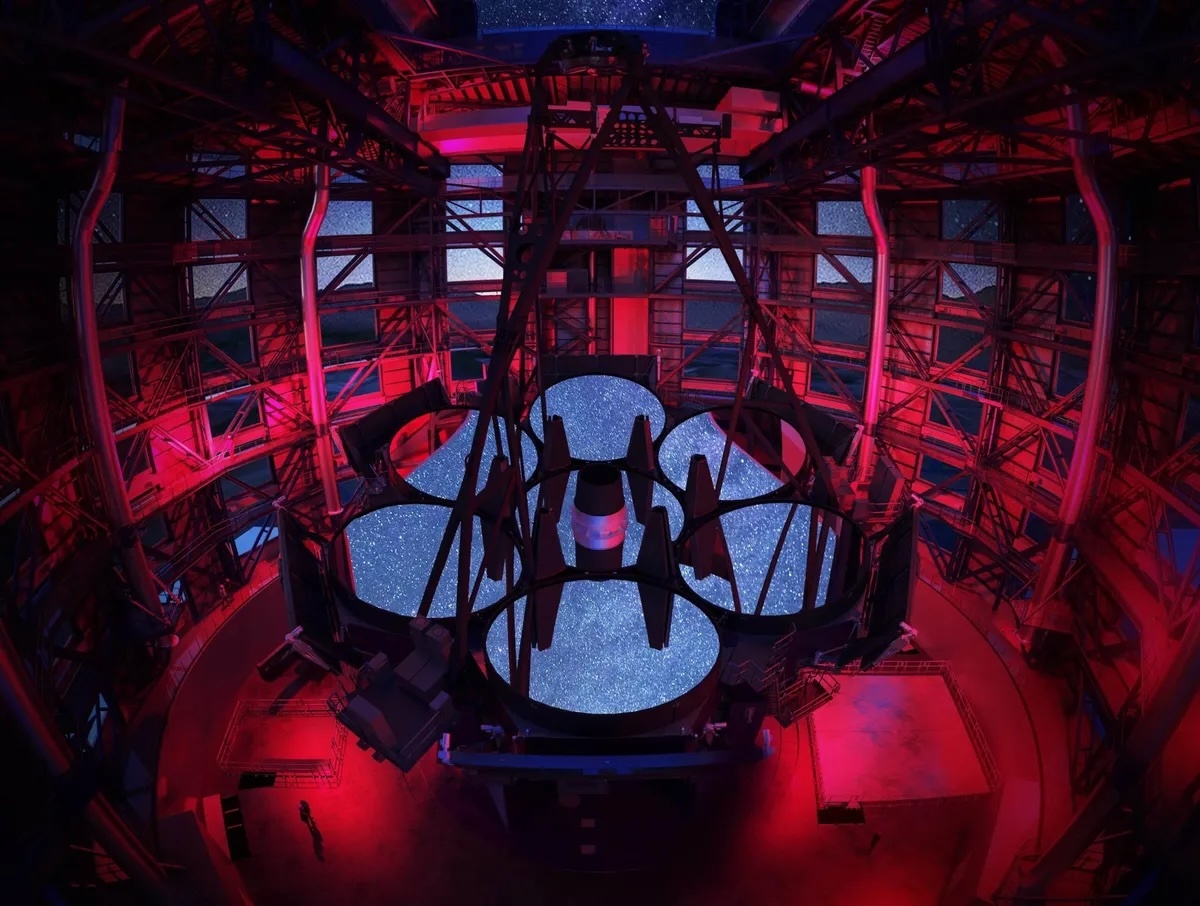
An artist's rendering of the seven primary mirrors reflecting the light of the stars. (Image credit: Giant Magellan Telescope – GMTO Consortium)
"This cycle is not yet understood because the gas has been too challenging to see," said Rudie. "The GMT will let us study galaxies at tremendous distances, which means peering back in time 10 or 11 billion years ago when galaxies were forming stars the fastest. It will revolutionize our understanding by creating the first maps of gas surrounding individual galaxies. We'll be able to peer into the hearts of these young galaxies to connect the sites of star-birth and star-death directly to these gas flows."
However, as excited as Rudie is about the potential for these observations, she is even more excited about the unexpected things that the GMT might find.
"I believe the most remarkable discoveries that the GMT will make will be the ones that we haven't even imagined yet," said Rudie. "There's no telling what we'll find."
However, all this potential will be lost if design and construction on the GMT isn't completed. Even with federal funding hopefully granted by the U.S. Congress, it won't be enough, and Jaffe says that the project is looking to enlarge the current 16-strong consortium and encourage even further private investment to fund the estimated total of over $2 billion to build and operate the telescope.
"This will bring in more resources and added brain-power to drive discovery, leading to science observations in the 2030s," said Jaffe.
With luck, all three giant telescopes will be fully funded, constructed and in operation by the mid-2030s. Between them, and working with other established observatories such as Rubin and the James Webb Space Telescope, they promise to transform our understanding of stars, galaxies and the potential for life beyond Earth.
Quelle: SC
----
Update: 19.04.2026
.
Giant Magellan Telescope and Coquimbo Regional Government Sign Strategic Partnership to Strengthen Astronomy in Chile
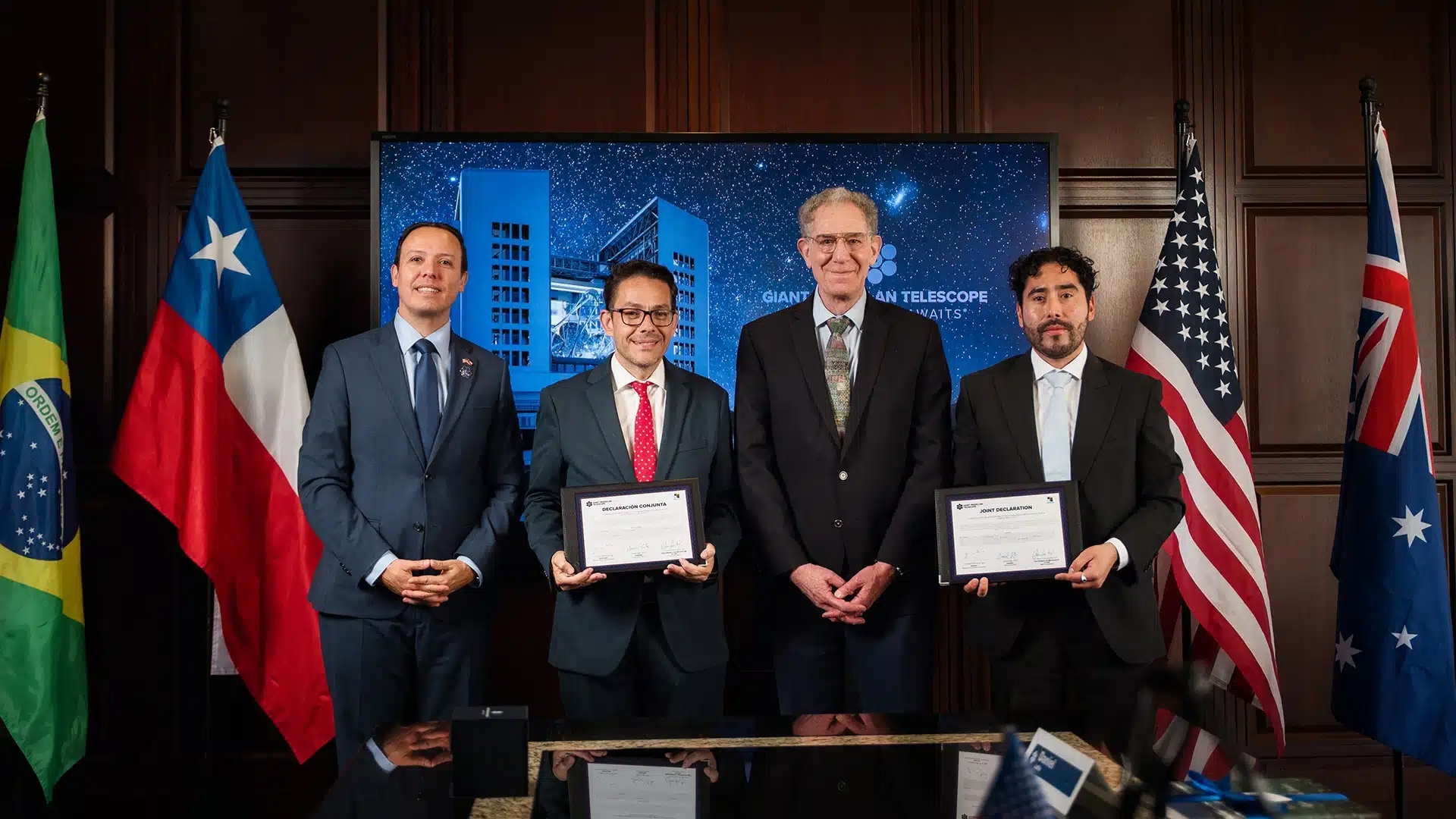
New partnership advances regional economic growth through astronomy and positions Coquimbo region as Chile’s global hub for science, technology, and innovation
PASADENA, CA – April 17, 2026 – Today, the Giant Magellan Telescope and the Coquimbo Regional Government announced a strategic collaboration to advance Chile’s astronomy industry, drive regional economic growth, and position the Coquimbo region as a global hub for science, technology, and innovation. At the heart of this partnership is Chile’s first national visitor and education center for astronomy, designed in partnership with Exploratorium to bring the excitement of discovery, technological innovation, and astrotourism directly to the public.
“This partnership positions the Coquimbo Region at the forefront of an industry that is shaping the future of science, technology, and opportunity,” said Governor Cristóbal Juliá. “By working with the Giant Magellan Telescope, we are creating high-quality jobs, advancing innovation, and establishing our region as a leader in one of the most important industries in the world, all while connecting Chileans with the incredible discoveries happening from our skies.”
To support public engagement and communicate the progress of the partnership, the Giant Magellan Telescope and the Coquimbo Regional Government have launched a dedicated website at coquimbo.giantmagellan.org. The site will serve as a central platform to share updates, highlight regional impact, and showcase the significance of the collaboration.
The agreement was formalized during the Governor’s official visit to the Giant Magellan Telescope’s headquarters in Pasadena, where he met with the observatory’s international leadership, including President Daniel Jaffe, and with the attendance of the Chilean Consul in Los Angeles, Mr. Francisco Leal. The signing reflects a growing alignment between regional leadership and one of the most significant international scientific infrastructure projects underway today.
Chile is home to the majority of the world’s astronomical infrastructure and, by the 2030s, will host nearly 70 percent of it. The Coquimbo Region plays a central role in that leadership, hosting major observatories and operational centers, including the Vera C. Rubin Observatory, the world’s newest and most advanced survey telescope. The region’s growing infrastructure, observatory operators, and scientific workforce will also be celebrated through the proposed national visitor and education center, providing public access to Chile’s astronomy industry, technological innovations, and scientific discoveries.
“The Giant Magellan Telescope represents a multi-billion-dollar international investment in Chile, and this partnership ensures that its benefits extend well beyond the observatory site,” said Daniel Jaffe, President of the Giant Magellan Telescope. “Together, we are establishing a long-term foundation that supports scientific leadership, economic growth, expanded opportunity across the region, and a public-facing hub that will connect people directly with Chile’s world-class astronomy industry.”
Located at Las Campanas Observatory, the Giant Magellan Telescope is part of a new generation of “extremely large telescopes” that support a world-class scientific, engineering, and industrial ecosystem. Over nearly a century of operations, the observatory will anchor sustained demand for expertise in engineering, construction, data systems, and scientific research.
As part of this partnership, the Giant Magellan Telescope will establish its primary operations base in the Coquimbo Region, creating a central hub for telescope operations, data systems, and scientific activity. Within this campus is a flagship visitor and education center, a first-of-its-kind national landmark in Chile, developed in collaboration with the Exploratorium, a global leader in interactive science education. Envisioned as a world-class destination, the center will showcase technological innovation, and scientific discoveries, support workforce development, and promote astrotourism, making Chile’s leadership in the industry visible and inspiring to all.
“Together we’re creating a place where people can gather and directly experience the power of science and engineering,” said Anne Richardson, Chief Experience Officer at the Exploratorium. “Drawing on decades of experience creating spaces that spark curiosity and learning, we’re proud to partner on this effort. This center will connect communities to Chile´s astronomy research, inspire future generations and make discovery tangible and accessible to all.”
For regional commerce, the partnership will also establish the Port of Coquimbo as the main logistics hub for the project, supporting the transport of major telescope components and infrastructure from international partners as the observatory is constructed over the next few years. This coordinated approach strengthens regional supply chains and positions the Coquimbo region as a critical entry point for global scientific infrastructure.
“This is about connecting the development of the telescope with regional growth,” said Oscar Contreras, Vice President and Chile Representative for the Giant Magellan Telescope. “Through this partnership, we are strengthening local capabilities, expanding opportunities for Chilean talent, and ensuring that the benefits of this global scientific investment are realized within the communities closest to it.”
A central pillar of the partnership is the protection of Chile’s astronomical observing conditions as a strategic national resource, one that is becoming increasingly rare worldwide. Ensuring long-term astronomical site protection is essential for maintaining Chile’s leadership in a global industry that depends on stable, high-quality skies.
This strategic partnership establishes the Coquimbo Region as a global hub for astronomy, linking the operations center, the first-of-its-kind national landmark visitor center, and the protection of Chile’s world-class observing sites, while engaging the public in Chile’s astronomy industry. Together, these efforts will expand Chile’s leadership in the astronomy for generations to come.
Quelle: Giant Magellan Telescope
----
Update: 9.07.2026
.
Korea Astronomy and Space Science Institute Increases Investment in Giant Magellan Telescope

Multi-million-dollar investment advances scientific instrument development and supports critical milestone toward completion of one of the world’s most powerful telescopes
PASADENA, CA – July 7, 2026 – The Korea Astronomy and Space Science Institute (KASI) has reaffirmed its long-term commitment to the Giant Magellan Telescope through a new investment that brings its total contribution to nearly $110 million (USD), strengthening the Republic of Korea’s leadership as the project’s third-largest partner.
“The Giant Magellan Telescope is one of the world’s most ambitious research facilities and represents the very best of international scientific collaboration,” said Jang-Hyun Park, president of KASI. “Our participation in the observatory is a cornerstone of South Korea’s long-term astronomy and space science strategy, and our new investment will advance the development of the world’s most advanced scientific instruments to ensure our scientists continue to play a leading role in ground-based and space-based astronomy for generations to come.”
The multi-million-dollar investment will help keep the observatory on the critical path through the U.S. National Science Foundation’s (NSF) Major Facilities Final Design Phase, which began in June 2025 and is scheduled to conclude in 2027. The Republic of Korea and the international consortium building the telescope elected to privately fund the phase, which is traditionally supported by the NSF.
“KASI has played a leading role in advancing the Giant Magellan Telescope since joining the project in 2009,” said Taft Armandroff, board chair of the Giant Magellan Telescope. “Today, the institution is the project’s third-largest partner and continues to shape the observatory’s future. KASI’s additional investment comes at a critical time in the project’s history, enabling our international consortium to privately fund a significant portion of the cost required to complete the NSF Major Facilities Final Design Phase. Their long-term commitment reflects a shared vision to push the boundaries of discovery and ensure scientists around the world have access to one of the most powerful telescopes in history.”
KASI is a contributing partner in the development of several of the Giant Magellan Telescope’s scientific instruments, helping position the observatory to answer some of the most profound questions in modern astronomy, including whether life exists beyond Earth and how the first stars and galaxies formed. The institution’s investment will advance the design and development of the following instruments:
- G-CLEF (GMT-Consortium Large Earth Finder), a high-resolution spectrograph designed to detect and characterize Earth-like planets orbiting nearby stars.
- GMTNIRS (GMT Near-Infrared Spectrograph), a near- to mid-infrared echelle spectrograph designed to study the earliest galaxies in the Universe and the formation of planetary systems.
The Giant Magellan Telescope is under development in Chile’s Atacama Desert, one of the best locations on Earth for ground-based astronomy. The region’s high altitude, extreme dryness, atmospheric stability, and dark skies create observing conditions that cannot be replicated by technology alone. From this Southern Hemisphere location, astronomers gain access to some of the Universe’s most important targets, including the center of the Milky Way, the nearest star to our Sun, and many of the closest galaxies and potentially habitable exoplanets.
Chile’s leadership in astronomy is built not only on geography but also on decades of investment in scientific institutions, international collaboration, and a world-class research community. Together, these advantages have made Chile home to many of the world’s most advanced observatories, including the recently commissioned Vera C. Rubin Observatory, of which KASI is an international partner.
“The skies above Chile are considered one of the best in the world for astronomical research and through international collaboration Chile has promoted the installation of important and visionary projects among them the Giant Magellan Telescope,” said Mathias Francke Schnarbach, Ambassador of Chile to the Republic of Korea. “It is expected that, over the next decade, Chile will account for approximately 75% of the world’s astronomical observation capacity. The growing participation of Korea, through the Korea Astronomy and Space Science Institute, in some of those major international projects in Chile, including the Giant Magellan Telescope and Vera C. Rubin Observatory, will contribute to strengthening and advancing the development of astronomical sciences in both countries.”
For KASI, participation in the Giant Magellan Telescope is part of South Korea’s long-term strategy to gain access to the next generation of research facilities known as “extremely large telescopes,” or ELTs. These ground-based observatories will have five times the light-collecting area and up to 200 times the power of today’s leading telescopes, enabling astronomers to push the boundaries of discovery and maximize the scientific return of future space-based missions. At the same time, KASI’s contributions to the Giant Magellan Telescope’s advanced instrumentation program are cultivating the technical expertise, engineering capabilities, and scientific workforce needed to support South Korea’s next generation of astronomy and space initiatives led by the Korea AeroSpace Administration (KASA).
KASI’s renewed investment reflects the growing international momentum behind the Giant Magellan Telescope and underscores the critical role global partnerships play in advancing humanity’s understanding of the Universe.
Quelle: Giant Magellan Telescope