
15.04.2026
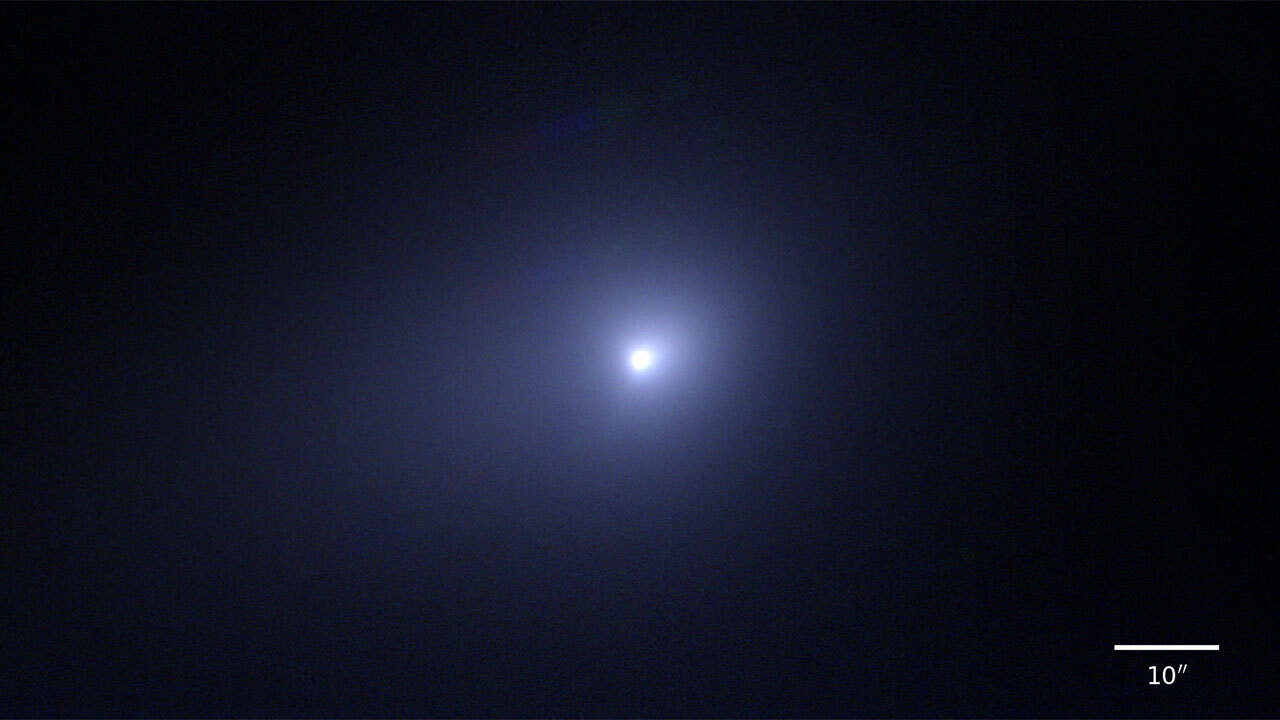
Interstellar comet 3I/ATLAS (C/2025 N1) captured by the Subaru Telescope on December 13, 2025 (Hawaii-Aleutian Standard Time). This image was created by combining three different wavelengths: V-band (550 nanometers, depicted in blue), R-band (660 nanometers, depicted in green), and I-band (805 nanometers, depicted in red). (Credit: NAOJ)
The Subaru Telescope observed the interstellar comet 3I/ATLAS on January 7, 2026 (UT), after it made its closest approach to the Sun. By observing colors in the coma around the comet, astronomers could estimate the ratio of carbon dioxide to water. This ratio is much lower than that inferred from earlier observations by space telescopes. These findings suggest that the chemistry of the coma is evolving over time and offers clues to the structure of comet 3I/ATLAS.
Comet 3I/ATLAS (C/2025 N1) has garnered much attention as a comet which originated outside of the Solar System. A research group led by Yoshiharu Shinnaka of the Koyama Space Science Institute, Kyoto Sangyo University, used the Subaru Telescope to observe comet 3I/ATLAS after perihelion, the comet’s closest approach to the Sun. The team applied analytical methods and expertise accumulated through investigations of Solar System comets to the data.
From this analysis, the team was able to estimate the ratio of carbon dioxide (CO2) to water (H2O) in the coma, the cloud of gas around the nucleus of the comet. Because the gas in the coma comes from the nucleus, the coma composition provides hints to the composition of the nucleus. Thanks to its notoriety, 3I/ATLAS had already been observed by space telescopes prior to perihelion. The CO2/H2O ratio calculated from the Subaru Telescope data was lower than the ratio suggested by the space telescope data. This change is consistent with the idea that the composition of the nucleus interior differs from that of the exterior, and as 3I/ATLAS heated up during its pass by the Sun, gas started to escape from different parts of the nucleus.
Shinnaka comments, “With the full-scale operation of survey telescopes in the coming years, many more interstellar objects are expected to be discovered. By applying the observational and analytical techniques we have developed through studies of Solar System comets to interstellar objects, we can now directly compare comets hailing from both inside and outside the Solar System and explore differences in their composition and evolution. Through studies of such objects, we hope to gain a deeper understanding of how planetesimals and planets formed in a wide variety of stellar systems, including our own Solar System.”
Quelle: National Astronomical Observatory of Japan
+++
Der interstellare Komet 3I/ATLAS (C/2025 N1), aufgenommen vom Subaru-Teleskop am 13. Dezember 2025 (Hawaii-Aleuten-Standardzeit). Dieses Bild entstand durch die Kombination dreier verschiedener Wellenlängen: V-Band (550 Nanometer, blau dargestellt), R-Band (660 Nanometer, grün dargestellt) und I-Band (805 Nanometer, rot dargestellt). (Bildnachweis: NAOJ)
Das Subaru-Teleskop beobachtete den interstellaren Kometen 3I/ATLAS am 7. Januar 2026 (UT), nachdem er der Sonne am nächsten gekommen war. Durch die Beobachtung der Farben in der Koma um den Kometen konnten Astronomen das Verhältnis von Kohlendioxid zu Wasser abschätzen. Dieses Verhältnis ist deutlich niedriger als das, das aus früheren Beobachtungen mit Weltraumteleskopen abgeleitet wurde. Diese Ergebnisse deuten darauf hin, dass sich die chemische Zusammensetzung der Koma im Laufe der Zeit verändert und liefern Hinweise auf die Struktur des Kometen 3I/ATLAS.
Der Komet 3I/ATLAS (C/2025 N1) hat als Komet außerhalb des Sonnensystems viel Aufmerksamkeit erregt. Eine Forschungsgruppe unter der Leitung von Yoshiharu Shinnaka vom Koyama Space Science Institute der Kyoto Sangyo University nutzte das Subaru-Teleskop, um den Kometen 3I/ATLAS nach seinem Perihel, dem sonnennächsten Punkt seiner Umlaufbahn, zu beobachten. Das Team wandte analytische Methoden und Expertise aus der Erforschung von Kometen im Sonnensystem auf die Daten an.
Mithilfe dieser Analyse konnte das Team das Verhältnis von Kohlendioxid (CO₂) zu Wasser (H₂O) in der Koma, der Gaswolke um den Kometenkern, bestimmen. Da das Gas in der Koma vom Kern stammt, gibt die Zusammensetzung der Koma Aufschluss über die Zusammensetzung des Kerns. Aufgrund seiner Bekanntheit war 3I/ATLAS bereits vor dem Perihel von Weltraumteleskopen beobachtet worden. Das aus den Daten des Subaru-Teleskops berechnete CO₂/H₂O-Verhältnis war niedriger als das aus den Daten des Weltraumteleskops abgeleitete. Diese Abweichung stützt die Annahme, dass sich die Zusammensetzung des Kerninneren von der des äußeren Kerns unterscheidet und dass sich 3I/ATLAS während seines Vorbeiflugs an der Sonne stark erhitzte, wodurch Gas aus verschiedenen Bereichen des Kerns entwich.
Shinnaka erklärt: „Mit dem vollständigen Betrieb von Durchmusterungsteleskopen in den kommenden Jahren werden voraussichtlich viele weitere interstellare Objekte entdeckt. Durch die Anwendung der Beobachtungs- und Analysemethoden, die wir im Rahmen der Erforschung von Kometen im Sonnensystem entwickelt haben, auf interstellare Objekte können wir nun Kometen innerhalb und außerhalb des Sonnensystems direkt vergleichen und Unterschiede in ihrer Zusammensetzung und Entwicklung untersuchen. Wir hoffen, durch die Erforschung solcher Objekte ein tieferes Verständnis dafür zu gewinnen, wie Planetesimale und Planeten in einer Vielzahl von Sternsystemen, einschließlich unseres eigenen Sonnensystems, entstanden sind.“
Quelle: National Astronomical Observatory of Japan