
3.06.2026
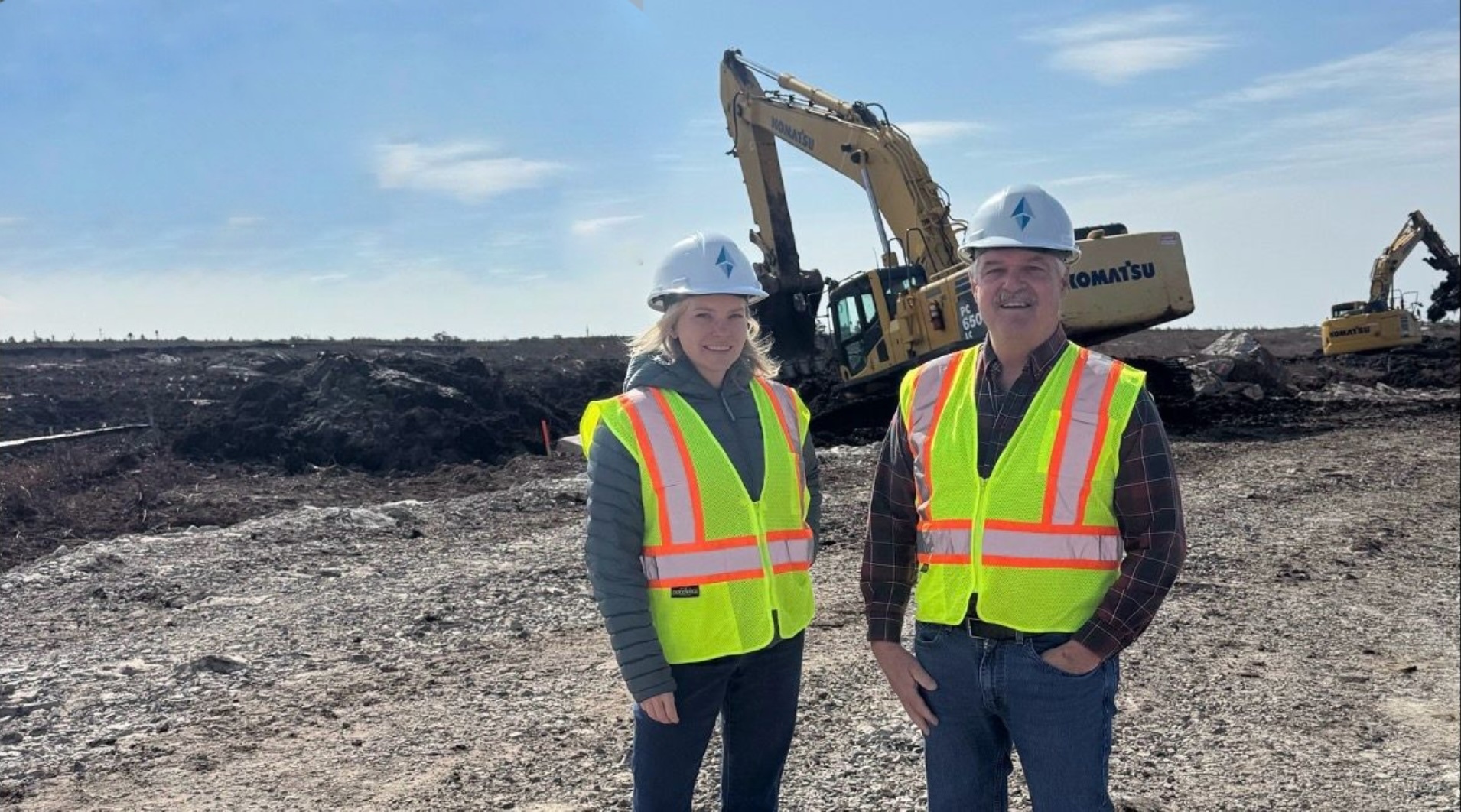
Melissa Quinn and Steve Matier at Spaceport Nova Scotia as construction on basic infrastructure continues. Credit:Maritime Launch Services
Maritime Launch Services (MLS) and Spaceport Nova Scotia have had a good week, and a better month. Just a few days ago, MLS announced a new deal with Isar Aerospace, as well as announcing that it paid back the $5.03 million that it had owed on its EDC facility and had nearly $1 million in Q1 revenue. The vast majority of that revenue is driven by a $200 million agreement in which MLS is subleasing a portion of the Spaceport Nova Scotia site to the Department of National Defence (DND) for a dedicated launch pad.
But that does raise a question: how is that process of building the spaceport going, exactly? What kind of progress is being made, and what is MLS building right now?
SpaceQ reached out to MLS’s CEO Stephen Matier for an update, and he provided some information about where MLS is at right now and where it’s going.
Matier started by talking about the civil construction being done by their civil contractor, Nova Construction, which he said “officially restarted” back in March, and which was able to “preposition their heavy equipment at the site before the spring road weight restrictions started.”

The civil work will be split into two phases, Matier said, “the first of which will be completed next week.” The first phase was focused on road construction, expanding the road network “to a key central location,” and expanding to the area where their customers’ buildings for launch vehicle integration and satellite processing will be constructed. The next phase of civil work will happen later, after the development of that central location.
Building the utility hub
The next step is building the Utility Hub, Matier said, which is “the heart of the facility.” This hub is where “all offsite utilities will be brought down to before being split to the four launch pads.” Nova Scotia Power will be bringing in electricity, and Bell Canada will be bringing in high-speed fibre Internet service, both from the nearby town of Canso.
The Hub will include “housing for the backup power, basic water services and other utilities,” Matier said. Adjacent to the hub, “in the near future,” will be the common gases like helium and nitrogen, which will be “centrally stored and provided to… respective launch pads.”
Matier said that the design has just been completed, and is being prepared for tender next week by their construction managers, Lindsay Construction. They’re looking for subtrades in everything from wells and foundations, to roofing, painting, plumbing, HVAC, and everything else one might expect.
They’ll be holding industry awareness sessions in the coming weeks to “educate and encourage Nova Scotian and other Atlantic Canadian companies about the work.” Matier also said that companies can reach out to Lindsay Construction about the project.
They expect to start construction on the Hub in the summer and to have power to it by late fall.
The entrance and the pads
Aside from the Hub, they’re also looking to start taking bids for the site entrance facility. The building will be “where the first site entrance control point is into the spaceport,” located between the town of Canso and the Sable Wind Farm, and will provide access control for both the wind farm and the outside perimeter of the launch site. “The design package is nearing completion,” Matier said, “and is expected to be tendered in late June.”
After that, MLS will be looking into the first launch vehicle integration facility for customers. “This package is also in the design phase,” Matier said, “and we expect to share renderings in the near future.” The design package is expected to be completed in July, with construction tendering starting “before the end of August,” with “design input coming through our ongoing launch client collaborations.”
August is also when the next phase of civil work is scheduled to begin. MLS is planning to “extend the road network down to the four launch pads,” Matier said, adding that they already have preliminary designs and are “working through the drawings to finalize them by midsummer.” Once they’re finalized, they’ll be bringing Nova Construction back in to “work to complete [the job] by the end of September,” with priority given to getting first launch clients access to their pads.

“Our launch clients are separately working on their pad layout designs,” Matier said, developing “finishes needed for their specific rockets.” One of these tenants will be Isar, which will help finish its own pad, as well as provide feedback for integration facilities and for the Launch Control Center (LCC).
Speaking of the LCC, Matier said that redesigning and resiting of the Launch Control Center is “further down the road,” but is still “something we are excited about.” They’re thinking about “how the LCC will represent Canada’s sovereign launch facility.”
Further development of the site for medium-lift launchers is also still planned for sometime in the future, but Matier couldn’t give any details. As to the DND contract, Matier said that it “does not change our construction plans and milestones,” and the DND pad is the same one that was used in the recent T-Minus Engineering suborbital launch from the spaceport. That pad, Matier said, is already “fully active currently to the DND requirements.”
Quelle: spaceQ