2.06.2026
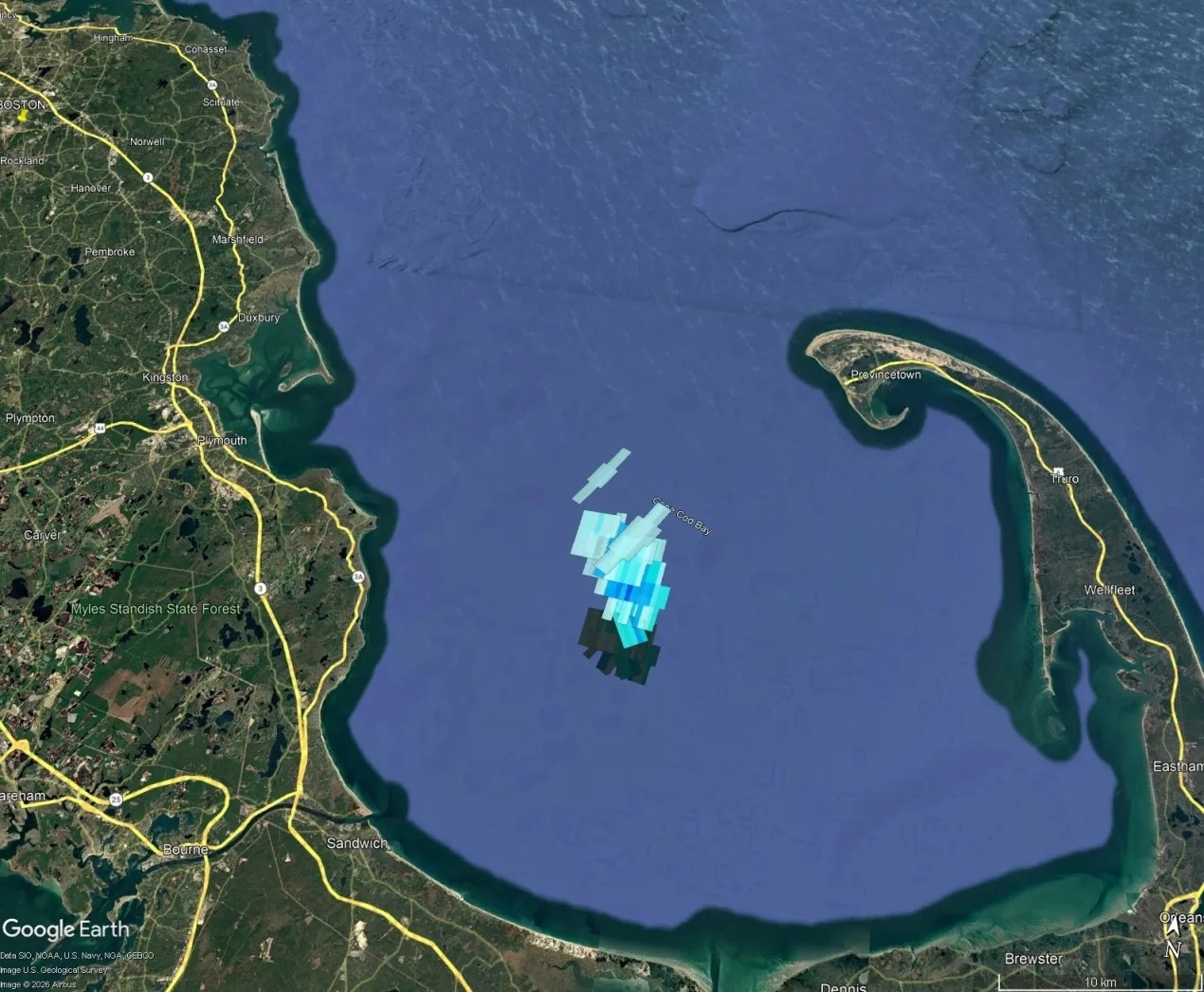
A NASA examination of radar imagery indicates meteorites from Saturday’s event crashed into Cape Cod Bay in the area depicted in this composite map. (Graphic courtesy NASA)
After a sonic boom from a meteor shook houses across the Northeast early Saturday afternoon, NASA said Sunday the meteorite landed in Cape Cod Bay.
“This was a daytime bolide that produced a meteorite fall right in the middle of Cape Cod Bay,” NASA said in a statement Sunday. “This fall into water is technically called a ‘fishy squisher’ in uber-serious scientific terms.”
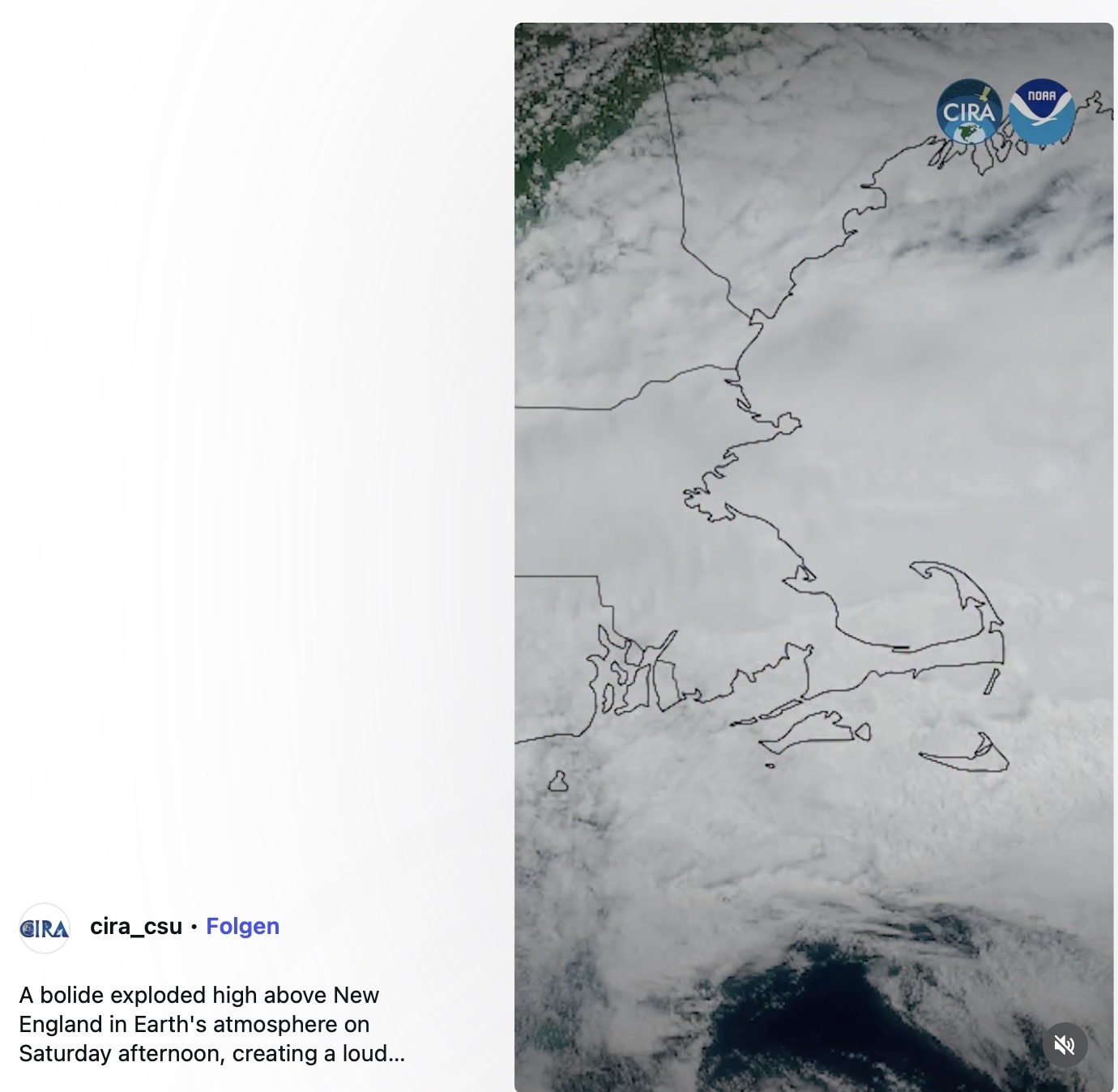
Around 2:06 p.m. Saturday, NASA confirmed a meteor “appears to have fragmented at an altitude of 40 miles over northeast MA and southeast NH.” The event caused a sonic boom and visible fireball in the sky across the a large swath of the Northeast United States and into Canada.
According to reports from American Meteor Society, multiple sources around greater Boston report hearing “a loud boom which shook my house” and “the floor under my feet vibrated.” The AMS collected 81 reports of a fireball seen around 2:06 p.m. on Saturday from across New England, as well as up to Ontario, Canada and down to New Jersey as of Sunday.
One viewer in Newton report “a loud rumbling outside that shook that house and reminded me of when snow falls off the roof,” noting she first thought a tree may have fallen outside.
The American Meteor Society said the meteor in question was about 3 feet wide and entered the atmosphere around the New Hampshire border with Massachusetts.
NASA stated on social media the energy released at breakup of the meteor “is estimated to be equivalent to about 300 tons of TNT,” accounting for the loud noise. Sonic booms aren’t typically felt on land, according the to the U.S. Geological Survey, making Saturday’s event a rare one.
The signatures of falling meteorites were “clearly indicated” by four radars, two in Boston and two in New York state, as well as a small signatures from Portland, Maine that might be related, NASA stated Sunday.
“While all the meteorites from this fall landed in water, the water depth at the fall site is 34m (100′),” NASA said. “Most meteorites are strongly attracted to a magnet, and these ones are within reach of a 100′ length of rope dangled off of a boat. In case anyone is interested in such factoids.”
Meteorites can be valuable for collectors as well as scientists, with pricing varying from $1 to $10 per gram for a common iron meteorite to upwards of $50 per gram for unique or rare specimens, according to the site Meteorites for Sale.
Quelle: Boston Herald
+++
NASA confirms exploding meteor caused the sonic boom over Boston
The boom could be heard across several states and shook houses