
11.04.2026
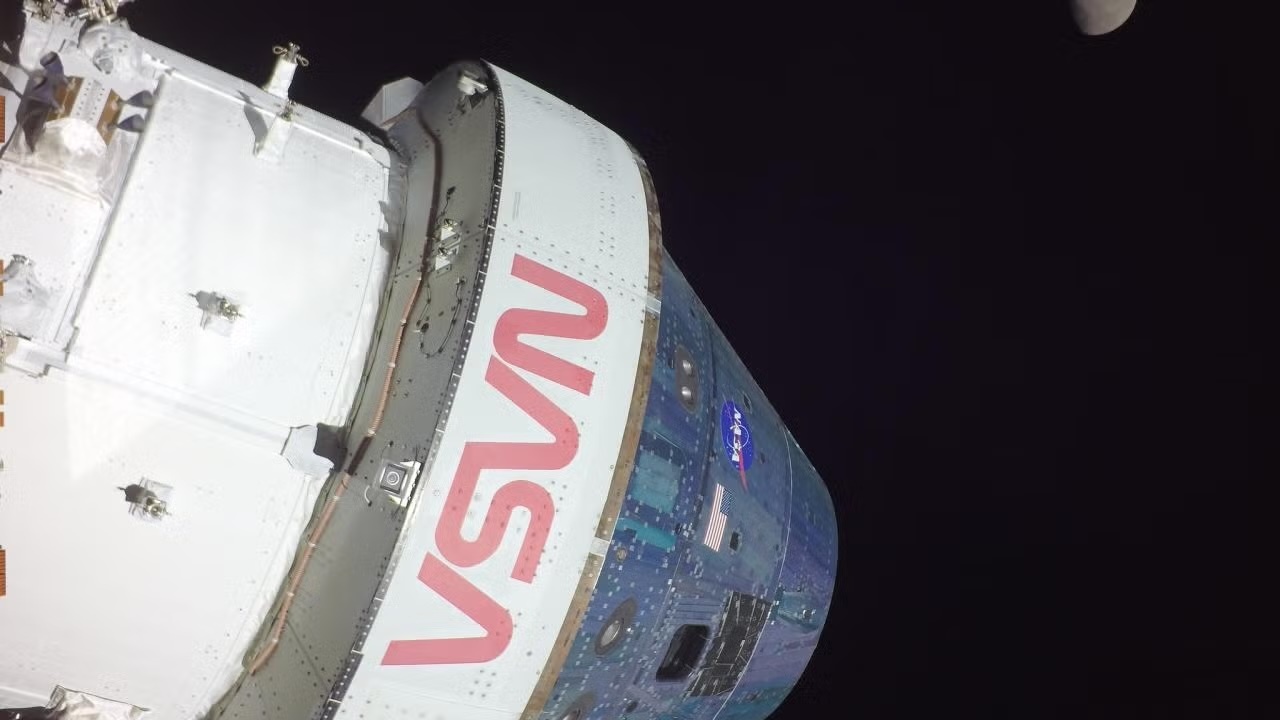
NASA's Artemis I mission takes a selfie of the Orion capsule on its way to the moon. Travel beyond the Earth's atmosphere and magnetic fields involves exposure to high levels of radiation from the sun and from cosmic rays. In a recent public talk, UC Davis physicist Daniel Cebra addressed these risks and how research in particle physics can help understand and mitigate them (NASA photo).
One of the big challenges with traveling to the Moon and beyond is protecting both human bodies and the electronics that support them in space against the onslaught of radiation from the sun and the rest of the universe.
“NASA has known about this space radiation for 40 years and they’ve been studying the most important parts,” said Daniel Cebra, professor and chair of the UC Davis Department of Physics and Astronomy. “The part they haven’t studied is high-energy nuclear collisions and that’s how a high-energy nuclear physicist gets involved.”
Cebra recently discussed the topic at the April 2026 Astronomy on Tapevent at Sudwerk Brewing Co. in Davis.
Three types of radiation
Outside the protection of Earth's atmosphere and magnetic field, there are three types of radiation to contend with, Cebra said: solar wind, solar energetic particles and galactic cosmic rays.
The solar wind is made of charged particles constantly boiling off the sun. With energies of one to ten kiloelectron-volts, these particles won't penetrate the walls of a spaceship.
Solar energetic particles, given off by solar flares, are hundreds of times more powerful and penetrating, but can still be stopped by a sufficiently thick layer of water.
The real problem, though, is from galactic cosmic rays. Given off by exploding stars and other enormously energetic events, these cosmic rays can have energies up to a Giga-electron volt, a billion times more powerful than the solar wind. They can pass through hundreds of meters of shielding.
Studying heavy ion collisions
Any electronic devices going into outer space consistently undergo radiation hardness testing. UC Davis conducts such testing at the Crocker Nuclear Laboratory.
With NASA’s recent return to the moon and its scheduled future missions, Cebra said the space agency is prioritizing high-energy measurements (those in the giga-electron volts range) as the next area of study for space radiation shielding.
Cebra's research group studies collisions between heavy ions, such as gold. They use instruments such as the Relativistic Heavy Ion Collider (RHIC) at the U.S. Department of Energy's Brookhaven National Laboratory. The results from their experiments can be used to simulate how high-energy cosmic rays can affect spacecraft.
Quelle: University of California