
10.04.2026 / 18:45 MESZ

Artemis II Flight Day 9: Crew Prepares to Come Home
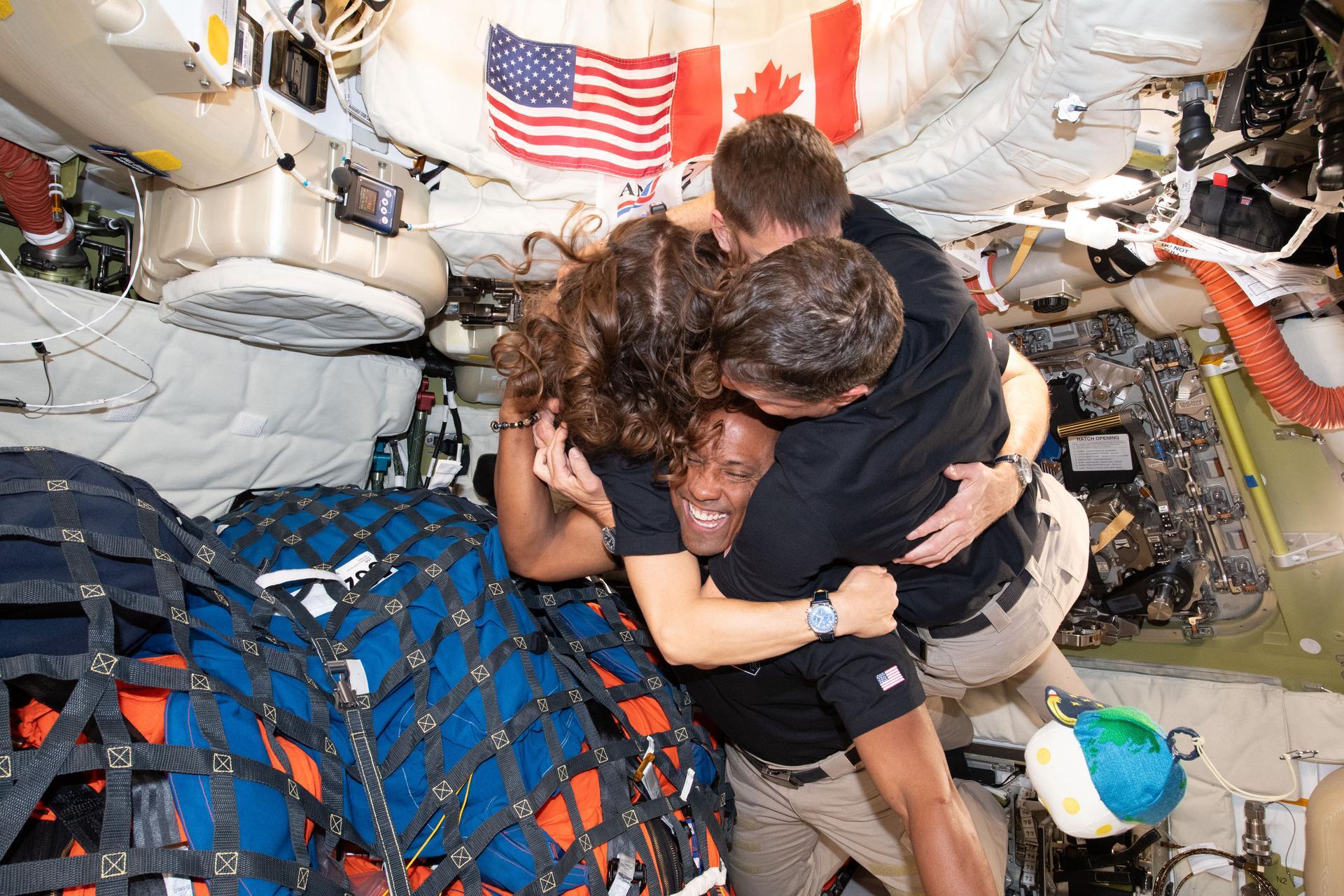
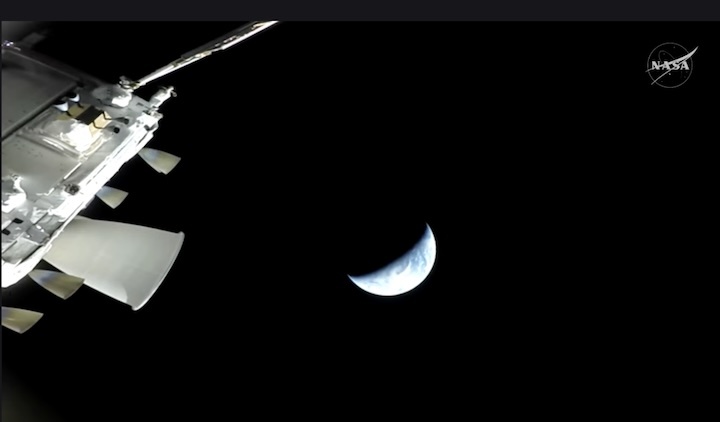
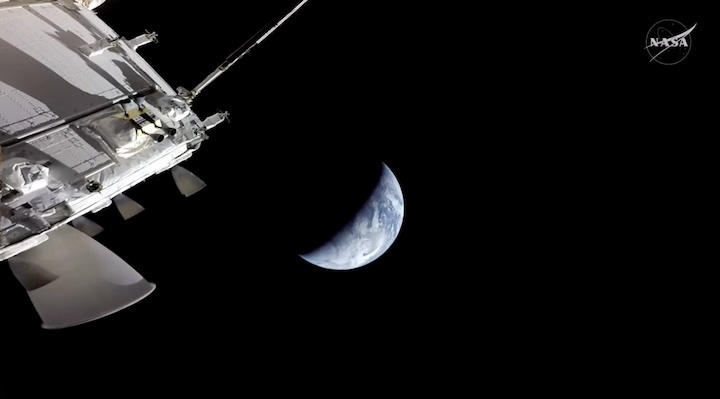
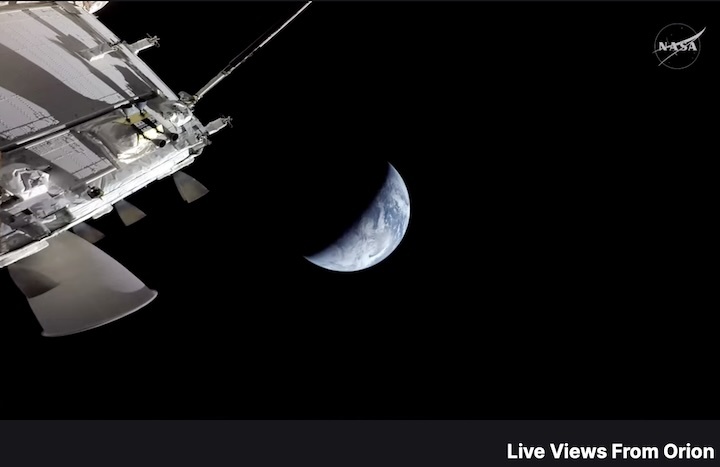
On their last full day in space, the Artemis II crew began the morning with “Lonesome Drifter” by Charley Crockett as they approached Earth at 147,337 miles.
NASA astronauts Reid Wiseman, Victor Glover, and Christina Koch, and CSA (Canadian Space Agency) astronaut Jeremy Hansen will continue preparing for their return to Earth set for Friday, April 10, including reviewing re-entry and splashdown procedures and conducting a return trajectory correction burn.
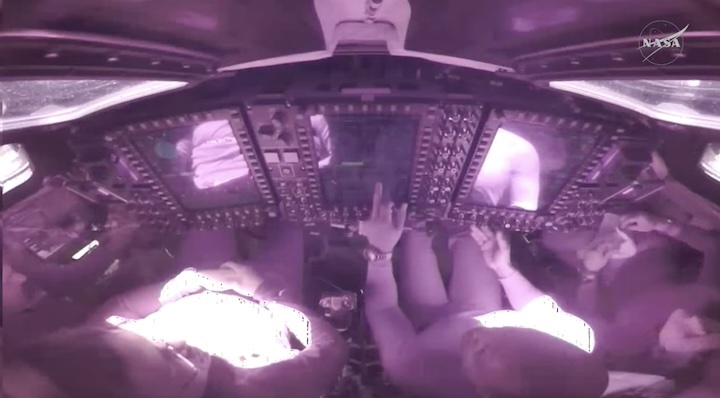
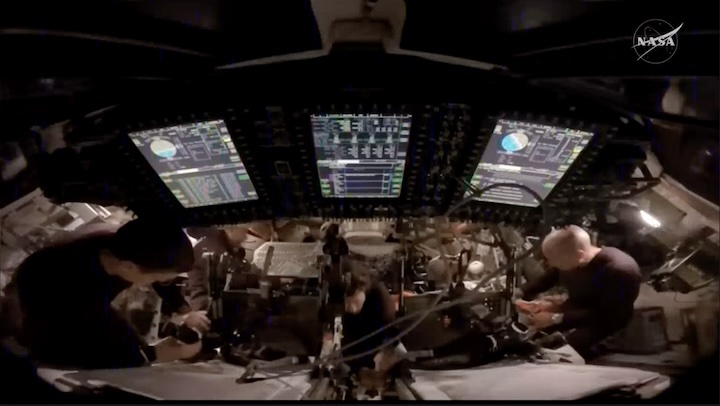
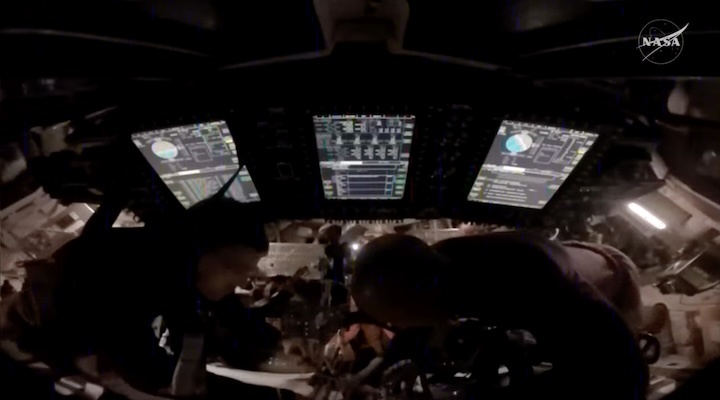
Cabin configuration for re-entry
Koch and Hansen will begin by stowing equipment they have had out during the mission, removing cargo and locker netting, installing and adjusting crew seats to ensure all items are secured before their return to Earth. As part of the day’s activities, the crew will review the latest weather briefing, recovery force status, and entry timeline. Throughout the day, they also will work through post‑landing operations.
Another push home
Orion’s thrusters are scheduled to ignite for the second return trajectory correction burn at 9:53 p.m. EDT to fine‑tune the spacecraft’s path toward Earth. The maneuver will further refine Orion’s trajectory and ensure the spacecraft remains aligned for atmospheric re-entry. During the burn, Hansen will review the procedure steps and monitor Orion’s guidance, navigation, and propulsion systems.
Preparing for splashdown
As Artemis II nears its return to Earth, NASA teams on the ground are completing final preparations for Orion’s re-entry and splashdown around 8:07 p.m. (5:07 p.m. PDT) Friday, April 10, off the coast of San Diego.
The agency will continue to provide updates about the test flight during the daily mission briefing. Today’s mission status briefing is at 3:30 p.m. and will stream on NASA’s 24/7 coverage on the agency’s YouTube channel.
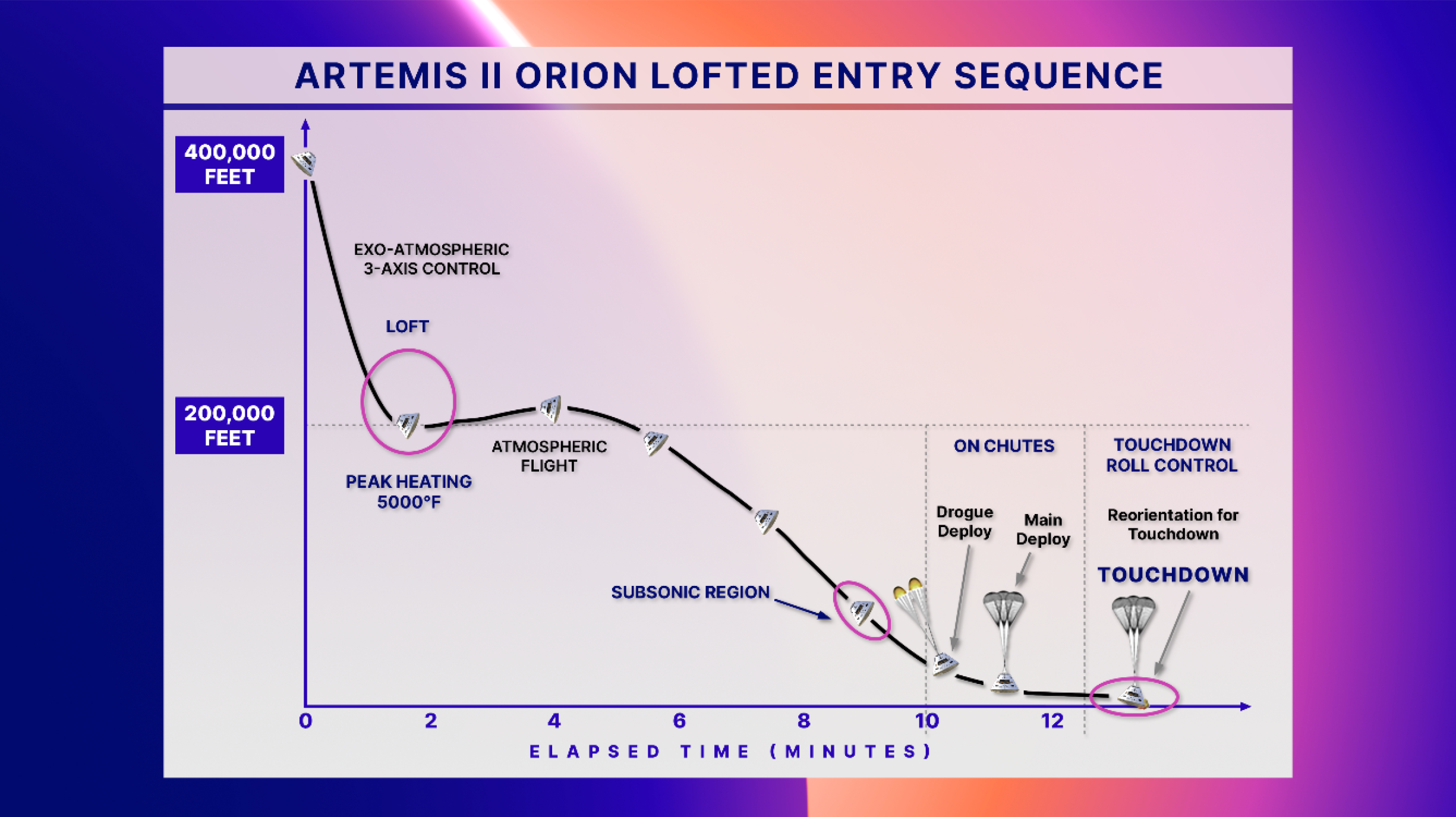
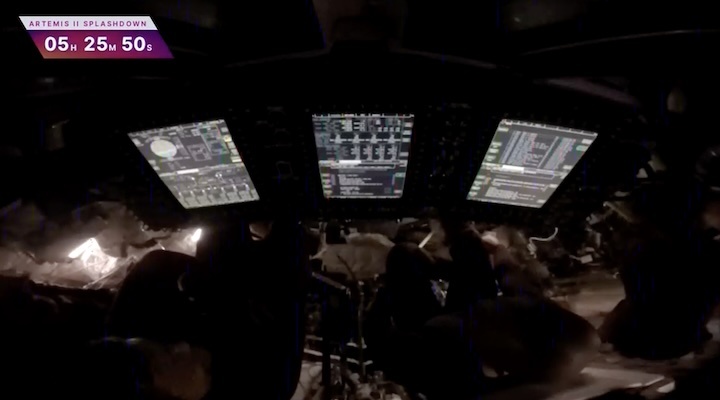
During re-entry, the service module will separate around 7:33 p.m., about 20 minutes before Orion reaches the upper atmosphere southeast of Hawaii. At 7:37 p.m., a final trajectory‑adjustment burn will fine‑tune the flight path before the spacecraft begins a series of roll maneuvers to safely distance itself from departing hardware. Orion will reach its maximum velocity — approximately 23,864 mph — just before entry interface.
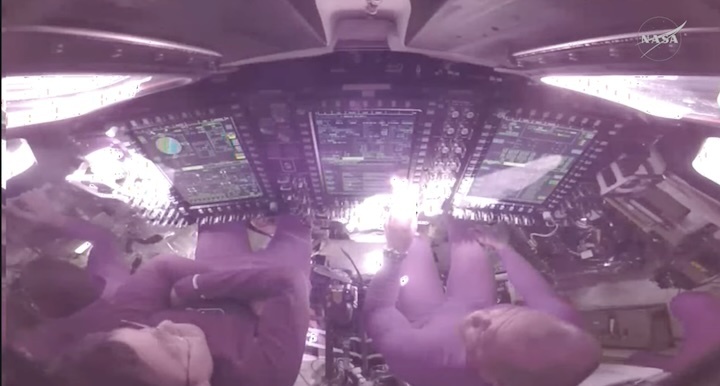
As Orion descends through about 400,000 feet, the spacecraft will enter a planned six‑minute communications blackout at 7:53 p.m. as plasma forms around the capsule during peak heating. The crew is expected to experience up to 3.9 Gs in a nominal landing profile.
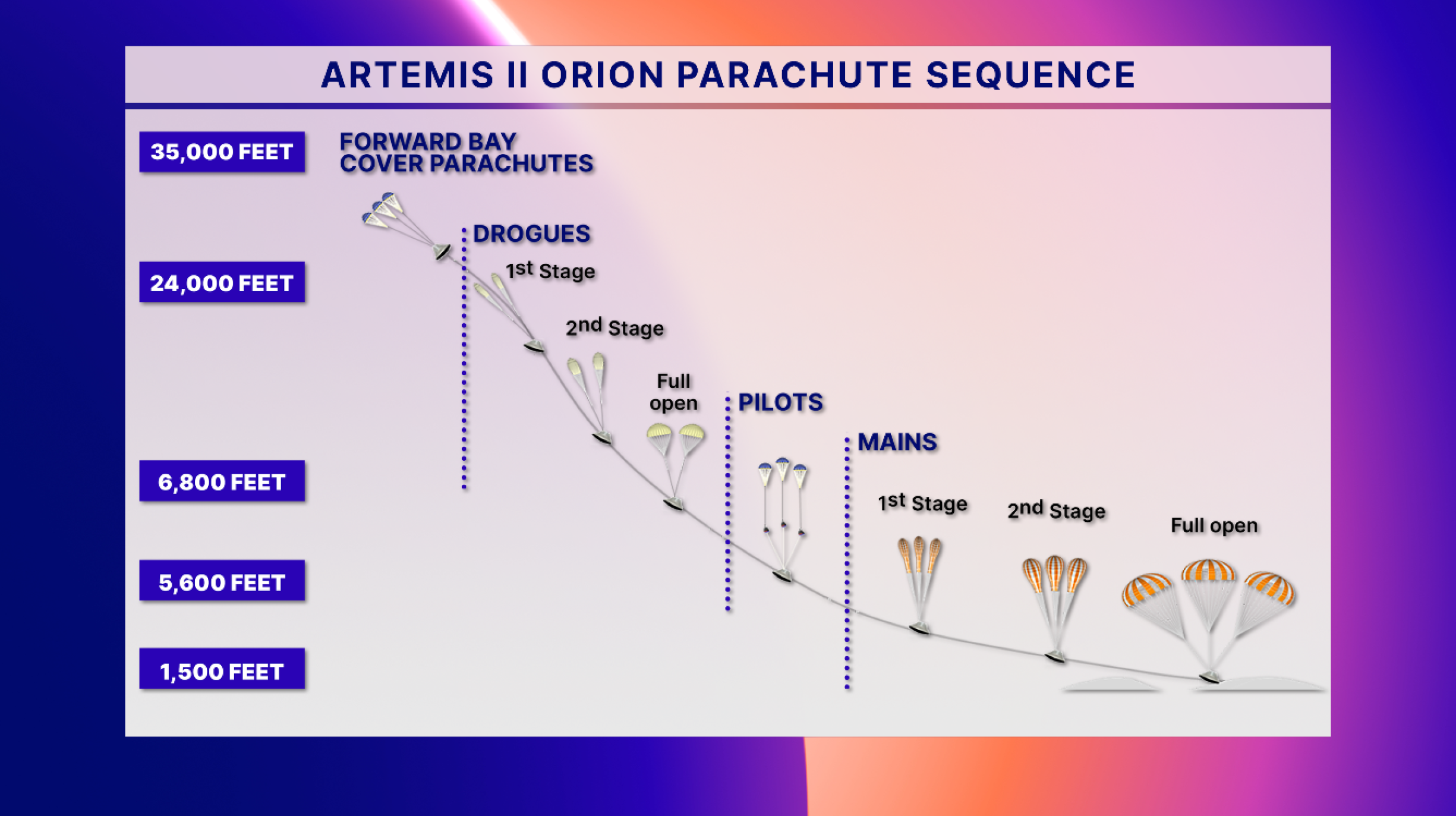
After emerging from blackout, Orion will jettison its forward bay cover, deploy its drogue parachutes near 22,000 feet at 8:03 p.m., and then unfurl its three main parachutes around 6,000 feet at 8:04 p.m. to slow the capsule for splashdown off the coast of San Diego.
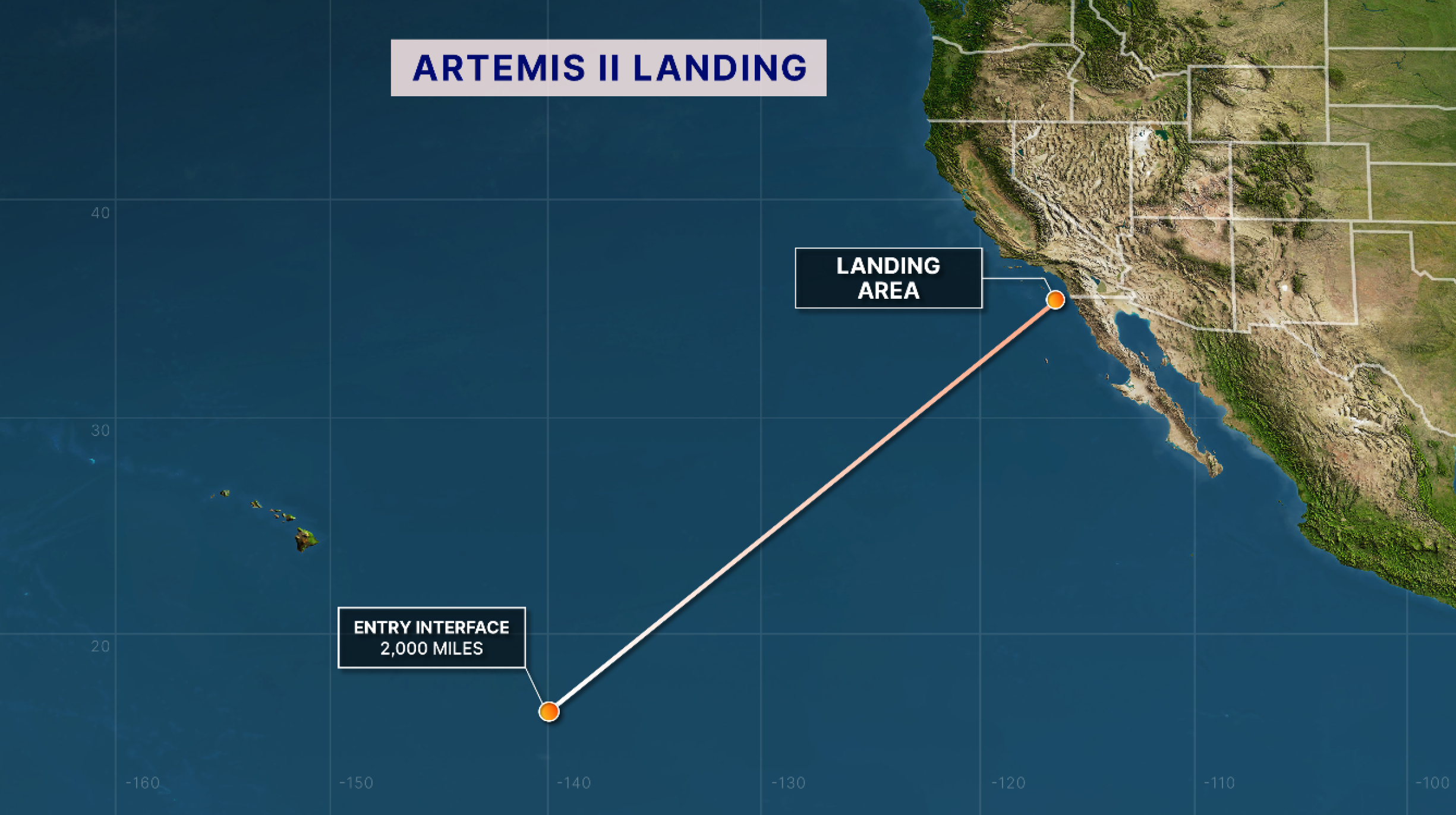
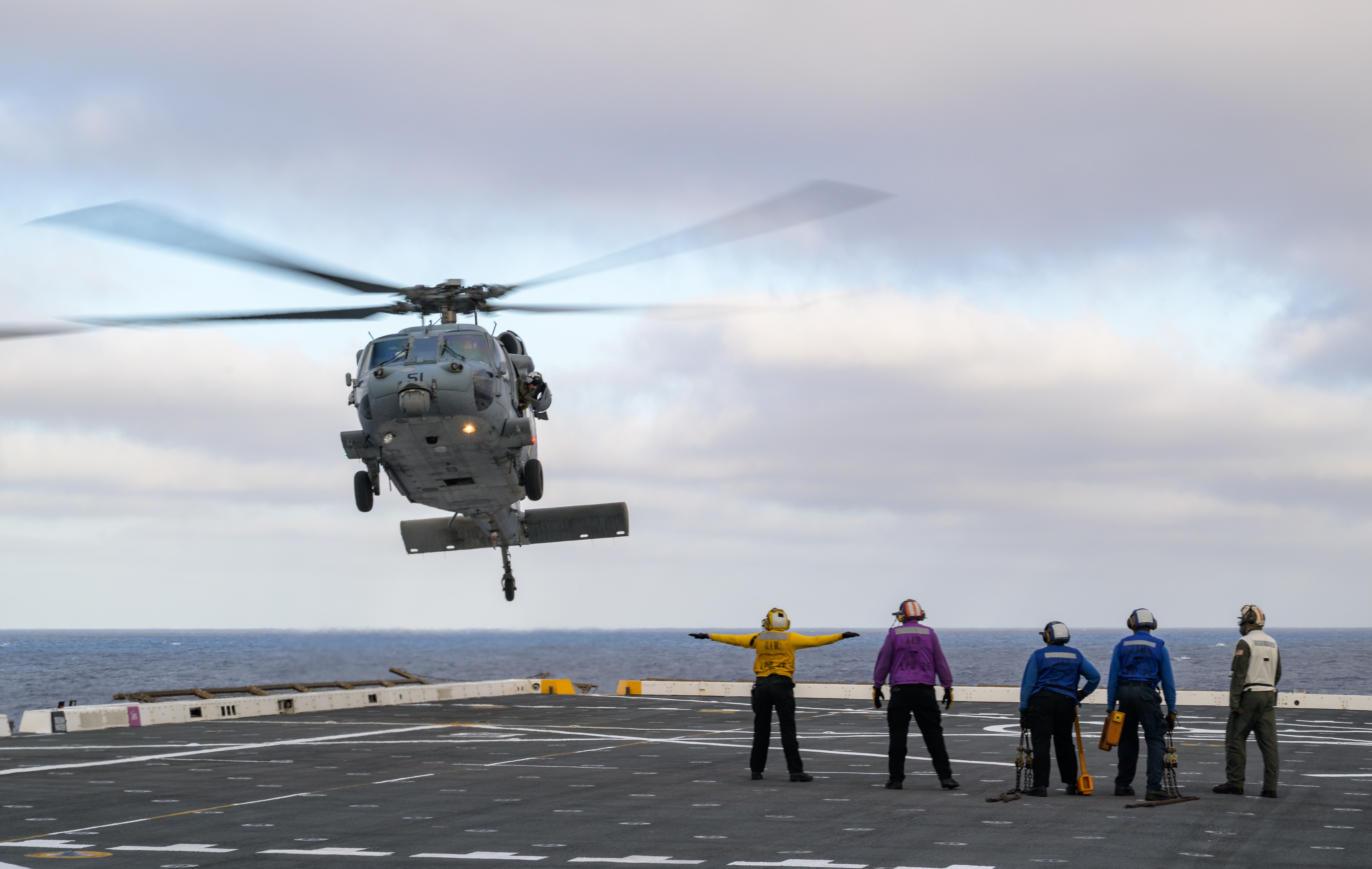
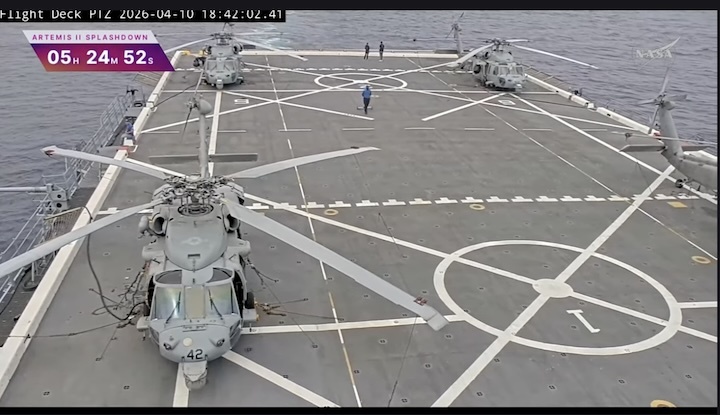
Within two hours after splashdown, the crew will be extracted from Orion and flown to the USS John P. Murtha. Recovery teams will retrieve the crew using helicopters, and once aboard the ship, the astronauts will undergo post‑mission medical evaluations before returning to shore to board an aircraft bound for NASA’s Johnson Space Center in Houston.
Artemis II Flight Day 9: Second Return Correction Burn Complete
At 10:53 p.m. EDT, the Orion spacecraft ignited its thrusters for 9 seconds, producing an acceleration in velocity of 5.3 feet-per-second and pushing the Artemis II crew toward Earth. The crew is now more than halfway home.
About two hours before the burn, there was an unexpected return link loss of signal during a data rate change affecting the transmission of communications and telemetry from the spacecraft to the ground. Two-way communications were reestablished, and flight controllers resumed preparing for the upcoming burn with the crew shortly after.
Earlier today, NASA officials held a mission status briefing and shared additional information on re-entry and splashdown procedures.
The third return trajectory correction burn is scheduled for April 10 at about 1:53 p.m. ahead of re-entry procedures.
NASA is targeting splashdown at 8:07 p.m. (5:07 p.m. PDT) Friday, April 10, off the coast of San Diego.
+++
Artemis II Flight Day 10: Crew Sets for Final Burn, Splashdown
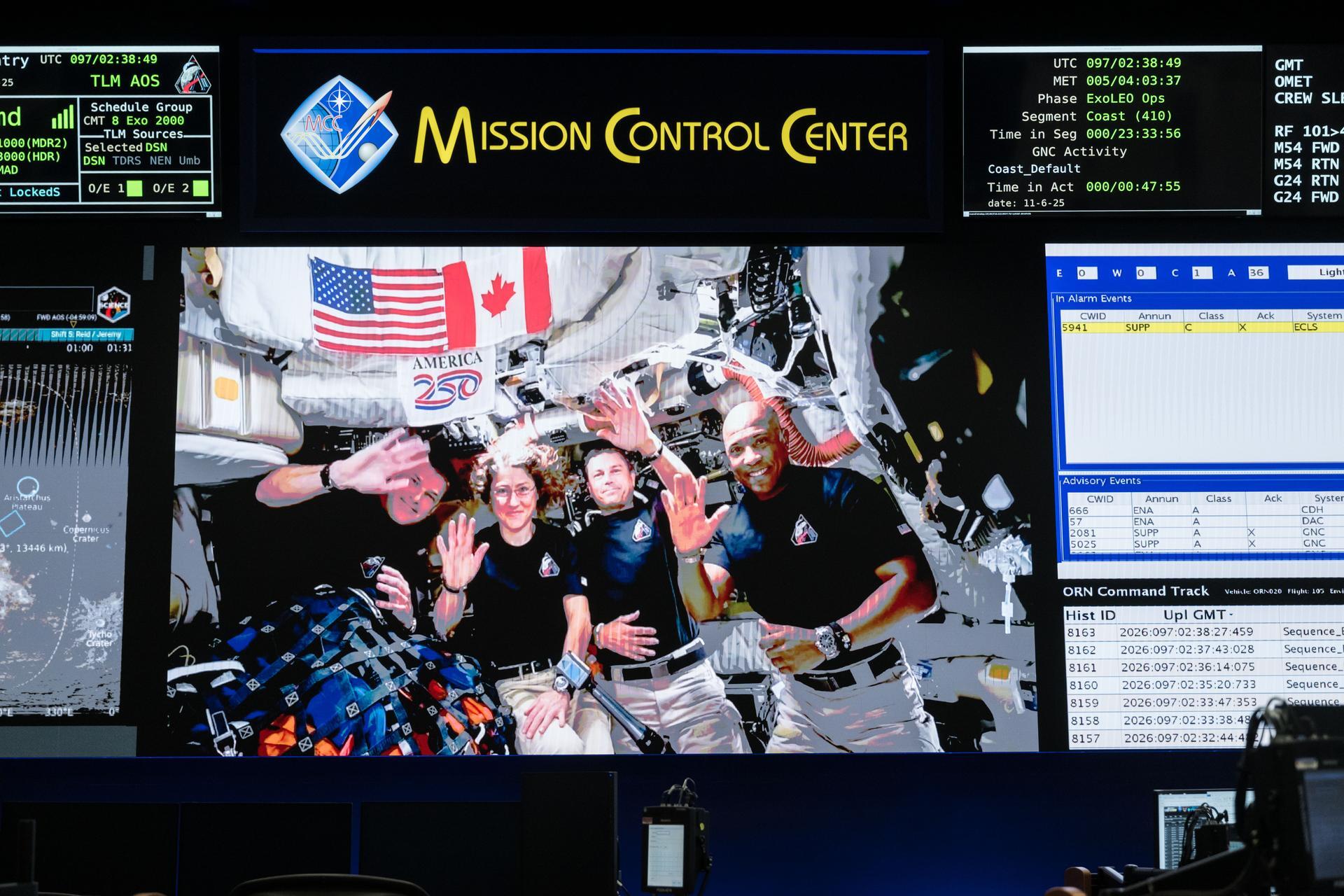
The Artemis II crew — NASA astronauts Reid Wiseman, Victor Glover, Christina Koch and CSA (Canadian Space Agency) astronaut Jeremy Hansen — began the final phase of their journey home to the songs “Run to the Water” by Live, selected by the crew, and “Free” by Zac Brown Band, as they prepared for their third return trajectory correction burn and shifted into full re-entry and splashdown preparations. When they woke up, they were 61,326 miles from Earth.
Splashdown is targeted for 8:07 p.m. EDT (5:07 p.m. PDT) off the coast of San Diego, where a combined NASA and U.S. military recovery team will be standing by to welcome the Artemis II crew home.
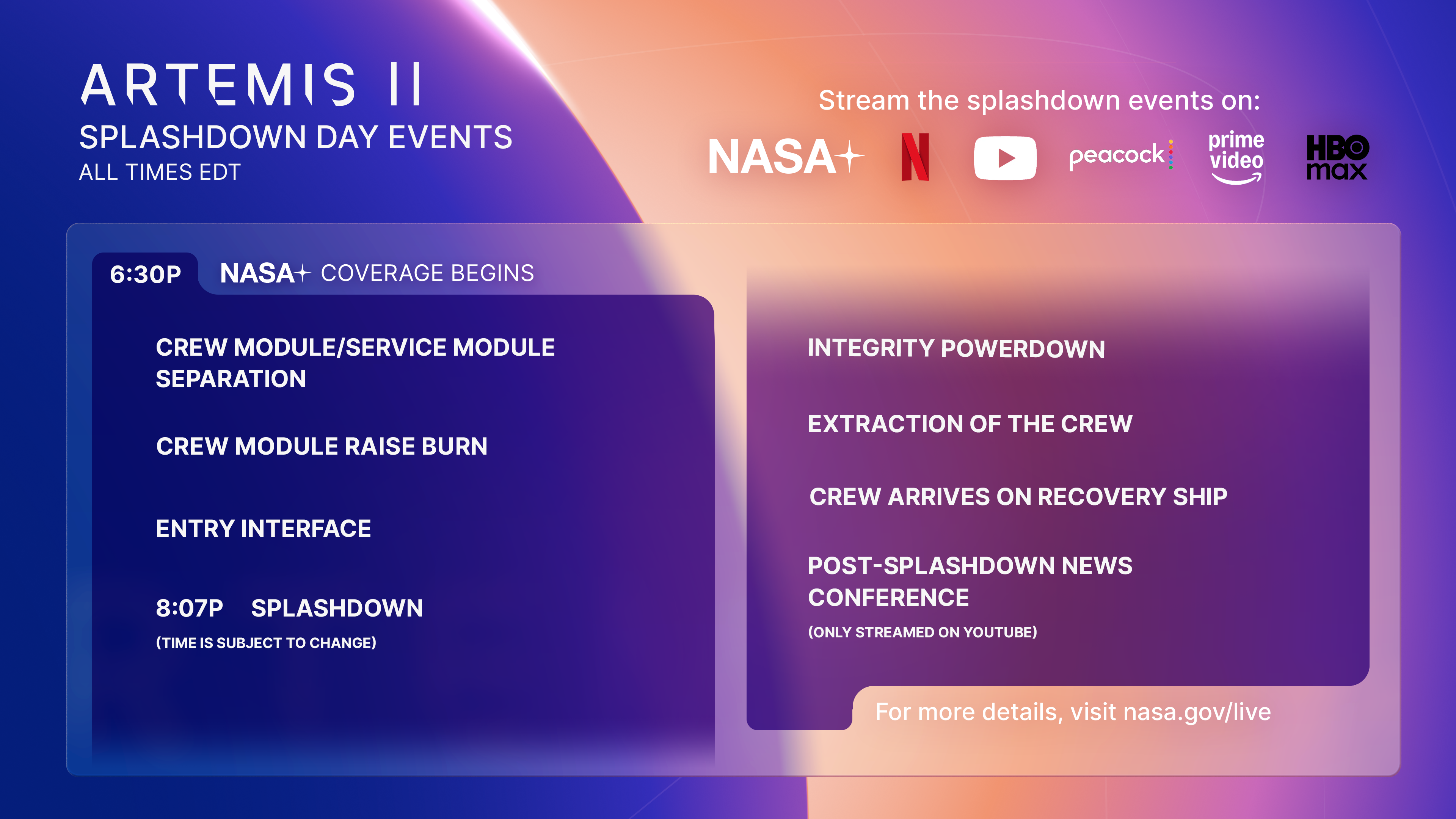
Watch live return coverage on NASA+, Amazon Prime, Apple TV, Netflix, HBO Max, Discovery+, Peacock and Roku starting at 6:30 p.m. Learn how to stream NASA content through a variety of online platforms, including social media.
Final return burn sets Orion for home
The third return burn will occur at 2:53 p.m., refining Orion’s path for atmospheric entry and splashdown. During the maneuver, the spacecraft will make precise adjustments to stay on its targeted course home.
Artemis II splashdown timeline
A carefully timed sequence will guide Orion through the final stages of descent:
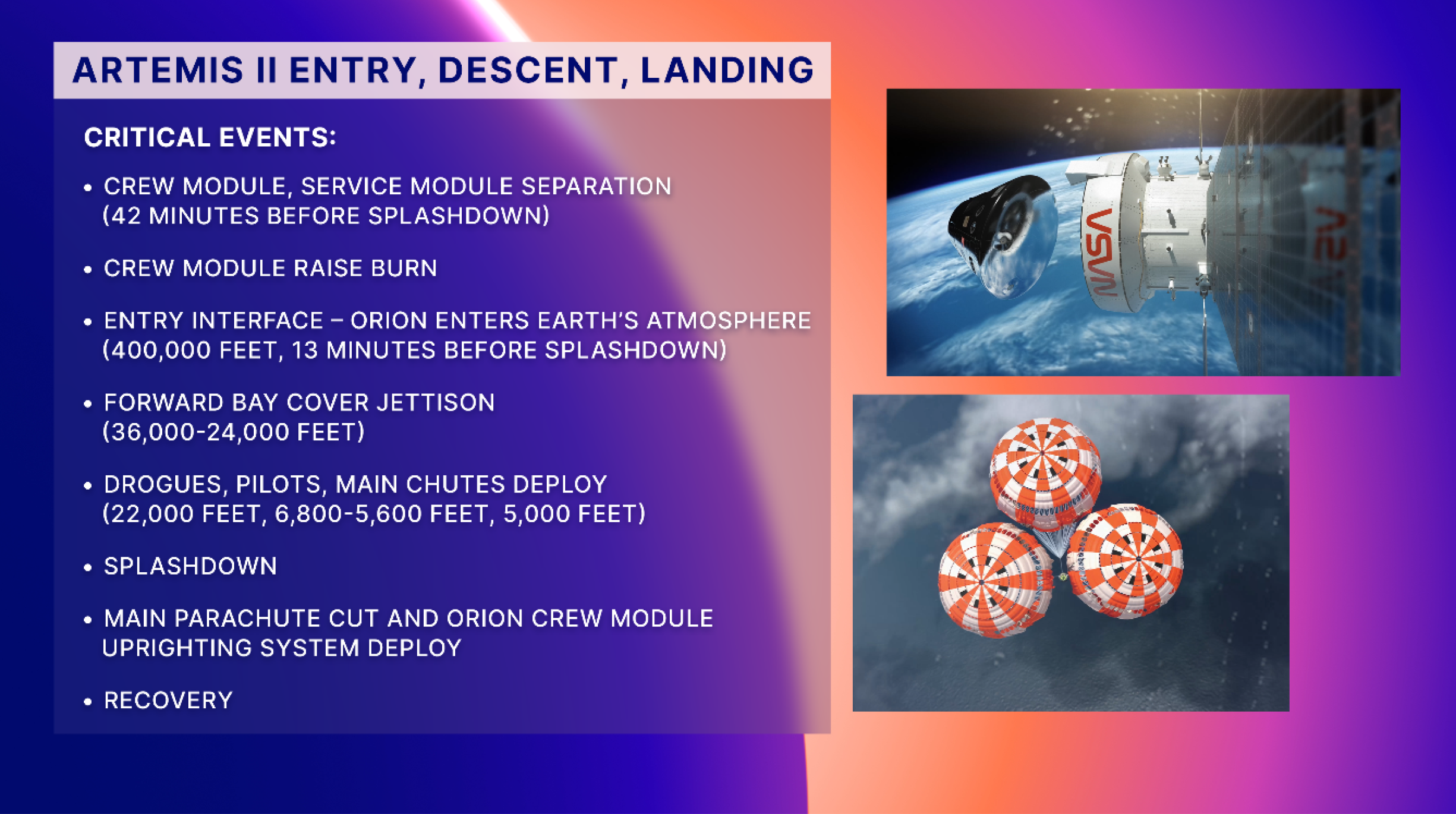
- 7:33 p.m.: Orion’s crew module will separate from the service module, exposing its heat shield for the spacecraft’s return through Earth’s atmosphere, where it will encounter temperatures of about 3,000 degrees Fahrenheit.
- 7:37 p.m.: Following separation, Orion will perform an 18 second crew module raise burn beginning to set the proper entry angle and align the heat shield for atmospheric interface.
- 7:53 p.m.: When Orion reaches 400,000 feet above Earth’s surface while traveling nearly 35 times the speed of sound. The crew is expected to experience up to 3.9 Gs in the planned entry profile. This moment marks the spacecraft’s first contact with the upper atmosphere and the start of a planned six-minute communications blackout as plasma builds around the capsule.
- 8:03 p.m.: Around 22,000 feet in altitude, the drogue parachutes will deploy, slowing and stabilizing the capsule as Orion nears splashdown.
- 8:04 p.m.: At around 6,000 feet, the drogues will release, and the three main parachutes will deploy, reducing Orion’s speed to less than 136 mph.
- 8:07 p.m.: Slowing to 20 mph, Orion will splash down in the Pacific Ocean off the coast of San Diego, completing the Artemis II crew’s return to Earth and a 694,481-mile journey.
- From there, teams from NASA and the U.S. military will extract the crew from Orion and fly them via helicopter to the USS John P. Murtha.
- Within two hours after splashdown, the crew will be extracted from Orion and flown to the USS Murtha. Recovery teams will retrieve the crew, assist them onto an inflatable raft, and then use helicopters to deliver them to the ship. Once aboard, the astronauts will undergo post‑mission medical evaluations before returning to shore where awaiting aircraft will take them to NASA’s Johnson Space Center in Houston.
The Artemis II mission began with the successful liftoff of NASA’s SLS (Space Launch System) rocket on April 1 at 6:35 p.m. from Launch Pad 39B at Kennedy Space Center in Florida, sending the first humans toward the Moon since 1972.
During the mission, the astronauts completed a historic lunar flyby, marking humanity’s return to the vicinity of the Moon for the first time in more than 50 years. Throughout the flight, the crew and teams on the ground have evaluated Orion’s systems in the deep‑space environment, including a series of tests in which astronauts directly operated and interacted with the spacecraft.
Quelle: NASA
+++
What’s the deal with the Artemis II music? The crew finally gave us some answers
It’s NASA tradition to wake up astronauts with a song. Here are the Artemis IIcrew’s favorites
Each day of the Artemis II mission around the moon, per NASA tradition, the Orion crew has woken up to a different song. So far that’s included everything from softer tunes such as Young & Sick’s cover of “Sleepyhead,” by Passion Pit, to CeeLo Green’s upbeat “Working Class Heroes (Work)” and the pop hit “Pink Pony Club,” by Chappell Roan. The songs were selected by “the moon crew,” according to NASA. And on Wednesday, the four Artemis II astronauts finally gave some insight into the stories behind the songs.
“My family suggested the one this morning—‘Under Pressure’ [by Queen and David Bowie]—and so that’s been my my favorite so far,” said Canadian Space Agency astronaut Jeremy Hansen during a live conversation with Canadian prime minister Mark Carney, who had called in to the Orion spacecraft on Wednesday night.
NASA astronaut Victor Glover revealed that his wife replaced one of his songs with “Good Morning,” by Mandisa and TobyMac. “It was actually really pleasant to wake up to, and so I give her a shout-out,” he said. “That was my favorite one.” (You can follow NASA’s official Spotify playlist for the Artemis IImission here.)
Meanwhile “Tokyo Drifting,” by Glass Animals and Denzel Curry, is a song that NASA astronaut Reid Wiseman listens to “every year” on vacations to Florida with his daughters, he said. “That one meant the most to me.”
NASA astronaut Christina Koch selected “Sleepyhead” because it played after a four-hour nap on the first day of the mission. “After being awake for—I’m not sure how long but many, many, many, many hours, I knew that we would need a little backup on that,” she said.
“The wake-up songs have been absolute perfection,” Koch said. “However, they did cut off ‘Pink Pony Club’ before the chorus,” she added, referring to the crew's all-too-short Saturday wake-up song. “I really was just singing it all day after that.”
The tradition of waking astronauts from their slumber with music dates back to at least 1965, according to a NASA report by Colin Fries, a now retired historian at the agency. The Gemini VI mission that year, for instance, included “Hello Dolly,” by Jack Jones, while Gemini VII played composers Ludwig van Beethoven and Johann Sebastian Bach, records show.
In 1969 the Apollo 10 mission astronauts were reportedly blessed by the sounds of Frank Sinatra (“It’s Nice to Go Trav’ling”) and Tony Bennett (“The Best Is Yet to Come”). On the space shuttle, which ferried astronauts to space between 1981 and 2011, crews were treated to songs that included “On the Road Again,” by Willie Nelson (in 1982), Steppenwolf's “Born to Be Wild” (1990) and “Son of a Son of a Sailor,” by Jimmy Buffett (1992). In 2005 Paul McCartney performed“English Tea” and “Good Day Sunshine” live for the International Space Station crew.
Looking to the final days of the Artemis II mission, Hansen said his “second favorite” song after “Under Pressure” will be on landing day. “I’ll let you wait to see what that one is,” he said. “It’s appropriate for the day.”
Quelle: SCIENTIFIC AMERICAN
+++
Update: 21:15 MESZ
Quelle: NASA
+++