
29.09.2026
Astronomers have found the first convincing “microblazar” in our Galaxy — a star with a black hole orbiting around it, firing a beam of near-light-speed matter almost straight towards Earth. Its opposite, invisible beam slams into a cloud of gas and may be the source of some of the most energetic particles ever detected.
Dwingeloo, the Netherlands — September 2026
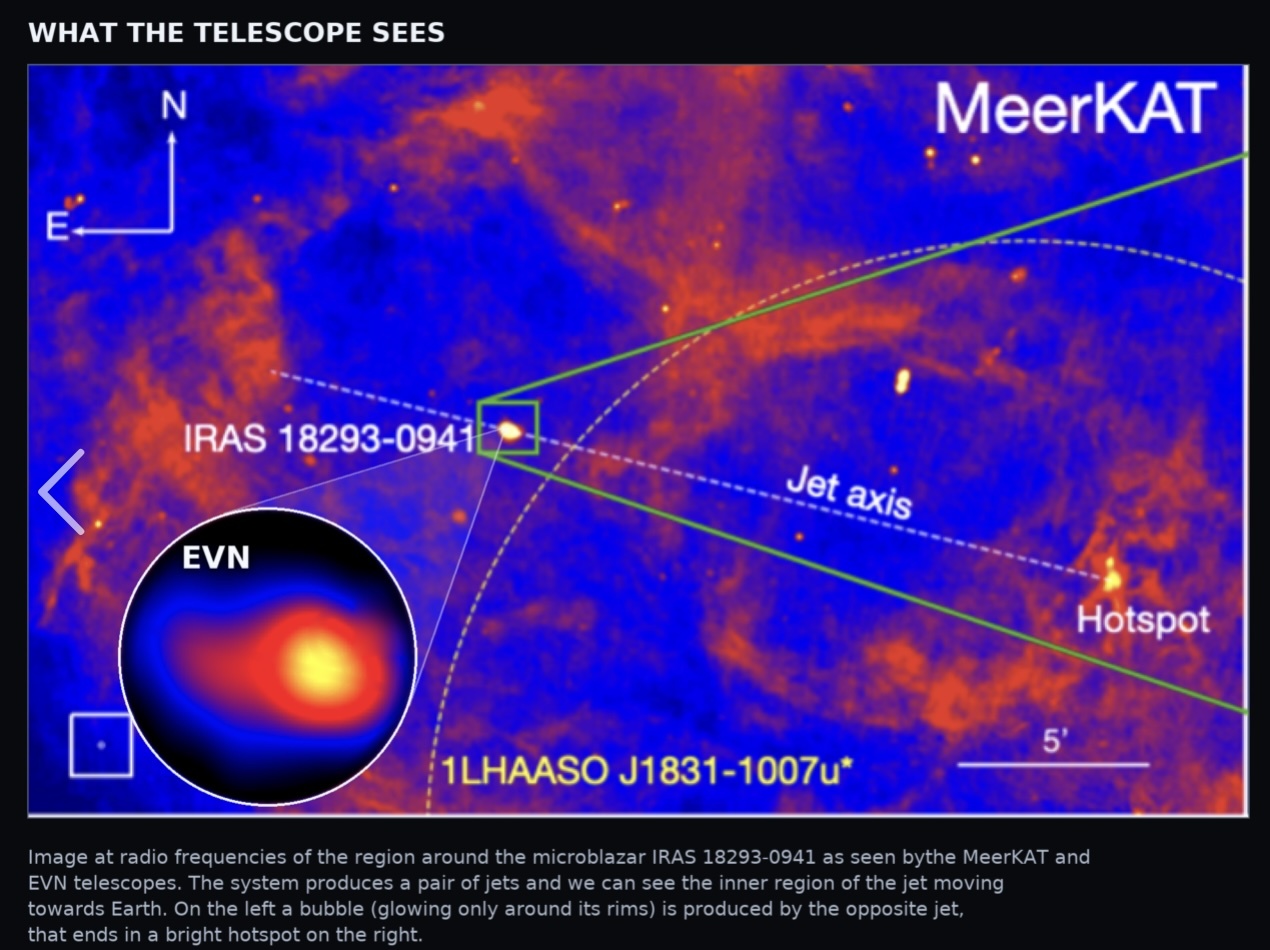
For thirty years, astronomers have been looking for something they were fairly sure had to exist in our Galaxy, but failing to find. Now an international team led by astronomers from Spain, Netherlands, and Argentina has found it hiding behind a wall of interstellar dust at roughly 12,000 light-years from Earth.
The object is called IRAS 18293−0941. It is a binary system: a hot, massive star orbited every 11.38 days by a black hole. Material from the star falls into the black hole, that swallows part of it and expels the other part along two opposing jets at three-quarters the speed of light. What makes this system remarkable is where those jets point: aimed almost directly at us.
The Galactic cousin of a cosmic monster
Jets pointed at Earth from black holes are not new to astronomy. Far outside our Galaxy, in the hearts of distant galaxies, supermassive black holes billions of times heavier than the Sun launch jets that happen to point our way. We call those objects blazars, and they are extremely bright and violent.
Since the 1990s, theorists have argued that the same trick should exist in miniature in our Galaxy, calling them microblazars. Nobody had ever found one that survived close inspection. IRAS 18293−0941 is the first that does not. “Everything about IRAS 18293−0941 was hiding in plain sight,” says Josep Martí (from University of Jaén, and lead author of the article). “It sits behind so much dust that it is essentially invisible in ordinary optical images. It was catalogued decades ago and then more or less forgotten.”.
A jet facing us
Years of monitoring, with outstanding participation of the Spanish astronomical observatories of Montsec, Calar Alto and University of Jaén, evidenced how the light of the star was subtly flickering. A whisper of variation that unveiled the 11.38-day orbit and that we were looking at the orbit almost face-on.
Radio images further unveiled the existence of a jet pointing towards us. A single one-side jet that was only explained if it was indeed almost focused on the direction of the Earth. The jet on the other side remains hidden due to a prediction of Einstein’s Relativity Theory. Using the European VLBI Network (EVN) they obtained images with very high resolution, confirming the orientation of the jet and the fact that this was truly coming from the stellar system. The EVN is a continent-spanning array of radio telescopes that behaves like a single dish thousands of kilometers wide, and involved antennas at Hartebeesthoek (South Africa), Irene (Latvia), Jodrell Bank (UK), Medicina and Noto (Italy), Onsala (Sweden), Tianma (China), Torun (Poland), Westerbork (The Netherlands), Yebes (Spain), and the eMERLIN antennas (UK).
Two entirely separate methods, radio and optical, gave the same answer.
“This was the moment the result became solid,” says Benito Marcote (from the Joint Institute for VLBI ERIC, JIVE, in The Netherlands). A one-sided radio jet on its own could always be from a distant galaxy that happens to lie in the same direction of the star we were studying. “The resolution achieved by the EVN position together with the known position of the star from the Gaia satellite confirmed it: the jet belongs to the stellar system”, concluded.
An invisible jet punching a cloud
The other jet — the receding one — is invisible. But it is not gone, and the team found its shadow.
Deep images from MeerKAT, the South African radio observatory, show that there is an enormous (100 light years in size) bubble where the jet passes through. And at the far edge of that bubble, sits a brilliant, compact knot of radio emission — a hotspot. A shock collision between the jet and the interstellar medium where particles are being accelerated, the dust is warmed, and makes the hydrogen gas to glow.
Exactly at such position, other observatories like the LHAASO (China), HAWC (Mexico), H.E.S.S. (Namibia), and the Fermi satellite have detected a source of ultra-high-energy gamma rays — single photons carrying more than 100 trillion electronvolts — over ten times the energy the Large Hadron Collider manages to give a single proton. Where these Galactic “PeVatrons” get their energy is one of the open questions in modern astrophysics.
Why it matters
The team shows how the pieces could fit. The jet carries enough power (half a million times the energy the Sun radiates) that, where it strikes the molecular cloud, accelerates protons to enormous energies and then slam into the dense gas. Those collisions produce particles that immediately shine by emitting gamma rays. “The elegance is that the accelerator engine and the target are two different objects, tens of parsecs apart,” says Pedro Luque-Escamilla (from the University of Jaén, Spain, and co-author of the research). “The jet does the accelerating. The cloud does the shining.”
For the first time, we have an analogous to the distant blazars in our backyard, confirming a 30-years-old prediction. It opens a window to explore such systems at a much detailed scale, and tracing their evolution down to human time scales. Additionally, the interaction of its jet with the interstellar medium, producing such genuine hotspot confirms that such interactions may be important when studying the evolution of the Galaxy. And finally, the potential association with a PeVatron region adds another step towards the understanding of these extreme regions and their origin.
The team is now pushing on several fronts: repeated high-resolution observations to try to catch the jet evolution and image deeper inside the system; a more detailed study of the molecular cloud and the jet interaction to unveil the processes that take place in those areas, and the continue searches for new of these systems in our Galaxy.
Quelle: NRF/SARAO