
1.09.2026
Watch Rocket Lab launch Japanese radar satellite to orbit early on Sept. 1

Rocket Lab will launch a private Japanese radar satellite to orbit early Tuesday morning (Sept. 1), and you can watch the action live.
An Electron vehicle is scheduled to lift off from Rocket Lab's New Zealand site on Tuesday during a window that opens at 7:30 a.m. EDT (1130 GMT; 11:30 p.m. local New Zealand time). It's carrying a single Strix satellite for Synspective, a Tokyo-based Earth-imaging company.
Synspective is assembling a constellation of about 30 Strix satellites in low Earth orbit (LEO). These spacecraft — which are named after a widespread genus of owl — use synthetic aperture radar (SAR) to study our planet both day and night, and in all weather conditions.
The Strix constellation will "make it possible to quickly monitor and confirm on-the-ground changes during disasters such as earthquakes and floods at night, as well as in areas that are difficult to access," Synspective's website reads.
"In addition to disaster response, we will leverage our SAR satellitecapabilities to promote efficient resource utilization," it adds. "For example, we can use our satellite data to monitor natural resources and urban development, ensuring sustainable and optimal use of land and water."
Ten Strix satellites have reached orbit to date, all of them atop Electron vehicles. Rocket Lab is currently the sole launch provider for Synspective and has 16 more missions for the company on its manifest after Tuesday's mission.
If all goes according to plan on Tuesay, the Electron's upper "kick stage" will deploy the Strix satellite 56 minutes after liftoff, at an altitude of 357 miles (575 kilometers).
The 59-foot-tall (18 meters) Electron is designed to give small satellites dedicated rides to Earth orbit and beyond. Tuesday's mission, which Rocket Lab calls "Owl Around the World," will be the rocket's 12th of 2026 and 85th overall.
Rocket Lab has also launched nine missions to date with HASTE, a suborbital version of Electron that allows customers to test sensors and instruments in a hypersonic flight environment. While Electron debuted in 2017, HASTE lifted off for the first time in June 2023.
Quelle: SC
+++
Watch Rocket Lab launch Japanese radar satellite to orbit early on Sept. 2
Liftoff of the "Owl Around the Moon" mission is scheduled for 7:00 a.m. ET on Wednesday (Sept. 2).
Rocket Lab will launch a private Japanese radar satellite to orbit early Wednesday morning (Sept. 2), and you can watch the action live.
An Electron vehicle is scheduled to lift off from Rocket Lab's New Zealand site on Wednesday during a window that opens at 7:00 a.m. EDT (1100 GMT; 11:00 p.m. local New Zealand time). It's carrying a single Strix satellite for Synspective, a Tokyo-based Earth-imaging company.
You can watch it live via Rocket Lab, beginning about 30 minutes before launch. Space.com will air the feed as well, if, as expected, Rocket Lab makes it available.
Synspective is assembling a constellation of about 30 Strix satellites in low Earth orbit (LEO). These spacecraft — which are named after a widespread genus of owl — use synthetic aperture radar (SAR) to study our planet both day and night, and in all weather conditions.
The Strix constellation will "make it possible to quickly monitor and confirm on-the-ground changes during disasters such as earthquakes and floods at night, as well as in areas that are difficult to access," Synspective's website reads.
"In addition to disaster response, we will leverage our SAR satellitecapabilities to promote efficient resource utilization," it adds. "For example, we can use our satellite data to monitor natural resources and urban development, ensuring sustainable and optimal use of land and water."
Ten Strix satellites have reached orbit to date, all of them atop Electron vehicles. Rocket Lab is currently the sole launch provider for Synspective and has 16 more missions for the company on its manifest after Wednesday's mission.
If all goes according to plan on Wednesday, the Electron's upper "kick stage" will deploy the Strix satellite 56 minutes after liftoff, at an altitude of 357 miles (575 kilometers).
The 59-foot-tall (18 meters) Electron is designed to give small satellites dedicated rides to Earth orbit and beyond. Wednesday's mission, which Rocket Lab calls "Owl Around the World," will be the rocket's 12th of 2026 and 85th overall.
Rocket Lab has also launched nine missions to date with HASTE, a suborbital version of Electron that allows customers to test sensors and instruments in a hypersonic flight environment. While Electron debuted in 2017, HASTE lifted off for the first time in June 2023.
Quelle: SC
----
Update: 6.09.2026
.
MISSION SUCCESS: ROCKET LAB LAUNCHES 94TH ELECTRON MISSION
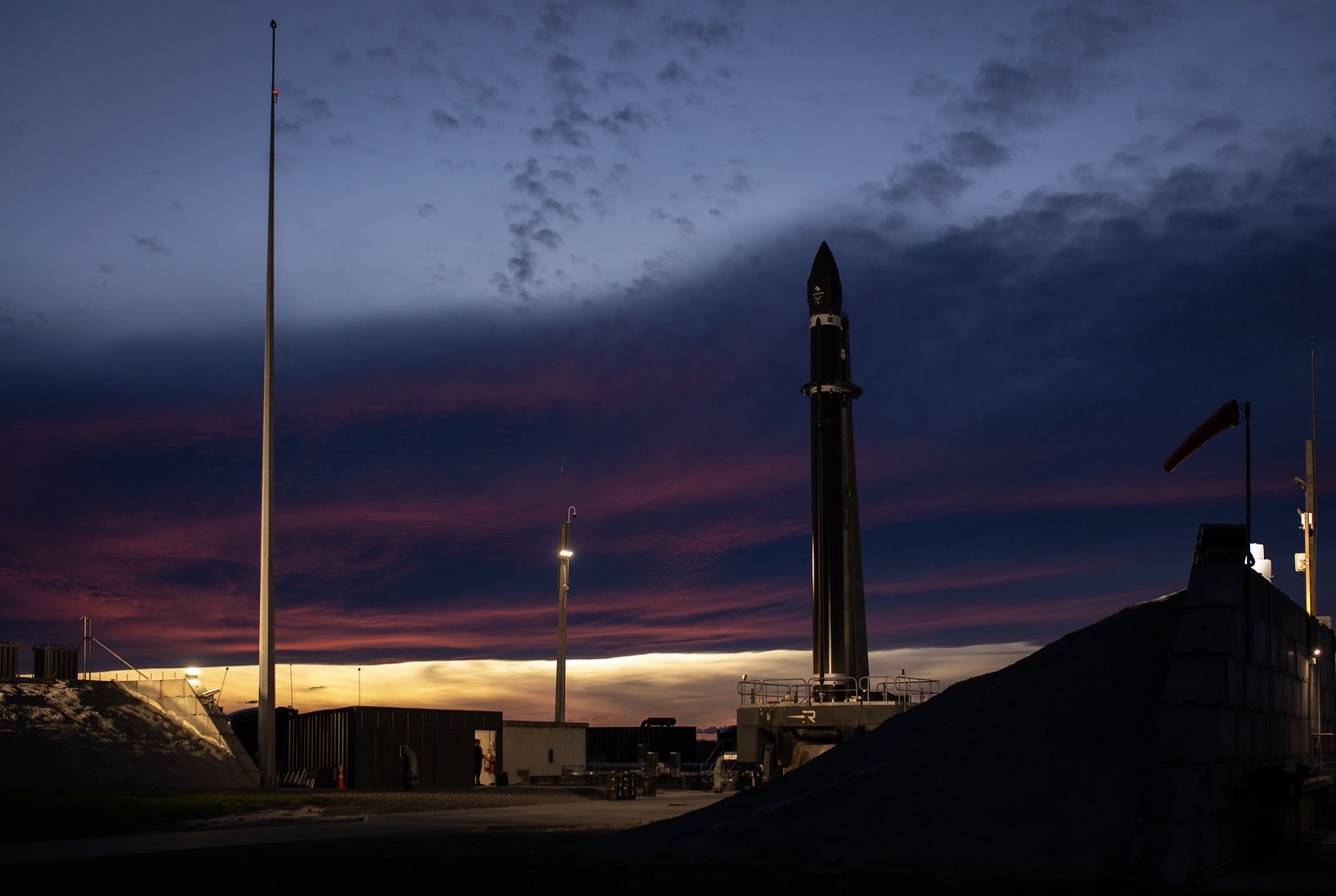
Rocket Lab Corporation (Nasdaq: RKLB), a global leader in launch services and space systems, today successfully launched its 94th Electron rocket to deploy the latest Earth-imaging satellite to space for Synspective.
The ‘Owl Around The World’ mission launched from Rocket Lab Launch Complex 1 in New Zealand at 12:01 am NZST on September 3, 2026. Electron successfully deployed the StriX satellite to a 575km low Earth orbit, further building out Synspective’s synthetic aperture radar (SAR) imaging constellation and expanding the company’s capabilities for advanced ground monitoring and Earth observation.
Mission Highlights:
- Strong Launch Cadence: This mission marked Rocket Lab’s 94th overall Electron launch and 15th launch of 2026. Electron remains the world’s most frequently launched small-lift orbital rocket
- Flawless Launch for Synspective: Today’s flawless delivery of the latest StriX satellite to space continues Rocket Lab’s 100% mission success record across all Synspective launches.
- Custom Fairing: A specially-configured Electron fairing was built to match the exact dimensions of the StriX satellite: a highlight of Rocket Lab’s dedicated mission service for its long-time partnership with Synspective.
- More Missions: Rocket Lab has been the sole launch provider for Synspective's constellation since 2020, with another 16 missions booked on Electron to deliver the rest of their constellation to orbit before 2030.
Quelle: Rocket Lab