
31.05.2026
Saturn's average density is about 0.687 grams per cubic centimetre. Water sits at roughly 1. On that measure alone, Saturn is the only planet in the Solar System with an average density lower than water, a point NASA states plainly on its Saturn facts page.
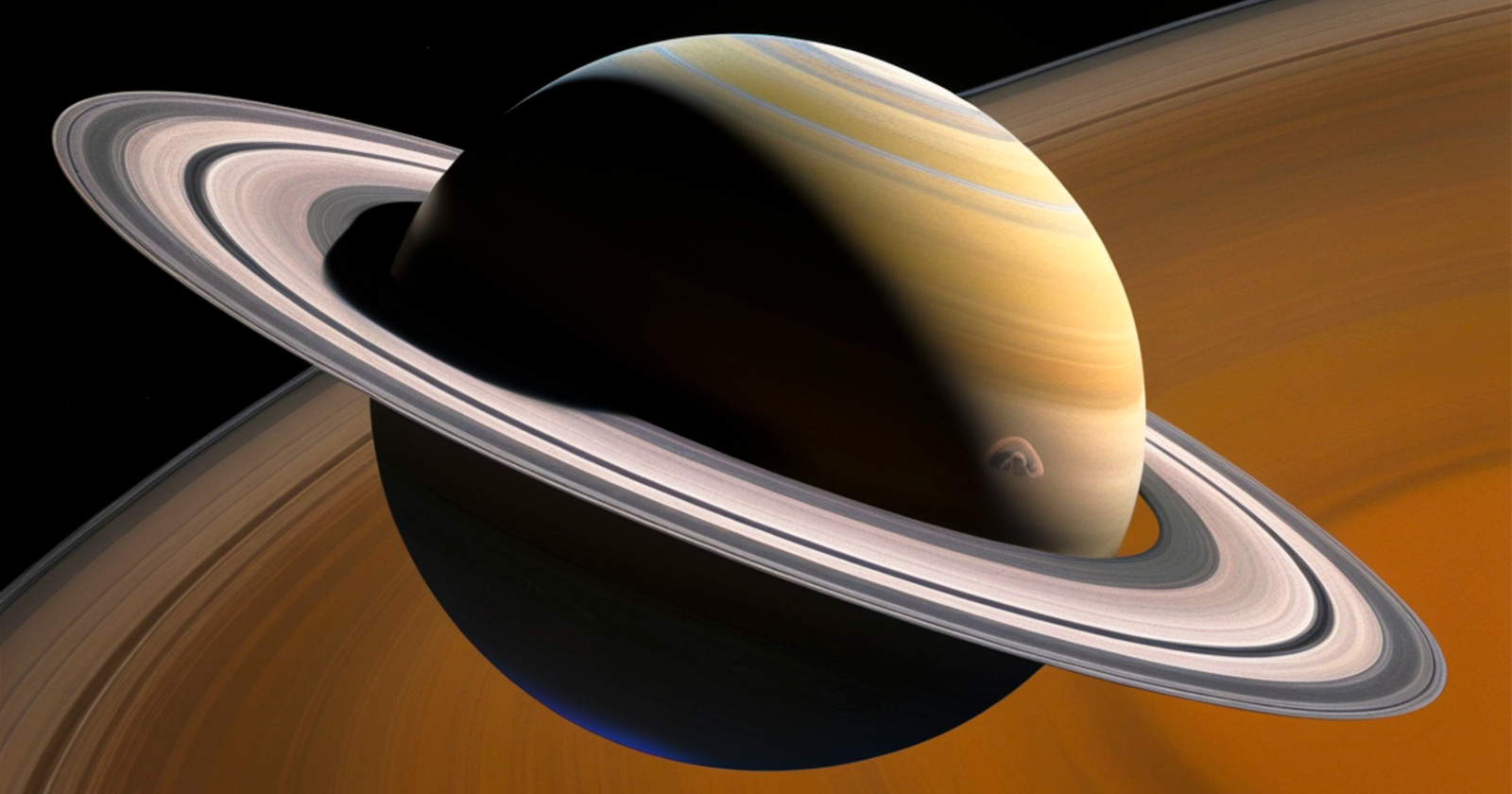
Saturn’s average density is about 0.687 grams per cubic centimetre. Water sits at roughly 1. On that measure alone, Saturn is the only planet in the Solar System with an average density lower than water, a point NASA states plainly on its Saturn facts page.
That figure is the source of a line repeated in classrooms and printed on novelty mugs: if you could find an ocean big enough, Saturn would float. The density comparison is sound. The mental image attached to it does most of the misleading.
What the number actually describes
Density is mass divided by volume. Saturn carries about 95 times Earth’s mass, but that mass is spread across a volume more than 750 times larger. Run the division and you get a number below water’s.
The reason is composition. According to NASA’s Saturn fact sheet, Saturn’s atmosphere is roughly 96 per cent molecular hydrogen with a few per cent helium, the two lightest elements there are. Most of the planet’s bulk is these gases, compressed into liquid and, deeper down, into liquid metallic hydrogen. NASA describes a dense core of iron, nickel and rocky material at the centre, but it sits beneath tens of thousands of kilometres of far lighter material. Averaged across the whole sphere, the light outer layers win.
So the headline figure is doing honest work. It tells you something true and specific about what Saturn is made of.
Why the bathtub image misleads
Buoyancy, as most people picture it, involves a solid object sitting on the surface of a liquid and displacing its own volume. A cork does this. A ship’s hull does this. Saturn cannot, because Saturn has no solid surface to rest on. It grades from near-vacuum at the top of the atmosphere to crushing pressures at the centre, with no boundary where a hull would sit.
Then there is the ocean. To float a body around 120,000 kilometres across, you would need a quantity of water larger than the planet itself. Water on that scale would not behave like a still bathtub. It would have enormous gravity and crushing internal pressures of its own. The water would form a massive planetary body, while Saturn’s gases and denser interior would be pulled and distorted by the combined gravity. There would be no calm surface for anything to bob on.
And there is Saturn’s own gravity, the thing holding the planet together in the first place. Put the scenario into real physics and you do not get a planet floating like an apple. You get two huge masses falling toward each other.
The float claim takes a true statement about average density and quietly swaps in the intuition we hold about solid objects in small tubs of water. The number survives the swap. The picture does not.
What the density is good for
The useful part of the factoid is the part that gets the least attention. A planet’s average density is one of the first things that tells you what kind of planet you are looking at.
Saturn’s low figure places it firmly with the gas giants and well apart from the rocky inner planets, whose densities run several times higher. On NASA’s comparison of planetary densities, Earth sits near 5.5 grams per cubic centimetre. Set that beside Saturn’s 0.69 and the gap stops being a curiosity. It reads as a fingerprint of two different ways a planet can form and what it ends up made of.
The figure also separates Saturn from Jupiter, the gas giant it tends to get lumped with. Jupiter is denser, closer to 1.3 grams per cubic centimetre. Saturn is the lighter of the two for its size, which is part of why its density stands out at all.
What to keep from the factoid
The density comparison is accurate and worth knowing. Saturn really is, on average, lighter for its size than water, and it is the only planet in the Solar System for which that holds.
The bathtub is best read as a teaching image rather than a literal claim. It makes the number memorable, which is most of its job. Look past the picture and the figure points at something steadier: a planet built almost entirely from the lightest elements, with its small dense core kept well out of sight.
Quelle: SD