Artemis II astronauts make long-distance call to the space station as they head home from the moon
Still aglow from their triumphant lunar flyby, the Artemis II astronauts put in a call to their friends aboard the International Space Station as they headed home from the moon. (AP produced by Javier Arciga)
It was the first moonship-to-spaceship radio linkup ever. NASA’s Apollo crews had no off-the-planet company back in the 1960s and 1970s, the last time humanity set sail for deep space.
“We have been waiting for this like you can’t imagine,” Artemis II commander Reid Wiseman called out.
For Christina Koch on Artemis II and Jessica Meir aboard the space station, it marked a joyous space reunion despite being 230,000 miles (370,000 kilometers) apart. The two teamed up for the world’s first all-female spacewalk in 2019 outside the orbiting lab.
Koch told her “astro-sister” that she’d hoped to meet up with her again in space “but I never thought it would be like this — it’s amazing.”
“I’m so happy that we are back in space together,” Meir replied, “even if we are a few miles apart.”
Houston’s Mission Control arranged the cosmic chitchat between the four lunar travelers and the space station’s three NASA and one French residents.
Koch described being awe-struck by not just the beauty of Earth, “but how much blackness there was around it.”
“It just made it even more special. It truly emphasized how alike we are, how the same thing keeps every single person on planet Earth alive,” she told the space station crew. “The specialness and preciousness of that really is emphasized” when viewing the home planet from the moon.
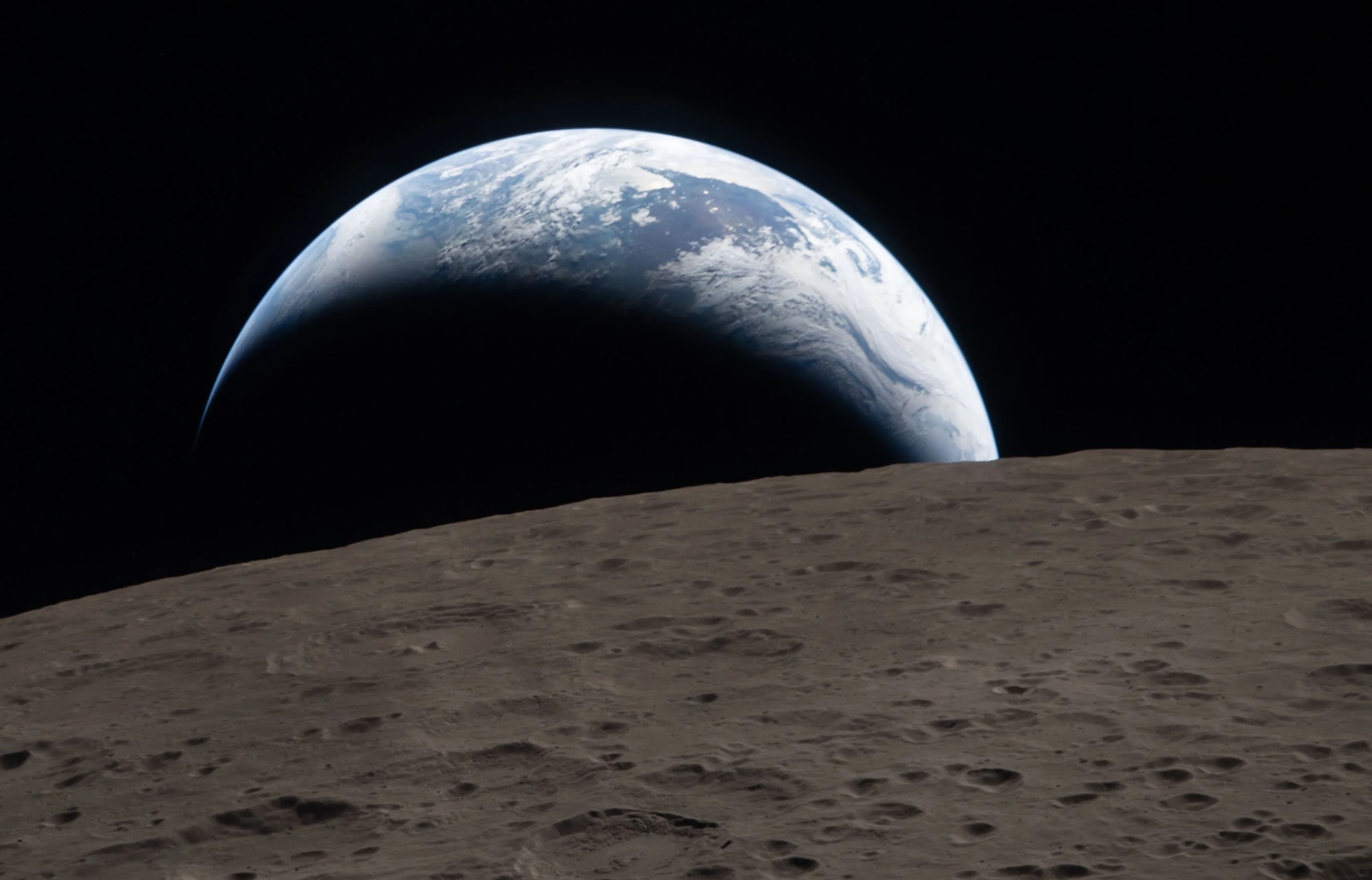
By late Tuesday afternoon, the Artemis II astronauts had beamed back more than 50 gigabytes’ worth of pictures and other data from the previous day’s lunar rendezvous, which set a new distance record for humanity. The highlight: an Earthset photo reminiscent of Apollo 8’s Earthrise shot from 1968.
“While they are inspirational and, I think, allow all of us to really feel a little bit of what they were feeling, there’s also a lot of science hidden inside of those images,” said Mission Control’s lead lunar scientist Kelsey Young. “The conversations and the science lessons learned are just beginning.”
During a debriefing with Young, the astronauts recounted how they spotted a cascade of pinpricks of light on the lunar surface from impacting cosmic debris. The flashes lasted mere milliseconds and coincided by chance with Monday evening’s total solar eclipse.
Young said it was too soon to know whether the crew witnessed an actual meteor shower or more random, run-of-the-mill micrometeoroid hits. Either way, there were “audible screams of delight” in the science operations center, she said.
Koch described being awe-struck by not just the beauty of Earth, “but how much blackness there was around it.”
“It just made it even more special. It truly emphasized how alike we are, how the same thing keeps every single person on planet Earth alive,” she told the space station crew. “The specialness and preciousness of that really is emphasized” when viewing the home planet from the moon.
The first lunar explorers since Apollo 17 in 1972, Wiseman and his crew are aiming for a splashdown off the San Diego coast on Friday to wrap up the nearly 10-day test flight. The recovery ship USS John P. Murtha left port Tuesday for the target zone.
It sets the stage for next year’s Artemis III, a lunar lander docking demo in orbit around Earth. Artemis IV will follow in 2028 with two astronauts attempting to land near the lunar south pole.
As for the Orion capsule’s pesky potty, Mission Control assured the astronauts that no maintenance was required Tuesday. The toilet has been on-and-off limits to the crew ever since last week’s launch, prompting them to rely on a backup bag-and-funnel system for urinating.
NASA Administrator Jared Isaacman told the crew following the lunar flyby Monday night: “We definitely have to fix some of the plumbing” ahead of the next Artemis mission. Engineers suspect a clogged filter in the overboard flushing system.
Aside from the toilet and other relatively minor matters, the mission has gone well, Isaacman noted at a news conference Tuesday, “but I’ll breathe easier when we get through reentry and everybody’s under chutes and in the water.”
Quelle: AP
+++
Artemis II Flight Day 7: Crew Makes Long‑Distance Call, Begins Return
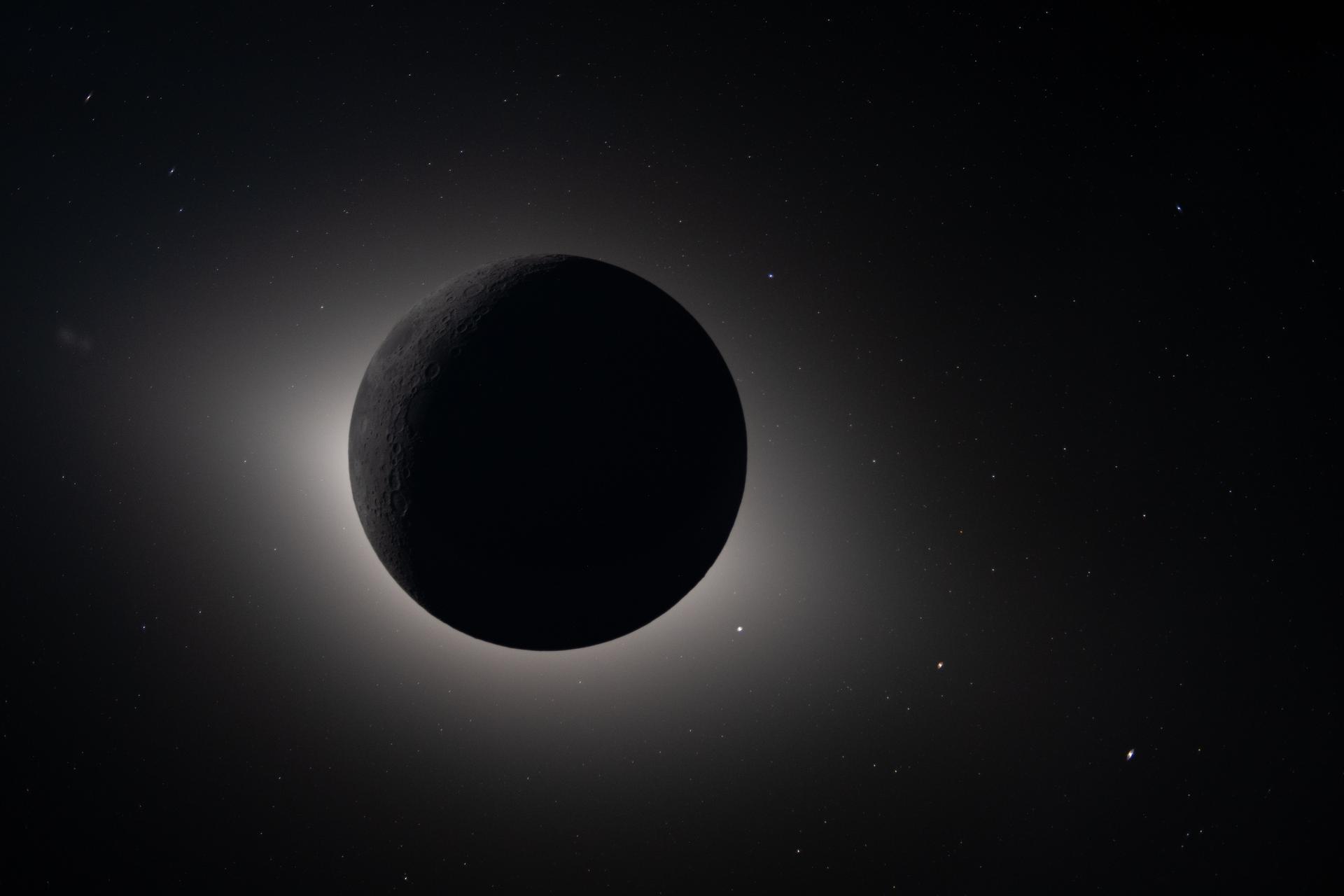
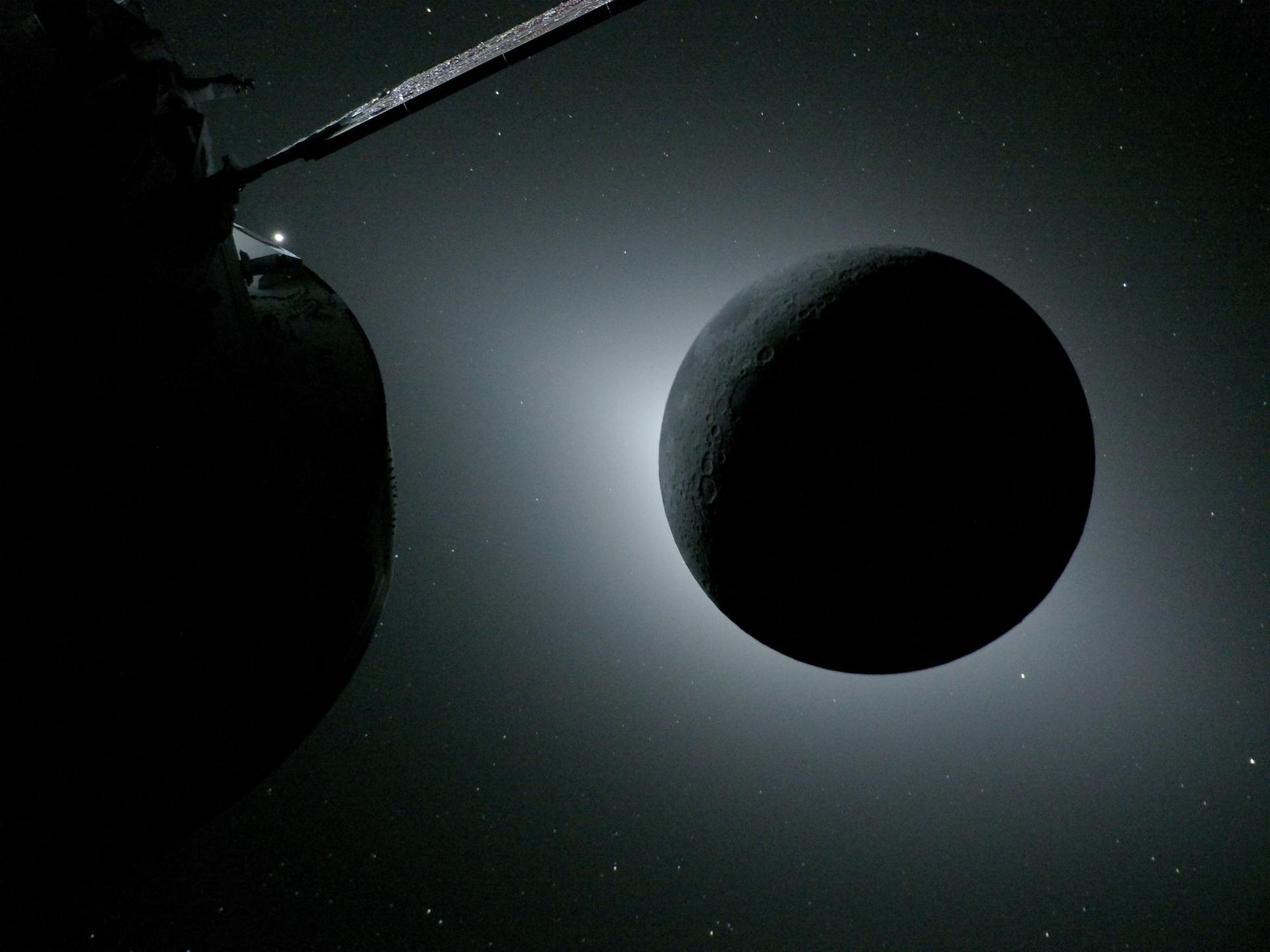
A close-up view of the eclipse as seen by the Artemis 2 crew on April 6, 2026. The bright-white object visible at left is the planet Venus. (Image credit: NASA)
April 6, 2026) – Earthset captured through the Orion spacecraft window at 6:41 p.m. EDT, April 6, 2026, during the Artemis II crew’s flyby of the Moon. A muted blue Earth with bright white clouds sets behind the cratered lunar surface. The dark portion of Earth is experiencing nighttime. On Earth’s day side, swirling clouds are visible over the Australia and Oceania region. In the foreground, Ohm crater has terraced edges and a flat floor interrupted by central peaks. Central peaks form in complex craters when the lunar surface, liquefied on impact, splashes upwards during the crater’s formation.
NASA
After their historic lunar flyby on April 6, the Artemis II crew is awake and preparing for the journey back to Earth. The crew started the day 36,286 miles from the Moon and 236,022 miles from Earth, waking to the sounds of “Tokyo Drifting,” by Glass Animals and Denzel Curry.
At 1:23 p.m. EDT, the Orion spacecraft and its crew — NASA astronauts Reid Wiseman, Victor Glover, and Christina Koch, along with CSA (Canadian Space Agency) astronaut Jeremy Hansen — will exit the lunar sphere of influence, marking their shift out of the Moon’s gravity.
First images from flyby
Earlier Tuesday, The White House and NASA shared the first images from the lunar flyby featuring Earthset (above) and the solar eclipse (below):
(April 6, 2026) – Captured by the Artemis II crew during their lunar flyby on April 6, 2026, this image shows the Moon fully eclipsing the Sun. From the crew’s perspective, the Moon appears large enough to completely block the Sun, creating nearly 54 minutes of totality and extending the view far beyond what is possible from Earth. The corona forms a glowing halo around the dark lunar disk, revealing details of the Sun’s outer atmosphere typically hidden by its brightness. Also visible are stars, typically too faint to see when imaging the Moon, but with the Moon in darkness stars are readily imaged. This unique vantage point provides both a striking visual and a valuable opportunity for astronauts to document and describe the corona during humanity’s return to deep space. The faint glow of the nearside of the Moon is visible in this image, having been illuminated by light reflected off the Earth.
NASA
Artemis II reaches out to Expedition 74
The Artemis II crew will speak with NASA astronauts Jessica Meir, Jack Hathaway, and Chris Williams, and ESA (European Space Agency) astronaut Sophie Adenot aboard the International Space Station during a 15-minute ship-to-ship, audio-only call beginning at 2:40 p.m. to share their mission experiences. The call can be heard on NASA’s YouTubechannel.
Lunar science download
Before Orion travels too far from the Moon, the crew will join science officers on the ground at 3 p.m. for a debrief. Teams are eager to hear the crewmembers’ impressions while yesterday’s lunar flyby is still fresh in their minds, gathering insights that will help inform future lunar science and exploration efforts.
Taking a break
Following the science debrief, the crew will have staggered off-duty periods, giving them time to rest and recharge before beginning their final tasks for the return to Earth.
NASA will host a mission status briefing at 4:30 p.m. on the agency’s YouTube channel.
Homeward bound
Marking their first push home, Orion’s thrusters are planned to ignite at 9:03 p.m. for the first of three return trajectory correction burns. This maneuver will adjust the spacecraft’s path and refine Orion’s course toward Earth. Koch and Hansen will review procedure and monitor spacecraft systems during the return burn.
Quelle: NASA
+++
NASA to Host Media Call with Artemis II Crew on Way Home from Moon
Media will have an opportunity at 9:45 p.m. EDT on Wednesday, April 8, to speak with NASA’s Artemis II crew members as they continue their journey toward Earth during their historic mission around the Moon.
The 20-minute virtual news conference will take place with NASA astronauts Reid Wiseman, Victor Glover, and Christina Koch, and CSA (Canadian Space Agency) astronaut Jeremy Hansen.
Live coverage will stream on NASA’s YouTube channel. An instant replay will be available online. Learn how to watch NASA content on a variety of platforms, including social media.
Members of the media previously credentialed at NASA’s Johnson Space Center in Houston and planning to be onsite must RSVP for consideration to ask a question during the call. NASA will prioritize media outlets that have not yet spoken to the Artemis II astronauts in space.
With just days until the crew splashes down off the coast of San Diego on Friday, April 10, the Artemis II test flight has reached multiple milestones, including a successful launch, manually piloting the Orion spacecraft, multiple spacecraft moves to propel Orion to the Moon and adjust its course during the flight, surpassing the Apollo 13 record for farthest crewed spaceflight, and a lunar flyby to view the far side of the Moon.
Artemis II is the first crewed mission under the agency’s Artemis program, where NASA is sending astronauts on increasingly difficult missions to explore more of the Moon for scientific discovery, economic benefits, and to build on our foundation for the first crewed missions to Mars.
Quelle: NASA
+++
NASA’s Artemis II Crew Beams Official Moon Flyby Photos to Earth
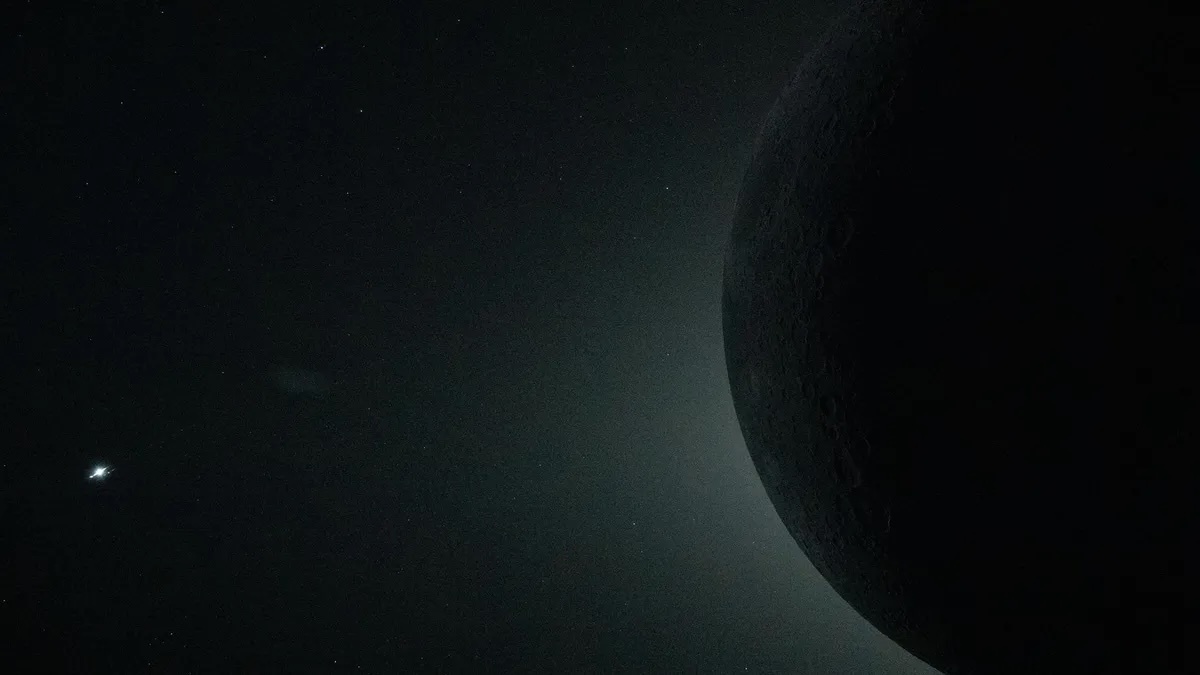
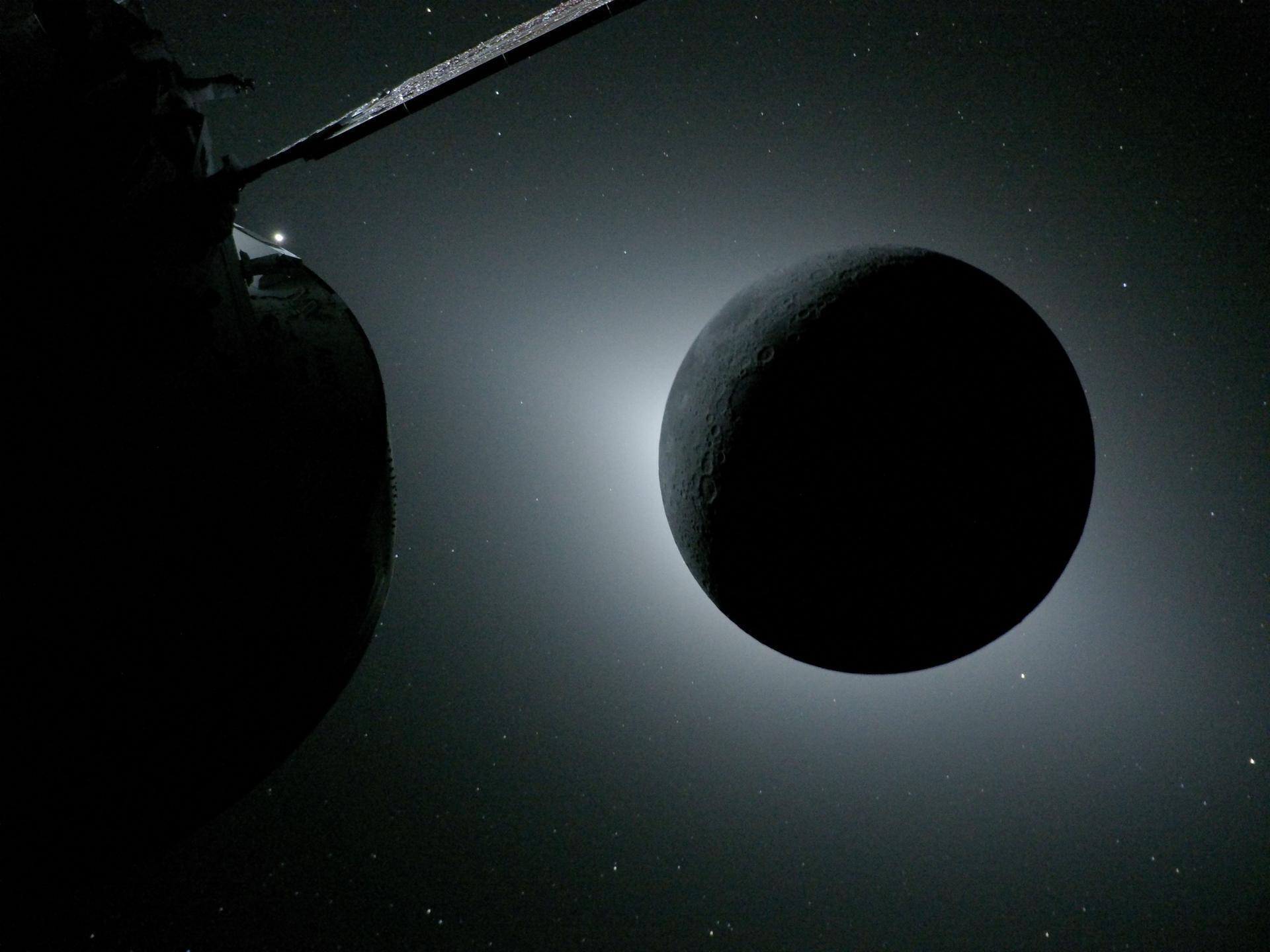
The Moon, backlit by the Sun during a solar eclipse, is photographed by NASA’s Orion spacecraft on Monday, April 6, 2026, during the Artemis II mission. Orion is visible in the foreground on the left. Earth is reflecting sunlight at the left edge of the Moon, which is slightly brighter than the rest of the disk. The bright spot visible just below the Moon’s bottom right edge is Saturn. Beyond that, the bright spot at the right edge of the image is Mars.
Credit: NASA
The first flyby images of the Moon captured by NASA’s Artemis II astronauts during their historic test flight reveal some regions no human has seen, including a rare in-space solar eclipse. Released Tuesday, astronauts captured the images April 6 during the mission’s seven-hour flyby of the lunar far side, showing humanity’s return to the Moon’s vicinity and opening a trove of scientific data.
NASA astronauts Reid Wiseman, Victor Glover, Christina Koch, and CSA (Canadian Space Agency) astronaut Jeremy Hansen, have used a fleet of cameras to take thousands of photos. The agency released several images, with more expected in the coming days as the crew members are more than halfway through their journey and now headed home toward Earth.
“Our four Artemis II astronauts — Reid, Victor, Christina, and Jeremy — took humanity on an incredible journey around the Moon and brought back images so exquisite and brimming with science, they will inspire generations to come,” said Dr. Nicky Fox, associate administrator, Science Mission Directorate, NASA Headquarters in Washington.
During the lunar flyby, the crew documented impact craters, ancient lava flows, and surface fractures that will help scientists study the Moon’s geologic evolution. They monitored color, brightness, and texture differences across the terrain, observed an earthset and earthrise, and captured solar‑eclipse views of the Sun’s corona. The crew also reported six meteoroid impact flashes on the darkened lunar surface.
Scientists already are analyzing the downlinked images, audio, and data to refine the timing and locations of these events and compare them with observations from amateur astronomers. The new imagery also will help NASA better understand the Moon’s geology and inform future exploration and science missions that will lay the foundation for an enduring presence on the Moon ahead of future astronaut missions to Mars.
“It was remarkable listening to the crew describe the stunning views during the flyby,” said Jacob Bleacher, NASA’s chief exploration scientist at the agency’s headquarters. “At first, their descriptions didn’t quite match what we were seeing on our screens. Now that higher resolution images are coming down, we can finally experience the moments they were trying to share and truly appreciate the scientific return provided by these images and our other research on this mission.”
NASA is targeting 8:07 p.m. EDT (5:07 p.m. PDT) Friday, April 10, for the return of Artemis II off the coast of San Diego. NASA+ live return coverage begins at 6:30 p.m. and will continue until NASA and Department of War personnel safely assist the crew out of Orion and transport them to the USS John P. Murtha.
Briefings, events, and 24/7 mission coverage are streaming on NASA’s YouTube channel and events will each have their own stream closer to their start time. Learn how to watch NASA content through a variety of online platforms, including social media.
As part of Golden Age of innovation and exploration, NASA will send Artemis astronauts on increasingly difficult missions to explore more of the Moon for scientific discovery, economic benefits, and to build on our foundation for the first crewed missions to Mars.
Quelle: NASA
+++
Artemis II Flight Day 7: First Return Correction Burn Complete
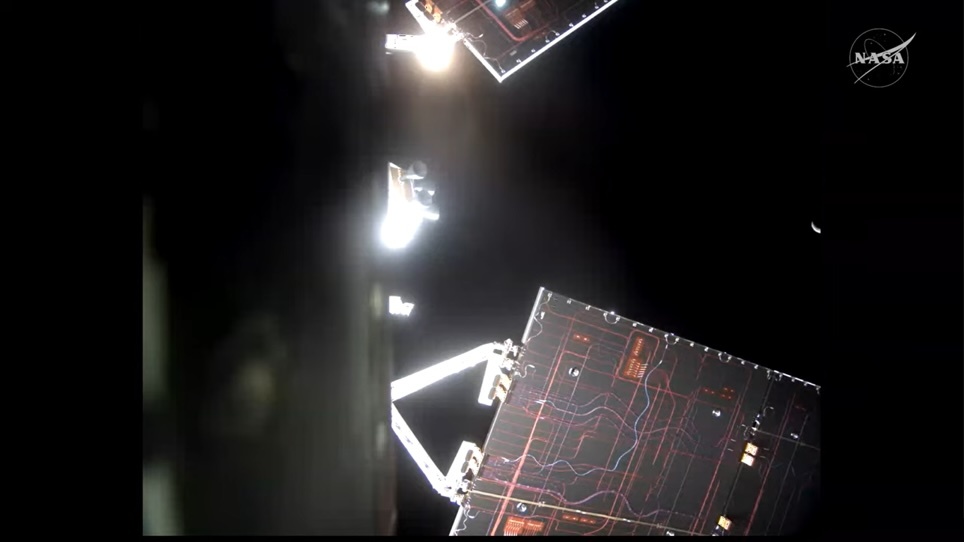
A live view shows the Orion spacecraft and its solar arrays as the Artemis II crew completed the mission’s first return correction burn on Flight Day 7.
At 8:03 p.m. EDT, the Orion spacecraft, named Integrity, ignited its thrusters for 15 seconds, producing a change in velocity of 1.6 feet-per-second and guiding the Artemis II crew toward Earth. NASA astronaut Christina Koch and CSA (Canadian Space Agency) astronaut Jeremy Hansen reviewed procedures and monitored the spacecraft’s configuration and navigation data.
During today’s mission status briefing, NASA officials shared the first images received from the crew during the lunar flyby and confirmed that the USS John P. Murtha has left port and is headed to the midway point toward the recovery site in the Pacific Ocean. The agency will provide updates on recovery operations and weather during the daily Mission Status briefings.
Looking ahead, the crew will settle in for a full night’s rest before a busy day of flight test objectives and return to Earth tasks on Wednesday, April 8.
Going with the blood flow
NASA astronauts Reid Wiseman, Victor Glover, along with Koch and Hansen, are scheduled to test an orthostatic intolerance garment. During the test, the crew will evaluate the garments — specialized equipment designed to help astronauts maintain blood pressure and circulation during the transition back to Earth’s gravity.
PilotingOrion
Following the garment testing, the crew will take manual control of the spacecraft, using Orion’s field of view to center a designated target before guiding the spacecraft to a tail to Sun attitude and comparing Orion’s control modes. The manual piloting demonstration will begin at 9:59 p.m.
The Moon, backlit by the Sun during a solar eclipse, is photographed by NASA’s Orion spacecraft on April 6. Orion is visible in the foreground on the left. The bright spot visible just below the Moon’s bottom right edge is Saturn. Beyond that, the bright spot at the right edge of the image is Mars.
Credit: NASA
HOUSTON—Following a record-setting, seven-hour pass beyond the far side of the Moon, NASA’s Artemis II astronauts returned into the gravitational sphere of Earth April 7 as they continued a free-return trajectory that will bring their nine-day mission to a close with a splashdown in the Pacific Ocean on April 10.
Prior to the crew waking up to begin their seventh day in space, the first images and recorded audio notes from their science observations during the lunar flyby were transmitted back to Earth for analysis.
The downlink, much of which was via an optical communications link, included pictures of the lunar terrain, showing color, brightness, surface textures and other features intended to give scientists a better understanding of the composition and evolutionary history of the Moon. Some of the far-side features were seen by human eyes for the first time, as the Artemis II Orion spacecraft soared 4,000-6,000 mi. beyond the lunar surface, a span that far exceeded the distance of the Apollo capsules’ orbits during the agency’s first forays to the Moon between 1968-72.
“What you did yesterday really made a difference scientifically,” Kelsey Young, the Artemis II lunar science lead, radioed to the astronauts April 7. “Our whole lunar science team and the broader science community have been pouring out positive feedback and gratitude.”
The observations by Orion astronauts Reid Wiseman, Victor Glover and Christina Koch, all with NASA, and Canadian Space Agency astronaut Jeremy Hansen included 4-6 bright flashes from micrometeorites that were visible during the final hour of the flyby when the Sun was eclipsed by the Moon.
“I don’t know if I expected to have the crew see any on this mission,” Young told reporters April 7. “I was not in the science evaluation room [at the time], but I heard there were audible screams of delight.”
With the optical communications link, NASA was able to download 20 gigabytes of data in a little more than 45 min. “That’s orders of magnitude more than we get via our S-band telemetry system,” flight director Rick Henfling told reporters. “Optical comm has been working really well, and hopefully we can take what we learned on Artemis II and expand its operational capability and implementation for future missions.”
The Orion capsule, named Integrity, left the Moon’s sphere of gravitational influence and fell back in the gravitational embrace of Earth at 1:23 p.m. EDT when Integrity was 41,072 mi. from the Moon. The transition was a seamless phase of the capsule’s “free return” trajectory provided by orbital mechanics, rather than chemical propulsion.
The Artemis II mission lifted off April 1 from NASA’s Kennedy Space Center. Following a 25-hr. checkout in high-Earth orbit, Orion’s European Space Agency-provided service module performed a 5 min. 50 sec. engine burn to begin the eight-day loop around the Moon and return to Earth. Integrity’s splashdown off the coast of San Diego on April 10 is expected at 8:06 p.m. EDT.
Integrity’s closest approach to the Moon—4,067 mi. — occurred at 7:02 p.m. EDT April 6 with the ship flying 3,138 mph relative to the lunar surface,
The first of three planned thruster firings to tweak Orion’s return trajectory was expected about 9 p.m. on April 7.
Earlier in the day, Wiseman, Glover, Koch and Hansen participated in a ship-to-ship call with astronauts aboard the International Space Station (ISS) to discuss their lunar flyaround.
“We know how fortunate all of us are to come up here and look down at the Earth from above. Every astronaut who comes to space remarks on that. We really wanted to hear how different that felt now from your new perspective around the Moon,” astronaut Jessica Meir radioed to the Artemis II crew from aboard the ISS.
“The thing that changed for me looking back at Earth was that I found myself noticing not only the beauty of the Earth, but how much blackness there was around it. It just made it even more special,” Koch replied.
“It truly emphasized how alike we are, how the same thing keeps every single person on planet Earth alive. We evolved on the same planet. We have some shared things about how we love and live that are just universal, and the specialness and preciousness of that is really emphasized when you notice how much else there is around it,” she said.
On a lighter note, Koch told Meir, “Jessica, I always hoped we would be in space again together, but I never thought it would be like this.”
The women flew together on the ISS from September 2019-April 2020.
At the time of the ship-to-ship, the ISS was orbiting 267 mi. above Earth south of Africa, and Orion was 231,793 mi. away from Earth.
Quelle: AVIATION WEEK
+++
How the Artemis II crew trained to observe and photograph the moon: A NASA science team geologist explains
The Artemis II crew has now broken the record — previously held by Apollo 13 — for the farthest distance any humans have ever travelled from Earth. The crew also completed a flyby of the moon’s far side and sent back some amazing images of the lunar surface.
I am a professor, an explorer and a planetary geologist, specializing in the study of meteorite impact structures. I am also a member of the First Artemis Lunar Surface Science Team and have been supporting NASA in developing the geology training for Artemis astronauts.
The flyby was particularly exciting as it offered a stunning new perspective of the lunar surface. It also provided the first operational test of a new science team and evaluation room at Mission Control in NASA’s Johnson Space Center in Houston, Texas.
And it was fantastic to see the Artemis II crew conduct observations and take photographs of geological landforms on the moon’s surface — putting their training with me at the Kamestastin Lake impact structure, on the territory of the Mushuau Innu First Nation in northern Labrador, into practice.
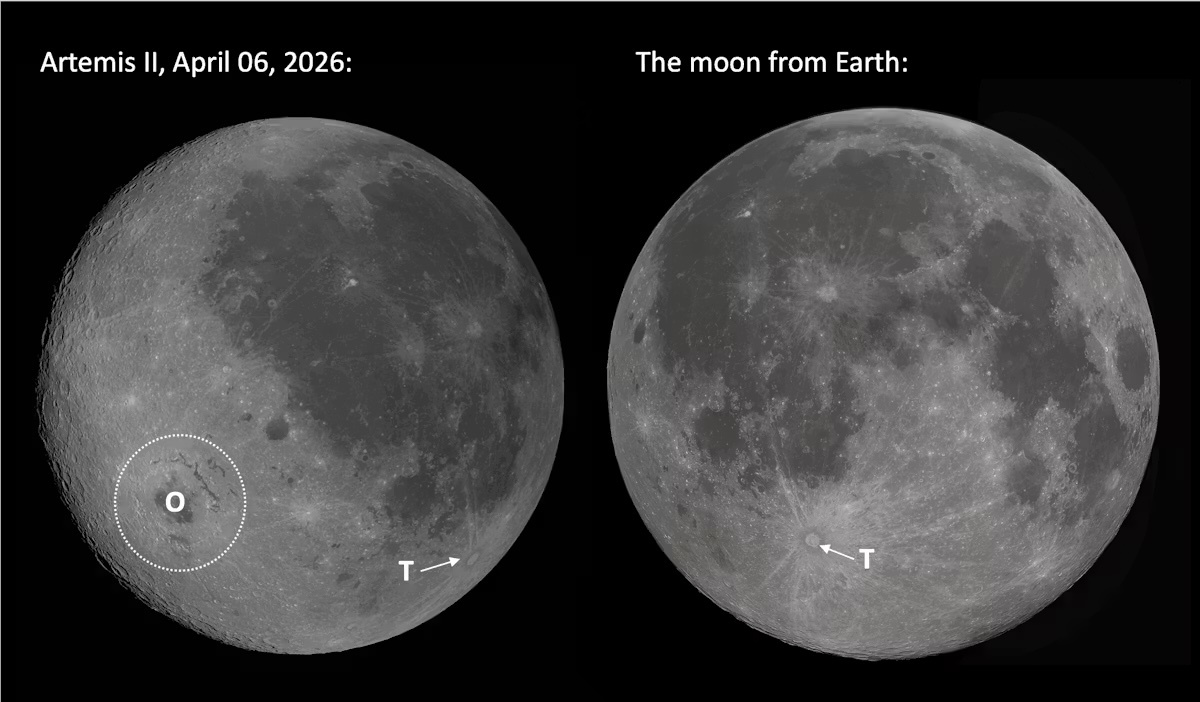
This greater distance allowed the crew to view the moon as a full disk, including regions near both the North Pole and South Pole.
The moon, viewed from Earth and by Artemis II crew. T marks the Tycho crater; O marks the Orientale crater.(G. R. Osinski using NASA images
The crew was also able to take targeted photographs of various geological landforms on the lunar surface as part of the Artemis II science program. One of the primary goals of these investigations is to inform future missions, including the planned first journey back to the lunar surface with Artemis IV as soon as 2028.
A new science team
One of the highlights of NASA’s livestream during the mission has been the direct conversations between two good friends: Canadian astronaut Jeremy Hansen and science officer Kelsey Young.
Science officers are the senior flight controllers responsible for lunar science and geology objectives during Artemis missions.
They act as the main interface between the wider Mission Control team and the Artemis II science team, which is located in a totally separate room called the Science Evaluation Room (SER).
Both science officers and the evaluation room are brand new for NASA’s Artemis program; they did not exist during the Apollo program.
We have been developing the structure and defining roles in the SER for the first Artemis mission to the moon’s surface. But there is nothing like a real mission to test and refine how the science team should work.
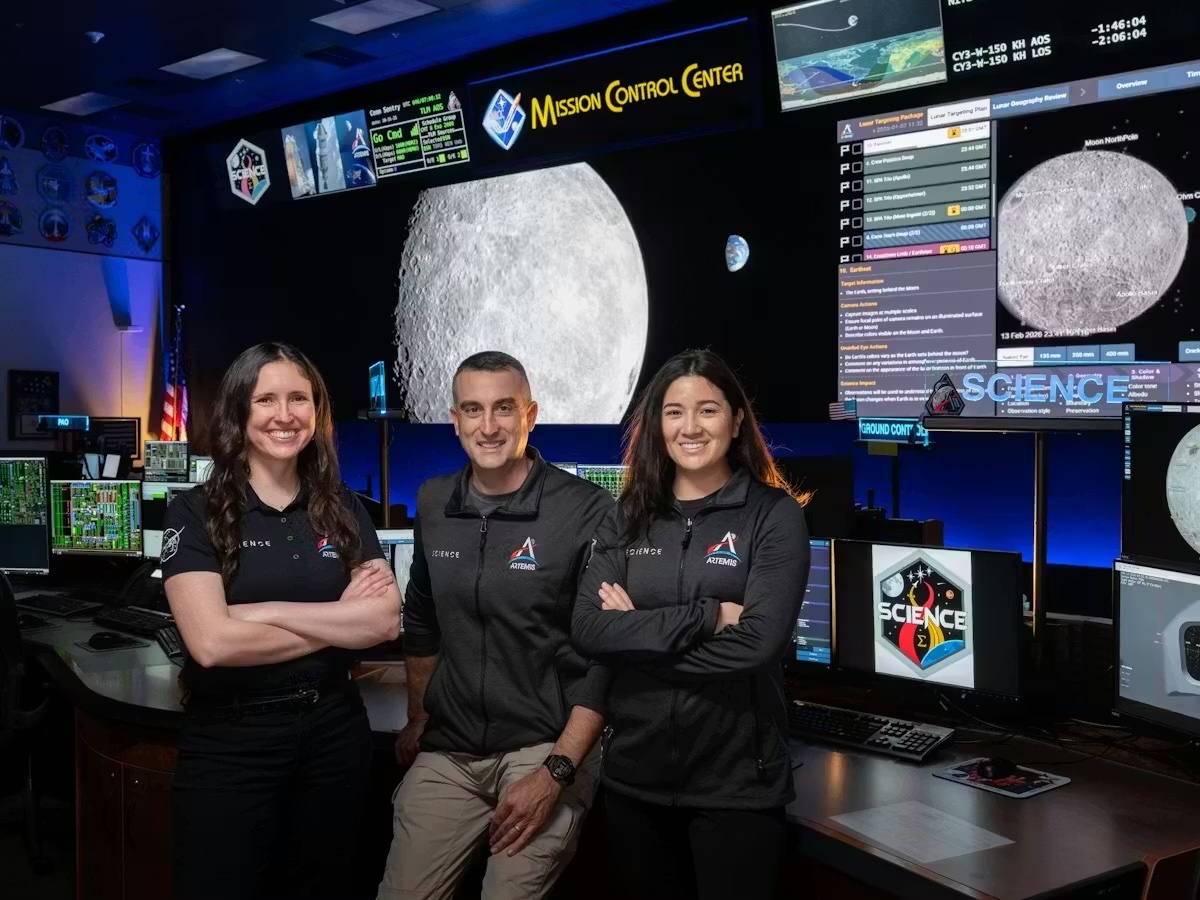
Artemis science officers, from left, Kelsey Young, Trevor Graff, and Angela Garcia stand at the new SCIENCE console in the Mission Control Center at NASA’s Johnson Space Center in Houston.(NASA/Josh Valcarcel)
A crash course in lunar geology
If you listened in to NASA’s livestream and heard any of the geological descriptions the astronauts were giving, I hope you were impressed — I certainly was!
Their knowledge is a testament to the geology training that NASA has provided the crew in the months and years since they were selected for the Artemis program.
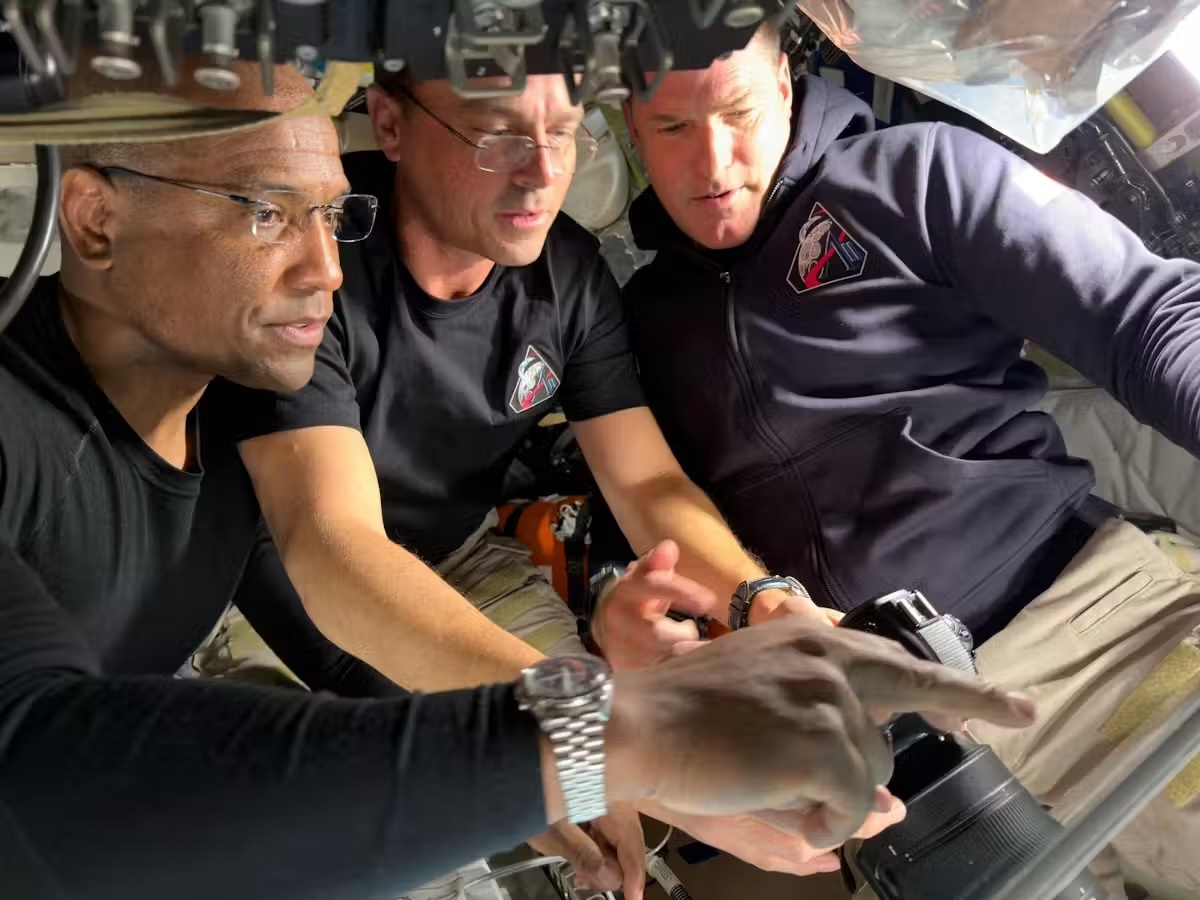
Artemis II Pilot Victor Glover, Commander Reid Wiseman, and Mission Specialist Jeremy Hansen configure their camera equipment shortly before beginning their lunar flyby observations.(NASA)
First, the crew participated in a crash course in lunar geology called “Lunar Fundamentals.” This weeklong, classroom-based training offered them the basics to understand lunar geology and the processes that shape the moon’s surface — primarily impact cratering and volcanism.
However, as somebody who has been teaching for more than 20 years, I know the best place to learn about geology is in the field. That’s why NASA also took the Artemis astronauts to a series of field sites in the United States, Iceland and Canada.
Early in their training, in September 2023, three of the crew members — Hansen, Christina Koch and back-up crew Jenni Gibbons — undertook geology training at the Kamestastin Lake impact structure in northern Labrador. Then the entire crew travelled to Iceland in August 2024.
Kamestastin Lake training expedition
I was honoured to play a leading role in the Kamestastin Lake training. This location was chosen because it offers a similar landscape to the surface of the moon.
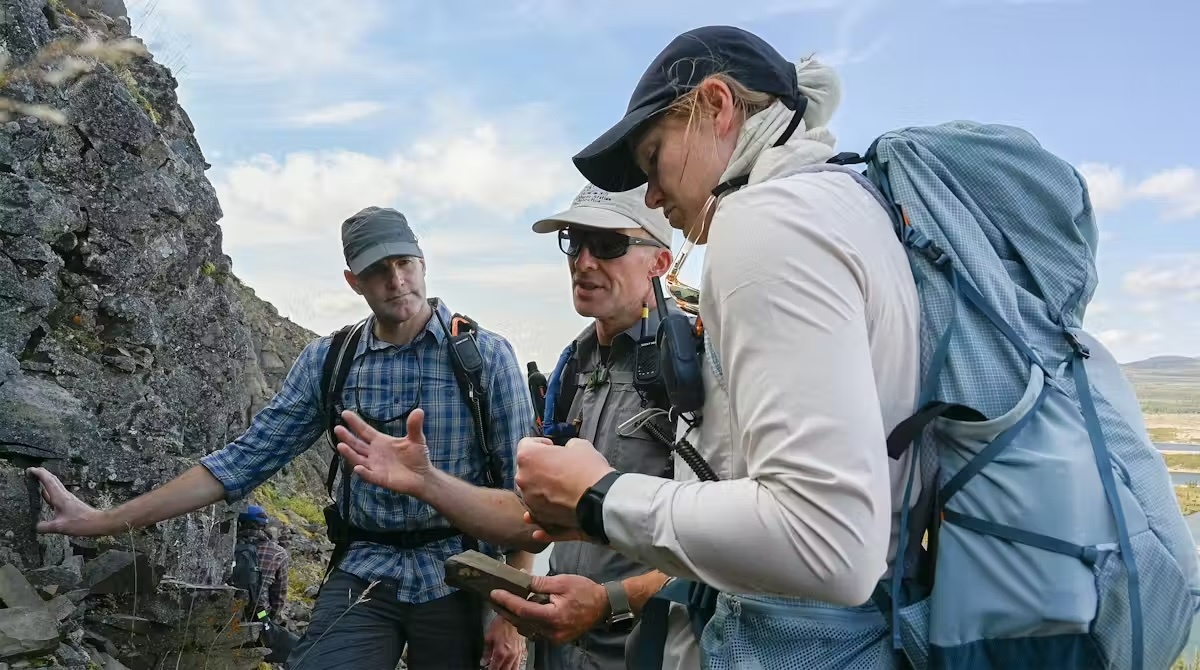
Gordon Osinski (centre) explains the processes that formed the 28-kilometre diameter Kamestastin Lake impact structure to Canadian Space Agency astronauts Jeremy Hansen (left) and Jenni Gibbons (right).(Canadian Space Agency)
The Kamestastin Lake crater was formed approximately 35 million years ago by the impact of an asteroid between one and two kilometres in diameter. Not only are rocks like breccias and impact melt rocks produced by the asteroid’s impact well preserved here, but the crater also formed in a rock called anorthosite — the exact same rock that makes up the lunar highlands.
Kamestastin is in a remote part of northern Labrador, so we flew in via Twin Otter aircraft and established a temporary base camp. From tents to pots and pans and food for 16 people, there was a lot to take care of. We then used zodiac boats to travel around the crater.
Sacred Innu stories of the moon
Kamestastin Lake and the surrounding region are on the territory of the Mushuau Innu First Nation. A key part of my role in the training was liaising with the First Nation, which has been following Hansen on this historic mission.
A highlight for me was sitting around the fire on one of our last nights with Innu Guardians from Natuashish and hearing about how sacred the moon is to them — as it is to many Indigenous Peoples around the world.
They also told us the story of Tshakepesh, an Innu hero who teaches that with courage, hard work and perseverance, one can always overcome difficulties.
As the Artemis II crew return from its journey, I am struck by the parallels. The crew has shown the world what can happen if we work together towards a common goal with courage, hard work, perseverance and humility.