
11.02.2026
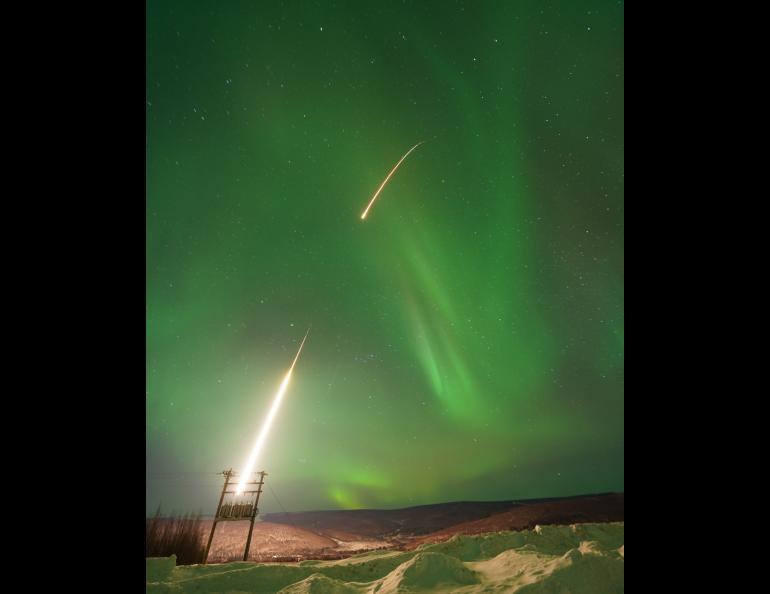
A two-stage NASA sounding rocket launches early Monday, Feb. 9, 2026, from Poker Flat Research Range. The rocket was carrying the Black and Diffuse Aurora Science Surveyor mission. Photo by Craig Heinselman
A second NASA sounding rocket launched from Poker Flat Research Range at about 3:30 a.m. today in a mission to study a form of northern lights known as black aurora.
The University of Alaska Fairbanks Geophysical Institute owns Poker Flat, located at Mile 30 Steese Highway, and operates it under a contract with NASA’s Wallops Flight Facility, which is part of Goddard Space Flight Center.
The Black and Diffuse Aurora Science Surveyor mission, led by Marilia Samara of Goddard Space Flight Center, launched 10 days after Poker Flat’s first launch of the season.
The launch window for a third mission, consisting of two rockets, closes Feb. 20. That experiment, led by Dartmouth College physics and astronomy professor Kristina Lynch, aims to gather information about how disturbances in Earth’s middle and upper ionosphere distort auroral curtains.
The two-stage rocket of Samara’s mission flew north on the second day of the two-week launch window. The mission was on the launchpad at Poker Flat in early 2025, but the necessary aurora conditions didn’t materialize before the launch window closed.
Black auroras form when streams of auroral particles temporarily thin or shut off in small regions of the upper atmosphere, creating well-defined dark shapes within the broader glow of a diffuse aurora. Diffuse auroras themselves are typically faint and spread over large areas.
Black auroras look as though pieces of the aurora have been erased. These dark structures drift and evolve along with the surrounding aurora.
Quelle: Geophysical Institute, University of Alaska Fairbanks
----
Update: 17.02.2026
.
NASA launches twin rocket missions from Alaska to study mysterious black auroras
A better understanding of the electrical activity within auroras could help us protect our astronauts and satellites.
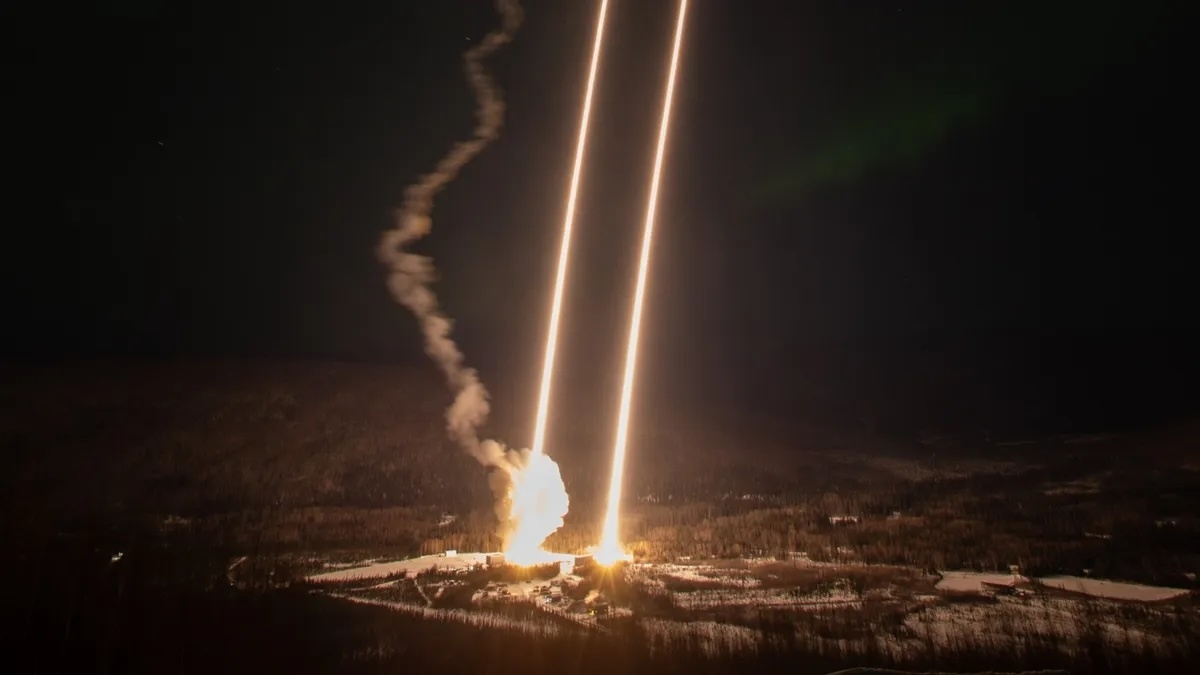
A long exposure shot of two sounding rockets launching from the Poker Flat Research Range near Fairbanks, Alaska on Feb. 10. (Image credit: NASA/Teik Araya)
NASA launched two rockets from Alaska this week to learn more about the electrical "circuitry" within auroras, the colorful light shows that occur when solar wind collides with Earth's atmosphere.
The missions saw two suborbital sounding rockets launch from the Poker Flat Research Range near Fairbanks, Alaska loaded with scientific equipment that will fly into the atmosphere for a short period of time to gather data.
The destination for the rockets in both missions was the northern lights, or aurora borealis.
The Black and Diffuse Auroral Science Surveyor (BADASS) mission launched in the early morning of Feb. 9 to study black auroras, an event that occurs when electrons shoot up into space, instead of flowing toward Earth, which is what happens with other auroras.
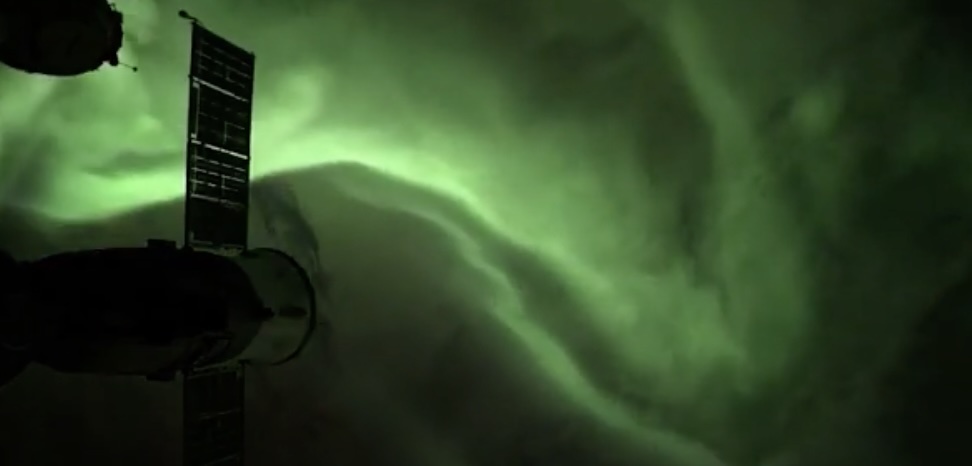
The rocket reached an altitude of 224 miles (360 km) before falling back to Earth. The BADASS mission's principal investigator Marilia Samara said everything went according to plan and that the scientific instruments on the rocket performed as expected, returning high-quality data that NASA can use to study black auroras and what causes the electron stream reversal to happen.
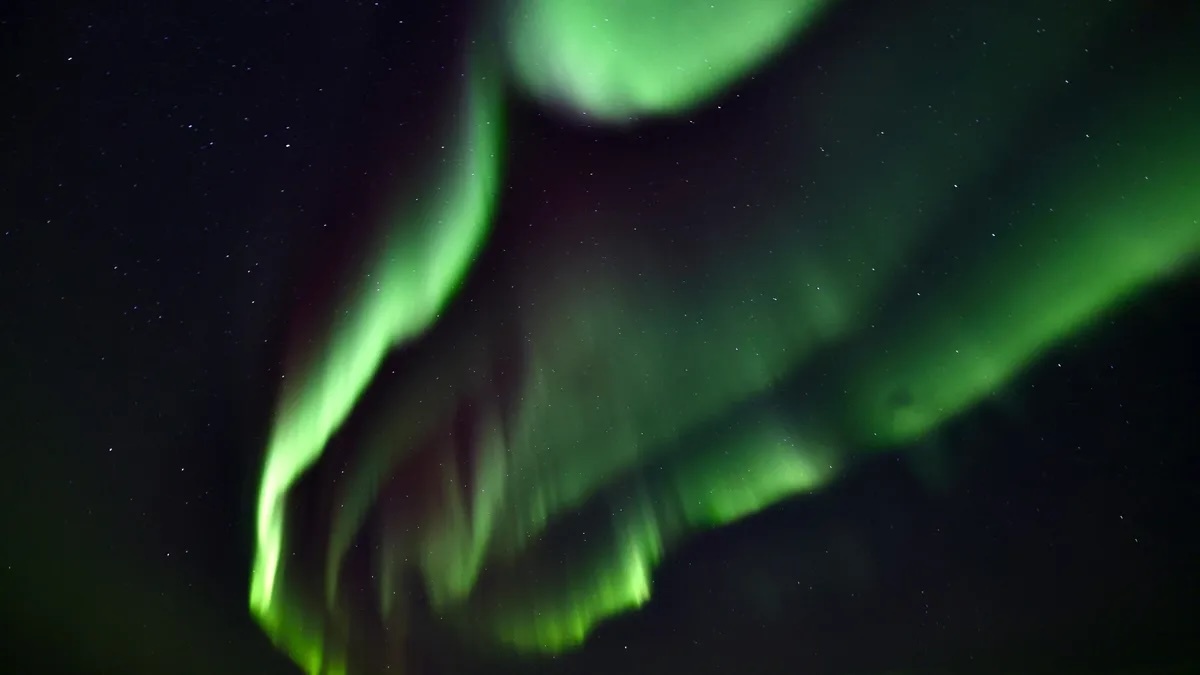
Black aurora seen on a Hurtigruten cruise voyage in Norway. (Image credit: Future/Daisy Dobrijevic)
The Geophysical Non-Equilibrium Ionospheric System Science (GNEISS) mission, pronounced "nice", used a pair of sounding rockets on a wider mission of creating a 'CT scan' of the electric currents flowing in the northern lights.
The GNEISS rockets launched back-to-back on Feb. 10 and reached peak altitudes of 198 miles (319 km) and 198 miles (319 km). The launches for the GNEISS mission went according to plan, gathering data that NASA will use to look into auroras' inner workings.
"We want to know how the current spreads downward through the atmosphere," Kristina Lynch, GNEISS principal investigator and Dartmouth College professor said in a NASA statement.
Using the two rockets with a network of ground receivers, the data gathered during the flight will allow researchers to create a three-dimensional view of an aurora's electoral environment.
"It's essentially like doing a CT scan of the plasma beneath the aurora," Lynch said.
Studying auroras is important, because they are associated with geomagnetic storms, which can cause all kinds of technical issues for satellites in space, as well as endanger astronauts. On Earth, the storms can lead to power blackouts, cause air travel diversions, and interfere with radio transmissions.
Quelle: SC