
12.05.2024
Exploring asteroid Apophis using miniature satellites
The scenario could be lifted straight from a disaster novel: On Friday, April 13, 2029-a date that alone might evoke unease-the asteroid known as (99942) Apophis will make a remarkably close approach to Earth, missing us by just 30,000 kilometers. Visible as a mere speck of light in the night sky from places like Wurzburg, this proximity provides a unique observational opportunity.
Apophis, measuring about 340 meters in diameter, poses a significant risk. Should it collide with Earth, the impact could create a crater several kilometers wide, potentially devastating a region as large as Central Europe, according to Jonathan Mannel, a research associate at the Julius-Maximilians-Universitat Wurzburg's (JMU) Space Technology Chair.
However, there is no immediate threat as NASA's calculations confirm Apophis will avoid Earth for at least the next century. Identified in 2004 as a potentially hazardous object, Apophis has been closely monitored by space agencies worldwide.
Research Opportunity Brought by Apophis
Asteroids are irregularly shaped celestial objects orbiting the sun. Approximately 1.3 million asteroids have been identified, with about 2,500 classified as potentially hazardous. This designation is given to near-Earth asteroids positioned within 20 lunar distances from Earth and larger than 140 meters.
The trajectory, structure, and potential interactions of asteroids when they pass near other celestial bodies raise several scientific questions. Apophis presents a rare research opportunity due to its size and the infrequency of such close encounters with Earth-events that happen once every 1,000 years. This situation offers a practical moment to potentially develop defensive strategies against asteroid threats.
Investigating Mission Concepts in Germany
Professor Hakan Kayal's team at JMU is exploring how Germany could contribute to studying Apophis through the NEAlight project, supported with approximately 300,000 euros from the Federal Ministry for Economic Affairs and Climate Action. Under project leader Jonathan Mannel, and with research assistants Tobias Neumann and Clemens Riegler, the team is assessing three small satellite mission concepts derived from the 2023 SATEX project, which evaluated the capabilities of small satellites for interplanetary tasks.
The first concept involves a national mission where a small satellite would trail Apophis as it approaches Earth, documenting any changes through photographs and measurements. This mission faces numerous technical challenges due to the distance and autonomy required.
The second concept involves collaboration on the European RAMSES mission, which would employ a larger satellite equipped with smaller satellites, telescopes, and other instruments to monitor Apophis. Here, a satellite from Wurzburg would participate, potentially enhancing the scientific yield and reducing the technical demands on JMU's team.
The third concept proposes a brief encounter where a JMU-built satellite would pass close to Apophis to capture photographs. This mission would require minimal resources but offer limited observation time and potentially less scientific data.
Further Plans and Project Goals
By April 2025, Kayal's team aims to finalize the requirements for these scenarios, outline the mission architectures, and assess the feasibility of each approach. This effort will also inform future projects involving interplanetary small satellites aimed at other near-Earth objects or lunar missions.
Launched in early May 2024, the NEAlight project is set to conclude after a year, taking place at the Interdisciplinary Research Centre for Extraterrestrial Studies (IFEX) at JMU's Chair for Space Technology. Funding for the project comes from the German Aerospace Centre (DLR) with an allocation of approximately 306,000 euros provided by the Federal Ministry of Economics and Climate Action.
Quelle: SD
----
Update: 18.07.2024
.
Asteroid Apophis will visit Earth in 2029, and this European satellite will be along for the ride
By characterizing Apophis and how it reacts to being in Earth's gravitational field, Ramses will boost our knowledge of NEOs and planetary defense.
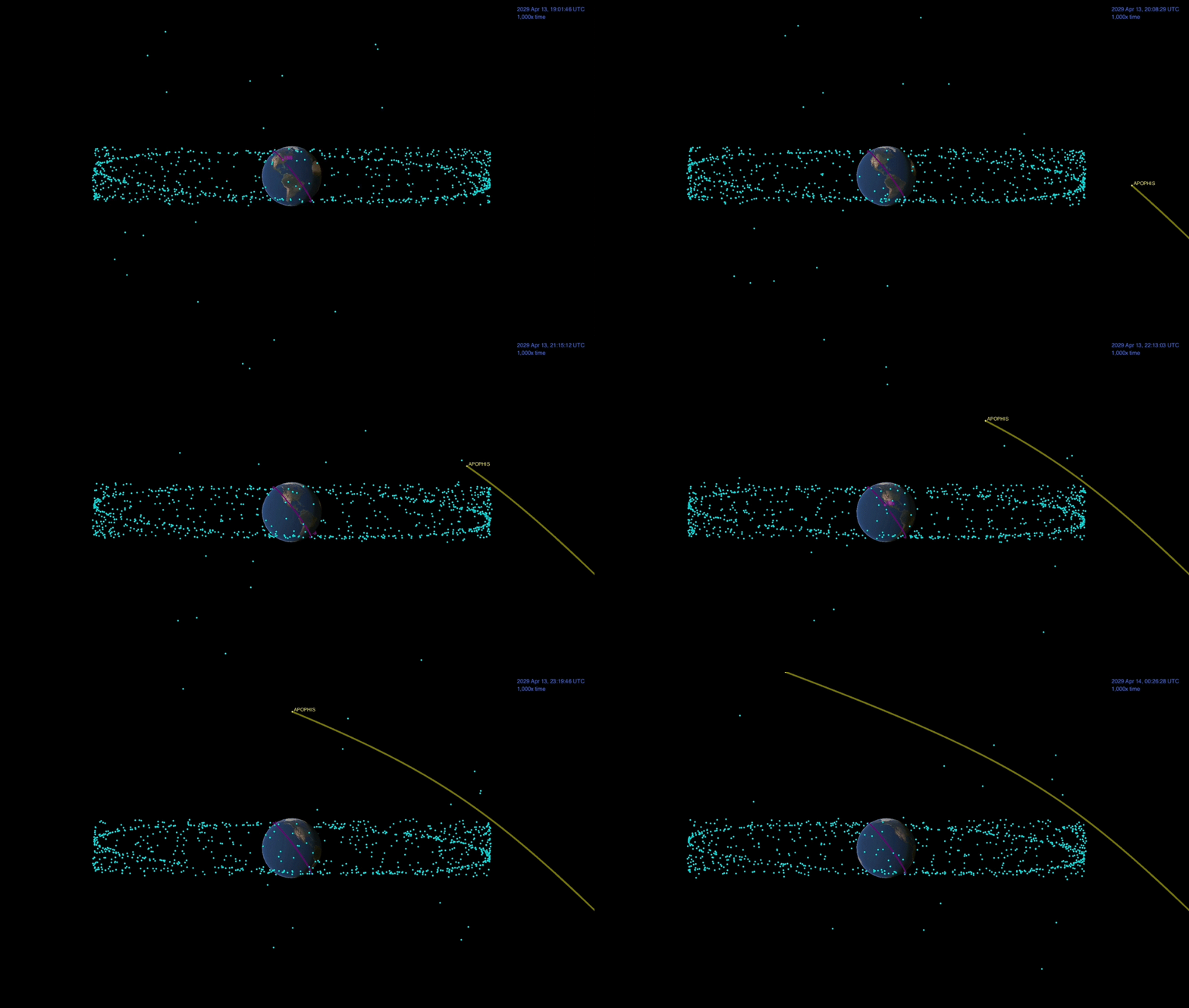
An animation shows Apophis' 2029 path compared to the swarm of satellites orbiting Earth. (Image credit: NASA/JPL-Caltech)
The European Space Agency is fast-tracking a new mission called Ramses, which will fly to near-Earth asteroid 99942 Apophis and join the space rock in 2029 when it comes very close to our planet — closer even than the region where geosynchronous satellites sit.
Ramses is short for Rapid Apophis Mission for Space Safety and, as its name suggests, is the next phase in humanity's efforts to learn more about near-Earth asteroids (NEOs) and how we might deflect them should one ever be discovered on a collision course with planet Earth.
In order to launch in time to rendezvous with Apophis in February 2029, scientists at the European Space Agency have been given permission to start planning Ramses even before the multinational space agency officially adopts the mission. The sanctioning and appropriation of funding for the Ramses mission will hopefully take place at ESA's Ministerial Council meeting (involving representatives from each of ESA's member states) in November of 2025. To arrive at Apophis in February 2029, launch would have to take place in April 2028, the agency says.
This is a big deal because large asteroids don't come this close to Earth very often. It is thus scientifically precious that, on April 13, 2029, Apophis will pass within 19,794 miles (31,860 kilometers) of Earth. For comparison, geosynchronous orbit is 22,236 miles (35,786 km) above Earth's surface. Such close fly-bys by asteroids hundreds of meters across (Apophis is about 1,230 feet, or 375 meters, across) only occur on average once every 5,000 to 10,000 years. Miss this one, and we've got a long time to wait for the next.
When Apophis was discovered in 2004, it was for a short time the most dangerous asteroid known, being classified as having the potential to impact with Earth possibly in 2029, 2036, or 2068. Should an asteroid of its size strike Earth, it could gouge out a crater several kilometers across and devastate a country with shock waves, flash heating and earth tremors. If it crashed down in the ocean, it could send a towering tsunami to devastate coastlines in multiple countries.
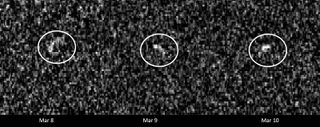
Over time, as our knowledge of Apophis' orbit became more refined, however, the risk of impact greatly went down. Radar observations of the asteroid in March of 2021 reduced the uncertainty in Apophis' orbit from hundreds of kilometers to just a few kilometers, finally removing any lingering worries about an impact — at least for the next 100 years. (Beyond 100 years, asteroid orbits can become too unpredictable to plot with any accuracy, but there's currently no suggestion that an impact will occur after 100 years.) So, Earth is expected to be perfectly safe in 2029 when Apophis comes through. Still, scientists want to see how Apophis responds by coming so close to Earth and entering our planet's gravitational field.
"There is still so much we have yet to learn about asteroids but, until now, we have had to travel deep into the solar system to study them and perform experiments ourselves to interact with their surface," said Patrick Michel, who is the Director of Research at CNRS at Observatoire de la Côte d’Azur in Nice, France, in a statement. "Nature is bringing one to us and conducting the experiment itself. All we need to do is watch as Apophis is stretched and squeezed by strong tidal forces that may trigger landslides and other disturbances and reveal new material from beneath the surface."
By arriving at Apophis before the asteroid's close encounter with Earth, and sticking with it throughout the flyby and beyond, Ramses will be in prime position to conduct before-and-after surveys to see how Apophis reacts to Earth. By looking for disturbances Earth's gravitational tidal forces trigger on the asteroid's surface, Ramses will be able to learn about Apophis' internal structure, density, porosity and composition, all of which are characteristics that we would need to first understand before considering how best to deflect a similar asteroid were one ever found to be on a collision course with our world.
Besides assisting in protecting Earth, learning about Apophis will give scientists further insights into how similar asteroids formed in the early solar system, and, in the process, how planets (including Earth) formed out of the same material.
One way we already know Earth will affect Apophis is by changing its orbit. Currently, Apophis is categorized as an Aten-type asteroid, which is what we call the class of near-Earth objects that have a shorter orbit around the sun than Earth does. Apophis currently gets as far as 0.92 astronomical units (137.6 million km, or 85.5 million miles) from the sun. However, our planet will give Apophis a gravitational nudge that will enlarge its orbit to 1.1 astronomical units (164.6 million km, or 102 million miles), such that its orbital period becomes longer than Earth's.
It will then be classed as an Apollo-type asteroid.
Ramses won't be alone in tracking Apophis. NASA has repurposed their OSIRIS-REx mission, which returned a sample from another near-Earth asteroid, 101955 Bennu, in 2023. However, the spacecraft, renamed OSIRIS-APEX (Apophis Explorer), won't arrive at the asteroid until April 23, 2029, ten days after the close encounter with Earth. OSIRIS-APEX will initially perform a flyby of Apophis at a distance of about 2,500 miles (4,000 km) from the object, then return in June that year to settle into orbit around Apophis for an 18-month mission.
Furthermore, the European Space Agency still plans on launching its Hera spacecraft in October 2024 to follow-up on the DART mission to the double asteroid Didymos and Dimorphos. DART impacted the latter in a test of kinetic impactor capabilities for potentially changing a hazardous asteroid's orbit around our planet. Hera will survey the binary asteroid system and observe the crater made by DART's sacrifice to gain a better understanding of Dimorphos' structure and composition post-impact, so that we can place the results in context.
The more near-Earth asteroids like Dimorphos and Apophis that we study, the greater that context becomes. Perhaps, one day, the understanding that we have gained from these missions will indeed save our planet.
Quelle: SD
----
Update: 7.03.2025
.
First CubeSat joins ESA's Ramses mission to asteroid Apophis
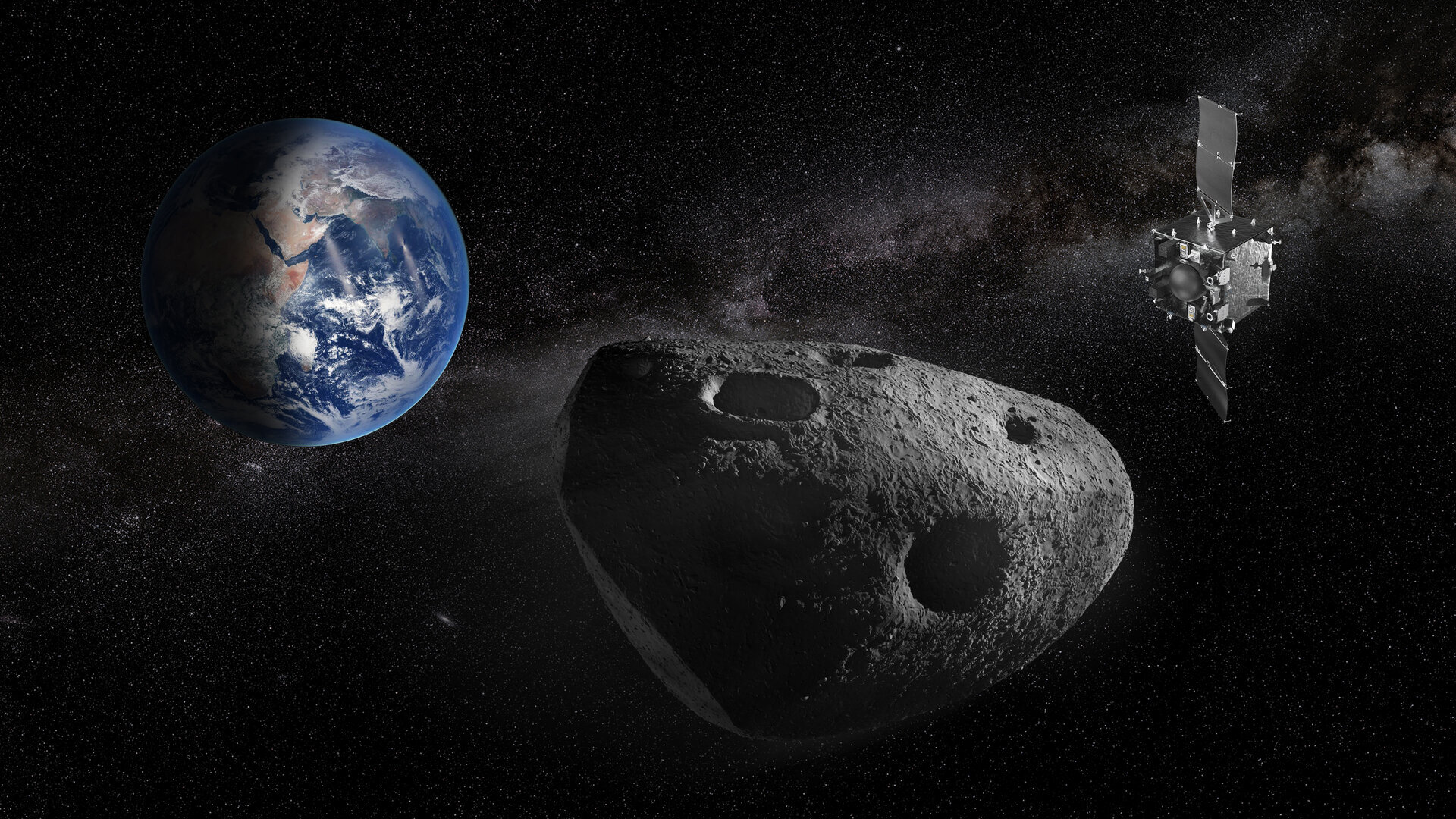
- The European Space Agency (ESA) has selected the first of two CubeSats to fly onboard its proposed Rapid Apophis Mission for Space Safety (Ramses).
- If approved, Ramses will rendezvous with the asteroid Apophis before it passes exceptionally close to Earth on 13 April 2029, exactly 1500 days from today.
- The Ramses spacecraft will deploy two smaller CubeSats at the asteroid to maximise the scientific return of this rare natural phenomenon.
- Tyvak International will lead the development of Ramses’ first CubeSat, drawing on their experience developing the Milani CubeSat for Ramses’ predecessor mission, Hera.
- The project has been awarded 4.7 million euros of the funding allocated to Ramses mission preparations in July 2024.
Building on Hera's legacy

ESA’s first planetary defence mission, Hera, launched in October 2024 on a journey to the binary asteroid system Didymos, where it and its two CubeSat passengers, Milani and Juventas, will study the aftermath of humankind’s first attempt at asteroid deflection.
To facilitate its rapid development, ESA's Ramses missionwill leverage much of the technology developed for Hera.
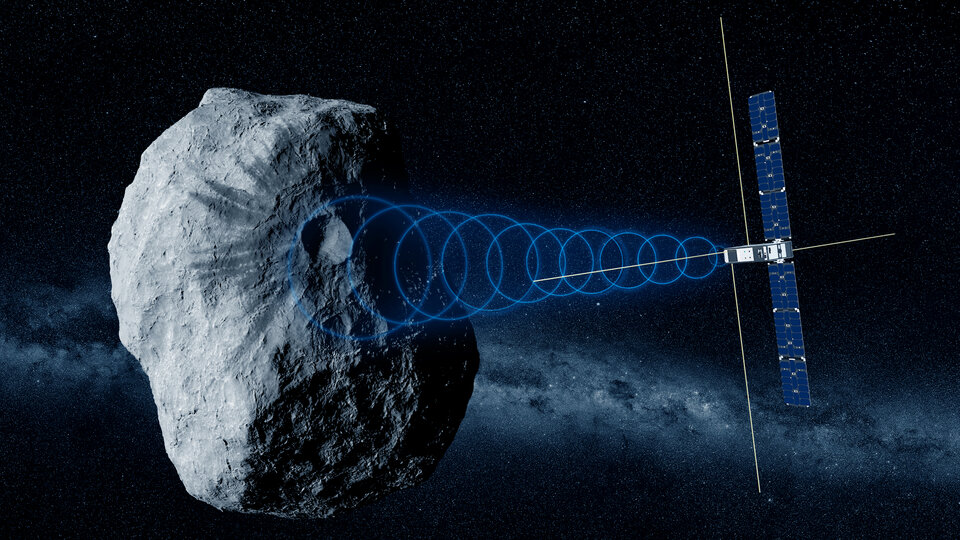
The mission’s first CubeSat will be a hybrid that combines the platform and dust analyser of Milani with the low-frequency radar instrument of Juventas.
The dust analyser will examine the material that could be released from the surface of Apophis by phenomena such as landslides, while the radar instrument will enable a detailed investigation of Apophis’ internal structure.
While Apophis poses no danger, these investigations would allow us to practice techniques that humankind could use to determine the structure of a hazardous asteroid and assess how best to knock it off a collision course with Earth.
Tyvak International will draw on their experience overseeing the development of Hera’s Milani CubeSat to lead a consortium of companies from a number of ESA Member States. The project has been awarded 4.7 million euros of the funding allocated to Ramses mission preparations in July 2024.
“By utilising existing technologies, this CubeSat will bring onboard the Ramses mission trusted European industrial and research partners that have demonstrated their ability to deliver high-quality mission elements under a tight deadline,” says Fabio Nichele, CEO at Tyvak International.
“Our commitment to undertake and exceed advanced space mission challenges, and flawlessly deliver miniaturised space system technologies, is pushing the boundaries of the European planetary defence to unrivalled excellence. We are thrilled to honour the trust of the Agency in such complex and historical journey.”
1500 days until Apophis – Ramses mission on track
Meanwhile, preparations for the main Ramses spacecraft are making good progress and demonstrating the maturity of the overall mission concept prior to the critical funding decision at ESA’s Ministerial Council in November.
“The recent discovery of asteroid 2024 YR4 has highlighted the fact that an asteroid reconnaissance mission could be required at short notice if we were to detect a significant impact hazard,” says Richard Moissl, Head of Planetary Defence at ESA.
“With Ramses, we are not only capitalising on a unique scientific opportunity, we are also demonstrating ESA’s ability to develop an asteroid mission on a strict deadline that realistically reflects the time we may have to respond to a hazard in the future.”

Ramses project manager, Paolo Martino, adds: “When Apophis passes Earth in April 2029, it will capture the attention of the entire world."
"With Ramses, we could put Europe in a front row seat: we could be the ones delivering the close-up images of Apophis and leading global efforts to harness this truly historic opportunity for space exploration, asteroid science and planetary defence.”
“Thanks to the hard work of our industrial and institutional partners in Europe and Japan, Ramses continues to pass each milestone on its tight schedule, which would require a launch in 2028 in order to rendezvous with Apophis before it passes Earth.”
Could we land on Apophis?
Relying on proven technology for the first Ramses CubeSat has enabled the team to explore exciting new possibilities for the second. The Ramses team is currently considering whether the mission’s second CubeSat could instead be a lander that would touch down on Apophis. The lander’s surface instruments could open up a new valuable dimension to the mission’s scientific capabilities.
Quelle: ESA
----
Update: 21.05.2025
-
Second CubeSat joins ESA’s Ramses mission to asteroid Apophis
- The European Space Agency (ESA) has selected Spanish company Emxys to lead the development of a CubeSat that will be deployed by its Rapid Apophis Mission for Space Safety (Ramses) at the asteroid Apophis.
- The project has been awarded 1.5 million euros of the funding allocated to Ramses mission preparations in July 2024.
On 13 April 2029, the 375 m asteroid Apophis will make a safe but exceptionally close flyby of Earth. ESA is preparing the Ramses mission, which, if fully supported at the Agency’s Ministerial Council meeting in November this year, will launch in 2028, rendezvous with the asteroid, and accompany it through the flyby.
Ramses will use a suite of scientific instruments on the main spacecraft and two smaller CubeSats that will be deployed at Apophis to conduct a thorough before-and-after survey of the asteroid’s shape, surface structure, cohesion, orbit, rotation and more.
Earth’s gravity will induce tidal forces in the asteroid that are likely to alter some of these properties during the flyby. By analysing these changes, Ramses will help scientists learn more about how an asteroid responds to external forces. This is important knowledge for assessing how best to deflect a hazardous asteroid if we discover one on a collision course with Earth in the future.
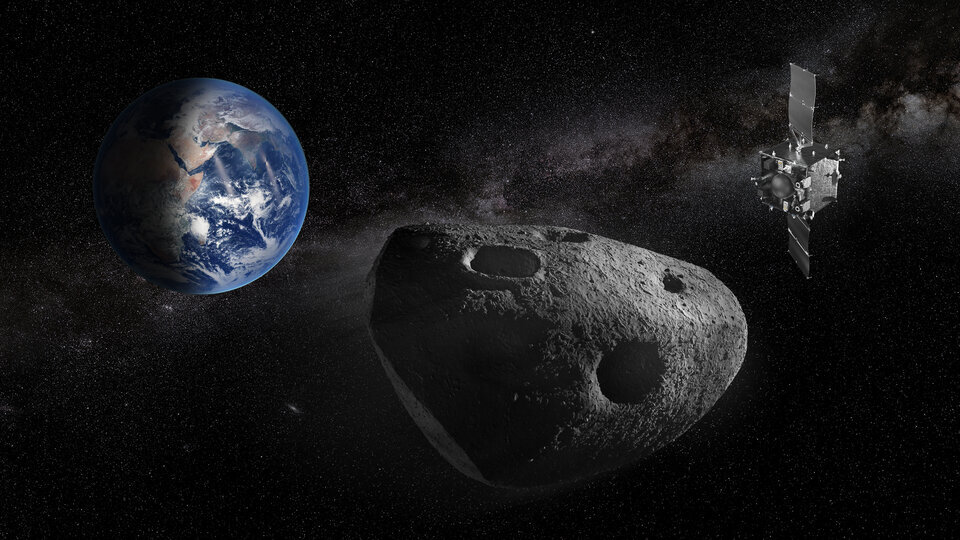
Ramses’ first CubeSat, announced in March, will conduct radar sounding to learn more about the interior structure of Apophis and analyse its surrounding dust environment.
The second CubeSat, led by Emxys, will be deployed from the main spacecraft just a few kilometres from Apophis. It will study the asteroid’s shape and geological properties and will carry out an autonomous approach manoeuvre before attempting to land on the surface. If the landing is successful, it will also measure the asteroid’s seismic activity.
“Landing on an asteroid is very challenging,” says Ramses Project Manager Paolo Martino. “The irregular shape and surface properties make it difficult to identify a stable landing site, while the very weak gravity makes it hard to stay on the surface without bouncing off and drifting away.”
“But the opportunity to study Apophis from the surface during this rare natural phenomenon is very exciting and scientifically valuable. Ramses’ CubeSats will attempt higher risk, high reward activities that the main spacecraft cannot, such as a landing. In doing so, they will help us maximise the mission’s scientific return, which is crucial, as an asteroid this large is thought to pass so close to Earth only once every few thousand years.”
“This project marks a milestone for our company,” said José A. Carrasco, CEO of Emxys. “To contribute to a mission that will monitor one of Earth’s closest encounters with a large asteroid represents the highest level of scientific and technological challenge. We are proud to bring our capabilities to Europe’s planetary defence efforts.”
Joining Emxys in the European consortium developing the CubeSat are GomSpace(Denmark), GMV (Spain), ISAE-SUPAERO (France), and the Royal Observatory of Belgium. Emxys contributed to the GRASS gravimeter on the Juventas CubeSat carried by ESA’s Hera mission, which is currently en route to the Didymos binary asteroid system to study the aftermath of humankind’s first attempt at asteroid deflection.
Quelle: ESA
----
Update: 28.05.2025
.
2028 mission to earth-grazing asteroid Apophis

After Rosetta, DART and Hera, Politecnico di Milano is preparing for a return to deep space. In 2028, the university will take part in the European Space Agency’s RAMSES mission to study Apophis which is a 350-metre-wide asteroid that will pass remarkably close to Earth, just 31,000 km away, on 13 April 2029.
The DART (Deep-space Astrodynamics Research and Technology) Laboratory, part of the Department of Aerospace Science and Technology, has been selected by ESA to contribute to the RCS-1 CubeSat, which is being developed by Tyvak International. This miniature satellite will travel aboard the RAMSES probe. Led by Professors Francesco Topputo and Fabio Ferrari, the Politecnico team will be responsible for mission design, development of autonomous guidance systems, and acquisition of close-up images of the asteroid’s surface.
CubeSats are compact, low-cost satellites that deliver significant scientific and technological value. In the RAMSES mission, they will operate autonomously in the vicinity of Apophis which is a fast-moving body travelling within geostationary orbit.
Scientifically, RCS-1 will provide key insights into Apophis's physical and dynamic properties through imagery and data gathered during the flyby. CubeSat RCS-1 will serve as a test platform for new autonomous navigation algorithms developed by the Politecnico team.
RAMSES, an ESA-proposed mission, aims to rendezvous with Apophis ahead of its 2029 flyby. The probe is scheduled to arrive by February 2029 to observe the asteroid and monitor any changes caused by Earth’s gravitational pull during its close approach.
Being part of the Apophis mission is a tremendous honour. We are developing state-of-the-art technologies that will venture into deep space, showcasing Italian innovation in tackling unprecedented challenges.
Francesco Topputo and Fabio Ferrari, Department of Aerospace Science and Technology
On 13 April 2029 Apophis will be visible from Earth with the naked eye. But observing it up close, from just 31,000 km away, will be instruments and algorithms created at the Politecnico di Milano. This marks a new milestone in Italian space exploration.
Quelle: Politecnico di Milano
----
Update: 12.02.2026
.
ESA Awards OHB a €81.2 Million Contract for Ramses Asteroid Probe
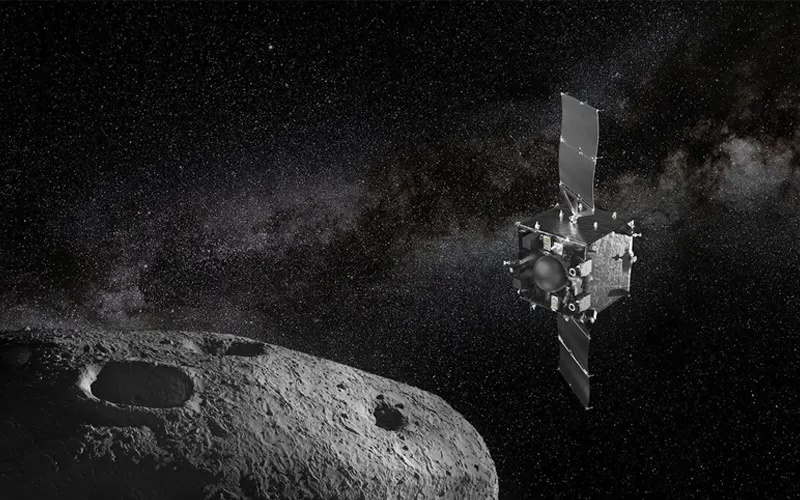
Credit: ESA Science Office
The European Space Agency (ESA) has awarded OHB Italia a €81.2 million contract for the construction, assembly, and testing phase of the agency’s Ramses mission, which will study the asteroid Apophis during its close encounter with Earth. The agency also announced that it had successfully concluded the mission’s Critical Design Review “in record time.”
In early 2029, Apophis will pass within 32,000 kilometres of Earth’s surface, closer than geostationary satellites orbiting the planet. ESA hopes to take advantage of this rare opportunity with its Rapid Apophis Mission for Space Safety (Ramses) probe, which will study the asteroid’s composition and how it reacts to Earth’s gravitational pull. The probe is currently expected to be launched in spring 2028 to enable it to rendezvous with the asteroid before its close approach.
On 17 October, ESA announced that it had awarded a €63 million contract to OHB Italia for the mission’s consolidation and early implementation phases. This funding came from existing allocations, with a final decision on whether to proceed with the mission and approve the remaining funds required for its development due to be taken at ESA’s Ministerial Council meeting in November 2025 (CM25).
With its 10 February 2026 announcement that the agency had awarded OHB Italia a €81.2 million contract for the mission’s construction, assembly, and testing phase, it is clear that the necessary funding was secured at CM25, allowing the mission to move into full development.
“With Ramses, ESA is seizing a once-in-a-lifetime opportunity to study asteroid Apophis as it swings past Earth, deepening our understanding of near-Earth objects and advancing our capabilities to protect our planet,” said ESA Mars & Beyond Projects Group Leader Orson Sutherland.
As part of the 10 February contract announcement, the agency revealed that an ESA review board had successfully concluded the mission’s Critical Design Review, ensuring that it meets all technical, scientific, and programmatic requirements.
“Passing the Critical Design Review in record time gives us full confidence that Ramses’ design is mature, robust, and ready to be built,” said Ramses mission manager, Paolo Martino. “Successfully maintaining the mission’s accelerated pace is an endorsement of the team’s commitment and engineering vision under a very demanding schedule.”
Although the Ramses mission is led by ESA, Japan’s space agency, JAXA, has agreed to contribute to it. According to ESA, JAXA will provide several components, including a solar array and a thermal infrared imager. The mission may also be launched as a rideshare with Japan’s Destiny+ mission aboard a Japanese H3 rocket.
The CubeSats
In addition to the main spacecraft being developed by OHB Italia, the mission will also include two CubeSats. Italy’s Tyvak International received a €4.7 million contractin March 2025, and Spain’s Emxys received a €1.5 million contract in May 2025 to begin preparatory work on the two CubeSats. On 10 February, ESA awarded Tyvak International a €8.2 million follow-on contract to complete construction and testing of its CubeSat. The announcement, however, did not include any information about a second contract for Emxys.
Quelle: European Spaceflight
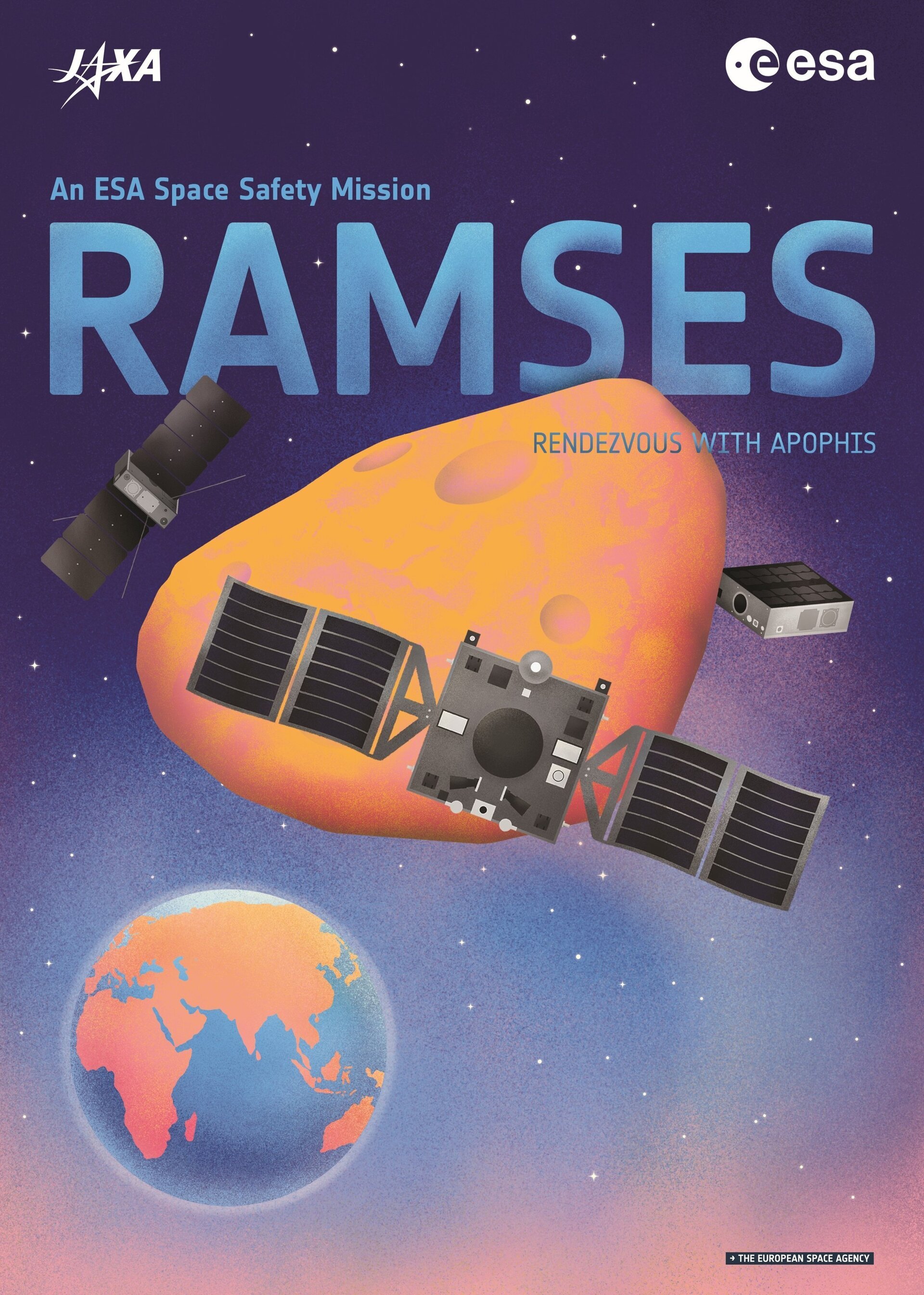
ESA and JAXA team up on planetary defence, Ramses mission to asteroid Apophis
The European Space Agency (ESA) and the Japan Aerospace Exploration Agency (JAXA) have signed a Memorandum of Cooperation to deepen collaboration in planetary defence, alongside a dedicated agreement for collaboration on the Rapid Apophis Mission for Space Safety (Ramses) to the near-Earth asteroid Apophis.
The agreements were signed on 7 May by ESA Director General Josef Aschbacher and JAXA President Hiroshi Yamakawa at the Embassy of Italy in Berlin, Germany, in the presence of European and Japanese institutional and industrial leadership. The event was hosted in collaboration with the Italian Space Agency (ASI), in light of ESA’s selection of OHB Italia as prime contractor for the Ramses mission.
The move builds on a joint statement from November 2024, in which ESA and JAXA committed to expanding large-scale cooperation, including on planetary defence.

“Planetary defence is, by definition, a global responsibility,” said ESA Director General Josef Aschbacher. “With today’s signatures, ESA and JAXA are moving decisively from shared intention to concrete implementation, translating commitment into mission‑level cooperation. This partnership builds on trust, technical excellence and a shared determination to protect our planet.”
“In an increasingly complex environment, international cooperation remains a cornerstone of Europe’s approach to space. Together, ESA and JAXA are showing how reliable partners turn ambition into action for the benefit of all.”
JAXA President Dr. Hiroshi Yamakawa added: “We are pleased to have signed today the Memorandum of Cooperation and the agreement to advance cooperation on planetary defence. We sincerely appreciate ESA and its Member States, including Italy, and expect this cooperation to further advance international efforts in this field.”
A global effort
Planetary defence is a challenge affecting every human and living being on Earth. As a field of applied scientific research, it brings together the international community to detect and characterise near-Earth objects early, track their trajectories, assess impact risks, and develop mitigation strategies if needed. By strengthening ESA–JAXA cooperation on planetary defence, the two agencies are committing to advancing this global effort.
ESA plays a leading role in planetary defence through its Space Safety programme. The programme’s Near-Earth Object Coordination Centre (NEOCC) monitors asteroid threats and refines orbit predictions, while its space missions oversee the development of rapid reconnaissance and deflection technologies.
The agency’s Hera planetary defence mission, for example, on which JAXA is an important partner, will arrive later this year at the Didymos binary asteroid system. There, it will help turn asteroid deflection by kinetic impact into a reliable and understood technique for protecting our planet.
The Ramses mission to Apophis
The first major outcome of the new ESA-JAXA cooperation is collaboration on the Ramses mission. Ramses will launch in 2028 and rendezvous with the asteroid (99942) Apophis ahead of its exceptionally rare, close flyby of Earth in April 2029.
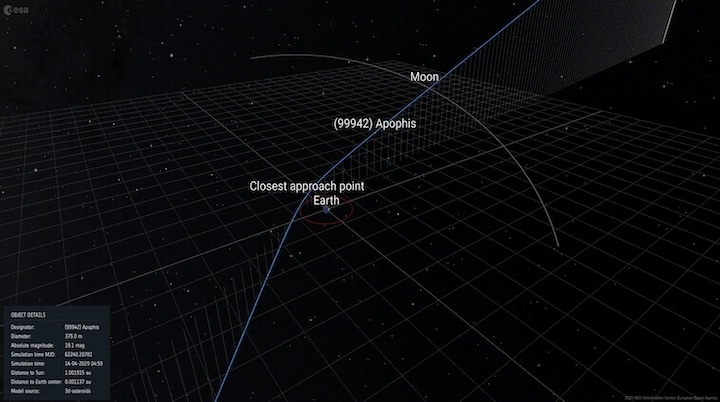
Roughly 375 metres across, Apophis will pass just 32 000 km above Earth’s surface on Friday 13 April 2029 – one tenth the distance to the Moon and closer than satellites in geosynchronous orbits.
While there is no risk of impact, the flyby is extraordinarily rare, occurring only once every 5 000 to 10 000 years for an object of this size. Visible in the night sky to the naked eye for up to two billion people on Earth, the event will offer a unique opportunity for science and public engagement.
Ramses will accompany Apophis throughout the flyby, observing how Earth’s gravity alters its shape, surface and motion. By comparing before-and-after measurements, scientists will gain insights into asteroid structure, composition and behaviour that will be important for any future deflection efforts.
ESA oversees the Ramses mission’s spacecraft design, integration and operations. JAXA will provide key elements, including the spacecraft’s lightweight solar arrays, an infrared imager, and launch aboard its H3 rocket. The partnership builds on JAXA’s contribution to Hera and ongoing collaboration on ESA-JAXA space missions such as EarthCARE and BepiColombo.
Until now, we have had to travel deep into the Solar System to study asteroids and interact with their surfaces. With Apophis, for the first time ever, nature is bringing an asteroid to us and conducting the experiment itself. As the asteroid is pulled and reshaped by tidal forces, ESA and JAXA will be there to capture every moment of this once-in-a-lifetime opportunity.
Quelle: ESA
----
Update: 4.07.2026
.
Surface CubeSat contracted for Ramses asteroid mission
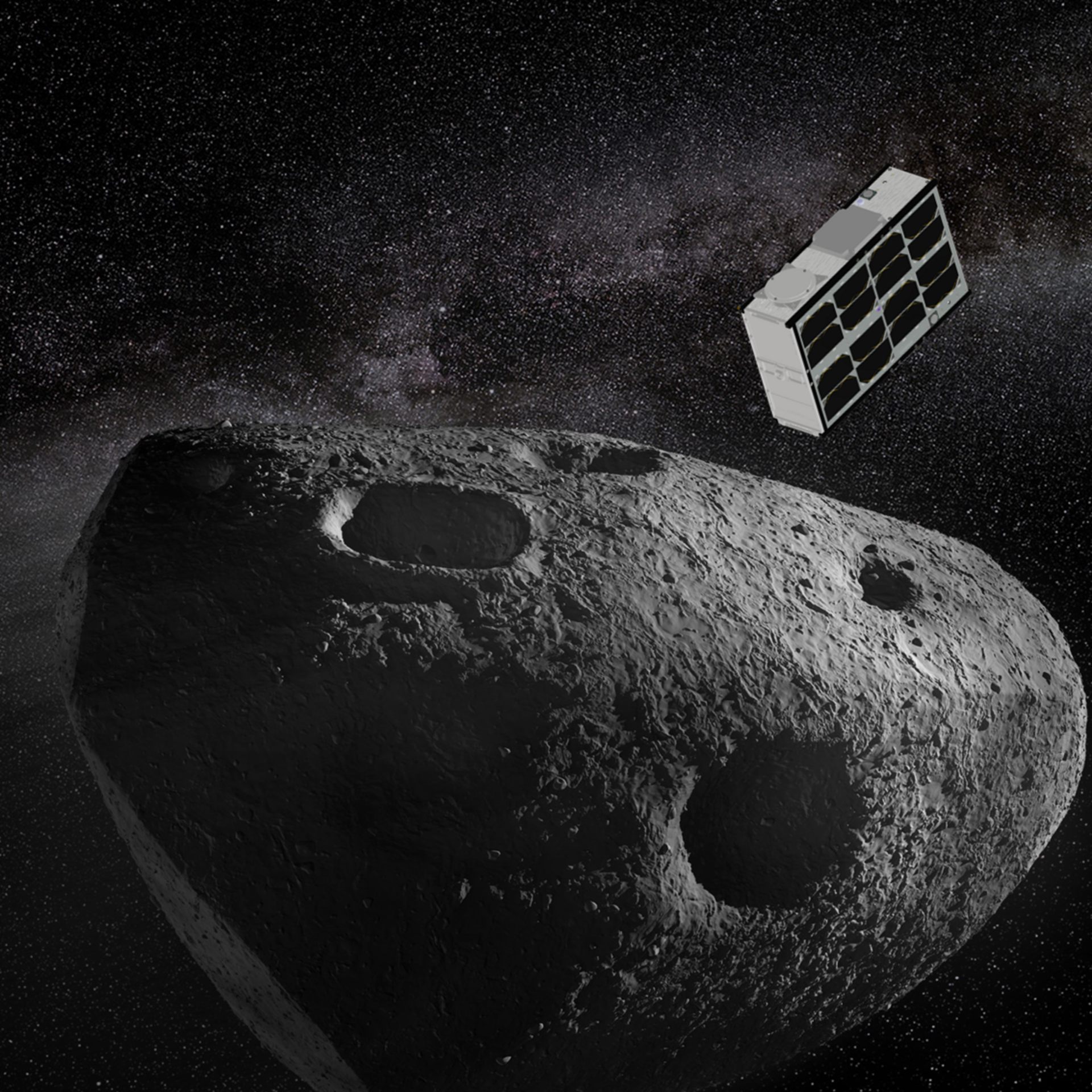
The European Space Agency has contracted Spanish company EMXYS for the first CubeSat designed to operate on the surface of an asteroid. Don Quijote is a shoebox-sized spacecraft that will be deployed onto the Apophis asteroid by ESA’s Ramses mission before the asteroid flies by Earth on 13 April 2029.

“The arrival of Apophis represents a unique opportunity,” said ESA’s programme manager for Mars and Beyond, Orson Sutherland. “It is exceedingly rare for such a large asteroid – at 375 m across, about the size of a cruise liner – to pass so near to Earth. Flying past at an altitude of 32 000 km, its trajectory will take it within the orbit of our geostationary satellites.

“It’s really a free experiment because the tug of Earth’s gravity is forecast to trigger deformation and potentially set off asteroid quakes, that Don Quijote will now be able to monitor right on the spot.”
Ramses mission manager Paolo Martino adds: “Now that also the last main contract has been signed, the team can get on with implementing the mission within an unavoidably tight timescale – because the asteroid will not be waiting around for us!”

Tight deadline for launch
To meet its spring 2028 deadline for launch on a Japanese H3 rocket, the development, integration and testing of Ramses must be completed within less than two years. To help achieve this, Ramses reuses design elements of ESA’s Hera asteroid mission, on track to reach the Dimorphos asteroid this November.
Ramses, like Hera, will also carry a pair of CubeSats – miniature spacecraft built up from 10 cm boxes – for closer observations of its target. Farinella, from Italy’s Tyvak International company, will combine a ground-penetrating radar with a dust analyser.
Don Quijote is being provided by Spain’s EMXYS company, which previously built a gravity-measuring ‘gravimeter’ for Hera’s Juventas CubeSat, which will aim to attempt a landing on the Dimorphos asteroid.

Into the unknown
José A. Carrasco, CEO of EMXYS explains: “We have previously provided CubeSat platforms for low-Earth orbit, but Don Quijote must operate in the much more challenging deep space environment, then proceed to land autonomously onto a strange and largely unknown surface. Once there it has not only to survive but also perform demanding science at the same time, then relaying results back to its Ramses mothership.”
The CubeSat will carry a trio of instruments. The Gravimeter for Small Solar System Objects (GRASS) is being developed by the Royal Observatory of Belgium with EMXYS to measure the asteroid's miniscule gravity field. The MARIE (Magnetosphere-induced Apophis Response Investigation Experiment), is being provided through the German Space Science Programme, a sub-programme of the national space programme, and manufactured by Technische Universität Braunschweig, to measure if the asteroid has a magnetic field – and how it might change when interacting with Earth’s own magnetic field and gravity. Finally the Seismic Instrument for Asteroids (SIA) seismometer comes from French aerospace centre ISAE-SUPAERO, designed to to perform the first seismic measurements on an asteroid.

Cramming all of Don Quijote within a space smaller than a desk drawer is also a challenge, adds EMXYS Chief Technology Officer Francisco García de Quirós: “We have to fit in all our instruments, plus the spacecraft electronics, batteries and inter-satellite links, along with eight thrusters for propulsion. At the same time we must maintain a carefully controlled centre of mass so the thrusters work with optimal efficiency as the CubeSat steers itself down to a safe landing.”

Landing, then bouncing?
Francesca Ingiosi, overseeing Ramses’ CubeSats, notes: “There won’t be time for sustained human oversight: Don Quijote is going to take itself down on a completely autonomous basis, relying on feature tracking to find a safe place to land. It will be running its gravimeter and magnetometer when it flies, but we have high expectations for its scientific work on the surface.
“It will come down quite slowly, but in the ultra-low gravity of Apophis some bouncing along the surface is possible. The CubeSat is therefore designed to operate from any orientation, although the precise nature of the surface remains a question mark: there is even a small possibility that Don Quijote sinks into the ground, which would not be good!

“The asteroid is likely to be tumbling chaotically, and passing from local day to night should mean big temperature shifts. To maximise our surface lifetime we would want to be on a spot experiencing both day and night, to allow us to recharge our batteries without overheating. But if we did end up in sustained shadow Don Quijote also has non-rechargeable batteries as a backup power source.”
Both CubeSats are now being built in their respective countries. They will join the Ramses spacecraft in autumn next year, during the mission’s qualification phase at the ESTEC Test Centre in Noordwijk, the Netherlands.

