
31.07.2026
A SpaceX rocket will crash into the moon next week, and scientists arent sure what to expect
"Watching this one gives us a rare chance to open up ejecta-plume science and calibrate those models against a real event, which matters for every future thing we deliver to the moon."
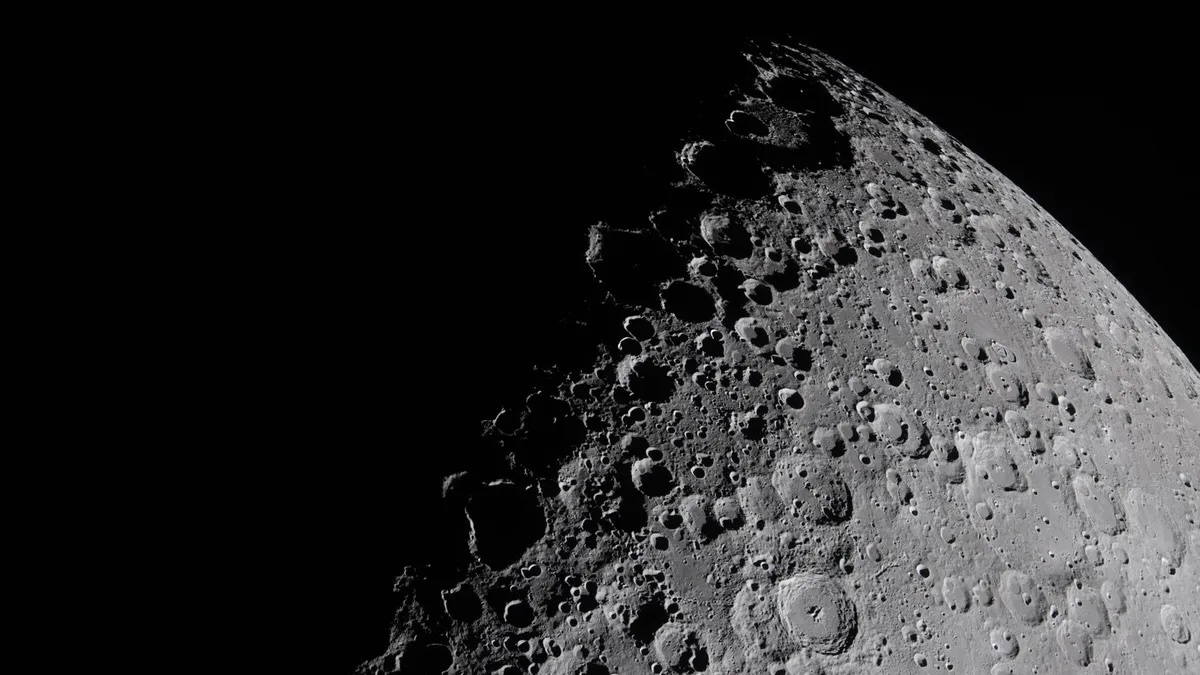
A portion of the moon captured by the Artemis II crew during their ten-day mission in April 2026.(Image credit: NASA/JSC)
On Aug. 5, Earth's moon is due for a human-made, high-speed impact from an identified flying object: a spent SpaceX Falcon 9 upper stage. The event will lead to a literal "dust up" on the lunar landscape.
That Falcon 9 upper stage is a leftover from the launch that sent Firefly's Blue Ghost-1 lander to the moon on Jan. 15, 2025. Onboard the same flight was the Hakuto-R Mission 2, called Resilience, a robotic lunar lander developed by the Japanese company ispace.
And according to a new study by an international team published on the open-source arXiv server, the resulting impact plume may briefly be bright enough to see against the dark sky near the moon's edge. That means it might be visible to moongazers with sufficiently sensitive telescopes.
his head-on collision of the errant stage is expected to occur near the Einstein and Bell craters near the western lunar limb. It may well be visible to ground and space-based assets. Indeed, putting aside all the unknowns and modeling uncertainties, some specialists suggest if you've got the time and observational prowess, it might be worth a look.
Visible ejecta spike
Using special physics simulations to model the impact, William Jo, a graduate research assistant at the University of Texas, Austin and colleagues predict the debris plume from the impact will have the central ejecta spike reaching roughly 47 miles to over 60 miles (75 kilometers to 100 kilometers) altitude.
"Our calculations suggest the plume should be several orders of magnitude brighter than the dark-sky background for the first few minutes after impact," Jo told Space.com. "So the plume should be visible, though I'd stress this is a single nominal case. The real one will look different, and the numbers are on the optimistic side. But the point worth making is that the flash isn't really the story here."
Jo emphasized that there's great slam-dunk science to be had. "Watching this one gives us a rare chance to open up ejecta-plume science and calibrate those models against a real event, which matters for every future thing we deliver to the moon," Jo said.
Implications for future moon missions
According to new research led by Benjamin Fernando of the Los Alamos National Laboratory in New Mexico, the impact flash and resultant ejecta plume are "potentially observable" from ground- and space-based observational facilities.
"This event provides an opportunity to attempt the recording of an artificial impact in real-time; although many of the properties of the event (such as visual magnitude) are imprecisely predicted at present," Fernando and colleagues report.
Moreover, this rocket stage meets moon occasion yields an opportunity to test a pipeline for localizing impacts on the lunar surface for future seismic experiments, investigating the dust and plume dynamics from impact events on the moon, and considering hazards from artificial space debris impacts that future astronauts on the lunar surface might have to avoid, Fernando and team members point out.
"The maximum ballistic range of resolved particles is found to be slightly under 1,000 km, which is far enough to be significant from the perspective of presenting a hazard to future astronauts or infrastructure across much of the lunar surface," Fernando et al wrote in the study.
Before and after
Brent Garry is a project scientist for NASA's Lunar Reconnaissance Orbiter (LRO) at Goddard Space Flight Center in Greenbelt, Maryland. LRO will be passing over the projected rocket stage crash site about seven days prior to the impact and about seven days after the impact, Garry explains.
"After the impact we might have a little bit more knowledge of where it is. We can do some additional targeting about a week after the impact and get some targeting over where the site is," said Garry, as noted in earlier Space.com reporting.
Meanwhile, Jo at the University of Texas, Austin underscores the fact that a spent rocket stage is a hollow, spacecraft-like body, and there are very few impact models for human-made objects like it. They seem to produce very different plumes than natural impactors, like asteroidsor comets do. But Jo stresses that the real scientific contributions will come by studying the moments after the impact.
"My concern is that most observers will stop at the sub-second flash and never track down the ejecta, which is the part that should actually be visible, and where the science is."
Quelle: SC
----
Update: 7.08.2026
.
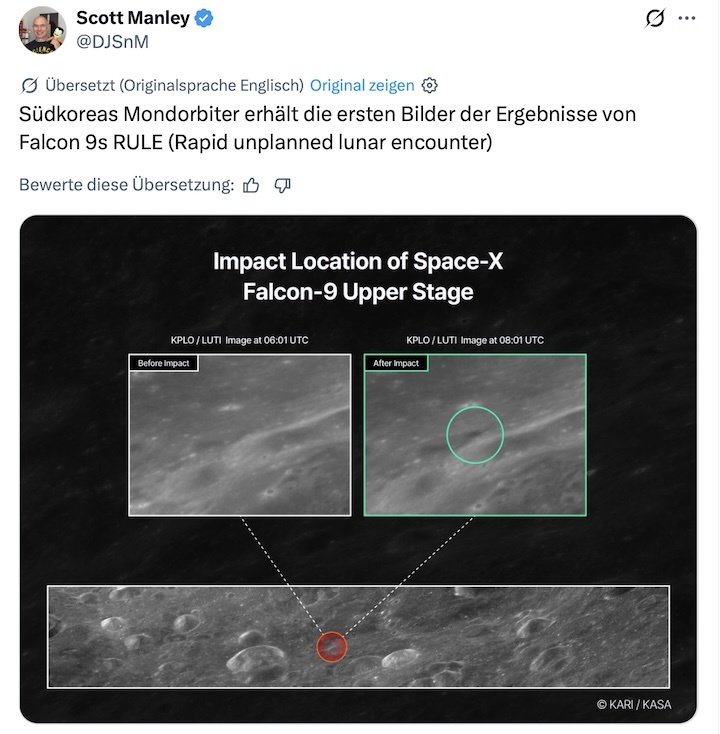
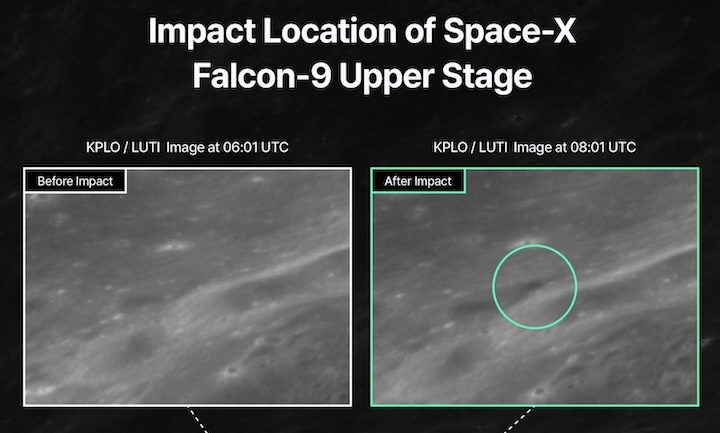
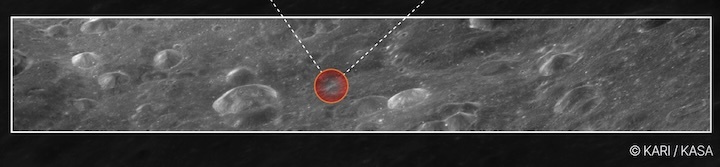
Quelle: X
----
Update: 19:00 MESZ
.
‘Spectral lines’ and a giant plume: what science saw when the SpaceX rocket hit the moon
Sodium and lithium gas was detected in a plume thought to span tens of kilometres, created when part of a SpaceX rocket crashed into the lunar surface
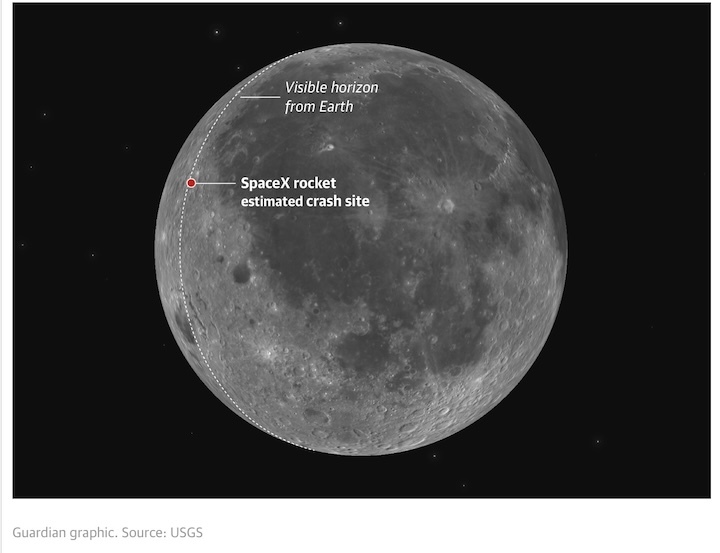
A telescope in Chile has captured evidence of the impact caused by part of a SpaceX rocket slamming into the moon while travelling at 8,690km/h (5,400mph).
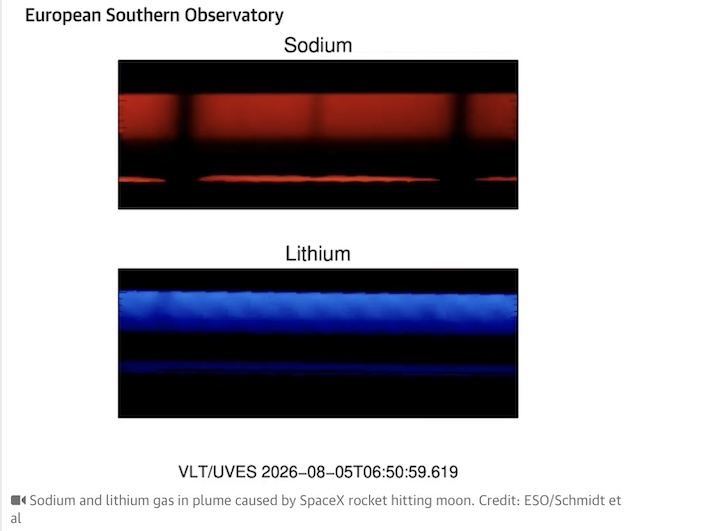
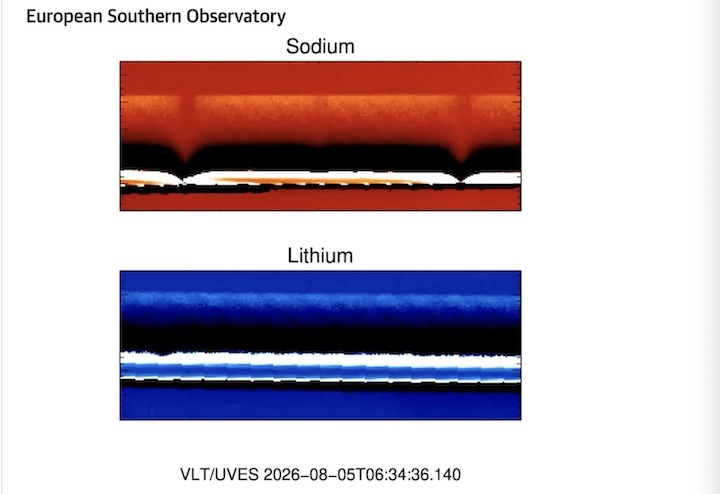
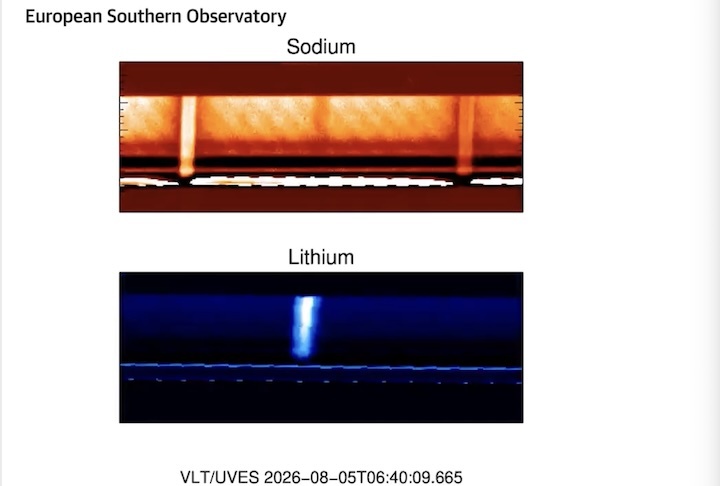
The European Southern Observatory’s (ESO) Very Large Telescope observed “spectral lines” – a colourful illustration of sodium and lithium gas – in the plume of lunar dust stirred up by the impact.
The ESO telescope recorded these “chemical fingerprints” of the plume, which were visible for five to 10 minutes, the observatory said. The plume measured a few tens of kilometres in size, according to Carl Schmidt, an astronomer from Boston University’s Center for Space Physics.
Benjamin Fernando of Los Alamos National Laboratory in New Mexico, said earlier the collision could provide valuable data for future seismic experiments, and assessing “hazards from artificial space debris impacts”. Nasa hopes to soon establish a sustained human presence on the Moon, making it critical to better understand space debris in lunar orbit.
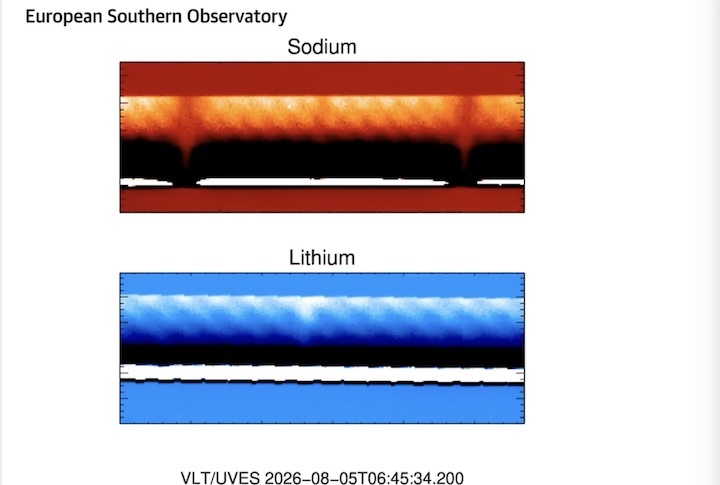
The impact occurred near the moon’s terminator line, or the boundary of its shadow between the sunlit side and its far side. Similar to past objects that have hit the moon, the rocket stage kicked up a plume of lunar dust that was briefly illuminated by sunlight, but difficult to spot with the naked eye from Earth.
Numerous satellites were orbiting the moon but none were in the right place at the right time to witness the crash, which occurred about 6.35am GMT on Wednesday. The piece of the rocket was the height of a five-storey building and weighed four tonnes.
Nasa and its Lunar Reconnaissance Orbiter probe and South Korea’s Pathfinder Lunar Orbiter are planning to take images of the site after impact, which may show the wreckage of the rocket, but it could take days to receive that information.
However, the manner in which the impact plume interacted with the sunlight allowed astronomers to glean some clues about its composition.
The sodium gas in the spectra is believed to have originated from the lunar soil, while the traces of lithium may have come from the rocket stage itself, Schmidt said.
“This observation did not go perfectly and this is a very crude analysis, but I wanted to share something quickly, and we can say more about these results in time,” he said.
Dr Sara Webb, an Australian astrophysicist at Swinburne University, said the tremendous force of the crash would have gouged out a “massive” new crater, probably 20 metres (65 feet) in diameter and five metres deep.
A vast plume was anticipated, Webb said, but “what we didn’t expect was how hard it was going to be to see this impact. We had multiple telescopes and eyes on the moon watching it, and nobody caught clear imagery or shots of it actually hitting.”
The Falcon 9 rocket from Elon Musk’s SpaceX launched in January 2025 carrying two lunar landers. Its booster returned to Earth, but the upper stage stayed in space to push the landers onward.
The rocket stage was just one of tens of thousands of pieces of “space junk” orbiting Earth. The moon routinely weathers impact from space debris including meteoroids. However, artificial collisions are less common.
Quelle: The Guardian