
5.05.2026
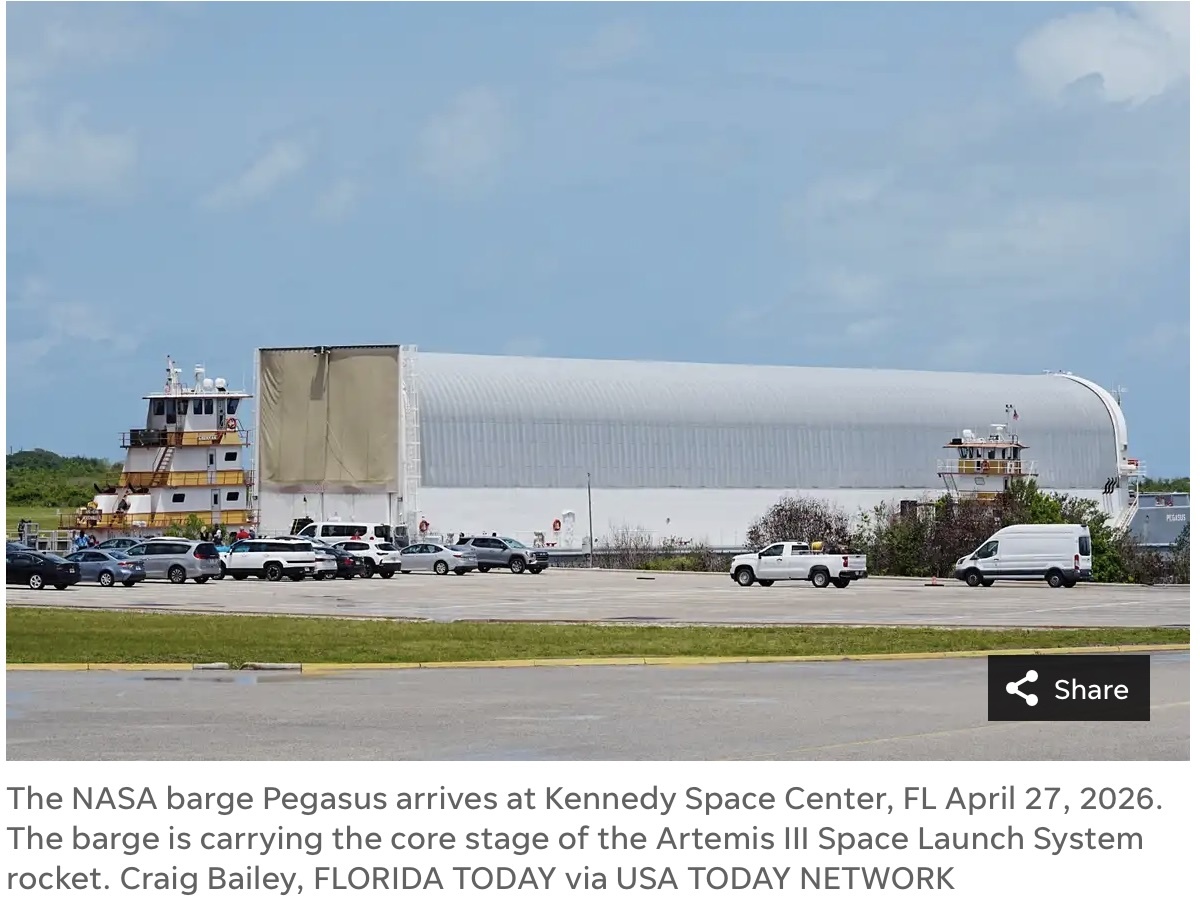
When NASA’s Pegasus barge and its crew took off on a multi-week voyage from Louisiana to Kennedy Space Center recently, they were delivering an important and historic cargo.
“Not everybody gets the opportunity to do this type of stuff,” said Arlan Cochren from NASA Marshall Space Flight Center logistics. ”When they get this job they’re like ‘Wow. I’m part of history.'"
Cochren, who oversees the Pegasus barge, is part of the group of six crew members who delivered the core stage of the Artemis III moon rocket to KSC's Vehicle Assembly Building. He stood on the ship's deck April 29, glancing over at the VAB where the core stage had already been tucked away. The VAB's side door was open just enough to catch a glimpse of the Mobile Launcher 1, which will carry out the fully stacked rocket next year ahead of launch.
Artemis III is the planned follow-up to this month's Artemis II mission, in which four astronauts conducted a trailblazing journey around the moon. NASA is targeting a planned launch of Artemis III in 2027. The mission calls for the Orion spacecraft to dock with either the SpaceX Starship HLS or Blue Origin Mark II lunar lander in low Earth orbit before a moon landing in 2028.
NASA's Pegasus barge arrived at KSC April 27, carrying the massive orange Boeing-built Artemis III core stage, which had been transported from NASA's Michoud Assembly Facility in New Orleans, Louisiana.
Work began the next day to slowly offload the core stage and roll it into the VAB where it will be stacked ahead of launch. Its solid rocket boosters are already waiting at KSC.
The day after the Artemis III core stage was offloaded, FLORIDA TODAY attended a media tour of the rocket-ferrying barge.
The purpose of NASA’s Pegasus
Pegasus is the size of a two-story tall floating building. While it now ferries the 212-foot-long core stage of NASA’s SLS (Space Launch System) moon rocket, its history spans three decades.
NASA has had Pegasus since 1999, Cochren said. The barge was originally acquired to ferry the space shuttle's 153-foot-long orange external tanks.
However, once NASA retired the shuttle and began work toward the Artemis missions, the agency discovered it had a problem: Pegasus was too short for the moon rocket’s core stage. Instead of scrapping Pegasus in favor of a new barge, an additional 50 feet were added to the barge.
The SLS core stage remains the largest cargo the ship has ever carried.
A look inside NASA’s SLS core stage barge: Pegasus
When entering the long barge, which is covered by a silver cylindrical dome, one is met with sounds of hammers and machinery.
Fire extinguishers, hoses, ropes, lines, and tools cover the walls. Large shop fans blow at full force to keep the barge's floor cool and dry.
Multiple doors along the side of the barge feature a large glass window that looks out over the water —the VAB looming through one of them.
A large American flag hangs on the wall over a steep metal staircase at the very front of the barge's interior. The top leads out to the deck, which not only boasts a great view but the heavy-duty line used to secure the barge when docked.
Slow and steady with a large cargo: Pegasus is not a speed boat
Pulled along by two tugboats, Pegasus travels at a steady 7 miles per hour under normal conditions. While the current can speed it up, weather can also force the trip to be slowed.
Ironically, rocket launches can also delay travel time as seen prior to the April 27 Falcon Heavy launch attempt. Pegasus waited near the Cape Canaveral locks until weather eventually scrubbed the rocket launch and it was safe to proceed into KSC.
When it arrived at KSC, docking of the large barge was quick, taking less than an hour.
Living on Pegasus
Cochren told FLORIDA TODAY most of the crew hail from New Orleans near Michoud. The six-person crew alternates on 12-hour shifts. While a couple of crew members rest, the others are on watch for fire hazards or possible risks to the cargo, as well as checking HVAC and generators.
He noted that it's also someone's job to prepare meals for those working onboard.
“That’s pretty much the majority of your day when you’re just doing rounds and checking to see that your cargo – your baby there – is in good shape,” Cochren said.
As for rest time, Pegasus has two cabins below deck which hold three beds each. Cochren described it as being a tight fit.
“Not the cruise line,” Cochren joked when asked about those off-duty hours.
And in a few months, the crew will be headed out again from New Orleans to pick up and deliver another piece of cargo that will be launching from Kennedy Space Center: the Nancy Grace Roman telescope from NASA’s Goddard Space Flight Center in Maryland. The new space telescope will have a field of view one hundred times larger than Hubble. It is expected to launch in Fall 2026 atop a SpaceX Falcon Heavy rocket.
Quelle: Florida Today