
28.04.2026
Isro is preparing to induct civilian specialists into its astronaut corps alongside military pilots. The shift reflects plans for sustained crewed missions despite training and technology gaps.
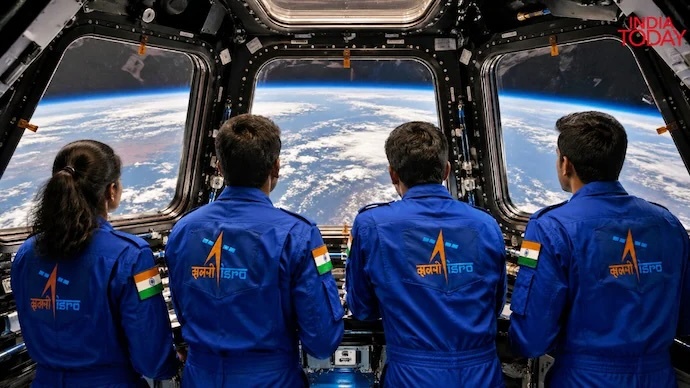
The committee has proposed an astronaut cadre of up to 40 individual. (Photo: Generative AI by India Today)
In a significant shift for India’s human spaceflight ambitions, Indian Space Research Organisation (Isro) is preparing to open its astronaut corps to civilians, signalling a move beyond its initial reliance on military test pilots as it builds a long-term spacefaring programme.
The space agency’s committee on astronaut selection and management has recommended that the second batch of astronauts include a mix of military and civilian candidates, according to a report by The Times of India.
The proposed pool will likely comprise 10 astronauts, six mission pilots drawn from military aviation backgrounds and four civilian specialists from science, technology, engineering, and mathematics (STEM) fields.
This marks a departure from the first batch selected for the Gaganyaan mission, which consisted entirely of Indian Air Force test pilots, including Air Commodore Prashanth Nair and Group Captains Shubhanshu Shukla, Ajit Krishnan, and Angad Prathap.
For the second batch, Isro is also expected to expand its military intake to include combat helicopter pilots, broadening the operational experience within the astronaut corps.
The inclusion of civilians reflects Isro’s evolving priorities. While early missions under Gaganyaan are focused on validating critical technologies for human spaceflight, the agency is now planning for sustained operations in orbit.
This includes regular crewed missions, scientific research, and eventual participation in long-duration missions aboard India’s proposed space station, the Bharatiya Antariksh Station.
However, civilian astronauts are unlikely to fly immediately.
According to the report, they are expected to join mission crews only from the fourth crewed Gaganyaan mission onward. This cautious approach aligns with global practices, where countries typically deploy military-trained astronauts in early missions until systems and safety protocols mature.
India Today Science recently reported on the slow pace of development of the Gaganyaan Mission and the urgent need for an astronaut pool to sustain long-term space exploration plans. You can read the report here.
The expansion of the astronaut cadre is also tied to an anticipated increase in mission frequency. Planning assumptions suggest that India could eventually conduct two human spaceflight missions annually, with astronauts potentially returning to space after a gap of about two years.
A full cycle of selection, training, and mission preparation is estimated to take around 4.5 years.
Looking further ahead, Isro is considering scaling up both crew size and astronaut numbers. From the seventh crewed mission, the number of astronauts per flight could increase from two to three, enabled by upgrades to the Gaganyaan crew module. Future batches may tilt heavily toward civilian specialists, with the third batch potentially including 10 specialists and only two mission pilots.
In total, the committee has proposed an astronaut cadre of up to 40 individuals to accommodate long-term programme needs, international collaborations, and potential attrition.
IS ISRO READY FOR A SUSTAINED HUMAN SPACE EXPLORATION?
Despite these ambitious plans, challenges remain. Isro is yet to establish a permanent astronaut training facility and currently relies on a temporary centre.
Technological gaps also persist, particularly in developing critical systems such as the Environment Control and Life Support System (ECLSS), essential for sustaining human life in space.
Even as these hurdles remain, the move to induct civilians marks a turning point, one that could redefine who gets to represent India beyond Earth.
Quelle: India Today