
7.03.2026
The Islamic Revolutionary Guard Corps’ nascent space program has only a handful of satellites.
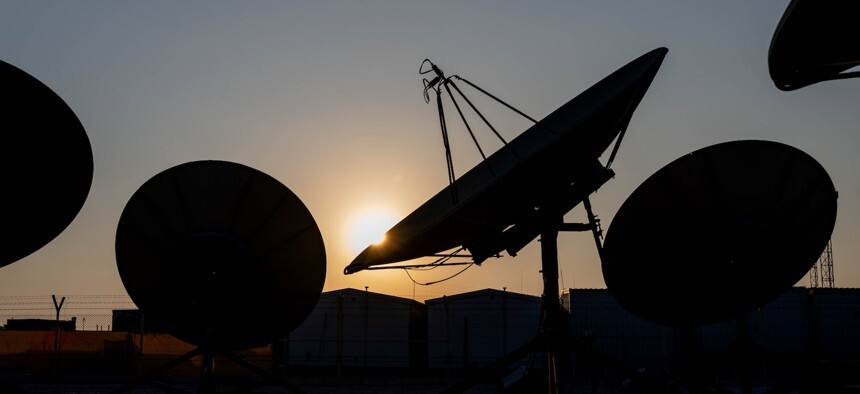
U.S. Space Force antennas in the U.S. Central Command area of responsibility, Nov. 26, 2024. U.S. AIR FORCE / SENIOR AIRMAN VIOLETTE HOSACK
U.S. forces destroyed Iran’s military space command, Adm. Brad Cooper, the head of Central Command, announced Thursday, saying the move degraded the regime’s ability to coordinate retaliatory strikes. But experts told Defense One that the country’s nascent space capabilities never posed a significant threat.
“We've also struck Iran's equivalent of Space Command, which degrades their ability to threaten Americans,” Cooper said during a press conference.
The Islamic Revolutionary Guard Corps announced the existence of its own space command in April 2020 during the launch of its first reconnaissance satellite. Iran has launched a total of 26 satellites since 2005, and 13 of them are still operational, according to the American Enterprise Institute’s space data navigator tool. Three of those are registered to the IRGC.
U.S. Space Command played a crucial role in the early hours of President Donald Trump’s war on Iran, with Joint Chiefs Chairman Dan Caine describingthe military’s cyber and space forces as the “first movers” that used waves of non-physical effects, like electronic warfare, to disrupt Iran's “ability to see, communicate and respond.” But Iran’s space capabilities, by comparison, present little threat to the U.S. military, experts said.
“I wouldn't compare it to our space command, since Iran had virtually no space assets of its own to speak of,” said Todd Harrison, a defense expert who created AEI’s space data navigator tool.
A CENTCOM spokesperson did not respond to Defense One’s questions asking what threat Iran’s space command posed to the American public and how it was eliminated.
Iran’s small number of satellites have limited capabilities, and it’s unlikely that the nation has advanced capabilities to destroy satellites. It also hasn’t demonstrated an ability to build homing kinetic kill vehicles, according to the non-profit Secure World Foundation’s 2025 global counterspace capabilities report.
“Technologically, it is unlikely Iran has the capacity to build on-orbit or direct-ascent anti-satellite capabilities, and little military motivation for doing so at this point,” the 2025 report said. “Iran has demonstrated an [electronic warfare] capability to persistently interfere with the broadcast of commercial satellite signals, although its capacity to interfere with military signals is difficult to ascertain.”
Since the IRGC’s space command is under the regime’s aerospace forces, which operate missiles, it’s possible that Cooper was referring to that threat being eliminated, said Victoria Samson, the Secure World Foundation’s chief director of space security and stability.
“They were not a threat in space capabilities,” Samson said. “The threat that they have for counter-space capabilities, they’re great at jamming and spoofing … but, big picture, no.”
There are Guardians overseas in the CENTCOM area of responsibility, not just deployed-in-place stateside, an official confirmed to Defense One, but declined to disclose the number, locations, or types of squadrons deployed. In 2022, the Space Force stood up Space Forces Central, the component field command headquartered with U.S. Central Command at MacDill Air Force Base in Florida.
The 162nd Electromagnetic Warfare Combat detachment is responsible for “training, equipping, and mobilizing specialized space electromagnetic warfare capabilities within the region,” according to Defense Department images.
“Proud of our Guardians executing with unmatched precision and professionalism at home station and deployed to CENTCOM,” Saltzman said in a Wednesday post on X.
Space Forces played crucial roles in last year’s U.S. strikes on Iran’s nuclear facilities and the January operation which led to the capture of then-Venezuelan President Nicolás Maduro. Officials have publicly confirmedguardians tracked missiles, provided satellite communication to transmit position, timing, and navigation data, and used other space-based capabilities to support the joint force.
Iran has warned, through relevant intermediaries, that countries with ground stations and companies providing uplink services against the regime will have“action…taken against them,” the IRGC-associated Tansim News Agency reported Thursday.
Harrison said Thursday’s announcement that Iran’s space command was eliminated could signal an end to the military’s main targeting operations.
“If anything, this is a sign that we are working our way down to near the bottom of the target list,” Harrison said.
Quelle: Defense One
+++
Making the Space Force the newest branch of the U.S. military is yielding clear benefits in Iran.
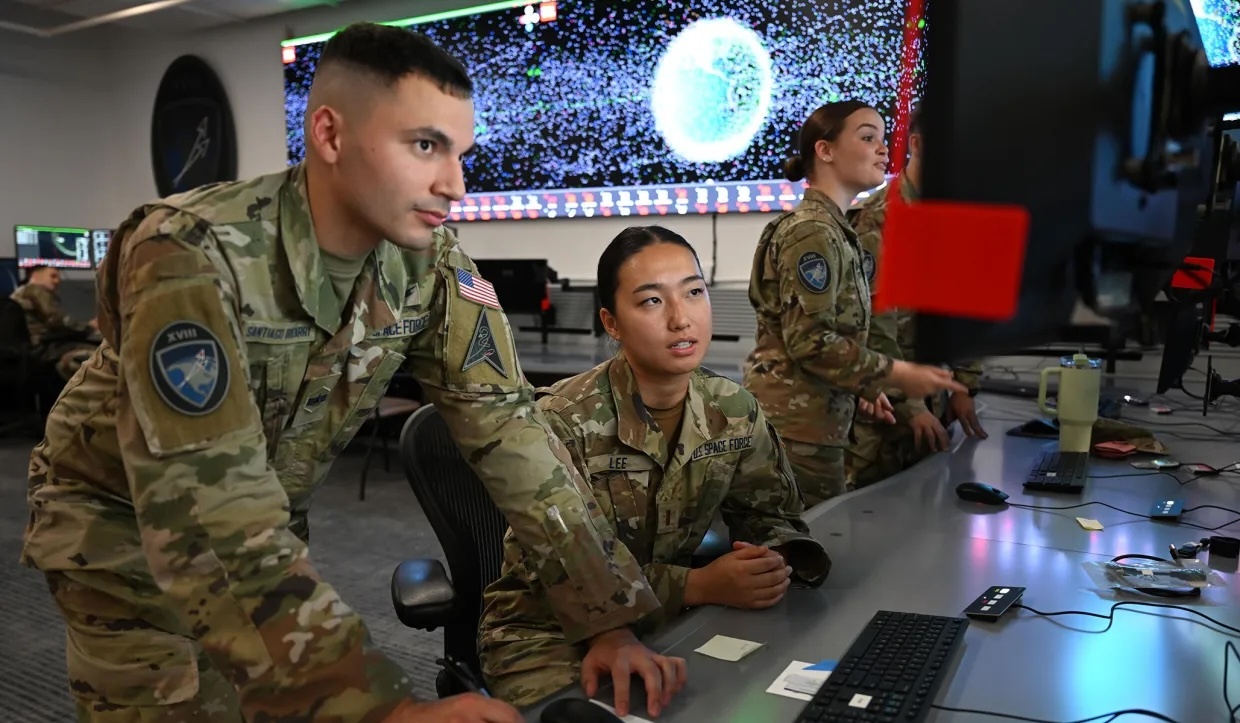
Space Delta 2 members observe orbital data at Vandenberg Space Force Base, Calif., October 4, 2024(David Dozoretz/U.S. Space Force)
In 20th-century wars, the key was air power. In 21st-century wars, it will be space power. This week’s military actions against Iran in Operation Epic Fury show that if America desires peace on earth, the ongoing conflict proves we must prepare for war in space — and the initial remarkable success the U.S. and coalition forces have demonstrated vindicates President Trump’s decision to elevate the Space Force as the sixth and newest branch of the American military.
The U.S. military’s dominance in space, primarily through the U.S. Space Force, the National Reconnaissance Office, and associated assets under U.S. Space Command played ...
Quelle: NR
+++
U.S. targeting Iran’s space capabilities early into Operation Epic Fury
The U.S. military targeted infrastructure and assets that enable Iran to move data and conduct warfare operations in space, Adm. Brad Cooper said Thursday.
Speaking alongside Defense Secretary Pete Hegseth during a press briefing at U.S. Central Command headquarters in Tampa, Florida, Cooper said Iran’s combat power is diminishing as Operation Epic Fury enters its sixth day.
“In just the last 72 hours, America’s bomber force has struck nearly 200 targets deep inside of Iran, including around Tehran. And in just the last hour, U.S. B-2 bombers dropped dozens of 2,000 pound penetrator bombs targeting deeply buried ballistic missile launchers,” Cooper, the commander of Centcom overseeing the military operation, said. “Notably, we’ve also struck Iran’s equivalent of Space Command, which degrades their ability to threaten Americans.”
Further details about that strike against the space-related facility were not supplied during the briefing.
The U.S. military’s Space Command is responsible for satellite-based navigation and communication capabilities and defending American and allied interests in outer space. As a “first mover” to support Epic Fury, Spacecom has been providing real-time intelligence to help track and target Iranian threats since the start of the operation.
“Our strikes against the Iranian Navy have intensified. You may have heard the president say just a little while ago that we have sunk or destroyed 24 ships. That was true at the moment. We’re now up over 30 ships,” Cooper said. “And in just the last few hours, we hit an Iranian drone carrier. A ship roughly the size of a World War II aircraft carrier — and as we speak, it’s on fire.”
According to the commander, the overarching mission for Epic Fury is to “eliminate Iran’s ability to threaten Americans.”
“If I just look back over the last 24 hours of the operation, compared to where we were at its start, ballistic missile attacks have decreased by 90% since day one. Drone attacks have decreased by 83% since day one,” Cooper noted. “Having said this, we remain vigilant.”
Following a recent order from President Donald Trump, Cooper said this joint operation with Israel also aims to level Iran’s ballistic missile industrial base.
“So we’re not just hitting what they have. We’re destroying their ability to rebuild. And so as we transition to the next phase of this operation, we will [systematically] dismantle Iran’s missile production capability for the future — and that’s absolutely in progress,” Cooper said. “This is going to take some time, but our forces are well supplied.”
Cooper and Hegseth declined to answer reporters’ questions about the types of targets Centcom is going after with its Low-cost Uncrewed Combat Attack System (LUCAS) drones that are deploying for the first time in this conflict.
Quelle: DEFENSESCOOP